
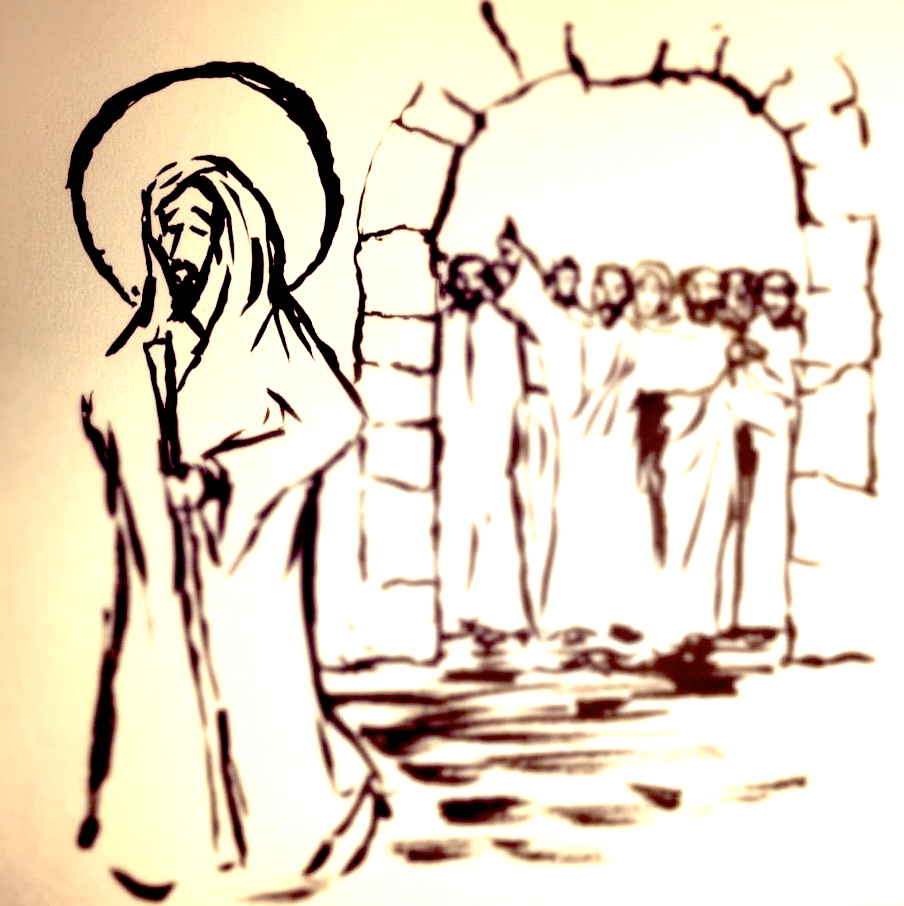
Don’t Let Rejection Get the Best of You (Mark 6:1-13)

He left that place and came to his hometown, and his disciples followed him. On the Sabbath he began to teach in the synagogue, and many who heard him were astounded. They said, “Where did this man get all this? What is this wisdom that has been given to him? What deeds of power are being done by his hands! Is not this the carpenter, the son of Mary and brother of James and Joses and Judas and Simon, and are not his sisters here with us?” And they took offense at him. 

Then Jesus said to them, “Prophets are not without honor, except in their hometown and among their own kin and in their own house.” And he could do no deed of power there, except that he laid his hands on a few sick people and cured them. And he was amazed at their unbelief.

Then he went about among the villages teaching. He called the twelve and began to send them out two by two and gave them authority over the unclean spirits. He ordered them to take nothing for their journey except a staff: no bread, no bag, no money in their belts, but to wear sandals and not to put on two tunics. 

He said to them, “Wherever you enter a house, stay there until you leave the place. If any place will not welcome you and they refuse to hear you, as you leave, shake off the dust that is on your feet as a testimony against them.” So they went out and proclaimed that all should repent. They cast out many demons and anointed with oil many who were sick and cured them. (New Revised Standard Version)

Homecooked Rejection

Jesus was well into his ministry, with the disciples in tow, and had made quite a splash around Judea. Eventually, he made it back to the region of Galilee and to his hometown. Having grown up in a small town myself, I can testify how any sort of celebrity status from one of their own is a really big deal. Anticipation was high amongst the townsfolk.

Knowing Jesus as they did, the people were downright slack-jawed at his wisdom and the way he taught – which is also a typical response of the hometown boy made popular. The town knew Jesus differently – as simply another nice, but normal, Jewish kid from a nice but scandalous family.

The homecoming turned sour as the crowd believed they knew more than Jesus. After all, they knew him as a little kid. And they knew where he came from. He’s the carpenter, the son of Mary. They remembered what was up with Jesus. Mary and Joseph weren’t yet together and she ended up pregnant. This guy is no Son of God, but son of who knows?

They took offense at Jesus. He was the one with the curious conception and birth. And now he was trying to teach them, the ones who “really knew” his origins – or so they thought.

Jesus was just too uppity for the hometown folks. He considered himself more than the people he grew up with would concede. By providing the self-reference of “prophet,” Jesus was placing himself in the company of many revered men of God who went against the grain of their own contemporary cultures. And the folks in Galilee most certainly did not think they needed a prophet, especially one with illegitimate origins.

For the townsfolk, Jesus was claiming more honor and status for himself than was warranted in the old hometown. It meant that others got knocked down to size. So the people in the town were not having it. They took offense.

Ironically, the people who ought to know better, don’t. Jesus was amazed at their lack of faith, their unbelief. So little could be done in such a place as this. After all, you cannot heal someone if they believe they don’t need healing.

Heaven-sent Mission

Rejection didn’t stop Christ’s mission on this earth. Jesus prepared his disciples for their initial ministry, sending them in pairs. Up to this point, he taught them about God’s kingdom, handled a good deal of one-on-one instruction, and demonstrated for them what healing is like and why he did it. And they also needed to understand that rejection from others is part of the ministry.

Jesus instructed the disciples to take only a few essentials; the hospitality of others would be a significant aspect of their ministry – especially since much of their work would take place from household to household. Synagogues were not always receptive places to a new kind of ministry. So, the grassroots efforts of the disciple pairs were important.

Rejection and judgment tend to go hand-in-hand. Those who spurned the disciples were judging the veracity of their work. And also, that same rejection was a sign for the disciples to not spin their wheels trying to persuade the already convinced. Instead, the disciples were to do their own action of shaking the dust off their feet, letting the stubborn people know they were not carrying the bad judgments with them.

All in all, Christ’s disciples had an effective ministry and a positive experience. They were able to bring their message and healing to many.

We can observe through this story that rejection from others and a failure to make inroads with some is not necessarily a reflection on us. Some people are going to misunderstand us and make judgments about us, regardless of how well we go about our work.

After all, if Jesus experienced it, how much more will we? Don’t let rejection get the best of you.

To never face rejection and judgment may be a sign that little to no action is actually taking place – or maybe that the avoidance of conflict is assigned a value much too high than Jesus would give it.

If you are working toward loving both God and neighbor, showing justice and mercy in all you do, then any sort of rejection isn’t worth getting upset about.

Gracious God, I release my grip on needing to be understood by everyone, and instead choose to hold onto you and your grace. Therefore:

  • I lay down my need to understand why things happen the way they do.
  • I lay down my fears about others judging me.
  • I lay down my desire to prove my worth.
  • I lay down my resistance to suffering.

I take up my cross daily, and seek to walk according to your ways, and to live into your words; through Jesus Christ my Lord, in the enablement of the Holy Spirit. Amen.

Accomplishing the Mission, No Matter What (Acts 25:1-12)

Saint Paul before Festus and Agrippa, by Philip Galle (1537-1612)

Three days after arriving in the province, Festus went up from Caesarea to Jerusalem, where the chief priests and the Jewish leaders appeared before him and presented the charges against Paul. They requested Festus, as a favor to them, to have Paul transferred to Jerusalem, for they were preparing an ambush to kill him along the way. Festus answered, “Paul is being held at Caesarea, and I myself am going there soon. Let some of your leaders come with me, and if the man has done anything wrong, they can press charges against him there.”

After spending eight or ten days with them, Festus went down to Caesarea. The next day he convened the court and ordered that Paul be brought before him. When Paul came in, the Jews who had come down from Jerusalem stood around him. They brought many serious charges against him, but they could not prove them.

Then Paul made his defense: “I have done nothing wrong against the Jewish law or against the temple or against Caesar.”

Festus, wishing to do the Jews a favor, said to Paul, “Are you willing to go up to Jerusalem and stand trial before me there on these charges?”

Paul answered: “I am now standing before Caesar’s court, where I ought to be tried. I have not done any wrong to the Jews, as you yourself know very well. If, however, I am guilty of doing anything deserving death, I do not refuse to die. But if the charges brought against me by these Jews are not true, no one has the right to hand me over to them. I appeal to Caesar!”

After Festus had conferred with his council, he declared: “You have appealed to Caesar. To Caesar you will go!” (New International Version)

The Story Up to Now

Paul was in a pickle. Earlier in his life, as an up and coming star amongst the Jewish Pharisees, he had a life-changing encounter with the risen Christ. Paul did a complete 180 degree turn from opposing and persecuting Christians to becoming a Christian himself.

As you might imagine, this did not go over well with the Jewish establishment, and especially the Pharisees. From the event of Paul’s conversion and onward, he was a marked man. And he knew it.

But Paul didn’t care. He embraced his new life and calling with as much or more zeal than his old life. Paul dedicated himself to missionary journeys, proving that Jesus is the Christ, and establishing churches. Some of the Jews (by no means all) hated him for it. As a result, the Apostle Paul was whipped, stoned, and left for dead more than once. Finally, the upset Jews were able to get Paul arrested and jailed.

And that is where we pick up Paul’s story. And it’s also likely why he appealed to Ceasar instead of staying in Palestine; he knew he wouldn’t survive for too long surrounded by the same sort of people whom he used to run with in trying to stamp out the Christians.

The Present Story

Paul originally dealt with Felix (Acts 24) but then with a change in administration, he faced Festus. The Jews who opposed Paul wanted him transferred to Jerusalem from Caesarea. But Festus was no dummy; he knew this was an age old trick to try and ambush the Roman guards on the way and assassinate Paul. So, Festus went and saw Paul in Caesarea.

Things went as one might expect: Unsubstantiated charges are leveled against Paul in court; Paul maintains his innocence; Festus asks Paul if he wishes to go to Jerusalem for trial, or not; and Paul refuses. But the thing that no one expected is that Paul took the further step of appealing directly to the emperor himself.

We aren’t told why Paul made this appeal – although it certainly appeared as if he may not get a fair trial in Palestine. Yet, we do know that Paul had a desire to fulfill his calling of bearing witness to the gospel of Christ in the West, and to Rome.

It seems to me that, at this point, Festus saw an opportunity to rid himself of all this Jewish weirdness (as he saw it) and send Paul off and out of his own jurisdiction. One less difficult Jewish problem to have to deal with in this far off Roman outpost in the Middle East.

The Story to Come

As Bible readers, we know what is upcoming for Paul – all of the dramatic events and twist and turns of his life getting to Rome and under house arrest in the city. Yet, even though none of us really know what another day will bring, the Apostle Paul was driven by his purpose of gospel proclamation and bringing the message of Christ to the farthest western reaches of the Roman Empire. And to that end, he was not going to be dissuaded or deterred, even when he had little to no control over his life as a prisoner.

A person with meaning and purpose is a person with faith and hope. And when love is the thing animating the purpose, then it doesn’t much matter what the outward circumstances are. Perseverance and resiliency always find a way where there seems to be none.

Half of life is spent discovering, learning, and developing our skills, gifts, and abilities. The other half is applying and honing those skills in new and different contexts. As long as we know what we’re about, and we keep putting in the hard work and practice it takes for continued and sustained excellence, then each situation we encounter becomes an opportunity to extend my purpose in a new experience.

And that is what the Apostle Paul did. It wasn’t about changing or manipulating situations or people; rather, it was about finding pathways to accomplishing his mission on this earth with the calling he received from God. I would say that Paul did a pretty dang good job at that.

I also believe that you and I can do it, too.

Holy God, you search us out and know us better than we know ourselves. Help us to discern your voice and your calling. We seek to listen and learn from the wisdom of Christ. Raise up faithful people who will speak words of life with clarity and grace, with justice and true compassion; in the strength of the Holy Spirit. Amen.

Pentecost (John 15:26-27, 16:4b-15)

The Holy Spirit, by He Qi

“When the Advocate comes, whom I will send to you from the Father, the Spirit of truth who comes from the Father, he will testify on my behalf. You also are to testify because you have been with me from the beginning…

“I did not say these things to you from the beginning, because I was with you. But now I am going to him who sent me, yet none of you asks me, ‘Where are you going?’ But because I have said these things to you, sorrow has filled your hearts. Nevertheless, I tell you the truth: it is to your advantage that I go away, for if I do not go away, the Advocate will not come to you, but if I go, I will send him to you. 

“And when he comes, he will prove the world wrong about sin and righteousness and judgment: about sin, because they do not believe in me; about righteousness, because I am going to the Father, and you will see me no longer; about judgment, because the ruler of this world has been condemned.

“I still have many things to say to you, but you cannot bear them now. When the Spirit of truth comes, he will guide you into all the truth, for he will not speak on his own but will speak whatever he hears, and he will declare to you the things that are to come. He will glorify me because he will take what is mine and declare it to you. All that the Father has is mine. For this reason I said that he will take what is mine and declare it to you. (New Revised Standard Version)

Pentecost, by John August Swanson (1938-2021)

This is the Christian Day of Pentecost. It is often referred to as the birthday of the Church. Pentecost marks the time when the Holy Spirit came upon the fledgling believers in power. 

Pentecost is significant for Christians because it marks the age of the Spirit, the era of new spiritual life and power. Ten days after recognizing Christ’s Ascension, and fifty days after Christ’s resurrection from death, the Christian Year observes the Day of Pentecost (which literally means “fifty” in Greek). 

An implication of Pentecost is that it brings both change and stability, of being uprooted as well as deeply grounded. To experience Pentecost, it is necessary to invite change and to allow ourselves to be changed.

To live a truly spiritual life, full of the Holy Spirit, means that things will never be the same again. With the Spirit, there is a new form of consciousness, an emerging awareness of both self and the world, and new interests and commitments which are followed.

Change involves unlearning old thinking and ways of doing things, becoming uprooted and planted in fresh spiritual soil. The spiritual person will discover new, necessary, and expansive ways of living the faith of Jesus Christ in today’s topsy-turvy world.

Today’s Gospel lesson has Jesus talking to his disciples for the last time before his crucifixion and resurrection. He communicated to them that he was going away, and they were sad and confused about it all. So, Jesus assured them that they would not be alone – his presence would be with them in the person of the Holy Spirit.

Jesus made it plain that the One who is coming, the Paraclete, is the One who comes alongside and offers to the disciples a ministry of advocating, testifying, speaking truth, glorifying, and proving the world wrong about sin and righteousness and judgment.

The Spirit advocates for us and all creation. The Spirit hears our pain, moaning, and desperation, bringing it all to God in helpful language (Romans 8:26). The Spirit testifies about Jesus to us and about his ministry. The Spirit speaks truth to us whenever we go astray from the words and ways of Jesus; and so, will challenge us and provoke us to live into our majesty as people created in God’s image and redeemed by Christ’s death and resurrection.

If and when our Christian life and worship becomes a ho-hum hodge-podge of ritualistic or legalistic goo, where no spiritual growth or life transformation is happening – and worse, if it becomes characterized by injustice – then the Spirit will have something to say in regard to sin, righteousness, and judgment.

A lack of faith can take many forms. For many Christians, the separation between belief and practice is a form of apostasy. Signing off on a set of doctrinal beliefs means nothing unless it has feet and hands to it by going after those who are suffering, giving restitution for what we’ve taken, and putting the love of Christ where love is not found.

A confession of faith is hollow and useless without first having a confession of sin. Jesus did not say that people will know Christians by their doctrinal confessions and ancient creeds, but that others will know the Christian by the fruit of a life given to righteousness and justice. (Matthew 7:16)

The worldly ruler is the one who perpetuates systems of evil and oppression; and ignores poverty, hunger, and need. The ruler of this world is condemned by the Spirit because of meanness, brutality, violence, and abject greed and selfishness.

Anyone who turns the life-giving good world which God has made into a death-dealing world of ignorance, sloth, and power politics is under the judgment of the Spirit, on orders by Judge Jesus. Whenever the bent of the will is developed into only being concerned with personal happiness, while ignoring communal needs, the person is existing far from the teachings of Jesus to his disciples.

On this Day of Pentecost, and into this proper Pentecostal season, our call is to have a genuine spiritual life that allows the true self to make a difference in this old fallen world. The spiritual person seeks to tap into the Spirit and insist on caring for others without prejudice or favoritism; and will ground themselves in healthy spiritual dynamics of positive change and transformation as living sacrifices to God. (Romans 12:1-3)

With the reality of Pentecost, believers in Jesus, and the whole Church everywhere, has the full power of the Holy Spirit with them at all times. This means our ultimate trust is not in the power of authoritative positions, economic budgets, polished programs, personal ingenuity, or a consumer self-realization.

Our trust is in the name of the Lord who made heaven and earth, in Jesus Christ, God’s only Son, and in the strength of the Holy Spirit who is the continuing presence of Jesus. Such power is given for a purpose. So let us be responsible and conscientious in living the Christian life.

And may the blessing of the Spirit move you to know Jesus better, love the world more, and be the person you were created to be – to the glory of God. Amen.

Jesus Prays For Us (John 17:6-19)

Word of Life, by Millard Sheets

“I have made your name known to those whom you gave me from the world. They were yours, and you gave them to me, and they have kept your word. Now they know that everything you have given me is from you, for the words that you gave to me I have given to them, and they have received them and know in truth that I came from you, and they have believed that you sent me.

I am asking on their behalf; I am not asking on behalf of the world but on behalf of those whom you gave me, because they are yours. All mine are yours, and yours are mine, and I have been glorified in them. And now I am no longer in the world, but they are in the world, and I am coming to you.

“Holy Father, protect them in your name that you have given me, so that they may be one, as we are one. While I was with them, I protected them in your name that you have given me. I guarded them, and not one of them was lost except the one destined to be lost, so that the scripture might be fulfilled. 

But now I am coming to you, and I speak these things in the world so that they may have my joy made complete in themselves. I have given them your word, and the world has hated them because they do not belong to the world, just as I do not belong to the world. 

“I am not asking you to take them out of the world, but I ask you to protect them from the evil one. They do not belong to the world, just as I do not belong to the world. Sanctify them in the truth; your word is truth. As you have sent me into the world, so I have sent them into the world. And for their sakes I sanctify myself, so that they also may be sanctified in truth. (New Revised Standard Version)

It seems to me only fitting that Jesus concluded his time with the disciples in the Upper Room before his betrayal, crucifixion, and death with prayer. It also seems to me that if you really want to know the heart of a person, listen to them pray.

The prayer of Jesus was thoroughly oriented toward the spiritual needs of his followers – even potential believers who will follow him in the future. And it was a prayer completely devoted toward honoring the heavenly Father through praying consistent with God’s will for this world.

Without the physical presence of Jesus – which would soon be gone – his followers would have to rely on prayer. And Christ was intent on instilling within his disciples the confidence and hope they needed for a solid life of prayer.

For post-resurrection Christians living in an ever-expanding world of oppression, greed, and indifference, we can be encouraged not to settle into despair or loneliness. Why? Because believers can have a solid hope and an abiding trust in the continuing presence of Jesus by means of the Holy Spirit.

God Gives

God gives. Jesus gives. Both the Father and the Son are givers. This is a major reason and motivation for prayer because God is not a reluctant giver. In the act of giving, the Father and the Son are fully on the same page; God is ready and willing to give. The Holy Trinity – Father, Son, and Spirit – are in complete unity, and act as One, in giving to us what we need.

“Those who drink of the water that I will give them will never be thirsty. The water that I will give will become in them a spring of water gushing up to eternal life.” (John 4:14, NRSV)

“Do not work for the food that perishes but for the food that endures for eternal life, which the Son of Man will give you.” (John 6:27, NRSV)

“I give them eternal life, and they will never perish. No one will snatch them out of my hand.” (John 10:28, NRSV)

We Belong

Through giving we are included. Believers and followers of Jesus – having been given the grace of faith – know that they belong to God. Christians are in union with Christ. The redemption which Jesus has secured is a million billion times stronger, and bonds us closer, than any sort of Gorilla glue. And, what’s more, once we belong, we are never forgotten, but always remembered by God.

“The Father knows me, and I know the Father. And I lay down my life for the sheep. I have other sheep that do not belong to this fold. I must bring them also, and they will listen to my voice. So there will be one flock, one shepherd.” (John 10:15-16, NRSV)

Christ the King, statue in Swiebodzin, Poland

The Name of Jesus

Because we belong, we know God’s name. The divine name stands for all that God is and all that God has done. It’s all focused in Christ. In the name of Jesus, through the person and work of Jesus Christ, we have everlasting life, spiritual power, and eternal security.

Now Jesus did many other signs in the presence of his disciples that are not written in this book. But these are written so that you may continue to believe that Jesus is the Messiah, the Son of God, and that through believing you may have life in his name. (John 20:30-31, NRSV)

We Have the Word

The Word became flesh and dwelt among us (John 1:14). Jesus has given to his disciples only those words which he first received from the Father. Those who accept the enfleshed Word and his words have been given power to become God’s children (John 1:12). Because believers belong to God, they know the truth and that truth has set them free.

It is the Christian’s mission to live into the words and ways of Jesus, to follow Christ in thought, word, and deed. The very glory of Jesus in his cross and resurrection is focused within the believing community, who is in union with Christ and belongs to God.

In his prayer, Jesus claimed an intimate oneness in the sharing of concern for people who are the objects of the Father’s gracious giving of love through the Son. All who belong to Christ belong to God, and vice versa. All the love that went into the cross was poured out upon us.

Those who believe in the name of Jesus Christ are the very glory of Jesus, and thus, the glory of God.

Sent Into the World

Because of the Father’s name—because of who the Father is and what the Father has given in love to the Son—we are set apart for truth; the words of God are truth.

Since we belong to God and bear the name of Christ, we don’t belong to the world’s systems of guilt, shame, injustice, and evil. And yet, we are separated from the world for precisely the reason of immersing ourselves in the world. In other words, Christianity is meant for the life of the world, and not as a religion that’s only concerned for itself.

To reach the world, we must be different from it. To reach the world, we need to have boots-on-the-ground in it. To reach the world, Christians are to be both far from the world, and near to the world.

As the Father sent the Son, so the Son sends us into the world – not to be like the world, but to embody the words and ways of Jesus to and for the world.

Just as the world rejected Jesus in his suffering and death, so the world, too, will reject his followers. Which means we will need to pray, a lot! And there is no better scriptural prayer to emulate than the very words of the Lord Jesus, who loved us and gave himself for us.

Holy Father, guard our hearts and minds in Jesus, as we pursue this Christian life which you gave as a gift through Christ, so that we can be united, just as the Father and the Son are one. Although we long for heaven, don’t take us out of the world until we have fulfilled our sacred mission to carry the words and ways of our Lord to the world. Make us holy, and give us everything we need for life in this present evil age; through Jesus Christ your Son, our Lord, who with you and the Holy Spirit are one God, now and forever. Amen.