

Acts 2:42-47 – A Changed Community

We Are All One in Jesus Christ by Soichi Watanabe, 2009

They devoted themselves to the apostles’ teaching and fellowship, to the breaking of bread and the prayers. Awe came upon everyone because many wonders and signs were being done by the apostles. All who believed were together and had all things in common; they would sell their possessions and goods and distribute the proceeds to all, as any had need. Day by day, as they spent much time together in the temple, they broke bread at home and ate their food with glad and generous hearts, praising God and having the goodwill of all the people. And day by day the Lord added to their number those who were being saved. (NRSV)

You’ve likely heard the old saying, “If it’s not broken, don’t fix it.” It is a wise saying. Yet, what if we don’t know something is broken? What if we keep living our lives with something out of whack and don’t even realize it? Or, worse yet, what if we don’t care?

The ancient church after Christ’s resurrection and ascension was on a mission to live communal life together different from how they lived before Jesus came into their lives. Today’s New Testament lesson gives us a glimpse of what that life together consisted of.

“Yesterday I was clever, so I wanted to change the world. Today I am wise, so I am changing myself.”

Rumi (13th century Persian poet and scholar)

We know something needs to change when it doesn’t quite match up to the life depicted by our ancestors in the faith – a life of fellowship, of glad and sincere hearts, and of concern for the common good of all. We never just change or alter something for change’s sake or because we like or dislike something. No, instead, we adjust our lives according to whether it lines up with the relational dynamics of Holy Scripture.

I had just one grandparent when I was growing up. My Grandma was seventy-nine years old when I was born, and she lived to be ninety-seven. I always knew her as an old lady. Although quite aged, she had a lot of spunk to her, all ninety-five pounds of her. 

I remember Grandma had an old wooden cutting board in her kitchen. I don’t how old it was, but it was probably purchased from Methuselah’s Kitchen Outlet. It was cracked and nearly falling apart. The board had deep furrows in it from the thousands of cuts made on it. Grandma liked her cutting board.

For Mother’s Day one year my Dad bought her a nice brand-new cutting board. After thanking my Dad for the gift, Grandma proceeded to put the new board in the back of her cupboard and continued to use her nasty old cutting board. Whenever my Mom or sisters helped her in the kitchen, they were not about to touch that old board because it was like a bacteria trap with its deep grooves. 

Grandma didn’t care about anyone’s concerns about her cutting board. When my Dad finally asked her why she did not use her new cutting board, she simply answered, “Oh, it is much too nice to use.” We all knew that was Grandma’s way of saying that she liked her nasty old cutting board and nobody was going to tell her she can’t use it.

Sometimes folks, including Christians, can be like my Grandma, bless her stubborn old heart. They just like the way they do things, and really don’t see what others see who aren’t Christ followers. They fail to consider or realize that non-Christians have no emotional attachment to the cutting board. All they see is an antiquated old board they would never use and find it weird anyone would ever want to use it.

Christians may forget or lose sight of how overwhelming and even intimidating they can be with those outside the faith. Because Christianity is familiar to Christians, we don’t see what others see when they view us from the outside. 

I remember once walking into a beautiful new church building and sitting down and seeing a huge old pulpit that was literally falling apart. Since I’ve been around a lot of churches, I quickly discerned it was likely the old pulpit from the old church building. I asked someone, and it was. But as an outsider to that fellowship, I had zero emotional attachment to the pulpit, and it was a distraction because it just looked like a big old ratty collar on a new little puppy.

“Be the change that you wish to see in the world.”

Mahatma Gandhi

The point I am making is this: The decision to change our lives, or not to change, must come from a motivation of biblical and human values. The Christian’s mission and purpose are the Great Commission (make disciples) and the Great Commandment (love God and love neighbor). We express those values through our daily devotion to teaching, fellowship, the breaking of bread, and prayer. Such life together is attractive and winsome to a watching world.

If people matter, including those who don’t think or believe like us as Christians, then we will make decisions based upon that value. Nothing need be fixed or changed if the mission is going forward with biblical values driving it. However, if people stay away, or know nothing about our shared life together, then we have a prime reason to change. If this has gone on for years, even decades, I suggest that the fellowship of people is eating meat prepared from a cutting board full of bacteria and it is making everyone sick.

Whenever a faith community is focused on trying to keep people from leaving, instead of reaching people with an outward focus, then that community has lost its sense of spiritual values.

“Never doubt that a small group of thoughtful, committed, citizens can change the world. Indeed, it is the only thing that ever has.”

Margaret Mead

The main verb contained within the Scripture verses for today is the word “added.” Those who accepted the message of repentance and faith in Jesus were baptized and about three thousand were “added” to their number that day. We then get a string of participles, that is, words connected to the main verb of “added.” The result is this: The Lord “added” to their number daily those who were being saved.  Please understand the text makes it quite clear that the driving force of Christ’s church is to reach people.

It could be we take the old cutting board for granted and simply expect other people to use it if they are in our kitchen. If that is the case, there is to be a driving motivation and desire for outreach. There are people aplenty who need the kind of deliverance Jesus provides.

“Everyone thinks of changing the world, but no one thinks of changing himself.”

Leo Tolstoy

If something is off in our faith community, then the biblical solution is to change our lives, change our practices, change our speech, and change our daily behavior by reaching people for Jesus and adding them to the fellowship.

Whenever Christians break bread together at the Lord’s Table, the communion reminds us of our highest purpose and values. Jesus came to this earth for those estranged and far from God and others. Through Christ’s life, death, resurrection, and ascension we are saved by grace through faith. This reality is made tangible to us in the elements of bread and cup. They are a visible sign and seal of an invisible grace. We are to come to the Table forsaking all personal agendas and embracing God’s agenda of redeeming humanity.

And, by the way, after about a year of sitting in my Grandma’s cupboard, my Dad took out the new cutting board, put it on the kitchen counter and threw away the old board. It was about time.

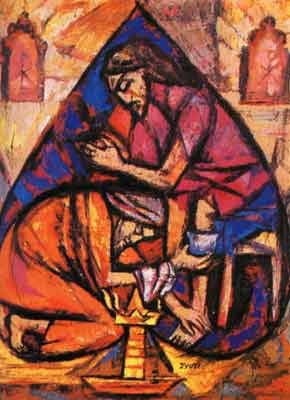
John 13:1-17, 31-35 – Maundy Thursday

Jesus Washes Peter’s Feet

It was before Passover, and Jesus knew that the time had come for him to leave this world and to return to the Father. He had always loved his followers in this world, and he loved them to the very end.

Even before the evening meal started, the devil had made Judas, the son of Simon Iscariot, decide to betray Jesus.

Jesus knew that he had come from God and would go back to God. He also knew that the Father had given him complete power. So, during the meal Jesus got up, removed his outer garment, and wrapped a towel around his waist. He put some water into a large bowl. Then he began washing his disciples’ feet and drying them with the towel he was wearing.

But when he came to Simon Peter, that disciple asked, “Lord, are you going to wash my feet?”

Jesus answered, “You don’t really know what I am doing, but later you will understand.”

“You will never wash my feet!” Peter replied.

“If I don’t wash you,” Jesus told him, “you don’t really belong to me.”

Peter said, “Lord, don’t wash just my feet. Wash my hands and my head.”

Jesus answered, “People who have bathed and are clean all over need to wash just their feet. And you, my disciples, are clean, except for one of you.” Jesus knew who would betray him. That is why he said, “except for one of you.”

After Jesus had washed his disciples’ feet and had put his outer garment back on, he sat down again. Then he said:

Do you understand what I have done? You call me your teacher and Lord, and you should, because that is who I am. And if your Lord and teacher has washed your feet, you should do the same for each other. I have set the example, and you should do for each other exactly what I have done for you. I tell you for certain that servants are not greater than their master, and messengers are not greater than the one who sent them. You know these things, and God will bless you, if you do them….

Now the Son of Man will be given glory, and he will bring glory to God. Then, after God is given glory because of him, God will bring glory to him, and God will do it very soon.

My children, I will be with you for a little while longer. Then you will look for me, but you won’t find me. I tell you just as I told the people, “You cannot go where I am going.” But I am giving you a new command. You must love each other, just as I have loved you. If you love each other, everyone will know that you are my disciples. (CEV)

Jesus Washing the Feet of His Disciple by Japanese artist Sadao Watanabe (1913-1996)

We all need to receive love and to give love. Without love, there is little to live for. Apart from love, relationships devolve into silent standoffs and destructive triangles. Indeed, with an absence of love the world ceases to spin on its axis.

Yet, where love is present all things are beautiful. Personal relations have meaning and joy. All seems right and just in the world.

Love, however, comes at a cost. Because we live in a broken world full of pride and hubris, greed, and avarice, hate and envy, we are victims of loveless systems and unjust actions. We need love to rescue us, to redeem us from the sheer muck of existence. It’s as if we are constantly walking knee deep through sludge so thick, we can barely get anywhere. We need saving. We need Jesus.

Christians everywhere around the world are journeying through Holy Week, the most sacred time of the year for followers of Christ. When we think about Holy Week, we are familiar with Good Friday and certainly Easter, but Maundy Thursday? 

On this day, the Church remembers the final evening Jesus shared with his disciples in the upper room before his arrest and crucifixion. The experiences in the upper room were highly significant because this was the last teaching, modeling, and instruction Jesus gave before facing the cross. Jesus was careful and deliberate to communicate exactly what was important to him: to love one another.

Maundy Thursday marks three important events in Christ’s Last Supper with his disciples: 

  • The washing of the disciples’ feet (the action of loving service)
  • The instituting of the Lord’s Supper (the remembrance of loving sacrifice)
  • The giving of a “new” commandment to love one another (the mandate of a loving lifestyle). 

For Jesus, his last night with the disciples was all about love, God’s love. On that fateful night, having loved his disciples for the past three years, Jesus showed them the full extent of his love by taking the posture of a servant and washing each one of the disciples’ feet, including Judas. After demonstrating for them humble service, Jesus said,

“I have set you an example that you should do as I have done for you” (John 13:15, NIV). 

This was an incredible act of love. Jesus Christ loves me just as I am, and not as I should be. He loves me even with my dirty stinky feet, my herky-jerky commitment to him, and my pre-meditated sin. 

The Last Supper by Indian artist Francis Newton Souza (1924-2002)

Not only did Jesus wash the disciples’ feet, but he lifted the cup of wine and boldly asserted: 

“Take this and divide it among you.  For I tell you I will not drink again of the fruit of the vine until the kingdom of God comes.”  And he took the bread, gave thanks, and broke it, and gave it to them, saying, “This is my body given for you, do this in remembrance of me.”  In the same way, after the supper he took the cup saying, “This cup is the new covenant in my blood, which is poured out for you” (Luke 22:17-20, NIV). 

Because of these words, the church throughout the world, for two millennia, have practiced this communion so that we might have the redemptive events of Jesus pressed firmly into our minds and our hearts by means of the visceral and common elements of bread and wine. We are to not just know about Jesus; we are to experience being united with him.

Having washed the disciples’ feet, and proclaiming to them the meaning of his impending death, Jesus gave them a clear commandment: 

“A new command I give you: Love one another. As I have loved you, so you must love one another.  By this everyone will know that you are my disciples, if you love one another.” (John 13:34-35, NIV)

Love one another, insisted Jesus, by imitating his humble service. We represent Christ on this earth when we carefully, diligently, and persistently practice love. Although love was not a new concept for the disciples, in the form and teaching of Jesus love was shown with four distinctions: 

  1. Jesus is the new model of love.
  2. A new motive of love, that Christ first loved me.
  3. A new motivator to help us love, the Holy Spirit.
  4. A new mission, the evangelization of the world, utilizing the power of Christ’s love to accomplish it.

Maundy Thursday is a highly significant day on the Church Calendar – one which deserves to be observed, and an opportunity to remember the important words and actions of Jesus on our behalf.  Through Jesus Christ we are to live always in love, modeling our life and church ministry after him. 

In Christ, love is to characterize our life together as we proclaim God’s love in both word and deed. A watching world will only take notice and desire to be a part of our fellowship if we are deeply and profoundly centered in the love of God in Christ. This is the reality Maundy Thursday brings to us.

Mark 1:14-20 – “Come, Follow Me”

Welcome, friends! The call of Jesus to his disciples two millennia ago remains the call for us, as well. Click the videos below and let us orient our lives around the gracious call of God…

I Will Follow by Chris Tomlin

May the Spirit of truth lead you into all truth, give you grace to confess that Jesus Christ is Lord, and strengthen you to proclaim the word and works of God; and may the blessing of God almighty, the Father, the Son, and the Holy Spirit, be among you and remain with you always. Amen.

Acts 13:16-25 – The Motivation of Ministry

Paul speaking in the synagogue, a 12th century Byzantine mosaic

Paul got up. He motioned with his hand and said:

People of Israel, and everyone else who worships God, listen! The God of Israel chose our ancestors, and he let our people prosper while they were living in Egypt. Then with his mighty power he led them out, and for about forty years he took care of them in the desert. He destroyed seven nations in the land of Canaan and gave their land to our people. All this happened in about 450 years.

Then God gave our people judges until the time of the prophet Samuel, but the people demanded a king. So, for forty years God gave them King Saul, the son of Kish from the tribe of Benjamin. Later, God removed Saul and let David rule in his place. God said about him, “David the son of Jesse is the kind of person who pleases me most! He does everything I want him to do.”

God promised that someone from David’s family would come to save the people of Israel, and that one is Jesus. But before Jesus came, John was telling everyone in Israel to turn back to God and be baptized. Then, when John’s work was almost done, he said, “Who do you people think I am? Do you think I am the Promised One? He will come later, and I am not good enough to untie his sandals.” (CEV)

In the Apostle Paul’s first missionary journey, he and Barnabas had the practice of traveling from city to city and attending the local synagogue services. It was customary to have a time in the worship when a word of encouragement could be offered from folks in the congregation. Paul consistently took those opportunities to talk of Jesus as the fulfillment of God’s promises to Israel.

“Life can only be understood backwards; but it must be lived forwards… Life is not a problem to be solved, but a reality to be experienced.” 

Søren Kierkegaard

Paul’s conversion to Christianity totally altered his motivation. Jesus was everything to him. Jesus is what got him up in the morning. Jesus is who sustained him through his days. Jesus was who Paul thought about when he went to sleep at night. Paul was unabashedly Christo-centric in all he said and did.

As for me, the spiritual care of others out of the overflow of my heart, full of Christ in the power of the Holy Spirit is the driving force of my life. As a Christian, I believe all spiritual care begins and ends with Jesus. The Christian tradition emphasizes that in the beginning, God created the heavens and the earth.  The apex of creation, the height of all God’s creative activity, is the formation of humanity upon the earth.  Human beings alone have been created in the image and likeness of God – reflecting the divine in their care for all creation (Genesis 1:26-27).

Therefore, all persons on the good earth which God created are inherently good creatures and deserve utmost respect and common decency. So, my identity as a person is firmly rooted and grounded in the soil of God’s grace in Jesus Christ. My Christianity has the practical effect of acknowledging that each person on planet earth is inherently worthy of love, support, concern, and care. 

What is more, everything in my life centers (ideally) around Jesus. As such, I take my cues for how to extend care to others from him. For me, Jesus is the consummate caregiver. Christ entered people’s lives and their great sea of need with the gift of listening; a focus on feelings; and the power of touch.  Christ was able to listen to others because he first listened to the Father. Jesus was present to others because he was present with the Father. Jesus Christ gave love to others with the love he enjoyed with the Father and the Spirit. 

By the wounds of Christ, we are healed. Paul knew this firsthand. He needed a boatload of emotional and spiritual healing from his guilt and shame as a persecutor of faith before his conversion. Paul discovered in Christ the grace of healing, both body and soul.  

People’s stories of joy and pain, laughter and sorrow, certainty and wondering, are sacred narratives – continuously being written and revised in the heart, trying to make sense of life and faith. The Apostle Paul had a doozy of a life story to tell. Coupled with his keen intellect and training, Paul could be very persuasive. Paul’s ministry, emulating the life of Christ, was not to force the gospel obnoxiously and belligerently onto others but to pastorally respond to everyone he encountered. Both Paul and Jesus confronted and confounded folks with incredible love.

The theologian who labors without joy is not a theologian at all. Sulky faces, morose thoughts and boring ways of speaking are intolerable in this field.

karl barth

Every person, without exception, is precious and carries within them the image of God. The personal journey and discovery of Godlikeness within each person is an emotional adventure worth taking. One of the great Christian theologians of the 20th century, the Protestant Swiss Karl Barth, believed that we are not fully human apart from mutual seeing and being seen, reciprocal speaking and listening, granting one another mutual assistance, and doing all of this with gratitude and gratefulness.

Only in relation to each other, including those in need, do we thrive as people – which is why Paul was intensely personal and relational in his missionary ministry. Christianity is a fellowship with God and one another, and not an isolated odyssey. Paul always traveled with others.

Christian ministry is a symbiotic relationship between the servant and the served, expressed with grace and hope given by Jesus in the power of the Holy Spirit. The person in need not be Christian for this to occur, since all share the common human experience of birth, life, and death as people distinct from all other creatures, worthy of compassionate support and spiritual uplift. This is the reason why I do what I do, as a believer in and minister for Jesus Christ, and I have a hunch it was the same for Paul.

Loving God, the One who cares and saves, enable me, like your servant Paul, to speak peace, be hospitable, heal the sick, proclaim that the kingdom of God has come near, not take rejection personally, and let you do your work of changing lives and bringing them into the dance of the Trinity with Christ and your Spirit. Amen.