Recover the Relational Commands (1 Timothy 6:13-16)

In the sight of God, who gives life to everything, and of Christ Jesus, who while testifying before Pontius Pilate made the good confession, I charge you to keep this command without spot or blame until the appearing of our Lord Jesus Christ, which God will bring about in his own time—God, the blessed and only Ruler, the King of kings and Lord of lords, who alone is immortal and who lives in unapproachable light, whom no one has seen or can see. To him be honor and might forever. Amen. (New International Version)

Jesus is Lord, and Ceasar is not. The Apostle Paul’s letter to Timothy, in some ways, could be summed up in this way.

As Timothy ministered to the fledgling church in Ephesus, he was to continually keep his eyes on Jesus and take his cues for ministry on the apostolic teaching handed down to him. Timothy was not to get caught up in the fear of living in an Empire that commanded fealty to Ceasar as the supreme being over all.

Timothy was to flee all that is contrary to the sound doctrine of Christian faith. He was instead to pursue righteousness, godliness, faith, love, endurance and gentleness. Paul encouraged and exhorted Timothy to fight the good fight of the faith; and take hold of the eternal life to which he was called. Timothy was to live into his confession of Christ and his call from God.

Embrace Jesus as Lord, and quit trusting in Ceasar as Lord.

Although we see nothing subversive about today’s New Testament lesson, it very much was when Paul originally wrote it. The Apostle was essentially saying that, as Timothy goes about pastoring the church at Ephesus within the Roman Empire, he must always uphold the sovereignty and lordship of Jesus Christ as supreme – which, if seen by Roman authorities, would be taken as a subversive action against the state.

The Empire cares about submission to the state, and would see Jesus as Lord as Timothy and Paul teaching people to submit to a different ruler than Ceasar. And they would be right because neither Paul nor Timothy had any intention of engaging in the cult of Ceasar.

Contrary to the Roman imperial gods, and Ceasar himself, Paul lifted up the God who gives life to everything. It is this God – embodied in the Lord Jesus Christ – whom Timothy is encouraged to maintain a steadfast and consistent commitment to. And, what’s more, this commitment is to be carried out without any spot or blame.

Timothy had no need to bully people or shame others into accepting and holding onto the gospel. The means and the methods of how we embrace our charge from God matters a lot. By persevering in faith, holiness, and humility, Timothy would preserve himself and be of benefit to his listeners.

Believers are to keep up this spiritual commitment until Christ returns. It is always open season on gospel proclamation and Christian growth and maturity – lived with a gracious spirit.

By looking to Jesus, followers of Christ can maintain their witness. Times of discouragement are bound to come. And in those difficult seasons of life, we are not to change or switch our allegiance to the political powers. As important as government is, politicians are not saviors; and a particular system of government is not going to deliver us from our greatest oppressions.

The Apostle Paul described Jesus as the King of kings and Lord of lords, the blessed and only Ruler. Christ is  sovereign over all earthly powers.

Furthermore, God alone is immortal and lives in unapproachable light. God is pure light, and in the Lord there is no darkness. God’s glory is bright and blinding; therefore, no one can see God. To this God deserves honor and might forever.

The mighty and holy God will fulfill all divine promises. Paul was looking to reinforce some courage in Timothy by reminding him of the sort of God they both serve.

In our current and contemporary world, it’s easy to become discouraged. Injustice abounds. Hardness of heart is everywhere. An inability to truly see one another is rife. And people look everywhere and to anyone who appears successful. They want to know the secret in how to survive and thrive on this earth, in their workplaces, and in their homes.

But it’s no secret. The hard work of relationships is what it takes – both human and divine. There is no replacement or surrogate work to the labor of investing yourself into others lives. There’s no substitute for a relationship with God which involves prayer and basic Scripture reading, worship and spiritual disciplines; and face to face relations with actual real people – getting to know them, their joys, their fears, and what motivates them.

Until we recover things such as spiritual mentoring, spiritual practices, group prayer, congregational worship, and create the time for relationships, we shall continue to struggle with a fundamentally broken world and all of its dysfunctional relationships.

No matter the organization, the neighborhood, the family, or the church, we need real people to do honest real work. Whenever a manager, a block captain, a parent, or a pastor allows themselves to be vulnerable and authentic – and lives on the same level as those they serve – then no one is looking for a secret sauce to success.

The Christian’s path of life is always to involve humility, gentleness, mercy, purity, and peacemaking, in doing the work of right relations with the people around them. This is the way of Christ.

Trying to discover a process or a system – apart from the muck of relationships – will fail, every time. This is the way of Ceasar.

Paul took the time and invested the effort into his relationship with Christ. Then, he put himself in a position to mentor others in the faith. Furthermore, he encouraged people like Timothy to do the same. Apart from this work, there is no Christianity.

Believers in Jesus are here today because of Paul and Timothy and the body of teaching and work they passed on to others who, in turn, did the same.

You then, my son, be strong in the grace that is in Christ Jesus. And the things you have heard me say in the presence of many witnesses entrust to reliable people who will also be qualified to teach others. (2 Timothy 2:2, NIV)

It’s time to roll up your sleeves and fulfill the calling you have received, the calling of righteousness (right relationships) with both God and others – because Jesus is Lord, and Ceasar is not.

Eternal Father, you gave to your incarnate Son the holy name of Jesus to be the sign of our salvation: Plant in every heart, we pray, the love of him who is the Savior of the world, our Lord Jesus Christ; who lives and reigns with you and the Holy Spirit, one God, in glory everlasting. Amen.


Abide In Love (John 15:9-17)

As the Father has loved me, so I have loved you; abide in my love. If you keep my commandments, you will abide in my love, just as I have kept my Father’s commandments and abide in his love. I have said these things to you so that my joy may be in you and that your joy may be complete.

“This is my commandment, that you love one another as I have loved you. No one has greater love than this, to lay down one’s life for one’s friends. You are my friends if you do what I command. I do not call you servants any longer, because the servant does not know what the master is doing, but I have called you friends, because I have made known to you everything that I have heard from my Father. You did not choose me, but I chose you. And I appointed you to go and bear fruit, fruit that will last, so that the Father will give you whatever you ask him in my name. I am giving you these commands so that you may love one another. (New Revised Standard Version)

We Need Love

The world, in truth, spins on the axis of love. Without love, there is no beauty. Apart from love, we would all be living in a dystopian world of mere survival. But with love, there is life, hope, purpose, and meaning; there is fulfillment, satisfaction, and security. With love, our most basic needs as people are met.

So, love is a word that must be intentionally pursued and valued; because we cannot live without it.

The very word “love” gets used in various and different ways in our world. Jesus used the word in a sacrificial sense – that love willingly gives up one’s life for the benefit of another.

Love is large. It involves the whole person – body, mind, emotions, and spirit. Love in today’s Gospel lesson is used by Jesus as an action. And it’s even more than that. Christ defined love in the Upper Room to his disciples as a willingness to die – not necessarily for a spouse or a child – but for a friend, a fellow follower of Jesus.

It seems that for most Christians, giving up one’s life for another is not at the forefront of our idea of loving another. Yet, to love our neighbor as ourselves does involve the willingness to die so that another may live. To know precisely what this is like, we need look no further than the love which exists within God.

God is Love

Love is seen above all in the love of God the Father shown forth in God the Son. Because God so loves the people of this world, the Father sent the Son, Jesus, to give his life for us. And Jesus, embodying the very love of God, willingly gave himself on our behalf. It hearkens us to Christ’s earlier words about this:

“For God so loved the world that he gave his only Son, so that everyone who believes in him may not perish but may have eternal life.”

Jesus (John 3:16, NRSV)

Just as the Father loved the Son, and the Son loved us, so we are to love others with the same sort of sacrificial love which was graciously shown to us. The Apostle John made this plain in his first epistle:

God’s love was revealed among us in this way: God sent his only Son into the world so that we might live through him. In this is love, not that we loved God but that he loved us and sent his Son to be the atoning sacrifice for our sins. Beloved, since God loved us so much, we also ought to love one another. (1 John 4:9-11, NRSV)

Therefore, it is our privilege and responsibility to abide in this divine love and let it fill us to the full, so that God’s love moves powerfully in us and through us, for the life of the world.

Remain in Love

Love is the end result of an abiding relationship and close connection between Christ and his followers. We are to remain in the love of Christ, just as Christ remains in the love of God. Jesus asks nothing of us that he has not already modeled for us in his sacrificial service to the world. Living in union with Christ, loving Jesus, and keeping God’s commands are all a single package, bound up together in a mutual relationship.

We don’t need to wonder what God wants for us and from us: Love. The commands of Jesus are not general; they are focused and specific. Christ commands that we love one another. Our continuing work on this earth is to keep on loving people as Christ has loved us and gave himself for us.

No Greater Love

There is no greater love than that shown in the giving of one’s life for one’s friends. The power of God’s love is focused in Christ. It is confirmed in Christ’s resurrection from death. And it flows from Christ giving his life on the cross for us.

Yes, Christians are servants who are committed to serving others with sacrificial love. Yet, the disciples and all those who follow Christ are much more than servants; they are considered primarily as friends of Jesus.

Through the cross and resurrection of Christ, believers have discovered the divine power of love. There is no greater love than this. And it is this sort of love that binds Christians together as united in their mission to love as Jesus loved them.

We have been called, chosen, and appointed by Jesus to embody love’s mission and purpose. What’s more, we are equipped for the active work of love.

Whatever You Ask in Love

The very name of Jesus is love itself. So, whatever you ask, “in my name,” said Jesus, “the Father will give you.”

Because Christians are united to Christ, they are to remain in and abide with Christ. This relational connection opens up the power of prayer. And the content of those prayers – if we are truly in Christ – will always come from a place of love, be directed to love, and go to great lengths to accomplish love.

Prayer is an activity which is grounded in the abiding relationship of Father, Son, Spirit, and the Christian community. Love directs our prayers. And prayers are directed toward the action of love.

A confidence in the power of prayer is an abiding trust in the power of Love. With love animating our prayers and infusing our service, we are bold to ask God for what is right, just, and good in this world. Indeed, we pray that we will give love to each other with the love we have received from God.

Love and Joy

Being called and appointed by God to love is a privilege and a joy. There isn’t any begrudging service when love is involved. Perhaps one of the greatest prayers we can pray is to pray that our hearts be filled with love. If you don’t feel love for others, then pray for it. And be assured that you will receive it.

Love and joy go together like mashed potatoes and gravy, peanut butter and jelly, grits and honey. We know we are loving others if our joy is complete in doing so.

Jesus came to this earth so that we might experience an overflowing life of abundant love and joy. Christ longs for his joy to be in us, and for us to abide in his love. Our joy comes from knowing that we have been loved by God – chosen, called, and sent out into the world with love and for the purpose of love.

And it is this divine love that has the power to renew and transform everything – even the most troubling and stubborn of people and problems that you are presently facing. Indeed, if love is not the answer, then you are not asking the right question.

Creator God, by the mercies of your son, our Lord, Jesus, compel us to turn our hearts to his way of Love, so that we might follow Christ together as your faithful people. Dear Jesus, guide us in your way. Amen.

Magic vs. Miracle (Acts 8:9-25)

Peter’s Conflict with Simon the Sorcerer, by Avanzino Nucci, 1620. Simon is on the right, wearing black.

Now for some time a man named Simon had practiced sorcery in the city and amazed all the people of Samaria. He boasted that he was someone great, and all the people, both high and low, gave him their attention and exclaimed, “This man is rightly called the Great Power of God.” They followed him because he had amazed them for a long time with his sorcery. 

But when they believed Philip as he proclaimed the good news of the kingdom of God and the name of Jesus Christ, they were baptized, both men and women. Simon himself believed and was baptized. And he followed Philip everywhere, astonished by the great signs and miracles he saw.

When the apostles in Jerusalem heard that Samaria had accepted the word of God, they sent Peter and John to Samaria. When they arrived, they prayed for the new believers there that they might receive the Holy Spirit, because the Holy Spirit had not yet come on any of them; they had simply been baptized in the name of the Lord Jesus. Then Peter and John placed their hands on them, and they received the Holy Spirit.

When Simon saw that the Spirit was given at the laying on of the apostles’ hands, he offered them money and said, “Give me also this ability so that everyone on whom I lay my hands may receive the Holy Spirit.”

Peter answered: “May your money perish with you, because you thought you could buy the gift of God with money! You have no part or share in this ministry, because your heart is not right before God. Repent of this wickedness and pray to the Lord in the hope that he may forgive you for having such a thought in your heart. For I see that you are full of bitterness and captive to sin.”

Then Simon answered, “Pray to the Lord for me so that nothing you have said may happen to me.”

After they had further proclaimed the word of the Lord and testified about Jesus, Peter and John returned to Jerusalem, preaching the gospel in many Samaritan villages. (New International Version)

Simon the Sorcerer was quite a character. For that matter, so was Simon Peter. The contrast between them, however, shows that there were really no similarities between the two – even though the Sorcerer tried to make it so.

The Sorcerer reminds me of the church elder who is a continual suck-up to the pastor. Those sorts of parishioners always drive me nuts in the ministry. I have known plenty of them over the years, who put on a façade of politeness and speak with flattery; but their real agenda is to have power, by any means possible.

People like Simon the Sorcerer have always existed, ever since the fall of humanity into sin. They aren’t committed to anything but themselves. Their actions are motivated by the accumulation of information so that they can use that knowledge to leverage for more power and control.

What is so sad about the Simon the Sorcerer sort of people is that they actually believe that everyone else is motivated by the very same things they are; and that the world operates on acquiring more and more control and power over it.

They need money because they believe everyone has a price. They compulsively follow influential individuals because they believe anyone can be manipulated. They continually boast (and even lie) about their importance and all the great things they have done in the past.

Perhaps most of all, the Simon the Sorcerer type person obsessively seeks attention because they believe their sense of security and self-worth are determined by how many other people like them.

The Apostles of Christ, Philip and John and Peter, saw right through the false discipleship of the Sorcerer. They didn’t need to know all the events of Simon’s past to clearly see that he was a bitter man who was a prisoner to the guilt and shame he carried around in his heart.

simony: The buying or selling of advantages for positions in the Church, or for religious pardons

The difference between Simon the Sorcerer and Simon Peter the Apostle is the difference between manipulative magic and divine miracles. Like the Egyptian magicians of Pharaoh, and the divinely inspired Moses, the ability to perform a great wonder of power, or spiritual sign of power, seem rather similar – that is, at first.

But the similarities of the supernatural powers are merely superficial. There are always limits to what the Sorcerer can do versus the unlimited abilities of the true believer possessing spiritual power – or even between supposed Christian faith healers and the godly believer who is gifted with being a healer.

The bottom line of it all is that the deeds of Simon the Sorcerer pointed to himself in selfish acts of self-glorification. The signs and wonders of Simon Peter – and all the other Christian Apostles – consistently pointed to the kingdom of God and validated the message of repentance and new life, faith and forgiveness, in Jesus Christ.

In other words, the Apostles did not really do any of the miracles of bringing a changed life to people; Christ himself did that, through the ministry and power of the Holy Spirit. It was a message about release and freedom from the dark forces of Satan, and the ability to live a good, just, and right life without having to pay for it in any way.

Today, although few people practice an overt form of magic as the ancients once did, we still must be wary of those who promise magical results for whatever we need or what ails us.

One could argue that much of contemporary marketing and consumerism are a modern form of buying into the magical thinking that my life can be mystically and unexplainedly improved through using a particular product (or a certain church consultant!).

The easy way is most typically the approach of the Sorcerer and charlatan; it doesn’t really change anything, or require anything of us, especially when it comes to the human heart. It never truly brings about a better world.

The way of the cross, however, is a hard road – the narrow way – and few end up finding it. The old life must go in order to make way for the new life. There must be a crucifixion before there can ever be a resurrection.

God, you sent your Son into the world that we might live through him. May we abide in his risen life so that we may bear the fruit of love for one another and know the fullness of joy. Amen.

Spiritual Sight and Power (Acts 3:1-10)

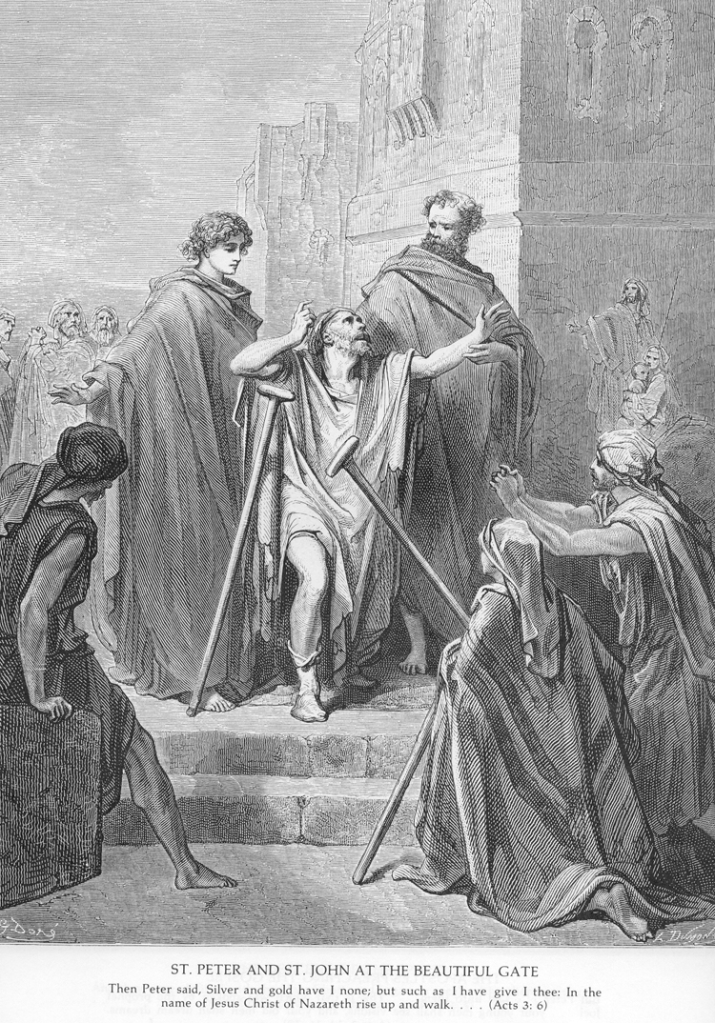
Peter and John heal the crippled man, by Gustave Doré (1832-1883)

Peter and John were going to the temple courtyard for the three o’clock prayer. At the same time, a man who had been lame from birth was being carried by some men. Every day these men would put the lame man at a gate in the temple courtyard. The gate was called Beautiful Gate. There he would beg for handouts from people going into the courtyard. When the man saw that Peter and John were about to go into the courtyard, he asked them for a handout.

Peter and John stared at him. “Look at us!” Peter said. So the man watched them closely. He expected to receive something from them. However, Peter said to him, “I don’t have any money, but I’ll give you what I do have. Through the power of Jesus Christ from Nazareth, walk!” Peter took hold of the man’s right hand and began to help him up. Immediately, the man’s feet and ankles became strong. Springing to his feet, he stood up and started to walk. He went with Peter and John into the temple courtyard. The man was walking, jumping, and praising God.

All the people saw him walking and praising God. They knew that he was the man who used to sit and beg at the temple’s Beautiful Gate. The people were amazed and stunned to see what had happened to him. (God’s Word Translation)

Peter and John at the gate of the temple, by Rembrandt

Money isn’t everything; and neither is having a lot of talent or giftedness. Yet, we often live our lives as if we cannot do much because of our lack of personal abilities and financial resources. But we can. All we need to do is give something that we all have to give.

Peter and John were disciples of Jesus. Though Jesus has ascended to heaven and the gift of the Spirit has come, they still maintained a daily rhythm of prayer three times a day at the temple.

As the two of them were about to attend afternoon prayer, they encountered a man at the gate. We are told that this particular guy was crippled. He came every day to the temple in order to beg. What is interesting to me is that this surely was not the first time Peter and John encountered the guy who begged at the gate.

Did they just ignore him? Was he one of many? Whatever the reason, they never put their eyes to him before. But on this occasion they did. In fact, they fixed their gaze on him and really took the time to stop and look at him.

I remember when my late brother-in-law had a complete turn around of his life to Jesus. At the time, he walked to work every day in the city. And every day there was a beggar on the corner. Most every day he had ignored him. One day he even spit on him.

The day after his great awakening to the Lord, he was walking to work and saw the beggar. But this time he really saw him. And when he looked into the man’s eyes, he had pity upon him. My brother-in-law – who took his lunch with him each day – surrendered it to the beggar. Eventually, he began a practice of bringing enough food for two, sitting down with the man, and talking with him as they ate together.

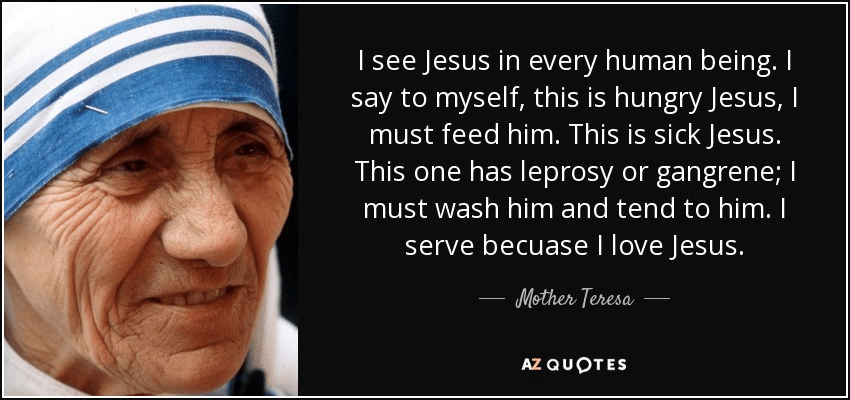
Perhaps for the first time, these disciples of Jesus, Peter and John, see the man who was there every day at the temple. They have not a thing with them. No money. No lunch. But they had something better: the power of grace and love.

In our contemporary Western society, we prefer things to be efficient and simple. Giving money, preferably online and dispassionately, is ideal for us. This way, we can give without any strings attached while feeling good about ourselves.

Yet, my brother-in-law and Peter and John decided to give the gift of connection. And that meeting of the eyes was the conduit for spiritual power to flow from one person to another. Doing what they saw Jesus do, the disciples gave the man who could not walk his legs back.

As a result, the guy was no longer lame nor a beggar. He became a fellow witness of God’s mercy and power. He went right up into the temple with Peter and John – walking and jumping and praising God.

It is not really money that gets things done. And it’s not our ingenuity or intelligence that really makes things happens. Throughout the book of Acts, demonstrations of God’s mighty power in the name of Jesus Christ is paramount. And those with alternative sources of power are shown to be powerless when it comes to life transformation.

In all of human history, including today, people like power; and power attracts wealth, as well as wealth attracting power. But the power of Christ’s resurrection is completely disconnected from worldly wealth. And it is never used for personal gain or popularity. And what’s more, this sort of power is available to every Christian – and not just a special class of super-Christians or clergy persons.

If we trace apostolic work in the New Testament, we shall find that the people with such spiritual power received it not because of extraordinary faith or exceptional virtue; instead, the Spirit grants us the ability to make a difference in this world by granting us the gift of sight – to truly see another as the precious image bearer of God that they are.

There are people right in front of us every day that we might not see. If we are wondering how to tap into the spiritual power of resurrection, we have no further to look than observing and gazing upon the folks within our eyesight, so that we can see them in new and redemptive ways.

Holy Lord, you gave us something more powerful and more valuable than riches; you have given us healing and hope. Please bring that healing and hope into our world and show us evidence of your presence in our lives. Amen.