Effective Communication (Acts 17:16-31)

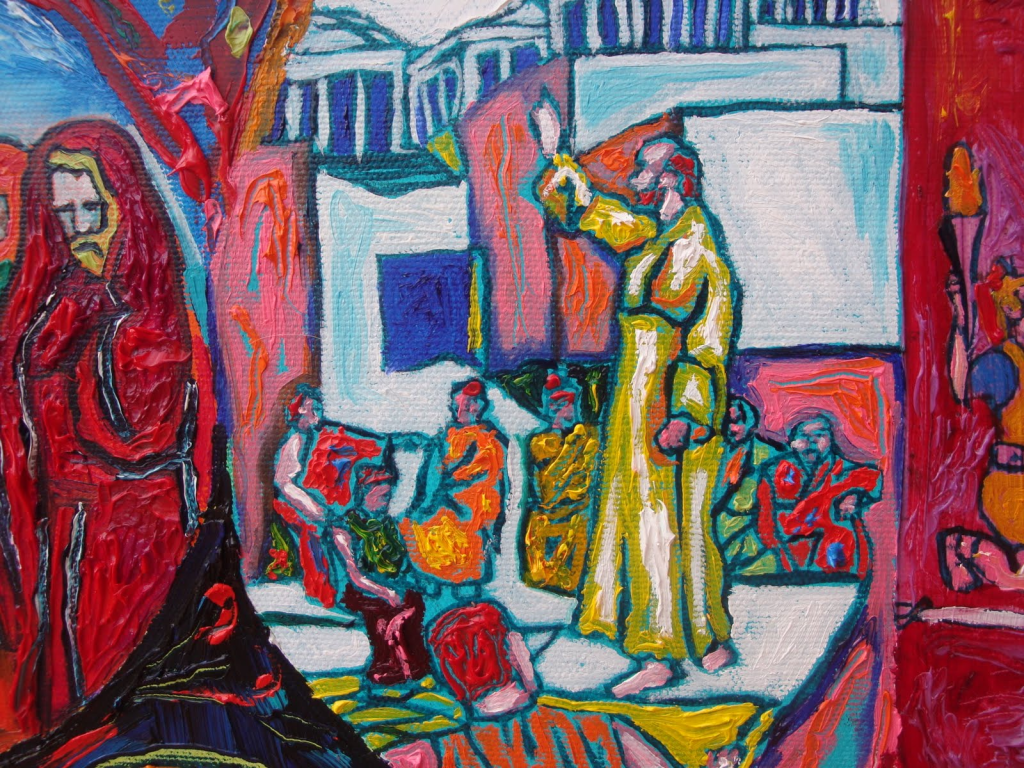
St. Paul preaching at the Areopagus in Athens, by Kennedy A. Paizs

While Paul was waiting for them in Athens, he was deeply troubled by all the idols he saw everywhere in the city. He went to the synagogue to reason with the Jews and the God-fearing Gentiles, and he spoke daily in the public square to all who happened to be there.

He also had a debate with some of the Epicurean and Stoic philosophers. When he told them about Jesus and his resurrection, they said, “What’s this babbler trying to say with these strange ideas he’s picked up?” Others said, “He seems to be preaching about some foreign gods.”

Then they took him to the high council of the city. “Come and tell us about this new teaching,” they said. “You are saying some rather strange things, and we want to know what it’s all about.” (It should be explained that all the Athenians as well as the foreigners in Athens seemed to spend all their time discussing the latest ideas.)

So Paul, standing before the council, addressed them as follows: “Men of Athens, I notice that you are very religious in every way, for as I was walking along I saw your many shrines. And one of your altars had this inscription on it: ‘To an Unknown God.’ This God, whom you worship without knowing, is the one I’m telling you about.

“He is the God who made the world and everything in it. Since he is Lord of heaven and earth, he doesn’t live in man-made temples, and human hands can’t serve his needs—for he has no needs. He himself gives life and breath to everything, and he satisfies every need. From one man he created all the nations throughout the whole earth. He decided beforehand when they should rise and fall, and he determined their boundaries.

“His purpose was for the nations to seek after God and perhaps feel their way toward him and find him—though he is not far from any one of us. For in him we live and move and exist. As some of your own poets have said, ‘We are his offspring.’ And since this is true, we shouldn’t think of God as an idol designed by craftsmen from gold or silver or stone.

“God overlooked people’s ignorance about these things in earlier times, but now he commands everyone everywhere to repent of their sins and turn to him. For he has set a day for judging the world with justice by the man he has appointed, and he proved to everyone who this is by raising him from the dead.” (New Living Translation)

Ancient ruins of Athens, Greece

The city of Athens was a major intellectual center in the ancient world. Ideas, philosophy, reason, rhetoric, and debate were standard fare amongst the citizens. At the time of the Apostle Paul’s arrival in the city, Greece knew next to nothing about Christianity.

Paul’s response to what he saw and felt in the city dictated what he did and said. And those words were wise and impactful for the people of Athens. The Apostle’s interaction with the philosophers was like a seminar in how to communicate with folks who believe and live very differently than ourselves.

Observation

Paul entered the city and made a simple observation: Athens is full of idols. Out of all the observations Paul could have made, this one would not likely be made by most people visiting the city. Athens was a glorious place with its unparalleled architecture. The Acropolis and the Agora were resplendent with the arts and democracy.

For all its physical beauty and brilliance, the one thing Paul homed-in on was the idols. This would have struck many folks as odd – something like focusing on the dog collar instead of the dog. Yet, Paul was using more than his physical eyes – his spiritual sight was making a big observation – that Athens was very much a religious place.

Feeling

The Apostle felt troubled and distressed. Paul was disturbed down deep in his gut with the spiritual state of this renowned city-state. The sheer volume of idols and the practice of idolatry did not sit well with him. He experienced feelings of pity mixed with anger.

Paul handled his emotions well. By freely acknowledging them, he was then able to choose his response. Had he not done so, it’s likely Paul might have gone on some frustrating tirade, thereby never truly connecting relationally with the people. There’s nothing wrong with being irritated or exasperated; it’s what we do with those feelings that’s important.

Need

Emotions, not thoughts, move us to act. Paul knew why he was feeling disturbed, and decided not to stuff those feelings. Instead, he stepped out and addressed the great need he was observing.

Paul decided to meet the Athenians on their turf and on their level by reasoning with them every day in the great buildings and open spaces of the city.

While in Athens, it seems that Paul, understandably, utilized the Socratic method of dialogue – involving questions and answers. It’s impressive that throughout the Acts of the Apostles, Paul demonstrated a deft ability to communicate and connect with a broad range of people.

Appeal

Paul wasn’t interacting and dialoging just for the fun of it; he wanted to make an appeal, a request for people to seriously consider the Christian good news of Jesus Christ’s resurrection as a viable philosophy of life. He made a widespread appeal to Jews, Greeks, and passers-by, as well as philosophers.

Since the massive intellect of Paul could handle any reasoned debate, he was invited to the Areopagus, which was the place where the best-of-the-best carried-on their discussions.

Paul’s address to them was incredibly cogent and well-reasoned – finding common ground from which to debate. While doing so, he maintained outward grace amidst his inward disturbance.

Conclusion

The late British exegete, John R.W. Stott, reflected on today’s New Testament lesson and gave us words which are still relevant for us in these contemporary times:

“Why is it that, in spite of the great needs and opportunities of our day, the church slumbers peacefully on, and that so many Christians are deaf to Christ’s commission, and dumb with tongues-tied in testimony? The major reason is this: We do not speak as Paul spoke because we do not feel as Paul felt. We have never had his indignation. Divine jealousy has not stirred within us. We constantly pray, ‘Hallowed be Thy Name,’ yet we do not seem to mean it… Paul saw people created in the image and likeness of God giving to idols the homage which was due to God alone… and he was deeply pained by it.”

May the good news of Jesus Christ be so pressed into our minds, hearts, and guts that what comes out of us is deep compassion, wise dialogue, and an effective ministry of communication with others. Amen.

Confronting the Evil in Front of Us (Mark 6:14-29)

St. John the Baptist rebuking Herod, by Giovanni Fattori (1825-1908)

King Herod heard of it, for Jesus’s name had become known. Some were saying, “John the baptizer has been raised from the dead, and for this reason these powers are at work in him.” But others said, “It is Elijah.” And others said, “It is a prophet, like one of the prophets of old.” But when Herod heard of it, he said, “John, whom I beheaded, has been raised.”

For Herod himself had sent men who arrested John, bound him, and put him in prison on account of Herodias, his brother Philip’s wife, because Herod had married her. For John had been telling Herod, “It is not lawful for you to have your brother’s wife.” 

And Herodias had a grudge against him and wanted to kill him. But she could not, for Herod feared John, knowing that he was a righteous and holy man, and he protected him. When he heard him, he was greatly perplexed, and yet he liked to listen to him. 

But an opportunity came when Herod on his birthday gave a banquet for his courtiers and officers and for the leaders of Galilee. When his daughter Herodias came in and danced, she pleased Herod and his guests, and the king said to the girl, “Ask me for whatever you wish, and I will give it.” And he swore to her, “Whatever you ask me, I will give you, even half of my kingdom.” 

She went out and said to her mother, “What should I ask for?” She replied, “The head of John the baptizer.” Immediately she rushed back to the king and requested, “I want you to give me at once the head of John the Baptist on a platter.” The king was deeply grieved, yet out of regard for his oaths and for the guests, he did not want to refuse her. 

Immediately the king sent a soldier of the guard with orders to bring John’s head. He went and beheaded him in the prison, brought his head on a platter, and gave it to the girl. Then the girl gave it to her mother. When his disciples heard about it, they came and took his body and laid it in a tomb. (New Revised Standard Version)

Feast of Herod with the Beheading of St John the Baptist, in the Museo del Prado, Madrid, Spain

The earthly life and mission of Jesus was connected to the social and political affairs of Judea and the Roman Empire. In truth, Christ’s impact is never only ethereal; rather, it smacks against every system and organization in this world.

John the Baptist’s death was closely connected to Christ’s mission and ministry; and it was also a result of the social and political forces John was subjected to. This would explain why Herod thought of Jesus as a resurrected John, after killing him. Both the messages of John and Jesus were met with resistance by the powers that be.

Marriages in the ancient world, especially among governmental officials, were primarily political affairs, and not love arrangements. The more authority and power a person had, the greater the political implications and impact there was. And marriage was one way of consolidating more power.

Herod’s marriage to Herodias may have been politically expedient, but was ethically repugnant, and John let him know about it. Herod was both a Jew and a Roman official, with his actual allegiance being to himself.

Herodias considered John as politically repugnant and found it unethically expedient to silence him once and for all when she had the opportunity. John the Baptist discovered first-hand that hell hath no fury like a woman’s scorn. Herodias hated him and waited for an opportune time to be rid of him once and for all.

But not only did Herodias orchestrate John’s demise, she did it in a way that sought to humiliate him. To die in battle at the hand of an enemy soldier was an honorable death; but to be executed because of a woman’s handiwork was a mark of shame.

Anyone who lives for God and speaks truth to power will nearly always suffer deep consequences. Hence, this is why a great many prophets ended up dead, often by tortuous methods – including Jesus and nearly all his original disciples.

Unfortunately, there are individuals in this world who are incapable of doing good.

Whenever such persons talk a good line, or do a good deed, it’s always in the service of a larger evil agenda. They often end up in positions of authority, simply because they have no scruples and will lie to you with a straight face.

And they will do anything to not only hold on to their power, but to acquire more so that they can be in control of everything around them. Of course, the people around such a person are miserable. They typically feel powerless to change the situation.

So, if there’s going to be transformation, there will need to be a prophet – someone like John the Baptist – who has the courage to speak truth to power and remind the world that God is the sovereign of the universe.

The Gospel writer Mark presents Herodias as a person with influence and power who only cares about her own interests. She had no scruples in using her daughter for malevolent purposes.

Whereas the young daughter of the synagogue ruler Jairus was (earlier in Mark’s account) raised to life by Jesus, in today’s story the young daughter of Herodias became the vehicle of a grisly murder. And, of all things, it’s this girl who brought the severed head of John the Baptist on a platter to her mother.

We are meant to see the impact and consequence when those in power have self-centered objectives and dark hearts. This is in direct contrast to both Jesus Christ and John the Baptist, both of whom gave their lives for that which is right, just, and good.

God’s mercy and redemption will eventually overwhelm all of creation. The cross and resurrection of Christ have won the victory over evil. Yet, until Christ returns, the dark forces of this old world know their time is short; and they are doing everything they can to throw a monkey wrench into the benevolent machine of grace, before the demonic forces themselves are thrown into the pit forever.

Christian mission and ministry was never designed to be easy nor pain-free. But it is meant to bring hope, love, redemption, peace, and satisfaction to all who believe.

Christ has connected himself to us. Let’s keep that gracious connection going by doing what is right and living a good and just life, and confronting the evil in front of us – to the glory of God. Amen.

The “Fool’s” Speech (2 Corinthians 11:16-33)

I repeat: Let no one take me for a fool. But if you do, then tolerate me just as you would a fool, so that I may do a little boasting. In this self-confident boasting I am not talking as the Lord would, but as a fool. Since many are boasting in the way the world does, I too will boast. You gladly put up with fools since you are so wise! In fact, you even put up with anyone who enslaves you or exploits you or takes advantage of you or puts on airs or slaps you in the face. To my shame I admit that we were too weak for that!

Whatever anyone else dares to boast about—I am speaking as a fool—I also dare to boast about. Are they Hebrews? So am I. Are they Israelites? So am I. Are they Abraham’s descendants? So am I. Are they servants of Christ? (I am out of my mind to talk like this.) I am more. I have worked much harder, been in prison more frequently, been flogged more severely, and been exposed to death again and again. 

Five times I received from the Jews the forty lashes minus one. Three times I was beaten with rods, once I was pelted with stones, three times I was shipwrecked, I spent a night and a day in the open sea, I have been constantly on the move. I have been in danger from rivers, in danger from bandits, in danger from my fellow Jews, in danger from Gentiles; in danger in the city, in danger in the country, in danger at sea; and in danger from false believers. I have labored and toiled and have often gone without sleep; I have known hunger and thirst and have often gone without food; I have been cold and naked. Besides everything else, I face daily the pressure of my concern for all the churches. Who is weak, and I do not feel weak? Who is led into sin, and I do not inwardly burn?

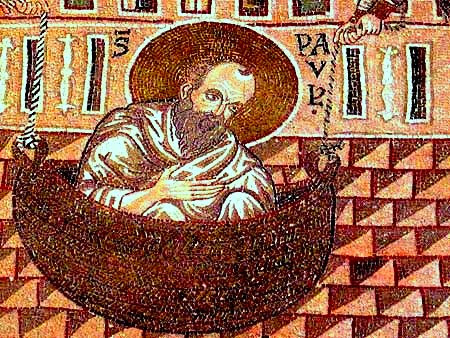
If I must boast, I will boast of the things that show my weakness. The God and Father of the Lord Jesus, who is to be praised forever, knows that I am not lying. In Damascus the governor under King Aretas had the city of the Damascenes guarded in order to arrest me. But I was lowered in a basket from a window in the wall and slipped through his hands. (New International Version)

Paul escaped the city of Damascus by being lowered in a basket at night (Acts 9: 23-25)

At this point in the Apostle Paul’s second letter to the Corinthian Church, he levels a direct and devastating attack on his proud, arrogant, and boastful opponents in the church. He points out the foolishness of their boasting, by means of playing the fool himself.

The gist of Paul’s argument was to boast of his humiliating experiences. In truth, Paul had plenty of glorious accomplishments he could have droned on about. Instead, he sought to expose the wide gulf that separated his understanding of apostolic ministry, and theirs.

With some rather hefty sarcasm behind his words, Paul offered some foolish boasting according to the human standards of his opponents. The Corinthians believed themselves to have superior strength and wisdom. Surely, they’re able to put up with these pathetic apostolic weaklings!

In reality, it is Paul’s weakness – and not humanly contrived understandings of strength – which establish his credibility and superiority as a minister of Christ’s gospel. The evidence is his hardships and trials – not his many triumphs. Paul intended for this irony to be felt by the Corinthians.

The Apostle’s litany of woes and adversities wasn’t meant to one-up the Corinthians. Rather, it was intended to be a parody of the Corinthians’ claims to superior wisdom and spiritual power.

While the church boasted of all the things that showed their strength, Paul boasted of his weaknesses – because it’s truly in weakness that the transcendent power of God is made known and manifested in this world.

Paul’s experience in Damascus not only illustrated the extreme danger he was in, but it served as an example of his weakness in contrast to the mighty strength of the Roman Empire.

In the Roman army, the soldier with the greatest strength and valor was the one who scaled the enemy wall first. The courageous ascent of the Roman soldier is viewed alongside the inglorious descent of Paul along the wall in escaping.

Christianity grew, flourished, and thrived not because of superior earthly strength, but because of humiliating weakness which allowed the power of heaven to work through it.

In light of Paul’s view of leadership and ministry, I find that many contemporary leadership theories are woefully lacking in an understanding of how people tick.

For example, some philosophies treat humans as if they were machines, and treat workers as cogs or parts in a larger mechanistic worldview, as if they could be replaceable.

Yet, leadership that relies on the factory system will inevitably demean a person’s basic humanity and see nothing of their inherent uniqueness and deserving of respect.

Instead, a more biblical, compassionate, and practical leadership style discerns that relationships are key; and that individual persons bring something special to their work, even if they are doing the same job as others.

In this understanding of leadership, every single person does their work or ministry in a way that isn’t fully reproducible by others. Our individual human uniqueness ensures that our place in the world is needed, and that what we bring to every endeavor we do is a special one-of-a-kind offering that no one else can do.

What’s more, in this view of leadership, there’s no room for boasting, at all. And no place for arrogant pride, because boasting is based upon comparison.

If every person is a unique creation of God, and everyone brings something individually special to their efforts, then comparison is a foolish waste of time, and boasting is nothing more than a fool’s game.

You can always tell the fool by how they keep talking and cannot keep their mouth shut about all of their accomplishments and everything they know. If they believe they’re right, and try and prove it with their comparative superiority to others, then you can bet that what you have in front of you is a card-carrying honest-to-goodness genuine Fool, with a capital “F.”

We can do better. And we can be better leaders and offer better leadership philosophies which are based in humility, the value of each person, sound relationships, and effective peacemaking.

Anything less than that will likely get a sarcastic comment from the Apostle Paul in heaven.

Give us, O God,
leaders whose hearts are large enough
to match the breadth of our own souls;
and give us souls strong enough
to follow leaders of vision and wisdom. Amen.

Don’t Let Rejection Get the Best of You (Mark 6:1-13)

He left that place and came to his hometown, and his disciples followed him. On the Sabbath he began to teach in the synagogue, and many who heard him were astounded. They said, “Where did this man get all this? What is this wisdom that has been given to him? What deeds of power are being done by his hands! Is not this the carpenter, the son of Mary and brother of James and Joses and Judas and Simon, and are not his sisters here with us?” And they took offense at him. 

Then Jesus said to them, “Prophets are not without honor, except in their hometown and among their own kin and in their own house.” And he could do no deed of power there, except that he laid his hands on a few sick people and cured them. And he was amazed at their unbelief.

Then he went about among the villages teaching. He called the twelve and began to send them out two by two and gave them authority over the unclean spirits. He ordered them to take nothing for their journey except a staff: no bread, no bag, no money in their belts, but to wear sandals and not to put on two tunics. 

He said to them, “Wherever you enter a house, stay there until you leave the place. If any place will not welcome you and they refuse to hear you, as you leave, shake off the dust that is on your feet as a testimony against them.” So they went out and proclaimed that all should repent. They cast out many demons and anointed with oil many who were sick and cured them. (New Revised Standard Version)

Homecooked Rejection

Jesus was well into his ministry, with the disciples in tow, and had made quite a splash around Judea. Eventually, he made it back to the region of Galilee and to his hometown. Having grown up in a small town myself, I can testify how any sort of celebrity status from one of their own is a really big deal. Anticipation was high amongst the townsfolk.

Knowing Jesus as they did, the people were downright slack-jawed at his wisdom and the way he taught – which is also a typical response of the hometown boy made popular. The town knew Jesus differently – as simply another nice, but normal, Jewish kid from a nice but scandalous family.

The homecoming turned sour as the crowd believed they knew more than Jesus. After all, they knew him as a little kid. And they knew where he came from. He’s the carpenter, the son of Mary. They remembered what was up with Jesus. Mary and Joseph weren’t yet together and she ended up pregnant. This guy is no Son of God, but son of who knows?

They took offense at Jesus. He was the one with the curious conception and birth. And now he was trying to teach them, the ones who “really knew” his origins – or so they thought.

Jesus was just too uppity for the hometown folks. He considered himself more than the people he grew up with would concede. By providing the self-reference of “prophet,” Jesus was placing himself in the company of many revered men of God who went against the grain of their own contemporary cultures. And the folks in Galilee most certainly did not think they needed a prophet, especially one with illegitimate origins.

For the townsfolk, Jesus was claiming more honor and status for himself than was warranted in the old hometown. It meant that others got knocked down to size. So the people in the town were not having it. They took offense.

Ironically, the people who ought to know better, don’t. Jesus was amazed at their lack of faith, their unbelief. So little could be done in such a place as this. After all, you cannot heal someone if they believe they don’t need healing.

Heaven-sent Mission

Rejection didn’t stop Christ’s mission on this earth. Jesus prepared his disciples for their initial ministry, sending them in pairs. Up to this point, he taught them about God’s kingdom, handled a good deal of one-on-one instruction, and demonstrated for them what healing is like and why he did it. And they also needed to understand that rejection from others is part of the ministry.

Jesus instructed the disciples to take only a few essentials; the hospitality of others would be a significant aspect of their ministry – especially since much of their work would take place from household to household. Synagogues were not always receptive places to a new kind of ministry. So, the grassroots efforts of the disciple pairs were important.

Rejection and judgment tend to go hand-in-hand. Those who spurned the disciples were judging the veracity of their work. And also, that same rejection was a sign for the disciples to not spin their wheels trying to persuade the already convinced. Instead, the disciples were to do their own action of shaking the dust off their feet, letting the stubborn people know they were not carrying the bad judgments with them.

All in all, Christ’s disciples had an effective ministry and a positive experience. They were able to bring their message and healing to many.

We can observe through this story that rejection from others and a failure to make inroads with some is not necessarily a reflection on us. Some people are going to misunderstand us and make judgments about us, regardless of how well we go about our work.

After all, if Jesus experienced it, how much more will we? Don’t let rejection get the best of you.

To never face rejection and judgment may be a sign that little to no action is actually taking place – or maybe that the avoidance of conflict is assigned a value much too high than Jesus would give it.

If you are working toward loving both God and neighbor, showing justice and mercy in all you do, then any sort of rejection isn’t worth getting upset about.

Gracious God, I release my grip on needing to be understood by everyone, and instead choose to hold onto you and your grace. Therefore:

  • I lay down my need to understand why things happen the way they do.
  • I lay down my fears about others judging me.
  • I lay down my desire to prove my worth.
  • I lay down my resistance to suffering.

I take up my cross daily, and seek to walk according to your ways, and to live into your words; through Jesus Christ my Lord, in the enablement of the Holy Spirit. Amen.