I Am the Bread of Life (John 6:35, 41-51)

Ethiopian Orthodox depiction of Jesus sharing with the disciples

Jesus said to them, “I am the bread of life. Whoever comes to me will never be hungry, and whoever believes in me will never be thirsty…

Then the Jews began to complain about him because he said, “I am the bread that came down from heaven.” They were saying, “Is not this Jesus, the son of Joseph, whose father and mother we know? How can he now say, ‘I have come down from heaven’?” 

Jesus answered them, “Do not complain among yourselves. No one can come to me unless drawn by the Father who sent me, and I will raise that person up on the last day. It is written in the prophets, ‘And they shall all be taught by God.’ Everyone who has heard and learned from the Father comes to me. Not that anyone has seen the Father except the one who is from God; he has seen the Father. Very truly, I tell you, whoever believes has eternal life. I am the bread of life. Your ancestors ate the manna in the wilderness, and they died. This is the bread that comes down from heaven, so that one may eat of it and not die. I am the living bread that came down from heaven. Whoever eats of this bread will live forever, and the bread that I will give for the life of the world is my flesh.” (New Revised Standard Version)

The lesson for today begins with the first of seven “I am” statements in John’s Gospel from Jesus:

  1. “I am the bread of life. Whoever comes to me will never be hungry, and whoever believes in me will never be thirsty.” (John 6:35)
  2. “I am the light of the world. Whoever follows me will never walk in darkness but will have the light of life.” (John 8:12)
  3. “I am the gate. Whoever enters by me will be saved and will come in and go out and find pasture.” (John 10:9)
  4.  “I am the good shepherd. The good shepherd lays down his life for the sheep.” (John 10:11)
  5. “I am the resurrection and the life. Those who believe in me, even though they die, will live,and everyone who lives and believes in me will never die.” (John 11:25-26)
  6. “I am the way and the truth and the life. No one comes to the Father except through me.” (John 14:6)
  7. “I am the true vine, and my Father is the vine-grower. He removes every branch in me that bears no fruit. Every branch that bears fruit he prunes to make it bear more fruit. I am the vine.” (John 15:1-2)

Also, for the first time in the Gospel of John, the Jews are named and identified as the ones who cause conflict for Jesus. John, of course, did not mean every single Jew; he was referring chiefly to the Jewish religious establishment, the leaders. And even then, he, of course, was not making reference to every single rabbi or person in the ruling council.

It’s important to say that, because Jews throughout the centuries have had far too much persecution from Christians who think all Jews have it in for Jesus. So, please, exercise some plain common sense and basic human kindness when it comes to reading the New Testament Gospels; they are most definitely not anti-Semitic.

The religious leaders were taking issue with the claims of Jesus, his “I am” statement. They argued that Jesus was a plain ordinary Jew from a typical Jewish family. There’s no need, the authorities contended, for Jesus to think of himself any other way than a common Jew.

Instead of entertaining the complaint against him, Jesus pointed to God the Father. God initiated the action by sending Jesus; and takes action by drawing people to Jesus. And Christ does his part by raising those people up at the last day; and teaching them about God’s actions of deliverance.

When it comes to the earthly ministry of Jesus, seeing is believing, and hearing is learning. Trust what you see with Jesus; and believe it. Have faith in what you hear from Jesus; and learn from it.
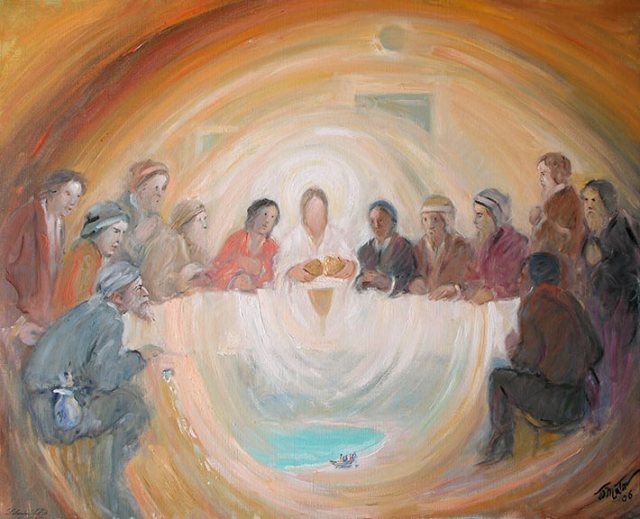
I Am the Bread of Life, by Joseph Matar

I like Jesus. I like metaphors. Jesus is a metaphor guy. I like that. Jesus said that he is the bread of life. Those who come to Jesus are satisfied. Those who eat him, live forever. This isn’t cannibalism, it’s a metaphor. The bread that Jesus gives for the life of the world is his flesh.

Metaphors help us relate to the concept, and grasp the message. If you’re hungry, just looking at a loaf of bread isn’t going to help you be satisfied. Obviously, you have to eat the bread and do more than see it, smell it, and touch it.

What’s more, people do more than eat once. We eat repeatedly, every day, at least a few times a day, in order to be healthy and alive.

Come and see Jesus. But do more than that. Ingest him. Take Jesus into your life. Let the bread of life come into you and thoroughly satisfy you. And do it every day. Do it several times a day. Make sure your soul is continually full of Jesus.

Then, you will have life to the full, an abundant life, filled with good things and right relationships.

Jesus is the bread of life. He is the great “I am.” And so much more.

Yet, perhaps at first glance, Jesus is just one person amongst a panoply of historical characters and religious figures. However, if we will but taste Jesus, we will come to see something very different about him. He’s more than a human being, more than a compelling teacher, and more than a miracle worker.

Jesus may appear, to many, as nothing more than a common person. But there’s really nothing ordinary about him, at all. Taking the time to have a good look at the Gospel of John, and watching Jesus move from village to village, and person to person will help us see a rather uncommon person who was no ordinary human being.

He moved to the beat of a different drum, and danced an alternative jig. And if we observe more closely, we can see the other two dance partners with him.

And with our two ears, when he says, “I am,” we can respond with an emphatic, “He is.”

Merciful Father, you heard the prayers of your people in the wilderness and fed them bread from heaven despite their sin. Graciously hear us today and feed us, too, with the Bread of Life from heaven, our Lord Jesus Christ, who lives and reigns with you and the Holy Spirit, one God, now and forever. Amen.

Jesus Prays For Us (John 17:6-19)

Word of Life, by Millard Sheets

“I have made your name known to those whom you gave me from the world. They were yours, and you gave them to me, and they have kept your word. Now they know that everything you have given me is from you, for the words that you gave to me I have given to them, and they have received them and know in truth that I came from you, and they have believed that you sent me.

I am asking on their behalf; I am not asking on behalf of the world but on behalf of those whom you gave me, because they are yours. All mine are yours, and yours are mine, and I have been glorified in them. And now I am no longer in the world, but they are in the world, and I am coming to you.

“Holy Father, protect them in your name that you have given me, so that they may be one, as we are one. While I was with them, I protected them in your name that you have given me. I guarded them, and not one of them was lost except the one destined to be lost, so that the scripture might be fulfilled. 

But now I am coming to you, and I speak these things in the world so that they may have my joy made complete in themselves. I have given them your word, and the world has hated them because they do not belong to the world, just as I do not belong to the world. 

“I am not asking you to take them out of the world, but I ask you to protect them from the evil one. They do not belong to the world, just as I do not belong to the world. Sanctify them in the truth; your word is truth. As you have sent me into the world, so I have sent them into the world. And for their sakes I sanctify myself, so that they also may be sanctified in truth. (New Revised Standard Version)

It seems to me only fitting that Jesus concluded his time with the disciples in the Upper Room before his betrayal, crucifixion, and death with prayer. It also seems to me that if you really want to know the heart of a person, listen to them pray.

The prayer of Jesus was thoroughly oriented toward the spiritual needs of his followers – even potential believers who will follow him in the future. And it was a prayer completely devoted toward honoring the heavenly Father through praying consistent with God’s will for this world.

Without the physical presence of Jesus – which would soon be gone – his followers would have to rely on prayer. And Christ was intent on instilling within his disciples the confidence and hope they needed for a solid life of prayer.

For post-resurrection Christians living in an ever-expanding world of oppression, greed, and indifference, we can be encouraged not to settle into despair or loneliness. Why? Because believers can have a solid hope and an abiding trust in the continuing presence of Jesus by means of the Holy Spirit.

God Gives

God gives. Jesus gives. Both the Father and the Son are givers. This is a major reason and motivation for prayer because God is not a reluctant giver. In the act of giving, the Father and the Son are fully on the same page; God is ready and willing to give. The Holy Trinity – Father, Son, and Spirit – are in complete unity, and act as One, in giving to us what we need.

“Those who drink of the water that I will give them will never be thirsty. The water that I will give will become in them a spring of water gushing up to eternal life.” (John 4:14, NRSV)

“Do not work for the food that perishes but for the food that endures for eternal life, which the Son of Man will give you.” (John 6:27, NRSV)

“I give them eternal life, and they will never perish. No one will snatch them out of my hand.” (John 10:28, NRSV)

We Belong

Through giving we are included. Believers and followers of Jesus – having been given the grace of faith – know that they belong to God. Christians are in union with Christ. The redemption which Jesus has secured is a million billion times stronger, and bonds us closer, than any sort of Gorilla glue. And, what’s more, once we belong, we are never forgotten, but always remembered by God.

“The Father knows me, and I know the Father. And I lay down my life for the sheep. I have other sheep that do not belong to this fold. I must bring them also, and they will listen to my voice. So there will be one flock, one shepherd.” (John 10:15-16, NRSV)

Christ the King, statue in Swiebodzin, Poland

The Name of Jesus

Because we belong, we know God’s name. The divine name stands for all that God is and all that God has done. It’s all focused in Christ. In the name of Jesus, through the person and work of Jesus Christ, we have everlasting life, spiritual power, and eternal security.

Now Jesus did many other signs in the presence of his disciples that are not written in this book. But these are written so that you may continue to believe that Jesus is the Messiah, the Son of God, and that through believing you may have life in his name. (John 20:30-31, NRSV)

We Have the Word

The Word became flesh and dwelt among us (John 1:14). Jesus has given to his disciples only those words which he first received from the Father. Those who accept the enfleshed Word and his words have been given power to become God’s children (John 1:12). Because believers belong to God, they know the truth and that truth has set them free.

It is the Christian’s mission to live into the words and ways of Jesus, to follow Christ in thought, word, and deed. The very glory of Jesus in his cross and resurrection is focused within the believing community, who is in union with Christ and belongs to God.

In his prayer, Jesus claimed an intimate oneness in the sharing of concern for people who are the objects of the Father’s gracious giving of love through the Son. All who belong to Christ belong to God, and vice versa. All the love that went into the cross was poured out upon us.

Those who believe in the name of Jesus Christ are the very glory of Jesus, and thus, the glory of God.

Sent Into the World

Because of the Father’s name—because of who the Father is and what the Father has given in love to the Son—we are set apart for truth; the words of God are truth.

Since we belong to God and bear the name of Christ, we don’t belong to the world’s systems of guilt, shame, injustice, and evil. And yet, we are separated from the world for precisely the reason of immersing ourselves in the world. In other words, Christianity is meant for the life of the world, and not as a religion that’s only concerned for itself.

To reach the world, we must be different from it. To reach the world, we need to have boots-on-the-ground in it. To reach the world, Christians are to be both far from the world, and near to the world.

As the Father sent the Son, so the Son sends us into the world – not to be like the world, but to embody the words and ways of Jesus to and for the world.

Just as the world rejected Jesus in his suffering and death, so the world, too, will reject his followers. Which means we will need to pray, a lot! And there is no better scriptural prayer to emulate than the very words of the Lord Jesus, who loved us and gave himself for us.

Holy Father, guard our hearts and minds in Jesus, as we pursue this Christian life which you gave as a gift through Christ, so that we can be united, just as the Father and the Son are one. Although we long for heaven, don’t take us out of the world until we have fulfilled our sacred mission to carry the words and ways of our Lord to the world. Make us holy, and give us everything we need for life in this present evil age; through Jesus Christ your Son, our Lord, who with you and the Holy Spirit are one God, now and forever. Amen.

Recover the Relational Commands (1 Timothy 6:13-16)

In the sight of God, who gives life to everything, and of Christ Jesus, who while testifying before Pontius Pilate made the good confession, I charge you to keep this command without spot or blame until the appearing of our Lord Jesus Christ, which God will bring about in his own time—God, the blessed and only Ruler, the King of kings and Lord of lords, who alone is immortal and who lives in unapproachable light, whom no one has seen or can see. To him be honor and might forever. Amen. (New International Version)

Jesus is Lord, and Ceasar is not. The Apostle Paul’s letter to Timothy, in some ways, could be summed up in this way.

As Timothy ministered to the fledgling church in Ephesus, he was to continually keep his eyes on Jesus and take his cues for ministry on the apostolic teaching handed down to him. Timothy was not to get caught up in the fear of living in an Empire that commanded fealty to Ceasar as the supreme being over all.

Timothy was to flee all that is contrary to the sound doctrine of Christian faith. He was instead to pursue righteousness, godliness, faith, love, endurance and gentleness. Paul encouraged and exhorted Timothy to fight the good fight of the faith; and take hold of the eternal life to which he was called. Timothy was to live into his confession of Christ and his call from God.

Embrace Jesus as Lord, and quit trusting in Ceasar as Lord.

Although we see nothing subversive about today’s New Testament lesson, it very much was when Paul originally wrote it. The Apostle was essentially saying that, as Timothy goes about pastoring the church at Ephesus within the Roman Empire, he must always uphold the sovereignty and lordship of Jesus Christ as supreme – which, if seen by Roman authorities, would be taken as a subversive action against the state.

The Empire cares about submission to the state, and would see Jesus as Lord as Timothy and Paul teaching people to submit to a different ruler than Ceasar. And they would be right because neither Paul nor Timothy had any intention of engaging in the cult of Ceasar.

Contrary to the Roman imperial gods, and Ceasar himself, Paul lifted up the God who gives life to everything. It is this God – embodied in the Lord Jesus Christ – whom Timothy is encouraged to maintain a steadfast and consistent commitment to. And, what’s more, this commitment is to be carried out without any spot or blame.

Timothy had no need to bully people or shame others into accepting and holding onto the gospel. The means and the methods of how we embrace our charge from God matters a lot. By persevering in faith, holiness, and humility, Timothy would preserve himself and be of benefit to his listeners.

Believers are to keep up this spiritual commitment until Christ returns. It is always open season on gospel proclamation and Christian growth and maturity – lived with a gracious spirit.

By looking to Jesus, followers of Christ can maintain their witness. Times of discouragement are bound to come. And in those difficult seasons of life, we are not to change or switch our allegiance to the political powers. As important as government is, politicians are not saviors; and a particular system of government is not going to deliver us from our greatest oppressions.

The Apostle Paul described Jesus as the King of kings and Lord of lords, the blessed and only Ruler. Christ is  sovereign over all earthly powers.

Furthermore, God alone is immortal and lives in unapproachable light. God is pure light, and in the Lord there is no darkness. God’s glory is bright and blinding; therefore, no one can see God. To this God deserves honor and might forever.

The mighty and holy God will fulfill all divine promises. Paul was looking to reinforce some courage in Timothy by reminding him of the sort of God they both serve.

In our current and contemporary world, it’s easy to become discouraged. Injustice abounds. Hardness of heart is everywhere. An inability to truly see one another is rife. And people look everywhere and to anyone who appears successful. They want to know the secret in how to survive and thrive on this earth, in their workplaces, and in their homes.

But it’s no secret. The hard work of relationships is what it takes – both human and divine. There is no replacement or surrogate work to the labor of investing yourself into others lives. There’s no substitute for a relationship with God which involves prayer and basic Scripture reading, worship and spiritual disciplines; and face to face relations with actual real people – getting to know them, their joys, their fears, and what motivates them.

Until we recover things such as spiritual mentoring, spiritual practices, group prayer, congregational worship, and create the time for relationships, we shall continue to struggle with a fundamentally broken world and all of its dysfunctional relationships.

No matter the organization, the neighborhood, the family, or the church, we need real people to do honest real work. Whenever a manager, a block captain, a parent, or a pastor allows themselves to be vulnerable and authentic – and lives on the same level as those they serve – then no one is looking for a secret sauce to success.

The Christian’s path of life is always to involve humility, gentleness, mercy, purity, and peacemaking, in doing the work of right relations with the people around them. This is the way of Christ.

Trying to discover a process or a system – apart from the muck of relationships – will fail, every time. This is the way of Ceasar.

Paul took the time and invested the effort into his relationship with Christ. Then, he put himself in a position to mentor others in the faith. Furthermore, he encouraged people like Timothy to do the same. Apart from this work, there is no Christianity.

Believers in Jesus are here today because of Paul and Timothy and the body of teaching and work they passed on to others who, in turn, did the same.

You then, my son, be strong in the grace that is in Christ Jesus. And the things you have heard me say in the presence of many witnesses entrust to reliable people who will also be qualified to teach others. (2 Timothy 2:2, NIV)

It’s time to roll up your sleeves and fulfill the calling you have received, the calling of righteousness (right relationships) with both God and others – because Jesus is Lord, and Ceasar is not.

Eternal Father, you gave to your incarnate Son the holy name of Jesus to be the sign of our salvation: Plant in every heart, we pray, the love of him who is the Savior of the world, our Lord Jesus Christ; who lives and reigns with you and the Holy Spirit, one God, in glory everlasting. Amen.

Maundy Thursday (John 13:1-17, 31b-35)

Jesus Washing the Disciples’ Feet, by Leszck Forczek (1946-2019)

Now before the festival of the Passover, Jesus knew that his hour had come to depart from this world and go to the Father. Having loved his own who were in the world, he loved them to the end. The devil had already decided that Judas son of Simon Iscariot would betray Jesus. And during supper Jesus, knowing that the Father had given all things into his hands and that he had come from God and was going to God, got up from supper, took off his outer robe, and tied a towel around himself. 

Then he poured water into a basin and began to wash the disciples’ feet and to wipe them with the towel that was tied around him. He came to Simon Peter, who said to him, “Lord, are you going to wash my feet?” Jesus answered, “You do not know now what I am doing, but later you will understand.” Peter said to him, “You will never wash my feet.”

Jesus answered, “Unless I wash you, you have no share with me.” Simon Peter said to him, “Lord, not my feet only but also my hands and my head!” Jesus said to him, “One who has bathed does not need to wash, except for the feet, but is entirely clean. And you are clean, though not all of you.” For he knew who was to betray him; for this reason he said, “Not all of you are clean.”

After he had washed their feet, had put on his robe, and had reclined again, he said to them, “Do you know what I have done to you? You call me Teacher and Lord, and you are right, for that is what I am. So if I, your Lord and Teacher, have washed your feet, you also ought to wash one another’s feet. For I have set you an example, that you also should do as I have done to you. Very truly, I tell you, slaves are not greater than their master, nor are messengers greater than the one who sent them.If you know these things, you are blessed if you do them….

“Now the Son of Man has been glorified, and God has been glorified in him. If God has been glorified in him, God will also glorify him in himself and will glorify him at once. Little children, I am with you only a little longer. You will look for me, and as I said to the Jews so now I say to you, ‘Where I am going, you cannot come.’I give you a new commandment, that you love one another. Just as I have loved you, you also should love one another. By this everyone will know that you are my disciples, if you have love for one another.” (New Revised Standard Version)

Today is Maundy Thursday. It is a time in Holy Week to reflect upon the great love of Christ for humanity, as well as much of humanity’s great resistance to that divine love.

The word “Maundy” is the Latin word for “commandment.” It’s a reference to Christ’s mandate for his followers to love one another. And Jesus gave his disciples an example of this love in a way they would never forget.

The jaw-dropping illustration of love for each other is preceded by setting the stage. It is the Last Supper, the final meal of Jesus with the disciples. Christ’s imminent crucifixion is very much tied to the Jewish Passover. Just as the festival is about to happen, dominating the spiritual landscape of Jerusalem, so the cross of Christ looms heavy in the Upper Room. The hour is nearly upon them.

Washing of the Feet, by John August Swanson, 2000

And only Jesus seems to know the brevity of the moment. He knows that Judas is about to betray him. Events that were prophesied centuries earlier are about to be set in motion. Every word and action of Jesus at this Supper is formed and informed by what is about to take place in the next few days.

We are meant to understand, as observers to this Upper Room meal, that Jesus not only knows what is happening, but that he also has control over the unfolding events. Satan may believe that he knows what’s going on and can influence Judas for diabolical purposes; but Jesus is really the One in charge. Even the workings of the devil are used for the divine agenda. Every event – whether meant for good or for ill – shall be bent toward the will of God.

The example, the capstone of all Christ’s teaching, is now divulged and acted out. The disciples themselves are participants in the drama; and they are aghast at what Jesus is doing. Christ proceeds to divest himself, humble himself, and serve them all by washing their feet.

Jesus intends his actions to be followed. Whereas the disciples likely believed that, over the past three years, they were being groomed for ruling in God’s new government, Christ was informing them that they will be servants in that new rule and reign of God. Yes, they will be leaders; but it will be a servant-leadership that uses its authority to love others.

Not everyone was immediately on board with this type of leadership and service. That’s because there were those who found it extremely hard to accept such a love as this.

Peter had serious difficulties with this foot washing thing. Maybe Peter thought that the roles should be reversed; he should be serving Jesus, and not the other way around. It could be that Peter was simply clueless or confused. Or perhaps he believed this action to be socially inappropriate and foolish. Yet, no matter what was going through Peter’s mind, he blatantly resisted the love of Christ.

Jesus would have none of this resistance to his loving service. Sharing in Jesus involves being served by him, even in so lowly and intimate a form as foot washing. Bottom line: the disciples of Jesus must be washed by him.

Peter (bless his extrovert mouth and heart) totally changes from rejection to the foot washing, to wanting a complete bath. Even in this, however, Jesus brings the zealot spirit down a few notches. He brought Peter to where he needs to be, and not where Peter wants to be.

Jesus Washing the Feet of His Disciple by Japanese artist Sadao Watanabe (1913-1996)

The whole washing of feet is an act of love and service that Jesus performed for them. Judas is there, too, getting his feet washed, as well. The example Jesus set was not simply one of service to an elite group of believers. The love of disciples for one another includes even those people we might prefer to forget.

Slaves were the ones who performed the service of washing feet whenever guests arrived at the master’s house. For the Christian, since our own Master initiated this practice, we ought also to love one another through meeting even the most mundane and stinky of needs. After all, we are not above our Master.

Yet, Christ considers us friends, and not necessarily as slaves, and even grants us an inheritance with him. Meeting needs requires the utilization of love.

It seems that Peter wanted to make the symbolic practice of washing feet something it was not meant to be. He asked for a lavish display of cleanliness for his entire body. Perhaps Peter thought that if you’re going to make a mark and a statement, then really go all out and do it!

For sure, Peter didn’t really know what he was saying. Jesus told Peter as much. But later, Jesus assured Peter, and all the disciples, that they indeed would, in time, understand all that he was opening up for them.

Of utmost value to Jesus was to have his disciples be driven by what drives he himself: love. Being a Christ follower is only secondarily about what one knows, and primarily about how one loves.

Christians have been profoundly loved by God through Jesus Christ. And what we do with that received love is of great importance to Jesus. As the Apostle Paul would say later to a young Corinthian Church, “Knowledge puffs up, but love builds up.” (1 Corinthians 8:1)

On this Maundy Thursday, it is more than appropriate to contemplate the incredible love shown to the original disciples, and toward us, all these centuries later. Let this contemplation compel us to put a great deal of thought and conversation into the best ways of loving the people in front of us with actions that have real meaning for them.

O God of love,
giver of concord,
through your only Son
you have given us a new commandment
that we should love one another
even as you have loved us,
the unworthy and the wandering,
and gave your beloved Son for our life and salvation.
Lord, in our time of life on earth
give us a mind forgetful of past ill-will,
a pure conscience and sincere thoughts,
and hearts to love one another;
for the sake of your Son, Jesus Christ our Lord.
Amen. – A Prayer of St. Cyril of Alexandria, 5th century