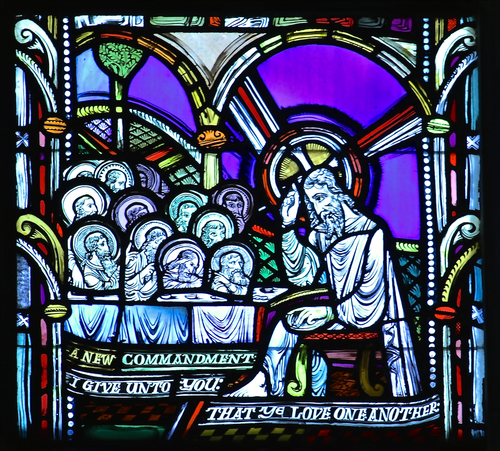
John 13:31-35 – Love One Another

Stained glass by Edgar Miller (1899-1993)

When he was gone, Jesus said, “Now the Son of Man is glorified, and God is glorified in him. If God is glorified in him, God will glorify the Son in himself, and will glorify him at once.

“My children, I will be with you only a little longer. You will look for me, and just as I told the Jews, so I tell you now: Where I am going, you cannot come.

“A new command I give you: Love one another. As I have loved you, so you must love one another. By this everyone will know that you are my disciples if you love one another.” (New International Version)

The Church was formed to represent Christ on earth. The Church is a new community of believers in Jesus, called and empowered by the Holy Spirit for mission.

Christianity was never intended to be just a personal faith; it was designed by God to be the community of the redeemed. Christian community is vital to every individual’s faith.

“No one can have God for his Father who does not have the Church for his Mother.”

John Calvin (1509-1564)

Loyalty and commitment to God translates to having a dedicated and devoted spirit to one another in the church. 

One of the last commands Jesus gave to his disciples before he went to the cross was to “love one another.” The Old Testament instructed the Israelites to love each other (Leviticus 19:18). Yet, Jesus gives new meaning to the command through four distinctions of loving one another.

A New Model of Love: Jesus

Our Lord’s life and teaching gave new meaning to the command to love each other. Notice what Jesus did in the Upper Room just before giving the command to love one another:

It was almost time for the Jewish Passover festival. Jesus knew that the time had come for him to leave this world and go back to the Father. Jesus had always loved the people in the world who were his. Now was the time he showed them his love the most.

Jesus and his followers were at the evening meal. The devil had already persuaded Judas Iscariot to hand Jesus over to his enemies. (Judas was the son of Simon.) The Father had given Jesus power over everything. Jesus knew this. He also knew that he had come from God. And he knew that he was going back to God. So while they were eating, Jesus stood up and took off his robe. He got a towel and wrapped it around his waist. Then he poured water into a bowl and began to wash the followers’ feet. He dried their feet with the towel that was wrapped around his waist. (John 13:1-5, ERV)

Jesus modeled a service-oriented love of compassionately meeting the need of another, regardless of who that person is. It is instructive to us that Jesus washed the feet of Judas Iscariot, along with all the other disciples. 

Christ died for us while we were still sinners. This demonstrates God’s love for us.

Romans 5:8, GW

We are to love everyone in the community of saints, and not just our friends or the ones we like. Loving one another also means we will be realistic in understanding that community is messy and downright hard work.  

A New Motive: Christ First Loved Me

Jesus has loved us with a love that took care of our brokenness once for all. Because of that love, we are now motivated to love each other. John would later say in his first epistle: 

God showed his love for us by sending his only Son into the world, so that we might have life through him. This is what love is: it is not that we have loved God, but that he loved us and sent his Son to be the means by which our sins are forgiven. Dear friends, if this is how God loved us, then we should love one another. (1 John 4:9-11, GNT)

Love is an attitude and a frame of mind. The motivation for the Christian is different than anyone else’s motive:  We are so thankful for Christ’s love to us, that we cannot help but extend that same love to one another in the church. 

This kind of love transcends human willpower. This is love as a grateful response for the grace shown us in Christ.

A New Motivator: The Holy Spirit

The Spirit energizes and enables us to love each other. Jesus also said in the Upper Room: 

If you love me, you will do as I command. Then I will ask the Father to send you the Holy Spirit who will help you and always be with you. (John 14:15-16, CEV)

There are times when we may lack the ability or spiritual energy needed for the work of loving each other. It is in those times that we need to check our spiritual electrical box to make sure we haven’t tripped a breaker by trying to live the Christian life on our own strength. 

We need the Spirit. The Spirit gives us the zeal we need to love one another. 

We typically don’t do anything in life unless we have the motivation for it. The Spirit is like the Christian’s personal trainer – encouraging, exhorting, getting in our face, comforting, and spurring us – toward the new way of love. 

A New Mission: World Evangelization

All people will know we are Christ’s disciples if we love one another. The way we treat each other in the church is foundational and fundamental to the mission of loving our neighbors who don’t know Jesus.

“Mission is putting love where love is not.”

St. John of the Cross (1542-1591)

When the church has a healthy and even supernatural dynamic of loving one another, they joyfully proclaim the good news to every person that Jesus is the answer to the terrible brokenness of this world.

Community is necessary to mission. Lesslie Newbigin (1909-1998) was a British missionary to India for forty years. After retiring and returning to Britain, he found his homeland was very different than when he left. He was astounded to find Britain had become very less Christian and was now predominantly un-Christian. It was clearly a post-Christian society. What to do about it? Here is Newbigin’s response:

“I have come to feel that the primary reality of which we have to take account in seeking for a Christian impact on public life is the Christian congregation.  How is it possible that the gospel should be credible, that people should come to believe that the power which has the last word in human affairs is represented by a man hanging on a cross? 

I am suggesting that the only answer, the only hermeneutic of the gospel [the only way society can discern who Jesus is] is a congregation of men and women who believe it and live by it. I am, of course, not denying the importance of the many activities by which we seek to challenge public life with the gospel – evangelistic campaigns, distribution of Bibles and Christian literature, conferences, and even books such as this one. But I am saying that these are all secondary, and that they have power to accomplish their purpose only as they are rooted in and lead back to a believing community.”

Conclusion

The implications of community for our faith are significant. If we keep other Christians at a distance and give them the stiff arm, we are really giving God the stiff arm. Jesus identifies so closely in love to his people, that to love them is to love him.

The late African-American preacher E.V. Hill told the following story about an experience with a white Christian leader in the 1950s:

“As a freshman at Prairie View College (part of the Texas A&M system) I was actively involved and was one of two students selected to go to our denomination’s annual meeting in Memphis. The trip through the South was by car—three whites and two blacks traveling together. I had no idea how we’d eat or how we’d sleep. So great was my anxiety and hatred over how the trip might turn out that I almost backed out entirely …. In all my experience I had never seen a white man stand up for a black man and never felt I would. 

But then Dr. Howard, the director of our trip and a white man spoke up. ‘We’ll be traveling together,’ he said. ‘If there isn’t a place where all of us can eat—none of us will eat. If there’s not a place all of us can sleep—none of us will sleep.’ That was all he said, but it was enough! For the first time in my life, I had met a white man who was Christian enough to take a stand with a Christian black man.” 

May the Spirit give us the courage together to love one another.

Gracious Lord, I pray for those who will believe in you through the good news of forgiveness in Christ. I pray that all of them may be one just as you are one. May they be brought to complete unity to let the world know that you sent the Son, Jesus, and have loved them even as you have loved us. Righteous God, may you help us make you known in the world so that the love you have for us may be in them through the cross of Christ. Amen.


John 13:1-17 – Stinky Feet Love

Jesus washing the feet of the disciples, by Leszek Forczek

Now before the festival of the Passover, Jesus knew that his hour had come to depart from this world and go to the Father. Having loved his own who were in the world, he loved them to the end. The devil had already put it into the heart of Judas son of Simon Iscariot to betray him. And during supper Jesus, knowing that the Father had given all things into his hands, and that he had come from God and was going to God, got up from the table, took off his outer robe, and tied a towel around himself. Then he poured water into a basin and began to wash the disciples’ feet and to wipe them with the towel that was tied around him. He came to Simon Peter, who said to him, “Lord, are you going to wash my feet?” Jesus answered, “You do not know now what I am doing, but later you will understand.” Peter said to him, “You will never wash my feet.” Jesus answered, “Unless I wash you, you have no share with me.” Simon Peter said to him, “Lord, not my feet only but also my hands and my head!” Jesus said to him, “One who has bathed does not need to wash, except for the feet, but is entirely clean. And you are clean, though not all of you.” For he knew who was to betray him; for this reason, he said, “Not all of you are clean.”

After he had washed their feet, had put on his robe, and had returned to the table, he said to them, “Do you know what I have done to you? You call me Teacher and Lord—and you are right, for that is what I am. So, if I, your Lord and Teacher, have washed your feet, you also ought to wash one another’s feet. For I have set you an example, that you also should do as I have done to you. Very truly, I tell you, servants are not greater than their master, nor are messengers greater than the one who sent them. If you know these things, you are blessed if you do them. (New Revised Standard Version)

One of the reasons I like Jesus so much is that he loves me as I am, and not as I should be. Jesus loves me even with my dirty stinky feet, my herky-jerky commitment to him, and my pre-meditated sin. Jesus loved even Judas and washed his feet. Jesus serves people because they need his love, and not so that they will love him back.

I read about a man who lives in Paris. His wife has Alzheimer’s. He was an important businessman, and his life was filled with busyness. Yet, he said when his wife fell sick, “I just couldn’t put her into an institution, so I kept her. I fed her. I bathed her. Through the experience of serving my wife every day, I have changed. I have become more human. The other night, in the middle of the night, my wife woke me up. She came out of the fog for a moment, and she said, ‘Darling, I just want to say thank you for all you are doing for me.’ Then she fell back into the fog. I wept for hours to know this grace.”

Sometimes Christ calls me to love people who either cannot or will not love me in return. They live in the fog of some sort of disability, depression, poverty, or common spiritual blindness. As I serve them, I may only receive brief glimpses of gratitude. Just as Jesus loves me within my own spiritual confusion, so I desire to continue loving others as they walk through whatever fog they are in.

Lord willing, my life will be useful through my words and my witness. If God desires, my life will bear fruit through my prayers, my service, and my love. Yet, the usefulness of my life is God’s concern, not mine; it would be indecent of me to worry about that. I simply desire follow my Lord’s example.

Neither many Christians nor churches wash feet anymore. So, the following is today’s Gospel lesson put in a slightly different context:

It was just before the biggest and most important feast of the year, Passover. Jesus knew that it was finally the time for him to face the cross and die for the world’s sins. Having spent the past three years loving his followers, he now wanted to leave them with a clear demonstration of his love that they would never forget.

The evening meal was being served, and the devil had already gotten a hold of Judas Iscariot to betray Jesus to those who wanted him dead and gone. But it was all according to plan. Jesus knew that his heavenly Father had given him all authority because he was his Son, and he was ready to do what needed to be done to secure salvation and return to his rightful place at his Father’s right hand.  So, Jesus got up from the meal, rolled up his sleeves, put an apron on, and ran a sink full of hot water.  Jesus told the servants to take the night off, and he began taking the dishes from the dinner table and started washing them, taking care to do all that waiters and dishwashers would do.

When Jesus came to take care of Simon Peter’s dishes and serve him dessert and coffee, Peter said to him, “Lord, are you going to serve me?” Jesus replied, “I know you do not understand why I am doing this since it seems like something that is beneath me to do, but later you will look back on this night and understand completely what I am doing.”

“No,” said Peter, “this is not right – you are the Master, and this is not what a well-respected rabbi does – you are only disrespecting yourself and making us all look foolish. You are not going to take my dishes and wash them.”

Jesus answered, “Unless I wash these dishes and serve you, you are not going to be able to follow me anymore and you will have no part of what I am doing in this world.”

“Well, then, Lord,” Simon Peter replied, “if that is the way it really is, then don’t just wash the dishes – come on over to my place and clean out the fridge and scrub the kitchen floor!”

Jesus answered, “A person who has had a decent meal needs only to wash the dishes so that he can enjoy the freedom of hospitable relationships with me and those around him.  And all of you here have had a decent meal, though not every one of you.”  For Jesus knew that Judas was only picking at his food in anticipation of betraying him.

When Jesus was all done washing the dishes and serving his disciples, he took his apron off, rolled his sleeves back down, and returned to the table.  He looked them all squarely in the eye and said, “Do you understand what I just did for you?  You call me ‘Teacher’ and ‘Master,’ and rightly so, for that is exactly what I am.  So, now that I, your Master, and your Teacher have washed your dishes, you also should wash one another’s dishes.  I have set you an example that you should do as I have done for you.  I am telling you the plain truth that no follower is greater than the one he follows, nor is a preacher greater than the one he preaches about.  Now that you know that it is your task in this life to provide humble loving service, you will have God’s stamp of approval on your life if you quit thinking about how to possess and use power for your own purposes and start thinking about how to use the authority I am giving you to love other people into the kingdom of God.

Loving Lord Jesus, how shocking it was for your disciples to be served by you in such a humble manner.  But I cannot be spiritually cleansed unless I allow you to love me in an almost embarrassing fashion.  Help me not to be so proud that I neither refuse your humble loving service toward me, nor neglect to offer that same kind of service to others.  May love be the word, the idea, and the action that governs my every motivation and movement in your most gracious Name, I pray.  Amen.

Song of Songs 5:2-6:3 – I Am My Beloved’s

Song of Songs by German illustrator Egon Tschirch, 1923

Beloved

I was asleep, but my heart was awake.
    It is the voice of my beloved who knocks:
    “Open to me, my sister, my love, my dove, my undefiled;
    for my head is filled with dew,
    and my hair with the dampness of the night.”
I have taken off my robe. Indeed, must I put it on?
    I have washed my feet. Indeed, must I soil them?
My beloved thrust his hand in through the latch opening.
    My heart pounded for him.
I rose up to open for my beloved.
    My hands dripped with myrrh,
    my fingers with liquid myrrh,
    on the handles of the lock.
I opened to my beloved;
    but my beloved left, and had gone away.
My heart went out when he spoke.
    I looked for him, but I didn’t find him.
    I called him, but he didn’t answer.
The watchmen who go about the city found me.
    They beat me.
    They bruised me.
    The keepers of the walls took my cloak away from me.

I adjure you, daughters of Jerusalem,
    If you find my beloved,
    that you tell him that I am faint with love.

Friends

How is your beloved better than another beloved,
    you fairest among women?
How is your beloved better than another beloved,
that you do so adjure us?

Beloved

My beloved is white and ruddy.
    The best among ten thousand.
His head is like the purest gold.
    His hair is bushy, black as a raven.
His eyes are like doves beside the water brooks,
    washed with milk, mounted like jewels.
His cheeks are like a bed of spices with towers of perfumes.
    His lips are like lilies, dropping liquid myrrh.
His hands are like rings of gold set with beryl.
    His body is like ivory work overlaid with sapphires.
His legs are like pillars of marble set on sockets of fine gold.
    His appearance is like Lebanon, excellent as the cedars.
His mouth is sweetness;
    yes, he is altogether lovely.
This is my beloved, and this is my friend,
    daughters of Jerusalem.

Friends

Where has your beloved gone, you fairest among women?
    Where has your beloved turned, that we may seek him with you?

Beloved

My beloved has gone down to his garden,
    to the beds of spices,
    to pasture his flock in the gardens, and to gather lilies.
I am my beloved’s, and my beloved is mine.
    He browses among the lilies. (World English Bible)

God is love. God rejoices over you. 

There is a reason why so many people in this cruel and calloused world are unloving and unkind: They are unaware that God loves them. 

If we neither believe nor know God’s infinite love for us, then our words and our actions will reflect more of hate than love. God really truly does love you and me. This is crucial. Do not forget this. Believe it. Live it. Enjoy it. Know it. Tell it to yourself until you are thoroughly bathed in it, because it is more wonderful than any ‘70’s sappy love song could ever describe it.

I believe the small book of Solomon’s Song of Songs too often gets a weird hermeneutical spin of literalism from modern-minded simpletons. For nearly all of history, this poetic ode to love was understood as an allegory of divine love for humanity – and the believer’s reciprocal response.

When the beautiful text of Scripture says I am my beloved’s and my beloved is mine, and that his desire is for me, it is a wonderful way of communicating that God’s love for us is not abstract, distant, or detached. (Song of Songs 6:3, 7:10) 

The truth is: We belong to God. The Lord’s desire is for you and me. God has an intense and overpowering longing for you. Let the deep desire of God for you shape and form your thoughts so that fear is replaced with faith; loneliness with enjoyment; the fickle nature of others with satisfaction; praying as duty with praying because I want to be with the God who loves me so much.

Oh, how we need a vision of God singing over us with joy! Yes, God loves you that much! Grab a hold of what the prophet says:

The Lord will take delight in you with gladness.
    With his love, he will calm all your fears.
    He will rejoice over you with joyful songs.

Zephaniah 3:17, NLT

Even the most unlovely of people are made lovely through God’s persistent and pursuing love for them. You are being wholly seen every single day by the infinite gaze and eternal compassion of God, who watches our every step with delight.

Christianity does not “happen” simply by knowing some beliefs about God, as if it is a mere contractual signing-off on a doctrinal statement. Rather, Christianity “happens” when individuals experience the white hot burning love of God in Jesus Christ. 

Jesus came not only for those who skip church and only occasionally read their Bibles. Christ came also for the hard-hearted prick, the immoral adulterer, the strung-out addict, the terrorist, the murderer, and for all those caught in bad choices and failed relationships. 

“I have not come to call respectable people, but outcasts.” (Matthew 9:13, GNT)

“Go out and train everyone you meet, far and near, in this way of life.” (Matthew 28:19, MSG)

“You will be witnesses for me.” (Acts 1:8, GNT)

“Love each other in the same way that I have loved you.” (John 13:34, GW)

All Christ’s words and actions are because of the Lord’s intense desire to love the world, and to love it through the divine beloved people of God.

God’s love is never based on our performance, or how good we look to others; it is never conditioned by our moods. The love of God only looks longingly at you and me with the potential of what we can become in Christ and cares for us as we are. It is a world-altering revolutionary thought that God loves me as I am and not as I should be. 

God loves me as I am, and not as I should be.

God has shown us how much he loves us—it was while we were still sinners that Christ died for us! (Romans 5:8, GNT)

Despite the erosion of church attendance, the majority of people still believe God exists. Conversely, however, many people do not believe God really loves them. We are in a crisis of love. People need to know the God who is pure Love. 

Christianity never begins with what we do for God to make ourselves lovely. Christianity always starts with what God has done for us, the great and wonderful love that exists for us in Christ Jesus.

It wasn’t so long ago that we ourselves were stupid and stubborn, easy marks for sin, ordered every which way by our glands, going around with a chip on our shoulder, hated and hating back. But when God, our kind and loving Savior God, stepped in, he saved us from all that. It was all his doing; we had nothing to do with it. He gave us a good bath, and we came out of it new people, washed inside and out by the Holy Spirit. Our Savior Jesus poured out new life so generously. God’s gift has restored our relationship with him and given us back our lives. And there’s more life to come—an eternity of life! You can count on this. (Titus 3:3-8, MSG)

All the wrong turns in the past, the mistakes and the moral lapses, everything that is ugly or painful, all melts in the light of God’s acceptance and love for us.

If the consuming passion of Christ’s followers is not showing God’s love, then we have lost both our mission and our first love of Jesus. Perhaps we must let time evaporate, as we bow at the foot of the cross, and experientially know the great love of God in Christ for us and for the world.

May it be so, to the glory of God.

1 Corinthians 12:27-31 – Diversity and Unity

All of you together are Christ’s body, and each of you is a part of it. Here are some of the parts God has appointed for the church:

first are apostles,
second are prophets,
third are teachers,
then those who do miracles,
those who have the gift of healing,
those who can help others,
those who have the gift of leadership,
those who speak in unknown languages.

Are we all apostles? Are we all prophets? Are we all teachers? Do we all have the power to do miracles? Do we all have the gift of healing? Do we all have the ability to speak in unknown languages? Do we all have the ability to interpret unknown languages? Of course not! So, you should earnestly desire the most helpful gifts.

But now let me show you a way of life that is best of all. (New Living Translation)

“Ubuntu” is an African Zulu word for humanity. It roughly translates into English as, “I am because we are.”

In whatever way it is to be translated, the idea behind ubuntu is a belief of being connected in a universal bond of humanity. So, an authentic individual human is part of a larger and more significant relational, communal, societal, environmental, and spiritual world.

That is precisely what today’s New Testament lesson is all about. Believers in Jesus are connected to one another, as well as having a human bond with all people, since everyone is created in the image and likeness of God.

“We are made for goodness. We are made for love. We are made for friendliness. We are made for togetherness. We are made for all of the beautiful things that you and I know. We are made to tell the world that there are no outsiders. All are welcome: black, white, red, yellow, rich, poor, educated, not educated, male, female, gay, straight, all, all, all. We all belong to this family, this human family, God’s family.”

Desmond Tutu

So, then, we are all to use whatever spiritual gifts and divinely given abilities for the common good of everyone. Just like the triune G-d who is both unity and diversity, and just as an individual human body has many parts yet one person, so also believers are diverse in every way yet thoroughly unified as one Body of Christ.

The Church at Corinth had divided into special interest groups who followed a particular person. Each was continually lobbying for what they wanted, rather than seeking to work together as one temple of G-d. And each group believed their gifts were superior.

Paul identified some spiritual gifts – neither to give an exhaustive list, nor to rank them in importance – but to clarify that all these diverse people and their G-d-given skills are to be used for the building up of the congregation. Ideally, the people’s gifts are to flow together in common worship, fellowship, encouragement, and mission:

  • Apostles. There are two kinds. Capital “A” Apostles are the original ones. They are set apart as those who saw the Lord and were his disciples. Little “a” apostles are “sent ones” or missionaries, proclaiming the gospel in word and deed to those who need to hear.
  • Prophets. These are folks possessing a function and gift of encouragement, building up the church through picturing a special future for the ministry of the community.
  • Teachers. Explaining sound doctrine through careful application of Scripture to daily life and ministry is the function of a biblical teacher.
  • Miracle workers and healers. Yes, miracles and healing happened and still occur. These are believers with an unusual gift of faith who are able to discern with spiritual eyes what others tend not to see.
  • Helpers. A necessary element of any Christian fellowship are people who serve in all kinds of capacities: giving to others’ needs; doing acts of mercy and benevolence; and attending to whatever physical needs Christians are faced with.
  • Leaders. Men and women who provide guidance and steer the church in directions they ought to go. They are skilled administrators, able to give wise counsel.
  • Speakers in tongues (languages). It must be borne in mind that this gift is not an end in itself. It is a Spirit-given ability to help include people. Christianity was never intended to be an exclusive club of Jews or devoted solely to a particular class or race. The gospel is meant for every type of person.

Reflecting on all these gifts and abilities within the Church, Paul rattled off a flurry of staccato-like rhetorical questions. The point is to lift up all the gifts as equally needed and appreciated. The ghettoized Corinthian Church needed an understanding of this. Their individual identities were too wrapped up in their abilities, rather than in Christ.

Keep in mind that today’s New Testament lesson immediately precedes the great ode to love of chapter 13. It is the primacy and permanency of love which holds everyone together. Love is the supreme end of all the speaking and serving gifts.

The most excellent way of engaging our giftedness is expressing it with the love of G-d in Christ Jesus. Anything less than this is a mere shadow of the gospel and severely truncates Christian mission and worship.

What’s more, not only does every local church need to function in unity through diverse exercise of gifts with the individual members, so every local church must cooperate and live in harmony with all other churches. Yes, if you are reading ecumenism in this, you are correct. An ecumenical spirit is a generous spirit which pays attention to other believers in our communities, countries, and throughout the world.

“Unity, not uniformity, must be our aim. We attain unity only through variety. Differences must be integrated, not annihilated, not absorbed.”

Mary Parker Follett

If leaders, teachers, helpers, healers, church planters and encouragers are all doing their jobs, according to the grace given them, then working together with believers everywhere simply happens. And it never seems weird to extend basic Christian mercy and care to believers everywhere – no matter whether they are in full agreement with our doctrinal statements, or not.

When Jesus prayed for all potential believers to be one as G-d is one, he wasn’t thinking of special interest groups, separated Christianized ghettos, nor some believers as being more right or special than other believers.

Diversity, unity, equity, inclusion, and most of all, love, are what characterizes the Lord. It should characterize us, too.

Methinks the Zulu were on to something with the concept of ubuntu. A person is most fully a person through other people. It seems to me it is high time to affirm the basic humanity in others through appreciating their unique difference.  

You and I are more than independent individuals. Our shared humanity is a quality we owe to each other.

I am because we are.

Lord G-d almighty, Creator of the universe, who made us different from one another in myriad ways we can see and in more ways we shall never know yet made us all in your image; fill our hearts with your love and our minds with your wisdom, that we may truly become brothers and sisters of your only Son, our Savior Jesus Christ our Lord; who lives and reigns with you in the unity of the Holy Spirit, one God, now and forever. Amen.