Whoever Believes (John 3:14-21)

Interview Between Jesus and Nicodemus, by James Tissot (1836-1902)

Just as Moses lifted up the snake in the wilderness, so the Son of Man must be lifted up,that everyone who believes may have eternal life in him.”

For God so loved the world that he gave his one and only Son, that whoever believes in him shall not perish but have eternal life. For God did not send his Son into the world to condemn the world, but to save the world through him. Whoever believes in him is not condemned, but whoever does not believe stands condemned already because they have not believed in the name of God’s one and only Son. 

This is the verdict: Light has come into the world, but people loved darkness instead of light because their deeds were evil. Everyone who does evil hates the light, and will not come into the light for fear that their deeds will be exposed. But whoever lives by the truth comes into the light, so that it may be seen plainly that what they have done has been done in the sight of God. (New International Version)

For many, the truth about God’s purposes in Christ is confusing, even troubling. It was for Nicodemus. And even though there many today who simplify the exchange between Jesus and Nicodemus with a single Bible verse of John 3:16, taking a good look at the Gospel of John puts most of us with Nicodemus.

Nicodemus, a learned Jewish scholar, a Pharisee, found Christ’s words both confusing and troubling because it required him to let go of everything he understood – to let go and become like a newborn baby, receiving and discovering the world on new and different terms. In other words, Nicodemus had to unlearn some things before he could learn truth.

There are some things that are hard to grasp, not because they are so intellectually challenging, but because those things ask a lot of us, demanding our very lives. And so, we don’t so much want to understand; it would require a radical change.

But why would anyone not want to understand the good news that God so loved the world that gave the Son so that we may believe and have eternal life? Because we would then have to contend with the ways Jesus describes himself.

Jesus likened himself to the serpent that Moses lifted up in the desert (John 3:14; Numbers 21:4-9). In that story of Moses in the Old Testament book of Numbers, God sent poisonous snakes into the Israelite camp as punishment for the people’s incessant complaining against God.

Then, when the people repented, God told Moses to make a bronze snake, put it on a pole, and lift it up, so that anyone bitten by one of the poisonous snakes could see it and live. Jesus likened himself to the story. In the same way the bronze snake was lifted on a pole, Jesus explained that so must the Son of Man be lifted up, or exalted high above the people.
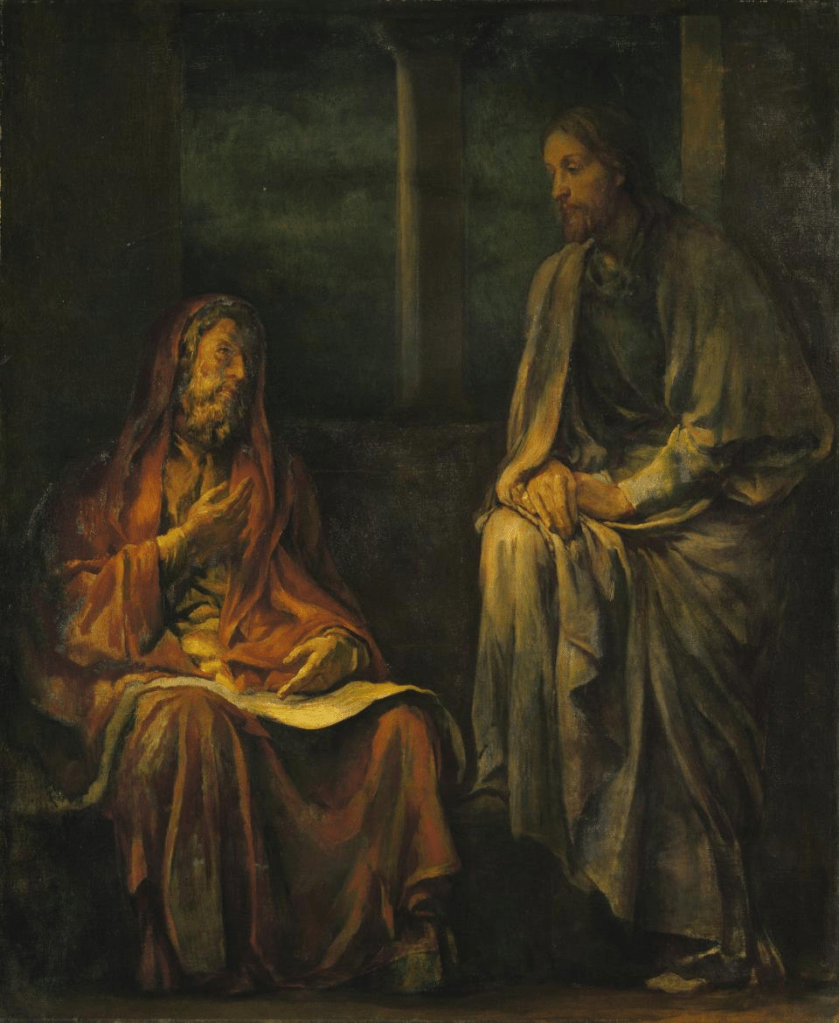
Visit of Nicodemus to Christ, by John La Farge, 1880

In the typical language of the Apostle John, using double meanings to a single concept, he meant to communicate that Jesus would be physically lifted onto the cross, above the people; and also that Jesus would be lifted up by God as the exalted One above all creation. (John 8:28; 12:32)

Just as the ancient Israelites were facing death because of their sin, and deliverance because of God’s action through Moses, so people everywhere in every age face the consequences of their sinful complaining; yet through the action of God through Christ’s crucifixion, resurrection and ascension, they can look up to the exalted and glorified Lord and receive deliverance from sin, death, and hell.

There is more to looking up at the lifted One than a mere incline of the head and eyes. In modern terms, we would refer to the sheer action of looking as an intellectual assent to faith. The Apostle John, however, means to have us believe, not simply acknowledge.

Jesus did not tell Nicodemus to simply acknowledge him as Savior, to accept him into the heart, and so, be saved. No, this was an encounter that left an intelligent man and an accomplished scholar scratching his head in bewilderment as he went back out into the darkness.

Today’s Gospel lesson is a story about how any one of us might reject the light offered to us because of the way it exposes what is dark within us. Therefore, to believe requires ultimate trust in another. It isn’t to acknowledge that Jesus was real and had an actual ministry on earth; it’s more than believing something happened in history in the ancient world of the first century.

To believe is to let our own lives be transformed by the Jesus we encounter in this story. And here is what that means:

  1. Realizing and becoming aware of the ways we are complicit in and benefit from having our loyalties elsewhere, other than Jesus. To believe demands us answering the question: Whom shall you serve?
  2. Placing our ultimate trust, allegiance, and loyalty in Jesus Christ. To believe begs the question: To whom will you commit all that you have, and all that you are?
  3. Forsaking all other competing loyalties and “gods,” including both secular and religious deities. To believe means a single-minded devotion, which asks of us all: To whom and to what will you forsake in order to embrace Jesus?
  4. Confronting inconvenient truths of our own personal values which clash with Christ’s ideals of righteousness. To believe presses us to answer the question: To whom and for what are you truly living for?
  5. Willing to die to self and to anything that would hinder knowing Jesus and him crucified, risen, ascended, and coming again. To believe forces us to ask ourselves: Am I willing to die for Jesus?

While there is nothing in this world worth killing for, there are things worth dying for. The lifting up of Jesus lets us know that the true life God has promised us is not the life that we can secure for ourselves through self-interest, caution, and theological debate.

Most merciful God,
we confess that we have sinned against you
in thought, word, and deed,
by what we have done,
and by what we have left undone.
We have not loved you with our whole heart;
we have not loved our neighbors as ourselves.
We are truly sorry and we humbly repent.
For the sake of your Son Jesus Christ,
have mercy on us and forgive us;
that we may delight in your will,
and walk in your ways,
to the glory of your Name. Amen.

Spiritual Blessings (Ephesians 1:7-14)

The Trinity, by Ukrainian artist Feodosiy Humeniuk, 1981

In him we have redemption through his blood, the forgiveness of our offenses, according to the riches of his grace that he lavished on us in all wisdom and insight.He did this when he revealed to us the mystery of his will, according to his good pleasure that he set forth in Christ, toward the administration of the fullness of the times, to head up all things in Christ—the things in heaven and the things on earth.

In Christ we too have been claimed as God’s own possession, since we were predestined according to the purpose of him who accomplishes all things according to the counsel of his will so that we, who were the first to set our hope on Christ, would be to the praise of his glory. And when you heard the word of truth (the gospel of your salvation)—when you believed in Christ—you were marked with the seal of the promised Holy Spirit, who is the down payment of our inheritance, until the redemption of God’s own possession, to the praise of his glory. (New English Translation)

The Apostle Paul wrote this letter to the Church at Ephesus. Believe it or not, the first chapter of Ephesians  comprises only two sentences in the Greek language for which he originally wrote. Ephesians 1:3-14 are one sentence, and Ephesians 1:15-23 is the other sentence. Thankfully, understandably, and mercifully, English translators have created multiple sentences for us so that we can better make sense of the text. 

It’s almost as if Paul was so excited to talk with the Ephesian believers about who they are in Jesus Christ and what they possess in him that he blurted out in writing with a flurry of enthusiasm and excited fervor without stopping to take a breath or a break.

Paul stacked word after significant word, on top of each other, in order to communicate the spiritual blessings that believers in Christ enjoy. Redemption, forgiveness, grace, wisdom, insight, predestination, faith, inheritance, and salvation are just some of the blessings given to those in union with Jesus Christ.

And, if that wasn’t enough, God has also graciously given us the Holy Spirit, the Paraclete, the one who comes alongside and helps us to live into the blessings we possess. Because God the Father predestined and elected us, God the Son redeemed us, and God the Spirit took possession of us, we are delivered from sin, death, and hell.

It’s as if we came to Christmas day expecting a package of underwear, and found instead a bunch of big boxes with some of the most lavish and expensive gifts we’ve ever seen!  This says much more about the giver than it says about us.

It was according to God’s good pleasure in Christ through the Spirit that believers in Jesus have such privileges.  Like the parent who sits back and watches the unpackaging of presents happen with great joy, so God delights and is pleased with the gifts given to us. The Lord absolutely delights in watching us unpack them and use them in this life.

These gifts, these blessings, are all lavishly provided because they are extensions of God, as if the Lord meticulously handmade each present with us in mind.

Throughout the entirety of Holy Scripture, all the stories and narratives, teachings and writings, are about God. The Lord of all creation is both the subject and object of each book of the Bible. Every good thing we have in this life is because of God’s gracious presence and power in this world.

Each positive experience we have is a direct result of God’s steadfast love toward people. All good gifts come from a good God who is delighted and pleased to give them.

Not a one of us purchased our own gifts and stuck them under the tree. God bought them all with the precious blood of Jesus and sent the Spirit to deliver them to us. 

Consider setting aside time today or tomorrow in a quiet place, and reflect on just one of the words in today’s New Testament lesson. Think about redemption or forgiveness, salvation, or grace, or any of the words which grab you.

Say the word repeatedly and meditatively, quietly and loudly, thoughtfully and with flavor. Consider what God did to bring you that gift. Contemplate the way(s) in which you have received the gift. 

Plan one way in which you might share your gift with another person. And make sure to give glory and praise to God for the grace lavishly given to you.

May your meditation lead to a deeper appreciation of what God has done for you; and may that revelation result in praise, honor, and glory to the One who accomplished so much on our behalf.

Gracious God, you have revealed and made known the way of deliverance from the power of darkness and brought me into your marvelous light. Help me to better understand all the ways you have acted on my behalf so that my life might reflect your grace and steadfast love to the world, through Jesus Christ, my Savior, in the enablement of the Holy Spirit. Amen.

Keeping Sacred Space Sacred (John 2:13-22)

Christ Casting Out the Money Changers, by Peter Gorban

The Passover of the Jews was near, and Jesus went up to Jerusalem. In the temple he found people selling cattle, sheep, and doves and the money changers seated at their tables. Making a whip of cords, he drove all of them out of the temple, with the sheep and the cattle. He also poured out the coins of the money changers and overturned their tables. He told those who were selling the doves, “Take these things out of here! Stop making my Father’s house a marketplace!” His disciples remembered that it was written, “Zeal for your house will consume me.” 

The Jews then said to him, “What sign can you show us for doing this?” Jesus answered them, “Destroy this temple, and in three days I will raise it up.” The Jews then said, “This temple has been under construction for forty-six years, and will you raise it up in three days?” But he was speaking of the temple of his body. After he was raised from the dead, his disciples remembered that he had said this, and they believed the scripture and the word that Jesus had spoken. (New Revised Standard Version)

It doesn’t take a Bible scholar to figure out that Jesus was upset. He quite literally came to the Jerusalem temple, whipped everyone into shape, and cleaned house. 

Cleaning house is what the season of Lent is really all about. This is the time of year for Christians to take a good hard look at the state of their hearts; it’s about shining light on the shadowy dark places, so that we can turn from all that hinders our relationship to Christ, and allow the presence of God to fill us and give us new life.

In the other Gospel accounts we discern why Jesus was upset. Matthew, Mark, and Luke each mention Jesus saying that the temple is to be a house of prayer, but the ones buying and selling in the temple courts were making it a den of robbers. (Matthew 21:12-16; Mark 11:15-18; Luke 19:45-47)

Two things were happening which angered Jesus: 

  1. Business was taking place in the Court of the Gentiles, thus pushing non-Jews out of being able to worship God.
  2. Those providing the service of sacrificial animals were charging exorbitant prices and gouging those who were just trying to offer a sacrifice during Passover. 

Disrespect of Gentiles, along with plain old greed, hindered prayer and worship for everyone seeking God. John, however, did not mention those reasons. He simply communicated that Jesus was downright mad over his Father’s house being turned into a market.

Orthodox depiction of Christ driving out the money changers

Jesus quoted from Psalm 69 saying, “Zeal for your house will consume me.” That particular psalm is a lament. The psalmist was grieving over the state of religion; it had degenerated into mindless empty ritual.

For Jesus, although worship was happening, he lamented and grieved over the state of people’s hearts, because they were far from God. The evidence was that people cared more about the presence of other people and animals than they cared about the presence of God.

Jesus stood in the Old Testament prophetic tradition of getting down to the heart of the matter (e.g. Amos 4:4-5; Hosea 5:6, 6:6). From a New Testament perspective, it is impossible for the blood of bulls and goats to take away guilt and shame.

Therefore, there is no longer any temple because Jesus has come. The temple represented God’s presence on earth. But now the temple is Jesus, who is God with us, and God’s presence on earth. With the sending of the Holy Spirit, the presence of Jesus continues to be alongside the Church. Believers are God’s temple, the continuing presence of Jesus on this planet.

This creates a problem for many people. It’s the age old predicament of caring more about the presence of other things rather than the presence of God. Jesus was not speaking to pagan kings or Gentile sinners; he spoke to people in the temple courts who professed and worshiped the name of God – but they did not seek the presence of God with all their hearts. The Lord was not their primary allegiance.

Jesus wants people to desire the presence of God more than anything else in the whole world – and to not hinder others from doing so, as well. In every aspect of life, the heart must be in it. And the heart needs to be in the right place, at home, at work, at church, in the neighborhood, and in everyplace we go and everything we do and say.

The Cleansing of the Temple, by Ippolito Scarzella (1550-1620)

Many of the religious folk of Christ’s day lost their true sense of purpose as God’s people. They neither perceived nor focused on God’s presence, but cared more about animals and sacrifices and making money and keeping their social positions secure. 

Christ not only extends grace and mercy through healing the needy of society; he also turns his burning love for the Father on those who would treat the sacred with sacrilege. There is a time for gentleness and meekness, and there is a time for zeal and action, done with flavor!

Jesus had a zero-tolerance policy toward using the representation of God, the temple, as the means to make money. As people from all over the Middle East poured into Jerusalem for the Passover, savvy marketers set up their wares. 

Knowing that not everyone could bring animals for sacrifice, the money-changers were more than ready to take advantage of the situation by providing sheep and cattle at inflated prices. The temple looked more like a marketplace than a worship space, and Jesus would have none of it.

Christ the Lord was consumed with zeal for his Father’s house. Jesus single-handedly took on the businessmen and drove them out of the temple courts with a homemade whip. Whereas the people seemed to settle for the status quo of secular Passover protocol, Jesus restored worship to its rightful place in the life of God’s people.

Jesus still has zeal for proper worship. As he did in the temple all those centuries ago, Christ rearranges the furniture and upsets how things have become. Like an extreme makeover, the Lord overturns tables designed for selfish gain and re-establishes a connection between us and God. He upholds holiness and righteousness so that you and I will have a clean and clear path of relationship with the sovereign God of the universe.

Sacred space is important, both as a physical room or building as well as in our own spiritual hearts. That space becomes the meeting place between us and God. The Lord wants a meaningful dialogue with us, and he will guard that place of connection with great zeal.

Christ Jesus, the one who zealously loves, you have gone before me and cleared the way for me to enter God’s presence. Thank you for your movement toward me, and your careful guarding of our relationship. May my time on this earth be an offering of praise and thanksgiving to you. Amen.

Shining the Light On Our Fears (Mark 9:2-8)

Six days later Jesus took Peter, James, and John, and brought them to the top of a very high mountain where they were alone. He was transformed in front of them, and his clothes were amazingly bright, brighter than if they had been bleached white. Elijah and Moses appeared and were talking with Jesus. 

Peter reacted to all of this by saying to Jesus, “Rabbi, it’s good that we’re here. Let’s make three shrines—one for you, one for Moses, and one for Elijah.” He said this because he didn’t know how to respond, for the three of them were terrified.

Then a cloud overshadowed them, and a voice spoke from the cloud, “This is my Son, whom I dearly love. Listen to him!” Suddenly, looking around, they no longer saw anyone with them except Jesus. (Common English Bible)

The transfiguration of Christ was a glorious experience on the mountain for those closest to Jesus. Yet, we are told that Peter, James, and John – the inner circle of Christ’s disciples – were terribly frightened.

Peter, always the extrovert of the group, and forever their mouthpiece, nervously babbled-on without making any sense because he was so nervous and afraid.

Have you ever wondered why Jesus would take three of his disciples with him to experience such an incredible vision? Why did Jesus show these men something so otherworldly that they nearly soiled themselves? 

I will tell you why I think Jesus put his close disciples in such a glorious, yet frightening, position as this:

Because the only way to see Jesus as our only hope, we must face our fears, insecurities, and anxieties, squarely, without hiding from them.

Jesus did not relieve their anxiety. He let his disciples feel the full impact of their fear. The glory of Christ shone show brightly that Peter, James, and John could not hide from what was happening to them, and could not avoid what was in their minds and hearts. 

Only through shining the light on the shadowy place of our fears and insecurities will we ever be able to accept that we need a savior. And that savior is Jesus, the light of the world, the Lord over fear, anxiety, and discouragement.

The invitation which Christ extends to us is to move further into our fears, face those fears, and sit awhile with our fears, so that we can see how desperately we need the Savior Jesus. 

No one seeks a savior when they don’t even believe they need deliverance from anything. “I’m just fine, thank you very much!” says the independently self-sufficient person among us. To seek salvation, for such a person, is an intensely personal affair; they will look within, not without. It will take quite the desperate situation for them to consult someone who knows the ways of the soul.

But the one who sees what is truly inside of them, and is aware of their fear of connection; the scary prospect of confrontation; the anxiety of what will happen; or, the discouragement of failure; this is the one who is then able to hear the voice of God, and listen to Jesus give the answer to our most pressing life issues, worries, and concerns.

Jesus Christ wants to change us from the inside-out. He helps us by showing us not to avoid the fears which cause us to be beside ourselves, but instead, to face those fears and confront the anxieties within. 

The bright light of God’s presence enables us to see very clearly all that is within us. And Christ’s intimate relationship with us assures us that change is possible. Then, the Holy Spirit comes and empowers us for transformation, so that we may shine, along with Jesus, and let the light help others, as well.

You and I are never alone; we always have the glorious presence of Christ with us as we walk through dark valleys and ascend high mountains. 

It is the wonderful existence and omnipresence of God, in Christ, through the Spirit, which makes all the difference. We were created for connection with the divine, not for separation and loneliness in our fears.

Glorious Christ, you love me with a grace and mercy which always has my best interests in mind. Help me through my most pressing fears and failures so that I might see your glory, hear your voice, and know your constant presence. Amen.