If You Ask a Question, Be Ready for the Answer (Mark 12:18-27)

The Pharisees and Sadducees Come to Tempt Jesus, by James Tissot (1836-1902)

Some Sadducees, who say there is no resurrection, came to him and asked him a question, saying, “Teacher, Moses wrote for us that if a man’s brother dies, leaving a wife but no child, the man shall marry the widow and raise up children for his brother. There were seven brothers; the first married and, when he died, left no children,and the second married the widow and died, leaving no children, and the third likewise; none of the seven left children. Last of all the woman herself died. In the resurrection, when they rise, whose wife will she be? For all seven had married her.”

Jesus said to them, “Is not this the reason you are wrong, that you know neither the scriptures nor the power of God? For when people rise from the dead, they neither marry nor are given in marriage but are like angels in heaven. And as for the dead being raised, have you not read in the book of Moses, in the story about the bush, how God said to him, ‘I am the God of Abraham, the God of Isaac, and the God of Jacob’? He is God not of the dead but of the living; you are quite wrong.” (New Revised Standard Version)

Two-thousand years ago, in the first century C.E. (Common Era) the Jewish Sadducees learned the hard way that trying to discredit Jesus in public with silly questions is a bad idea.

Somehow, probably in a back room and perhaps drinking too much wine, they came up with a story designed to show, once and for all, that Jesus was nothing but a hayseed yokel from the bumpkin village of Nazareth who believes in a crazy notion like resurrection.

The Sadducees wanted a very public and definitive display that Jesus was a backward hick, not worth the time of day. So, they concocted a bizarre hypothetical story meant to discredit the supernatural. 

The Sadducees went to the Old Testament, and pointed out in the law that if a man dies without having children, the brother must marry the widow, thus keeping the legacy and land of the dead man in his family. By conjecturing that if this were to happen seven times over, they posed a hypothetical question: Whose wife would she be among all the brothers at this supposed resurrection?

As they were snickering to themselves believing that they had demonstrated the absurdity of resurrection, Jesus turned the tables on the Sadducees. Here are some observational lessons from this Gospel reading for today:

  1. Think again before you try and trip-up Jesus with philosophically ethereal questions.
  2. Consider that you will receive a rebuke from Jesus for being ignorant, mistaken, and wrong, if you try to posture yourself and control how a conversation with him ought to go.
  3. Be aware that Abraham, Isaac, Jacob, and Jesus are all alive. The Sadducees, however, no longer exist.
  4. Realize that Jesus will take the time and attention to listen and give feedback – maybe the kind you weren’t looking for.
  5. Understand that many things we get hung up on, Jesus doesn’t – and what Jesus sticks on, we may act like Teflon and let it slide.

And the lessons could keep coming, because there is always something to learn and discover when being with Jesus.

To deny resurrection is to deny Jesus. Christ died. He’s now alive. Hence, there is a resurrection. More than that, because Christ lives, others live. This is the Christian’s hope. 

I fully understand plenty of people don’t believe in resurrection. That’s their prerogative. I will simply point such a person no further than their own mind and heart. “Search your feelings,” as the Jedi would say, “What do they tell you?” The evidence you need, you already have.

And this was the penultimate lesson of Jesus to the inquisitive Sadducees. They already had the answer to their question for Jesus. It was right under their noses the entire time – right their in the law that they valued so highly. They just plain didn’t see it.

You already have everything you need for life and godliness in this present evil age. There’s no need to play philosophical games with Jesus.

One of the great sages of the last century, Dorothy from The Wizard of Oz, wisely said:

“If I ever go looking for my heart’s desire again, I won’t look any further than my own backyard. Because if it isn’t there, I never really lost it to begin with.”

Resurrection has always been there because God has always been around – even when we don’t see, perceive, or acknowledge the divine. Just because one may not believe in life arising from death, doesn’t mean it isn’t there or doesn’t exist.

It probably would not be a good idea to procrastinate the inevitable end-of-life scenario that awaits us all. Anytime is the right time to do a bit of personal funeral planning. Yet, if we mire it all with the esoteric hypothetical questions about what would happen in the most far-fetched of scenarios, methinks God is big enough and smart enough to see through our puny charade.

Better to ponder what is truly within your own soul, and how Jesus might already be present within and around all things, without us even knowing it. 

A good place to start in peering within is to give a straightforward honest reading of the New Testament Gospels and discover what resonates deeply with you about the person and work of Jesus.

Feel free to question Jesus about anything you want; just brace yourself for what kind of answer you might receive.

Jesus Shows Up (John 20:19-31)

The Doubt of St. Thomas, by He Qi

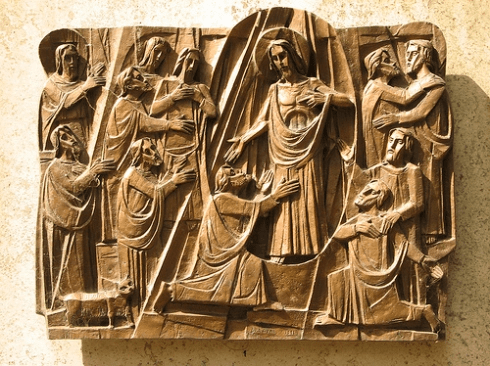
It was still the first day of the week. That evening, while the disciples were behind closed doors because they were afraid of the Jewish authorities, Jesus came and stood among them. He said, “Peace be with you.”After he said this, he showed them his hands and his side. When the disciples saw the Lord, they were filled with joy.Jesus said to them again, “Peace be with you. As the Father sent me, so I am sending you.”Then he breathed on them and said, “Receive the Holy Spirit.If you forgive anyone’s sins, they are forgiven; if you don’t forgive them, they aren’t forgiven.”

Thomas, the one called Didymus, one of the Twelve, wasn’t with the disciples when Jesus came.The other disciples told him, “We’ve seen the Lord!”

But he replied, “Unless I see the nail marks in his hands, put my finger in the wounds left by the nails, and put my hand into his side, I won’t believe.”

After eight days his disciples were again in a house and Thomas was with them. Even though the doors were locked, Jesus entered and stood among them. He said, “Peace be with you.” Then he said to Thomas, “Put your finger here. Look at my hands. Put your hand into my side. No more disbelief. Believe!”

Thomas responded to Jesus, “My Lord and my God!”

Jesus replied, “Do you believe because you see me? Happy are those who don’t see and yet believe.”

Then Jesus did many other miraculous signs in his disciples’ presence, signs that aren’t recorded in this scroll. But these things are written so that you will believe that Jesus is the Christ, God’s Son, and that believing, you will have life in his name. (Common English Bible)

Mosaic of Doubting Thomas, Cathedral of Monreale, Italy

When Jesus shows up, there is peace. Wherever Jesus goes, the Spirit of God is there. When Jesus appears, people believe.

The Meeting

After the crucifixion of Christ, the disciples were huddled together, mostly in fear of being found out and put out by the religious authorities. Out of nowhere, Jesus showed up, smack in the middle of the anxious group of men.

Christ in the center makes all the difference. From this central place, Jesus bestowed to the disciples his peace. The very first word the risen Christ spoke to his disciples was neither a command to stop being afraid, nor a rebuke for sitting around and doing nothing, or disappointment because they all ran away in the final hour of need at the crucifixion.  

Instead, the first word of Christ was a gift of peace. The presence and peace of Christ melted the disciples’ fear. Christ-centered peace is graciously given; and so, it only makes sense to gratefully receive it.

The Reality

Jesus showed up, then showed off his hands and his side. He was not fabricated out of the disciples’ imagination; he was not some ghostly apparition. Rather, Christ was standing in the middle of them, very real, very physical, and very alive.

Christ gave his disciples real truth: actual wounded hands and side, on a real body. Christ is risen and alive – not just spiritually, but physically. Since the resurrection of Jesus really happened, then nothing else matters; our joy is complete. We have what we need.

The Mission

As Jesus was sent by the Father, so Jesus sent his disciples; and he is still sending us, his disciples, out into the world. Just as Jesus came not to condemn the world but to save it, so we go out with words of grace and peace. The church exists for the life of the world – to bless it with the presence and peace of Christ.

“Whoever believes in me does not believe in me only, but in the one who sent me. The one who looks at me is seeing the one who sent me. I have come into the world as a light, so that no one who believes in me should stay in darkness.” (John 12:44-46, NIV)

Our spiritual DNA makes us little Christ’s walking around, doing the will of God, for the benefit of a world in darkness. We bear the name of Christ: Christians, proclaiming a message of life, delighting in God and creation; and not destroying the earth and its inhabitants.

The Gift

We are not alone. The Holy Spirit has been graciously given to us by Jesus. Although our mission is a big one, our resource for accomplishing it is even bigger. Jesus gives the Spirit in the same way he gives himself – as a sheer gift with no strings attached. Just as God breathed life into the very first people on earth, so Jesus breathes on the disciples and gives them new life and a new heart.

I will give you a new heart and put a new spirit in you; I will remove from you your heart of stone and give you a heart of flesh. And I will put my Spirit in you and move you to follow my decrees and be careful to keep my laws… and you will be my people, and I will be your God. (Ezekiel 36:26-28, NIV)

The Privilege

Christ has redeemed us, forgave us of our guilt and shame. Now, we pass on the forgiveness to others. The special mission of the Church is giving Jesus to others with grace and peace, so that they may believe he is truly the risen Lord; and so, receive Jesus, the Spirit, forgiveness, and purpose in life, with Christ at the center of all things.

For the one whom God has sent speaks the words of God, for God gives the Spirit without limit. The Father loves the Son and has placed everything in his hands. Whoever believes in the Son has eternal life, but whoever rejects the Son will not see life, for God’s wrath remains on them.” (John 3:34-36, NIV)

The Appearance

When Jesus appears, its good if we also show up to see him. It seems Thomas was late for church and missed the beginning of the service. He wasn’t with the other gathered disciples. Nobody knows where he was or what he was doing. But the important thing is that he did eventually show up, because showing up is the beginning of a changed life.

The Witness

After Jesus showed up, the disciples bore witness to what they saw and heard to Thomas. Yet Thomas, bless his doubting heart, wasn’t having it. He’s a realist. He wants proof, some actual physical evidence. Thomas was clearly a tactile learner because he needs some touch to believe any of this crazy talk of his disciple brothers.

The Risen Lord appears to St. Thomas and the apostles, Catacombs of St. Callixtus, Rome, Italy

Sometimes Thomas gets a bad rap, but he is really our Everyman. Doubt and skepticism are an important part of a full-orbed and honest faith. Jesus gave Thomas some space, time, and respect to begin wrapping his head and heart around this new reality of resurrection. I wonder if we all can do the same with others.

The Middle

A second time, Jesus showed up in the middle of the disciples. The Word became flesh and dwelt among us – and didn’t become a ghost and hang out in secret places. Once again, peace is given by Jesus to his followers. Both appearances happen on a Sunday (which is why Christians worship on Sunday); and both meetings are literally Christ-centered (which every Christian meeting is supposed to be). Every Sunday; and Christ in the middle. Keep those two together forever, and you cannot go wrong.

The Invitation

There’s no beating around the bush with Jesus. He immediately engaged Thomas and invited him to touch the wounds on his very real body. Christ knew Thomas’ hangup, and went right to it. Thomas wanted evidence; Jesus offered it. If we get anything out of this encounter, it’s that the risen Christ honors honest doubt.

The evidence is here. Now believe it, and stop disbelieving. We have documentary evidence of the Old and New Testaments; the Church’s witness in Creeds, Confessions, and contemporary narratives of changed lives; and the internal testimony of the Holy Spirit. Therefore, look into them carefully and draw a sound conclusion.

The Confession

“My Lord and my God!” That’s the confession and the conclusion Thomas drew from the evidence – not only that Jesus is real, alive, existed, a good teacher; or other people’s Lord and God – but that he is my Lord and my God.

Jesus cared enough for Thomas to specifically meet him personally at his point of need. The grace of God keeps coming and never runs out. Jesus is filled up to the full in both grace and truth.

The Believer

Thomas had the physical evidence. But it doesn’t take that to truly believe. God blesses those who’ve never seen nor touched, but still believe. Jesus was thinking of you and me, and not only the people in front of him at the time. The Lord Jesus blesses us with the gift of peace, grace, and faith.

Though you have not seen him, you love him; and even though you do not see him now, you believe in him and are filled with an inexpressible and glorious joy, for you are receiving the end result of your faith, the salvation of your souls. (1 Peter 1:8-9, NIV)

The Conclusion

All this is for our benefit, so that we, too, may believe that Jesus is the Christ, the Son of the living God. Since Jesus is alive, he continues to bless us with his presence, power, and peace. Jesus is with us:

  • through the Word of God, giving us his peace, showing up and meeting needs people.
  • at the Table in the sacrament of communion, bringing grace and forgiveness
  • in the person of the Holy Spirit, enabling and energizing us for mission and ministry to the world

It’s a life worth living, a Christ-centered life, full of God’s blessing. Amen.

Raised Into a Spiritual Body (1 Corinthians 15:35-49)

But someone will ask, “How are the dead raised? With what kind of body will they come?” How foolish! What you sow does not come to life unless it dies. When you sow, you do not plant the body that will be, but just a seed, perhaps of wheat or of something else. But God gives it a body as he has determined, and to each kind of seed he gives its own body. 

Not all flesh is the same: People have one kind of flesh, animals have another, birds another and fish another. There are also heavenly bodies and there are earthly bodies; but the splendor of the heavenly bodies is one kind, and the splendor of the earthly bodies is another. The sun has one kind of splendor, the moon another and the stars another; and star differs from star in splendor.

So will it be with the resurrection of the dead. The body that is sown is perishable, it is raised imperishable; it is sown in dishonor, it is raised in glory; it is sown in weakness, it is raised in power; it is sown a natural body, it is raised a spiritual body.

If there is a natural body, there is also a spiritual body. So it is written: “The first man Adam became a living being”; the last Adam, a life-giving spirit. The spiritual did not come first, but the natural, and after that the spiritual. The first man was of the dust of the earth; the second man is of heaven. As was the earthly man, so are those who are of the earth; and as is the heavenly man, so also are those who are of heaven. And just as we have borne the image of the earthly man, so shall we bear the image of the heavenly man. (New International Version)

We have so far experienced, in this Christian Year:

  • Advent and the anticipation of Christ’s birth; a celebration of that birth in the Christmas season
  • Epiphany with it’s light shining on the salvation we enjoy for all kinds of people
  • Lent, as we moved slowly and silently toward the cross and practiced spiritual disciplines
  • Holy Week, by walking with Jesus in Jerusalem, to the Garden of Gethsemane, up the hill to where he was crucified

But that is not the end of the story. Christ is risen! On Easter Sunday we celebrated Christ’s resurrection from death. Now, we are in the season of Eastertide, an extended time of celebration in which we revel in new life. Life is possible and real because the resurrection of Jesus from death is real.

The resurrection is crucial and central to the entire Christian life. That’s why the Apostle Paul concluded his letter to the Corinthians with a long defense of its truth.

Today’s lesson zeros in on a particular point in Paul’s argument for the importance and place of resurrection in Christianity. He insisted that the resurrection – the spiritual body – is unique; it’s not like any other sort of body. And this is the body that believers will have in the future. Just as Christ was resurrected, we too, shall experience a resurrection.

We shall be transformed from being like Adam, the original person with a physical body, to being like the risen Christ, the first with a spiritual body.

Sometimes the Apostle Paul’s arguments can seem thick and hard to get through. So, allow me to put his line of thinking in a context which I deal with every day. In my work as a hospital chaplain, I visit patients on the cardiac units. The following is the sort of conversation I sometimes have:

Patient: “Ever since I had my heart operation, I don’t feel close to God. I’ve always had a good relationship with the Lord. But I don’t sense it. It’s as if God is distant. Did I do something wrong? Maybe God is punishing me.”

Chaplain: “Sounds like you really love God.”

Patient: “Yeah, I do. I don’t get it, why I’m like this now.”

Chaplain: “Think about this with me for a minute. Your body was just traumatized. Somebody opened up your chest and messed with your literal physical heart. And that doesn’t only affect your body. It messed with your spiritual heart, too. The two hearts are different, in some ways. But there’s a close relationship between the physical heart and the spiritual heart. Trauma is trauma. It impacts your whole person, not just part of you.”

Patient: “So, am I always going to feel this way?”

Chaplain: “It’s going to take a long time to physically heal from what your body has been through. It won’t take near as long for your spiritual heart to heal – but it will heal. You’ll be close to God again. But it probably isn’t going to happen today. What’s more, it’s possible that when you heal, you’ll actually feel even closer to God than before; after having been through this, it will be like you have a new lease on life.”

Paul’s understanding of the resurrection is not far off from these sort of interactions I have with hospital patients. We live the Christian life in the tent of this body, not knowing anything different. But we will eventually die. And when that happens, we never go back to the way things were when we were living on this earth.

We don’t just get resuscitated; we eventually get resurrected. We don’t become disembodied people after death, and at the end of the age when Christ returns. No, instead, we get a body – it’s our body, but it’s different, it’s changed, because it is a spiritual body. And it’s likely to be like nothing you’ve ever experienced before.

Life on this old fallen planet of ours is sometimes characterized by adversity, trouble, hardship, and even sometimes traumatic situations. But it will not always be this way. The resurrection of Jesus Christ from death changes everything.

Death will give way to life. There will be a spiritual body. We shall be healed in the complete sense of the word – physically, mentally, emotionally, and spiritually – without any more death, disease, and destruction. Suffering will lead to glory.

This is a Christian perspective on resurrection. Since Christ is risen from death, and now has a spiritual body, so too, will his followers be raised to life with just such a body – so that we can be with the Lord forever, as it was intended when God originally created people in God’s image.

Resurrection means hope. We have the confident expectation that promises of an eternal spiritual body is coming. Just as a tiny seed is transformed into a plant, so we will be changed. For those who have had to struggle with the constant debilitations of the body, this is truly good news. And it’s no April Fools.

Lord Jesus, You suffered death but conquered it. You laid in the tomb, but on the third day, You rose again. You are the resurrection, our hope and our life. O glorious and victorious Redeemer, help us not to be afraid of death, for we must pass through it to see you face to face. And on the last day we will rise again because You said so. Amen.

Resurrection of the Lord (John 20:1-18)

Mosaic of Mary Magdalene in the garden with Jesus, Resurrection Chapel, Washington National Cathedral, Washington D.C.

Early on the first day of the week, while it was still dark, Mary Magdalene came to the tomb and saw that the stone had been removed from the tomb. So she ran and went to Simon Peter and the other disciple, the one whom Jesus loved, and said to them, “They have taken the Lord out of the tomb, and we do not know where they have laid him.” 

Then Peter and the other disciple set out and went toward the tomb. The two were running together, but the other disciple outran Peter and reached the tomb first. He bent down to look in and saw the linen wrappings lying there, but he did not go in. 

Then Simon Peter came, following him, and went into the tomb. He saw the linen wrappings lying there, and the cloth that had been on Jesus’s head, not lying with the linen wrappings but rolled up in a place by itself. 

Then the other disciple, who reached the tomb first, also went in, and he saw and believed, for as yet they did not understand the scripture, that he must rise from the dead. Then the disciples returned to their homes.

But Mary stood weeping outside the tomb. As she wept, she bent over to look into the tomb, and she saw two angels in white sitting where the body of Jesus had been lying, one at the head and the other at the feet. They said to her, “Woman, why are you weeping?” She said to them, “They have taken away my Lord, and I do not know where they have laid him.” 

When she had said this, she turned around and saw Jesus standing there, but she did not know that it was Jesus. Jesus said to her, “Woman, why are you weeping? Whom are you looking for?” Supposing him to be the gardener, she said to him, “Sir, if you have carried him away, tell me where you have laid him, and I will take him away.” 

Jesus said to her, “Mary!” She turned and said to him in Hebrew, “Rabboni!” (which means Teacher). Jesus said to her, “Do not touch me, because I have not yet ascended to the Father. But go to my brothers and say to them, ‘I am ascending to my Father and your Father, to my God and your God.’” 

Mary Magdalene went and announced to the disciples, “I have seen the Lord,” and she told them that he had said these things to her. (New Revised Standard Version)

Do Not Hold On To Me, by He Qi

Although Peter and John have a role in this story about Christ’s resurrection, the main character is Mary Magdalene. This is significant and symbolic for several reasons:

  1. It was Mary who experienced one of the most profound and deep changes of life due to the ministry of Jesus. Mary had been an immoral woman and spiritually enslaved to the machinations of seven demons. Jesus thoroughly delivered her from her personal hell.
  2. Mary was forever thankful to Jesus for changing her life, and so, she followed Christ and supported him in any way she could. 
  3. Mary was at the foot of the cross when Jesus died. While other disciples were keeping their distance out of fear, Mary was bold in standing with the other women for all to see that they were completely devoted to Jesus. Mary never turned her back on Jesus. 
  4. It was Mary who was there on the Sunday morning of Christ’s resurrection. Whereas the other followers were nowhere to be found, Mary came to the grave, still with a heart given to Jesus and grieving over his death. 

Because Mary had been given a new chance at life, she was deeply thankful and everything she had belonged to Jesus. Mary Magdalene was forgiven much, and, so she loved much. Here she is, after her Lord’s crucifixion, death, and burial, at the grave of Jesus. 

Mary came to the tomb on Easter Sunday still living in a Good Friday world – grieving, sad, and discouraged.  She soon discovered, however, that Christ is risen!

In the midst of your days of disappointment, loss, or sadness, how have you been surprised by joy and the presence of the risen Christ?  How has your grief been turned to gratitude?  Have you seen the risen Lord?  

Let Mary Magdalene’s experience be of encouragement to you. Mary was given new life and was transformed by the Lord. Yet, on Easter Sunday she did not immediately get what the heck was going on. Jesus rising from death was not anywhere on her radar. 

The empty tomb and the angels did not immediately lead her to faith – not until she saw Jesus, and even then, she did not recognize him. Only when Jesus called her name did Mary recognize him and respond, believing it was her Lord. 

And Jesus is still calling out names. He is calling your name. Jesus had said to his disciples that the sheep listen to the shepherd’s voice; he calls his own sheep by name and leads them out (John 10:3-4). One little word can change our lives forever: our name.

Easter opens a whole new world for us, as it did for Mary – a future of announcing good news and proclaiming resurrection.

There is a simple reason why the grave clothes were left in the tomb just lying there – they were not needed anymore! We no longer need the grave clothes of discouragement, defeat, and despair. We no longer need to weep and wonder because Christ is risen! Jesus Christ has called us by name, and we hear his voice.

The twentieth century theologian, Karl Barth, said that what brings people to worship God – not just on Easter, but any day – is an unspoken question clinging to our minds and hearts: Is it true? Is it true that God lives? Is it true that Jesus is alive? Could it be true that I can live a new life in Christ? Is it true that I can rebuild my life?  Is it all true? 

Mary Magdalene approached the tomb and found that it was true: Christ Jesus is risen from death!

Today, all over the world, followers of Jesus are testifying that this day and it’s deep implications for life is real: Christ is risen, and there is new life in Jesus. Believers across the globe are worshiping the risen Lord because they declare along with us, “I have seen the Lord!”

God has always been in the business of changing lives. British author A. N. Wilson, used to be known for his scathing attacks on Christianity and proclaimed the death of God. Yet he celebrated Easter in 2009 at a church with a group of other church members, proclaiming that the story of Jesus is the only one that makes sense out of life and its challenges. Wilson said:

“My own return to faith has surprised none more than myself…. My belief has come about in large measure because of the lives and examples of people I have known—not the famous, not saints, but friends and relations who have lived, and faced death, in light of the resurrection story, and in the quiet acceptance that they have a future after they die.”

The moment Jesus calls a person’s name, the power of the resurrection is enabled—the same power that raised Jesus from the dead. 

Come now, see what you consider as immovable slabs of stone in your life—bitterness, insecurity, fear, self-doubt or cynicism. Those immense rocks can be rolled away. To know Jesus is to know the power of the resurrection. 

We don’t need to merely hear testimonies of changed lives like Mary Magdalene’s; we can experience new life ourselves.

There is one word, one name, which has forever changed the world: “Jesus.”  And Jesus wants to change the world by uttering one simple word, one name, your name, so that you can exclaim with great joy, “I have seen the Lord!”

Loving Lord Jesus, you are our freedom. When I was lost in a dark hole of guilt and shame, you liberated me. You lifted me from sin, death, and hell.

Almighty God, hear today our prayers for the salvation of the world. Grant mercy to everyone who has turned away from you. Open their hearts and minds with your gracious light. Gather your children from the east and the west, from the north and the south. 

O God, bring people everywhere out of the darkness of disease and death, and into your marvelous light. Hear our prayers and answer us. May the benevolent way of Jesus be the hope of the world; among all nations may your salvation come.

Gracious Lord, our neighbors, relatives, friends, and co-workers, along with the sick, the poor, the prisoner, the widow, and all creation are in your hands. Therefore, fill us all with your love and your mighty resurrection power! And, grant us peace through Jesus Christ, our risen Lord. Amen.