For the Life of the World (John 6:1-21)

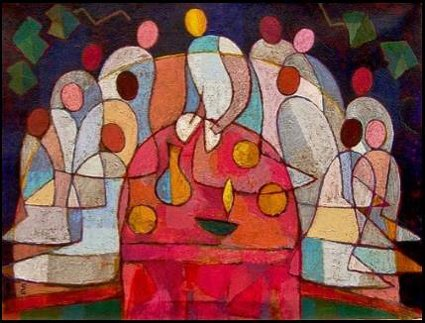
The Miracle of the Loaves and Fishes, by James Tissot, 1886

After this Jesus went to the other side of the Sea of Galilee, also called the Sea of Tiberias. A large crowd kept following him because they saw the signs that he was doing for the sick. Jesus went up the mountain and sat down there with his disciples. 

Now the Passover, the festival of the Jews, was near. When he looked up and saw a large crowd coming toward him, Jesus said to Philip, “Where are we to buy bread for these people to eat?” He said this to test him, for he himself knew what he was going to do. 

Philip answered him, “Two hundred denarii would not buy enough bread for each of them to get a little.” One of his disciples, Andrew, Simon Peter’s brother, said to him, “There is a boy here who has five barley loaves and two fish. But what are they among so many people?” 

Jesus said, “Make the people sit down.” Now there was a great deal of grass in the place, so they sat down, about five thousand in all. Then Jesus took the loaves, and when he had given thanks he distributed them to those who were seated; so also the fish, as much as they wanted. 

When they were satisfied, he told his disciples, “Gather up the fragments left over, so that nothing may be lost.” So they gathered them up, and from the fragments of the five barley loaves, left by those who had eaten, they filled twelve baskets. When the people saw the sign that he had done, they began to say, “This is indeed the prophet who is to come into the world.”

When Jesus realized that they were about to come and take him by force to make him king, he withdrew again to the mountain by himself.

When evening came, his disciples went down to the sea, got into a boat, and started across the sea to Capernaum. It was now dark, and Jesus had not yet come to them. The sea became rough because a strong wind was blowing. When they had rowed about three or four miles, they saw Jesus walking on the sea and coming near the boat, and they were terrified. But he said to them, “It is I; do not be afraid.” Then they wanted to take him into the boat, and immediately the boat reached the land toward which they were going. (New Revised Standard Version)

Christ Walking on the Waters, by Julius Sergius Von Klever, c.1880

The Deliverers Moses and Jesus

The Apostle John intended us to see the link between Moses and Jesus. God used Moses to bring deliverance of the people from slavery through a miracle at the Red Sea. The Lord also used him for a divine provision of manna in the wilderness.

And the Lord Jesus brought about a deliverance of the disciples from anxiety through a miracle on the Sea of Galilee. Christ also brought a divine provision of food in the middle of nowhere for thousands of people.

The miraculous displays by Jesus happened at the time of Passover, the very time that Jews celebrate the deliverance from Egypt. Just as divine power was exerted at the time of Moses in the original Passover, so also divine power likewise showed itself with Jesus in the supply of food and control of the sea.

What’s more, today Christians everywhere around the world remember God’s saving events with the elements of bread and cup, recalling divine deliverance and provision, and finding relief from their fears and anxieties.

A Miraculous Provision and Distribution of Food

It’s no coincidence that Jesus is pictured as sitting on a mountain – reminiscent of Moses on a mountain receiving the divine law and wisdom. The gathering of people around Christ was so great (thousands of them) and the need for food equally as great, that Jesus questioned his disciples concerning resources for such a large crowd.

Christ, of course, could have circumvented his disciples and simply provided the needed foodstuffs without them. Yet, he didn’t, on purpose. Always the rabbi and teacher, Jesus intended to give the disciples a lesson they wouldn’t forget.

After ascertaining that the only food available was a boy’s five barley loaves and two dried fish, Jesus knew that this was plenty, in order to feed up to 5,000 people. It was enough, because Jesus is enough. Only a small amount is needed to fill the bellies of thousands.

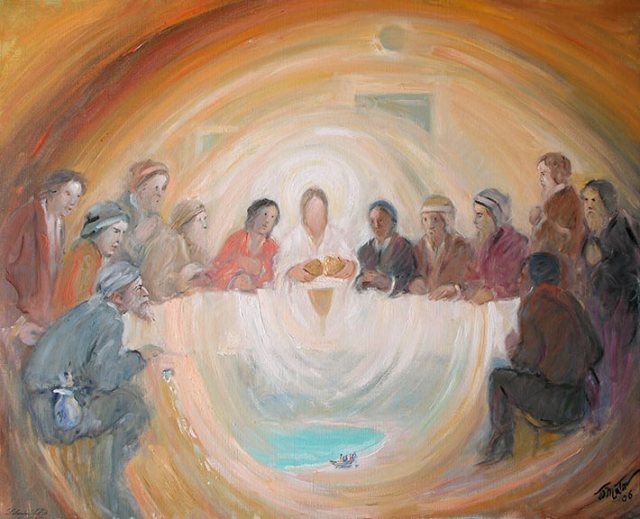
Sacramental Living, by Charissa Jaeger-Sanders

And, what is more, for those with the faith to see it, a little communion wafer and a small swallow from a cup is more than enough to satisfy and satiate the hungriest of faithful and penitent people.

Not only did the people eat as much as they needed and wanted, but there was also so much remaining food that the twelve disciples collected twelve baskets of bread. They could keep on ministering, providing, and distributing for people because little is much when God is in it. Long after Christ’s death and resurrection, his followers continued to give with the divine largess from Jesus.

Walking on Water

It had been a full day of teaching and miraculous ministry, in the full light for all to see. Christ’s power, however, is also operative at night. The darkness is not able to subdue continued miracles from Jesus.

For the Apostle John’s writings, darkness is almost always a theological statement, denoting that there are dark forces operative on this earth. And those powers definitely did not like Christ’s effective day of ministry.

The actual physical storm symbolized the chaotic and angry response of the sinister elements in the world. But despite the terrible conditions, Jesus calmly walked on the sea as the new Moses who takes charge of the water.

The disciples abject fear turned on a dime into exuberant joy, as they realized it was indeed Jesus who entered the boat. In addition, they experienced an immediate place of safe harbor.

Christ was standing in the divine tradition of bringing people from stormy circumstances and evil situations to the safe haven of God’s presence.

Jesus saves people from their fears and anxieties, their travails and ills, and their guilt and shame. Christ also provides everything we need, both material and immaterial. And he does it for the life of the world, for everyone who comes by faith.

Gracious Lord, you are the Sustainer of the hungry. Like a mother, you long to feed your children until each is satisfied. Turn our eyes to you alone, so that, aware of our own deepest longings, we will reach out with Christ to feed others with the miracle of your love. Amen.

Developing the Skill of Wisdom (Colossians 1:9-14)

Colossians 1:9-10, by Bible Art

For this reason, since the day we heard about you, we have not stopped praying for you. We continually ask God to fill you with the knowledge of his will through all the wisdom and understanding that the Spirit gives, so that you may live a life worthy of the Lord and please him in every way: bearing fruit in every good work, growing in the knowledge of God, being strengthened with all power according to his glorious might so that you may have great endurance and patience, and giving joyful thanks to the Father, who has qualified you to share in the inheritance of his holy people in the kingdom of light. 

For he has rescued us from the dominion of darkness and brought us into the kingdom of the Son he loves, in whom we have redemption, the forgiveness of sins. (New International Version)

When I was younger, I played a lot of ping-pong. And I got good at it. In fact, during a several months stretch, back-in-the-day, I had a record of 156-2. Not bad.

That kind of record was only possible because of the two reasons that make any skill an accomplishment:

  1. Knowledge. I learned the game of ping-pong and eventually knew it inside and out.
  2. Experience. I practiced for hundreds, if not thousands, of hours in developing my technique.

The sort of knowledge that Paul was talking about was more than information and intellectual understanding; he used a specific word (in the Greek language – ἐπιγινώσκω, pronounced “EPee-gi-NOS-ko) which refers to knowledge gained by experience.

In English, we need to put two words together in order to communicate Paul’s concept: experiential knowledge – an understanding which is gained by continual repetition and practice until there is proficiency.

There are just some things that can only be learned and integrated into life through constant use and development over time. And this is precisely how a person becomes mature in life:

Growth + Time = Maturity.

And with maturity comes the wisdom to live life as it meant to be lived. This means that wisdom doesn’t come overnight or quickly; to be wise requires a great deal of learning, effort, experience, and time.

The wisdom and understanding Paul refers to is not some sort of secret information which has to be accessed through careful initiation into a group of people who have the inside knowledge. No, this is wisdom which can be gained by anyone who embraces a life of faith and spiritual discipline.

The highest form of knowledge for the Apostle Paul is knowing God in Christ.

This sort of knowledge is an understanding of salvation, and experiencing deliverance from guilt, shame, and the false self. Such knowledge is evidenced by the fruit of the Spirit in living a life of love, joy, peace, patience, kindness, goodness, faithfulness, gentleness, and self-control. (Galatians 5:22-23)

Colossians 1:11, by Bible Art

From the outside of Christianity looking in, it may appear that this is all a grand achievement of the human will. But it isn’t. On the inside, the Christian life is thoroughly a work of God’s glorious power, bringing new life, and effecting spiritual growth and maturity into a wise and good way of life.

We did not deliver ourselves. God did. The Lord transferred our membership from the realm of darkness to the empire of light. Christians are simply people who have been redeemed by God in Christ. Our liberation is because of God’s gracious forgiveness of sins.

Forgiveness, however, is not the end game. Forgiveness frees us to pursue the spiritual life without guilt and shame hindering us and weighing us down all the time. Forgiveness opens us to the possibilities of positive and life-giving relational connections with God and other people.

In our relationship with God, prayer becomes the conduit of divine/human conversation. That connection, in the past, had blockage because of our unhealthy lifestyles. But it is now unobstructed because of God’s gracious intervention by Jesus, in the Spirit.

So, when it comes to our interactions in prayer, there’s no need to invent a new game; we just need to learn the one we’ve got, and put in the hours of work necessary to become accomplished at it. 

Today’s New Testament lesson is a prayer from the Apostle Paul to the Colossian Church. His prayer for them was singular: To have wise minds and spirits, that is, to have knowledge of God – an understanding of who God is and how God operates.

To learn divine ways is to acquire the skill of wisdom.

Paul prayed for a reason: so that we might live our lives in a way which pleases God and enables us to sustain a lifetime of spiritual growth. 

As people created in God’s image and likeness, we are hard-wired with a spirit which needs strengthening and exercise. That happens as we put in the constant repetitions of connecting with the divine and putting in the time on our knees – praying daily for ourselves and others to mature in faith so that we might all together act wisely and justly in this world, for the life of the world.

A good place to start is to use Paul’s prayer as our own. Never has there been such a need than now for us to know how to apply wisdom in the places and in the circumstances we’ve never been in before. 

For wisdom to happen, we must grow in our knowledge by putting in the hours of prayer.

The skill of wisdom doesn’t magically happen. Wisdom is the culmination of acquired understanding; a lot of practice exercising love in the places where love is not; and engaging in a lifetime project of becoming knowledgeable through constant learning, struggling, and growing.

Direct me, O Lord, in all my doings with your most gracious will and wisdom. Further in me your continual help – that in all my work and in all I do and say, I may glorify your holy name; and, by your mercy, obtain the life that is truly life; through Jesus Christ, my Lord.  Amen.

Renewal (Mark 6:30-34, 53-56)

Great Crowds Followed Jesus as He Preached the Good News, by Elizabeth Wang (1942-2016)

The apostles gathered around Jesus and told him all that they had done and taught. He said to them, “Come away to a deserted place all by yourselves and rest a while.” For many were coming and going, and they had no leisure even to eat. And they went away in the boat to a deserted place by themselves. 

Now many saw them going and recognized them, and they hurried there on foot from all the towns and arrived ahead of them. As he went ashore, he saw a great crowd, and he had compassion for them, because they were like sheep without a shepherd, and he began to teach them many things….

When they had crossed over, they came to land at Gennesaret and moored the boat. When they got out of the boat, people at once recognized him and rushed about that whole region and began to bring the sick on mats to wherever they heard he was. 

And wherever he went, into villages or cities or farms, they laid the sick in the marketplaces and begged him that they might touch even the fringe of his cloak, and all who touched it were healed. (New Revised Standard Version)

Recuperation

Christ’s disciples had just returned from their first ministry trip without Jesus. He had sent them in pairs to take authority over unclean spirits, with specific instructions on how to handle themselves. (Mark 6:6-13)

Now they had come together after a successful experience. Jesus immediately recognized that the disciples needed rest in a private retreat so that they could recover and debrief on their mission.

Jesus knew a thing or two about what we now call “self-care.” Christ understood the necessity for awareness of one’s physical, mental, emotional, and spiritual state – and to take appropriate steps in caring for oneself in order to maintain a vigorous life and ministry. He often punctuated his life with solitary times away with his heavenly Father. (e.g. Mark 1:35)

So, the disciples followed Jesus to a deserted place where they could be alone. Besides, it had become ever more risky to be out in the open. The religious authorities were looking for ways to snuff out this popular upstart of a movement with Jesus as rabbi.

Redirection

Things don’t always go as planned, even for the Son of God. Interruptions are part of working with people. Yet, Jesus never saw those disruptions as a bad thing. It seems that perhaps he even understood them as part of the plan from his heavenly Father. However Christ thought of them, he was unfazed by them.

With an expanding ministry came a larger and more expansive crowd following Jesus. Like a group of ancient paparazzi, there were people dedicated to tracking down Jesus and watching for him; they were absolutely intent on seeing him.

Whereas a lot of people might be annoyed with this behavior (especially us introverts!) Jesus truly saw them, viewing the crowds as “sheep without a shepherd.” In other words, Christ understood the people’s vulnerability, and he had compassion on them.

Refocus

Christ felt genuine care and concern for the people from the pit of his gut. Jesus knew their very real spiritual predicament, an age-old one that God was familiar with:

I, the Lord God, say you shepherds of Israel are doomed! You take care of yourselves while ignoring my sheep. You drink their milk and use their wool to make your clothes. Then you butcher the best ones for food. But you don’t take care of the flock! You have never protected the weak ones or healed the sick ones or bandaged those that get hurt. You let them wander off and never look for those that get lost. You are cruel and mean to my sheep. They strayed in every direction, and because there was no shepherd to watch them, they were attacked and eaten by wild animals. (Ezekiel 34:2-5, CEV)

Jesus, in the spirit Moses, took up the concern for people:

Moses spoke to the Lord: “Let the Lord, the God of all living things, appoint someone over the community who will go out before them and return before them, someone who will lead them out and bring them back, so that the Lord’s community won’t be like sheep without their shepherd.” (Numbers 27:15-17, CEB)

Because the Lord Jesus is the Good Shepherd and takes up the responsibility of caring for the flock, there were sheep (the crowds of people) continually either present around him or pursuing him (hence, the need for continual times of rest and recuperation).

All of this resulted in the impossibility of Jesus strolling into a town, village, or city under the radar.

Restoration

Not only did everyone want to see Jesus, but the people also desired to touch him, or at least the tassels of his garment – anything toget close and experience healing.

What’s so amazing about this account is that every single person who Jesus saw or touched experienced healing – without exception. It wasn’t that a few people, or even some of them, walked away changed. All of them did.

Indeed, Jesus is the divine shepherd, who will gather his sheep from the places where they have been scattered.

Christ went into towns and villages to the public places where the people were. That meant Jesus spent a good deal of time in the marketplaces. Since these were gathering areas where people bought and sold and interacted with each other, there you would also find the weakest, sickest, and most vulnerable people.

The needy were looking for help. And Jesus did for them, well beyond what any of them expected.

The Lord Jesus was also doing more than we might expect, as well. By conducting ministry in the economic center of a town, he was introducing a different (and subversive) economy from the kingdom of God.

Those with goods, resources, and money do not occupy the commercial spaces in God’s kingdom realm. Instead, the ones with the least, inhabit the spaces and places of honor. Indeed, many who are first will be last, and the last will be first. (Mark 10:31)

Christ’s earthly ministry restored people’s bodies, minds, emotions, and spirits – thus bringing a thriving economy into God’s kingdom. All of his work resulted in renewal of people’s lives, and a renewed way of living in this world.

“Healer of Our Every Ill” by Marty Haugen, 1987

Refrain:
Healer of our every ill,
light of each tomorrow,
give us peace beyond our fear,
and hope beyond our sorrow.

You who know our fears and sadness,
grace us with your peace and gladness;
Spirit of all comfort, fill our hearts. [Refrain]

In the pain and joy beholding
how your grace is still unfolding,
give us all your vision, God of love. [Refrain]

Give us strength to love each other,
every sister, every brother;
Spirit of all kindness, be our guide. [Refrain]

You who know each thought and feeling,
teach us all your way of healing;
Spirit of compassion, fill each heart. [Refrain]

Amen.

Effective Communication (Acts 17:16-31)

St. Paul preaching at the Areopagus in Athens, by Kennedy A. Paizs

While Paul was waiting for them in Athens, he was deeply troubled by all the idols he saw everywhere in the city. He went to the synagogue to reason with the Jews and the God-fearing Gentiles, and he spoke daily in the public square to all who happened to be there.

He also had a debate with some of the Epicurean and Stoic philosophers. When he told them about Jesus and his resurrection, they said, “What’s this babbler trying to say with these strange ideas he’s picked up?” Others said, “He seems to be preaching about some foreign gods.”

Then they took him to the high council of the city. “Come and tell us about this new teaching,” they said. “You are saying some rather strange things, and we want to know what it’s all about.” (It should be explained that all the Athenians as well as the foreigners in Athens seemed to spend all their time discussing the latest ideas.)

So Paul, standing before the council, addressed them as follows: “Men of Athens, I notice that you are very religious in every way, for as I was walking along I saw your many shrines. And one of your altars had this inscription on it: ‘To an Unknown God.’ This God, whom you worship without knowing, is the one I’m telling you about.

“He is the God who made the world and everything in it. Since he is Lord of heaven and earth, he doesn’t live in man-made temples, and human hands can’t serve his needs—for he has no needs. He himself gives life and breath to everything, and he satisfies every need. From one man he created all the nations throughout the whole earth. He decided beforehand when they should rise and fall, and he determined their boundaries.

“His purpose was for the nations to seek after God and perhaps feel their way toward him and find him—though he is not far from any one of us. For in him we live and move and exist. As some of your own poets have said, ‘We are his offspring.’ And since this is true, we shouldn’t think of God as an idol designed by craftsmen from gold or silver or stone.

“God overlooked people’s ignorance about these things in earlier times, but now he commands everyone everywhere to repent of their sins and turn to him. For he has set a day for judging the world with justice by the man he has appointed, and he proved to everyone who this is by raising him from the dead.” (New Living Translation)

Ancient ruins of Athens, Greece

The city of Athens was a major intellectual center in the ancient world. Ideas, philosophy, reason, rhetoric, and debate were standard fare amongst the citizens. At the time of the Apostle Paul’s arrival in the city, Greece knew next to nothing about Christianity.

Paul’s response to what he saw and felt in the city dictated what he did and said. And those words were wise and impactful for the people of Athens. The Apostle’s interaction with the philosophers was like a seminar in how to communicate with folks who believe and live very differently than ourselves.

Observation

Paul entered the city and made a simple observation: Athens is full of idols. Out of all the observations Paul could have made, this one would not likely be made by most people visiting the city. Athens was a glorious place with its unparalleled architecture. The Acropolis and the Agora were resplendent with the arts and democracy.

For all its physical beauty and brilliance, the one thing Paul homed-in on was the idols. This would have struck many folks as odd – something like focusing on the dog collar instead of the dog. Yet, Paul was using more than his physical eyes – his spiritual sight was making a big observation – that Athens was very much a religious place.

Feeling

The Apostle felt troubled and distressed. Paul was disturbed down deep in his gut with the spiritual state of this renowned city-state. The sheer volume of idols and the practice of idolatry did not sit well with him. He experienced feelings of pity mixed with anger.

Paul handled his emotions well. By freely acknowledging them, he was then able to choose his response. Had he not done so, it’s likely Paul might have gone on some frustrating tirade, thereby never truly connecting relationally with the people. There’s nothing wrong with being irritated or exasperated; it’s what we do with those feelings that’s important.

Need

Emotions, not thoughts, move us to act. Paul knew why he was feeling disturbed, and decided not to stuff those feelings. Instead, he stepped out and addressed the great need he was observing.

Paul decided to meet the Athenians on their turf and on their level by reasoning with them every day in the great buildings and open spaces of the city.

While in Athens, it seems that Paul, understandably, utilized the Socratic method of dialogue – involving questions and answers. It’s impressive that throughout the Acts of the Apostles, Paul demonstrated a deft ability to communicate and connect with a broad range of people.

Appeal

Paul wasn’t interacting and dialoging just for the fun of it; he wanted to make an appeal, a request for people to seriously consider the Christian good news of Jesus Christ’s resurrection as a viable philosophy of life. He made a widespread appeal to Jews, Greeks, and passers-by, as well as philosophers.

Since the massive intellect of Paul could handle any reasoned debate, he was invited to the Areopagus, which was the place where the best-of-the-best carried-on their discussions.

Paul’s address to them was incredibly cogent and well-reasoned – finding common ground from which to debate. While doing so, he maintained outward grace amidst his inward disturbance.

Conclusion

The late British exegete, John R.W. Stott, reflected on today’s New Testament lesson and gave us words which are still relevant for us in these contemporary times:

“Why is it that, in spite of the great needs and opportunities of our day, the church slumbers peacefully on, and that so many Christians are deaf to Christ’s commission, and dumb with tongues-tied in testimony? The major reason is this: We do not speak as Paul spoke because we do not feel as Paul felt. We have never had his indignation. Divine jealousy has not stirred within us. We constantly pray, ‘Hallowed be Thy Name,’ yet we do not seem to mean it… Paul saw people created in the image and likeness of God giving to idols the homage which was due to God alone… and he was deeply pained by it.”

May the good news of Jesus Christ be so pressed into our minds, hearts, and guts that what comes out of us is deep compassion, wise dialogue, and an effective ministry of communication with others. Amen.