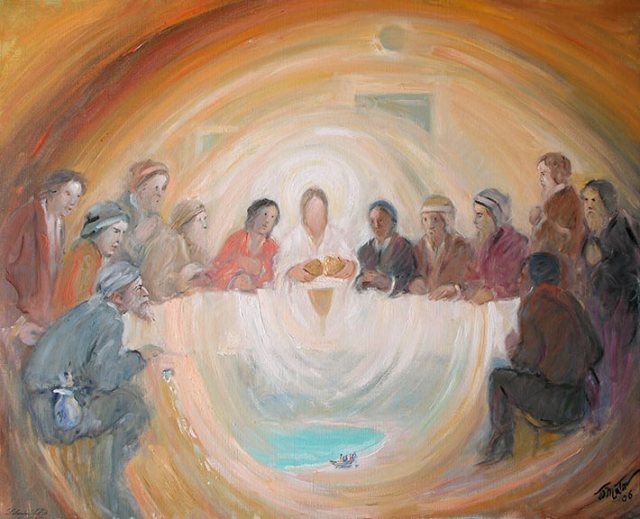
Living Bread from Heaven (John 6:51-58)

Art by Nigel Wynter (1957-2024)

I am the living bread that came down from heaven. Whoever eats of this bread will live forever, and the bread that I will give for the life of the world is my flesh.”

The Jews then disputed among themselves, saying, “How can this man give us his flesh to eat?” 

So Jesus said to them, “Very truly, I tell you, unless you eat the flesh of the Son of Man and drink his blood, you have no life in you. Those who eat my flesh and drink my blood have eternal life, and I will raise them up on the last day, for my flesh is true food, and my blood is true drink. Those who eat my flesh and drink my blood abide in me and I in them. Just as the living Father sent me and I live because of the Father, so whoever eats me will live because of me. This is the bread that came down from heaven, not like that which the ancestors ate, and they died. But the one who eats this bread will live forever.” (New Revised Standard Version)

To the religious leaders of Christ’s day, Jesus was making more noise than a couple of skeletons dancing on a tin roof. And they neither liked it, nor appreciated him drawing so much attention to himself.

Tensions had been escalating between Jesus and the religious establishment. The atmosphere was thick with grumbling leaders, as they tried to make some sense of Christ’s words to them.

Jesus offering his body for people to eat was causing far too much noise for the Jewish leaders. What in the world is this guy talking about?

Rather than making the meaning clear for them, Jesus added drinking his blood to the discussion. What’s more, Christ got up in their grill and confronted them with a choice, instead of a straightforward explanation.

Using some good old double negative language, Jesus flatly stated that there’s no life without any eating of his flesh and drinking of his blood. Then conversely, stated positively, Jesus affirmed that eternal life is found in those who eat his flesh and drink his blood.

This was next level communication of Jesus to the religious leaders. Earlier, Christ let them know that they needed to make the choice of coming to himself, of engaging in a life-giving relationship with him.

Yet now, it’s a matter of outright participation in Jesus, of eating and drinking the body and blood of Christ. Both the choice of relationship and of participation are radical decisions, which requires ditching some old traditions, and beginning some new ones.

Christ’s words are difficult, because they demand a change in thinking and behavior. Indeed, his words demand a change in our very way of being.

Christian discipleship requires that we stop the false ways of being in this world, and start a different way of being, according to the true self. In other words, Jesus was insisting on repentance and faith.

We are all on the hook to not just talk some theology and take some communion elements. It’s a lot more involved than that. Jesus demands our very lives, and not simply to sign off on some doctrinal statement about him. It’s about life itself, the power of life and death.

By eating and drinking Christ, there is meaningful relational connection, and ongoing participation in his life and ministry.

None of this is about literal cannibalism, and not even about actual bread and wine. This is deep metaphorical stuff which is meant to convey to us who Jesus is and how we can be related to him.

When we ingest food and drink, it goes into us and throughout our entire body. You cannot get much closer to something than by eating it and having it inside you. Just as eating bread goes to our very core and helps sustain life, so ingestingJesus is about allowing him to be as close to us as possible, into the very depths of our soul.

And by taking Christ into us, we will truly live and connect; and not be separated and die.
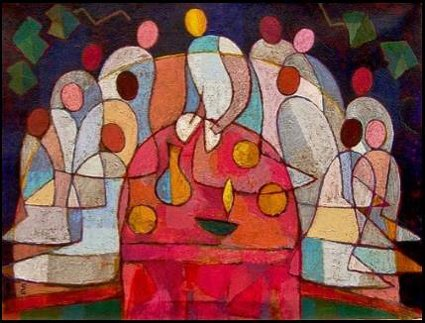
Art by Soiche Watanabe

We can no more spiritually live without taking Jesus into us, as we could live without eating on a regular basis. Christ is our breakfast, lunch, and dinner; our midnight snack and our birthday cake. Jesus is all that, and more.

Perhaps you are wondering why Jesus didn’t just state plainly who he is, why he came, and what will happen. Because it’s too much to handle.

We don’t simply accept Jesus into our heart, and then go on our merry way. Jesus Christ is someone to search for and discover, as if we were looking for fresh water or for the best baguette in the world.

Anyone can affirm a few belief statements, or do some good deeds. But it takes real courage to go hard after the spiritual life and find out what it’s all about:

It requires some solid bravery to explore the depths of your own true self and face the internal crud that’s been hiding in the shadows of your soul.

It demands identifying the bogus ways we prop up a false self for others to see – wanting to control how people view us and treat us.

It takes some real chutzpah to pursue the God life without worrying about where it will take you or who it will upset.

Jesus is a force to contend with. He is the Son of God, sent from above, to provide the world with real spiritual food and drink. Christ is the one who sustains life, and makes abundance possible. He is the Lord who speaks, calls out, and draws us to himself.

Jesus Christ helps us fit, even though we come from the island of misfit toys.

Even more pertinent than the question of “Who is Jesus?” is the probing question, “And what will you do with him?”

Christ cannot fit into your neat theological system, your tidy doctrinal statements, and on your nicely cleaned coffee table within the attractive Bible. Sooner or later, we all must contend with the divine force which gives life to everything. We cannot get away from him.

So, go after Jesus. Find out who he is. Determine how to deal with a mercy so powerful that it melts away guilt and shame as if it were in a 500 degree oven. After all, it’s better to have a tasty loaf of bread than to become a hard slice of burnt toast.

But let’s not worry about how hot it is in here, but how noisy it’s getting.

Gracious Lord, move us, your people, to experience your love more deeply. Fill us with the energy that comes from a desire for service. Connect us with creation to care for your world. Engage us in the scriptures and increase our knowledge of you. Raise up your power and come among us. May your bountiful grace and mercy equip us. Amen.

Spiritual Growth (2 Peter 3:14-18)

So then, dear friends, since you are looking forward to this [a new heaven and a new earth] make every effort to be found spotless, blameless and at peace with him. Bear in mind that our Lord’s patience means salvation, just as our dear brother Paul also wrote you with the wisdom that God gave him. He writes the same way in all his letters, speaking in them of these matters. His letters contain some things that are hard to understand, which ignorant and unstable people distort, as they do the other Scriptures, to their own destruction.

Therefore, dear friends, since you have been forewarned, be on your guard so that you may not be carried away by the error of the lawless and fall from your secure position. But grow in the grace and knowledge of our Lord and Savior Jesus Christ. To him be glory both now and forever! Amen. (New International Version)

When it comes to Christianity – the Christian life and church ministry – the value and necessity of spiritual growth within individual believers and local churches is of vital importance. 

We were created by God, who made us in the divine image and likeness. That is, we were formed as spiritual people. Every one of us carries within ourselves a God-given spirit; it is a vital part of who we are.

Therefore, we must recognize that the area of our greatest value, potential, fruitfulness, and life fulfillment will be in the realm of the spiritual. 

If we deny our inherent spirituality, whether in thought or in practice, we will inevitably become confused. This then, sets us up for failure, because our basic nature is one of being spiritual persons.

Nothing is more valuable for us than spiritual growth, and the provision God has made for us to experience this growth.

There is a verse tucked away at the end of Peter’s second epistle that states for us to grow in the grace and knowledge of our Lord and Savior Jesus Christ. Grace and knowledge are important words that both point to Jesus. 

“Grace” refers to all the benefits of redemption for us through the person and work of Christ.

“Knowledge” denotes all the benefits of God’s revelation to us in Jesus Christ.

Here is a simple, yet profound, observation of the text: The word “grow” is a command; it is not optional. It’s not something to maybe think about doing when we get around to it. God insists that we spiritually grow.

God has made every provision for our spiritual growth. What’s more, we have been given the ability as a redeemed believer, and as a redeemed community, to grow spiritually. 

So then, each and every believer in Jesus Christ, as well as every local church, must face their own personal responsibility to obey this scriptural exhortation. To do otherwise is to live outside of God’s will.

Sticking with the Apostle Peter’s words, here is another verse of importance which relates to our spiritual growth: 

Like newborn babies, crave pure spiritual milk, so that by it you may grow up in your salvation. (1 Peter 2:2, NIV) 

We are to seek the Word of God with the same kind of intensity that a newly born baby will seek for food. As babies, my kids were barracudas when it came to feeding time; they took their eating seriously, and with a lot of gusto. That same desire for feeding must be present with us as Christians and churches. When the command of Peter is obeyed, and made a priority in our life, then we will grow.

Like any good thing in our lives, there are potential problems, along with the benefits. A significant downside, when pursuing spiritual growth, is that we all have a disease-like force in our lives. There exists within us a destructive tendency of lethargy and passivity toward spiritual things.

It’s rather ironic that people who confess Jesus as Lord, and are convinced about their Christianity, can be so doggone nit-picky about trivial matters which don’t really contribute much of anything to their spiritual growth.

And the trivial things only distract us from feeding upon the Word of God, and consuming the Bread of Life. We cannot – we must not – go on living like this and expect to be successful in the Christian life.

If we are going to grow spiritually, we must be about the business of speaking the truth in love – which results in us growing up into people who embody the words and ways of Jesus. (Ephesians 4:15) 

We are to have an aggressive application of the truth in our speech and our actions, which then impacts our daily faith walk with Jesus. 

The way we grow up spiritually, whether personally or corporately, is through practicing the truth of Holy Scripture – which requires reading it, learning it, and knowing it better than we know our own back door.

Our priorities, goals, and values need to reflect a solid commitment to fulfill scriptural truth in daily life. In that vein, let us ask ourselves some penetrating questions:

  • Have we humbled ourselves before God and confessed the things we have done, and the things we have left undone, when it comes to God’s revealed will?
  • Have we humbled ourselves before one another as believers, and in the church, asking for prayer?
  • Have we read the Bible on the subject of spiritual growth, and followed its teachings, so that we can know the joy and love God has for us?
  • Would we be lethargic and passive about treating a physical cancer in our lives?

God the Father and God the Son have conspired together to give believers God the Holy Spirit for our spiritual growth. The blessed Holy Trinity – the God whom Christians serve – has gifted us the Spirit, so that we might come into close fellowship with the Lord Jesus. 

Once we begin to obey the Scripture in this area of practicing biblical truth, we will experience spiritual growth and the joy of the Lord. 

However, if we allow ourselves to remain lethargic and apathetic concerning spirituality, we will not become our true selves. We must choose to make a biblical response to God, to one another, and to ourself. 

Spiritual growth is not a matter of personal willpower that can be achieved by our own efforts. Instead, we must face our spiritual condition, and seek help within the community of the redeemed, the church. Then, spiritual growth will become a reality.

Gracious heavenly Father, the God of all mercy, thank you for adding another day to my life. I dedicate both my soul and my body to serving you with a right spirit and a holy life. Strengthen me in this life, so that I may grow in grace, and in the knowledge of your Son, my Savior, Jesus Christ, who with you and the Holy Spirit are one God, now and forever. Amen.

I Am the Bread of Life (John 6:35, 41-51)

Ethiopian Orthodox depiction of Jesus sharing with the disciples

Jesus said to them, “I am the bread of life. Whoever comes to me will never be hungry, and whoever believes in me will never be thirsty…

Then the Jews began to complain about him because he said, “I am the bread that came down from heaven.” They were saying, “Is not this Jesus, the son of Joseph, whose father and mother we know? How can he now say, ‘I have come down from heaven’?” 

Jesus answered them, “Do not complain among yourselves. No one can come to me unless drawn by the Father who sent me, and I will raise that person up on the last day. It is written in the prophets, ‘And they shall all be taught by God.’ Everyone who has heard and learned from the Father comes to me. Not that anyone has seen the Father except the one who is from God; he has seen the Father. Very truly, I tell you, whoever believes has eternal life. I am the bread of life. Your ancestors ate the manna in the wilderness, and they died. This is the bread that comes down from heaven, so that one may eat of it and not die. I am the living bread that came down from heaven. Whoever eats of this bread will live forever, and the bread that I will give for the life of the world is my flesh.” (New Revised Standard Version)

The lesson for today begins with the first of seven “I am” statements in John’s Gospel from Jesus:

  1. “I am the bread of life. Whoever comes to me will never be hungry, and whoever believes in me will never be thirsty.” (John 6:35)
  2. “I am the light of the world. Whoever follows me will never walk in darkness but will have the light of life.” (John 8:12)
  3. “I am the gate. Whoever enters by me will be saved and will come in and go out and find pasture.” (John 10:9)
  4.  “I am the good shepherd. The good shepherd lays down his life for the sheep.” (John 10:11)
  5. “I am the resurrection and the life. Those who believe in me, even though they die, will live,and everyone who lives and believes in me will never die.” (John 11:25-26)
  6. “I am the way and the truth and the life. No one comes to the Father except through me.” (John 14:6)
  7. “I am the true vine, and my Father is the vine-grower. He removes every branch in me that bears no fruit. Every branch that bears fruit he prunes to make it bear more fruit. I am the vine.” (John 15:1-2)

Also, for the first time in the Gospel of John, the Jews are named and identified as the ones who cause conflict for Jesus. John, of course, did not mean every single Jew; he was referring chiefly to the Jewish religious establishment, the leaders. And even then, he, of course, was not making reference to every single rabbi or person in the ruling council.

It’s important to say that, because Jews throughout the centuries have had far too much persecution from Christians who think all Jews have it in for Jesus. So, please, exercise some plain common sense and basic human kindness when it comes to reading the New Testament Gospels; they are most definitely not anti-Semitic.

The religious leaders were taking issue with the claims of Jesus, his “I am” statement. They argued that Jesus was a plain ordinary Jew from a typical Jewish family. There’s no need, the authorities contended, for Jesus to think of himself any other way than a common Jew.

Instead of entertaining the complaint against him, Jesus pointed to God the Father. God initiated the action by sending Jesus; and takes action by drawing people to Jesus. And Christ does his part by raising those people up at the last day; and teaching them about God’s actions of deliverance.

When it comes to the earthly ministry of Jesus, seeing is believing, and hearing is learning. Trust what you see with Jesus; and believe it. Have faith in what you hear from Jesus; and learn from it.

I Am the Bread of Life, by Joseph Matar

I like Jesus. I like metaphors. Jesus is a metaphor guy. I like that. Jesus said that he is the bread of life. Those who come to Jesus are satisfied. Those who eat him, live forever. This isn’t cannibalism, it’s a metaphor. The bread that Jesus gives for the life of the world is his flesh.

Metaphors help us relate to the concept, and grasp the message. If you’re hungry, just looking at a loaf of bread isn’t going to help you be satisfied. Obviously, you have to eat the bread and do more than see it, smell it, and touch it.

What’s more, people do more than eat once. We eat repeatedly, every day, at least a few times a day, in order to be healthy and alive.

Come and see Jesus. But do more than that. Ingest him. Take Jesus into your life. Let the bread of life come into you and thoroughly satisfy you. And do it every day. Do it several times a day. Make sure your soul is continually full of Jesus.

Then, you will have life to the full, an abundant life, filled with good things and right relationships.

Jesus is the bread of life. He is the great “I am.” And so much more.

Yet, perhaps at first glance, Jesus is just one person amongst a panoply of historical characters and religious figures. However, if we will but taste Jesus, we will come to see something very different about him. He’s more than a human being, more than a compelling teacher, and more than a miracle worker.

Jesus may appear, to many, as nothing more than a common person. But there’s really nothing ordinary about him, at all. Taking the time to have a good look at the Gospel of John, and watching Jesus move from village to village, and person to person will help us see a rather uncommon person who was no ordinary human being.

He moved to the beat of a different drum, and danced an alternative jig. And if we observe more closely, we can see the other two dance partners with him.

And with our two ears, when he says, “I am,” we can respond with an emphatic, “He is.”

Merciful Father, you heard the prayers of your people in the wilderness and fed them bread from heaven despite their sin. Graciously hear us today and feed us, too, with the Bread of Life from heaven, our Lord Jesus Christ, who lives and reigns with you and the Holy Spirit, one God, now and forever. Amen.

No Class (1 Corinthians 11:17-22)

In the following directives I have no praise for you, for your meetings do more harm than good. 

In the first place, I hear that when you come together as a church, there are divisions among you, and to some extent I believe it. No doubt there have to be differences among you to show which of you have God’s approval. 

So then, when you come together, it is not the Lord’s Supper you eat, for when you are eating, some of you go ahead with your own private suppers. As a result, one person remains hungry and another gets drunk. 

Don’t you have homes to eat and drink in? Or do you despise the church of God by humiliating those who have nothing? What shall I say to you? Shall I praise you? Certainly not in this matter! (New International Version)

The memory of the Last Supper with Jesus and his disciples is one that has significantly shaped church history. In the earliest church, we see from the Apostle Paul how impactful table fellowship was for the believers.

Paul received the words of faith, and passed them on to the churches he established, including the church at Corinth. The Apostle faithfully engaged in handing down a tradition which Christians practice all over the world, even today.

The Corinthian Church had devolved into a bunch of divided special interest groups. They were in great need of unity in order to reflect being the one Body of Christ. The divisions fractured their worship, especially their communion with one another.

The Christians in Corinth were gathering for a shared meal, but not really for communion with each other and their Lord. There was no true interaction and fellowship that was happening.

The church’s divisions were such that the groups had no intention of meaningfully interacting with one another. In other words, the church culture was so fragmented and polarized that the Apostle Paul had enough of their disunity, and addressed it head on in his letter.

One of the significant situations was the class differences amongst the believers. The wealthy members of the congregation were given to a lot of leisure time with a good deal of discretionary money. They would often come together, well before the working class and the day laborers could show up to eat.

The richer parishioners feasted amongst themselves. By the time others arrived, many of them either had very little, or went without altogether. For Paul, this was a travesty of the communion meal, which was supposed to signify the unity of believers and the sacrifice of Christ for all.

The Apostle clearly understood that the poor were being humiliated and treated as second class citizens in the church. So, Paul condemned this situation of division, and the inequitable treatment of the less privileged.

The rich people were therefore instructed to eat and drink privately in their own homes, so that the wealthy would not come and scarf all the food, making a mockery of the sacrament.

The shared meal was to remind them of Christ, and was not a time for petty and ostentatious selfishness. Jesus gave his life for all. All believers – whether rich or poor – are to remember both the corporeal body of Jesus, and the corporate body of believers, so that every Christian may overcome ungodly divisions and live into the unity provided through the cross of Christ.

What the Corinthians were doing was not the Lord’s Supper. The believers’ conduct and character eviscerated it’s true purpose and meaning, and made it something else altogether.

Celebration, by John August Swanson (1938-2021)

If the church was to celebrate at the Table, then they needed to listen to what the Lord told Paul about it. Christians coming together for fellowship, eating, and remembering the Lord is not a collection of individual believers doing their own thing. It is a collective meal, meant to emphasize their unity with Christ and one another.

Unlike a contemporary church potluck, the Corinthians brought their own food to eat without sharing. Thus, the rich were eating caviar and crème brûlée, whereas the poor chewed on a peanut butter sandwich with no jelly, and stale potato chips.

On one side of the room there was a group of well-to-do people gorging themselves on a feast, while on the other side of the room the less fortunate folks just tried to eat their meager rations.

The have’s and the have-not’s were splitting the church in ways that made it no different from the wider pagan culture. And Paul would have none of it. The Apostle’s train of thought and Christian convictions on this were clearly spelled out just a few verses earlier in his letter:

So whether you eat or drink or whatever you do, do it all for the glory of God. Do not cause anyone to stumble, whether Jews, Greeks or the church of God—even as I try to please everyone in every way. For I am not seeking my own good but the good of many, so that they may be saved. (1 Corinthians 10:31-33, NIV)

We are all to ensure that our meetings together are helpful, life-giving, and promote the common good of everyone. Anything less than this is simply unchristian.

Almighty God our heavenly Father, you declare your glory and show forth your handiwork in the heavens and in the earth: Deliver us in our various occupations from the service of self alone, that we may do the work you give us to do in truth and beauty and for the common good; for the sake of him who came among us as one who serves, your Son Jesus Christ our Lord, who lives and reigns with you and the Holy Spirit, one God, for ever and ever. Amen.