Welcome, friends! For Christians all over the world, today begins a 40-day journey to Easter. Click the videos below, and together we will start that journey toward Jesus…
Joel 2:1-2, 12-17 Pastor Tim
Forgive, almighty God, those things we have done which have caused you sadness, and those things we should have done that would have brought you joy. In both we have failed ourselves, and you. Bring us back to that place where our journey began, when we said that we would follow the way that you first trod. Lead us to the Cross and meet us there. Amen.
Transfiguration of Jesus by Macedonian artist Armando Alemdar
After six days Jesus took Peter, James, and John with him and led them up a high mountain, where they were all alone. There he was transfigured before them. His clothes became dazzling white, whiter than anyone in the world could bleach them. And there appeared before them Elijah and Moses, who were talking with Jesus.
Peter said to Jesus, “Rabbi, it is good for us to be here. Let us put up three shelters—one for you, one for Moses and one for Elijah.” (He did not know what to say, they were so frightened.)
Then a cloud appeared and covered them, and a voice came from the cloud: “This is my Son, whom I love. Listen to him!”
Suddenly, when they looked around, they no longer saw anyone with them except Jesus.
As they were coming down the mountain, Jesus gave them orders not to tell anyone what they had seen until the Son of Man had risen from the dead. (Mark 9:2-9, NIV)
It is quite possible that in reading this account of Christ’s transfiguration (or metamorphosis) that this all seems very strange, even confusing. Maybe you just have no categories of thought to explain such an encounter.
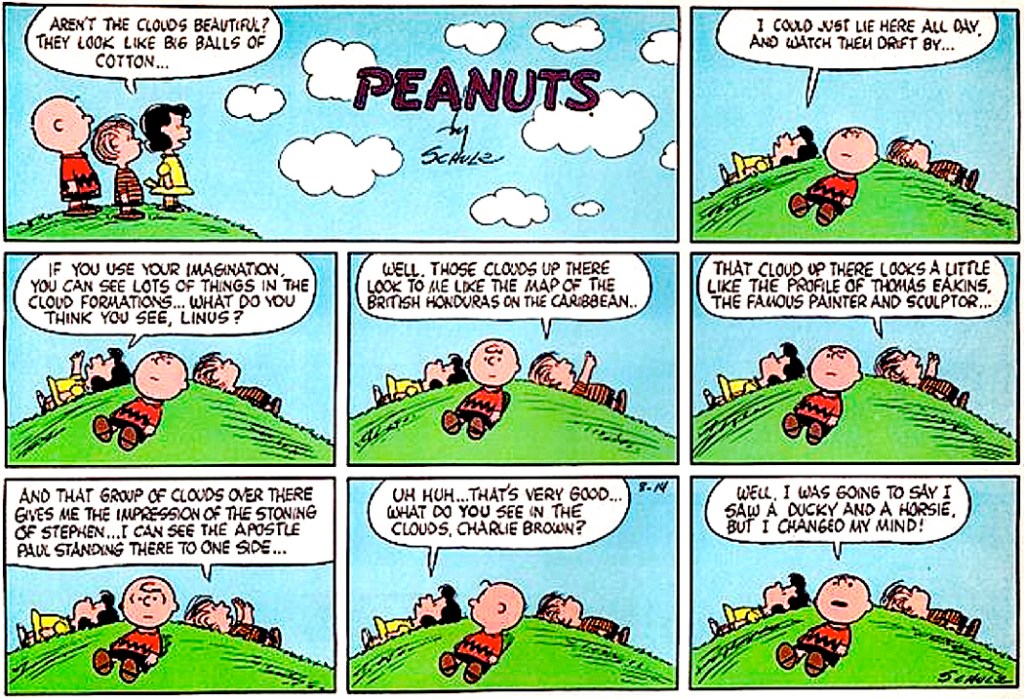
In a Peanuts cartoon Charlie Brown, Lucy, and Linus were lying on their backs looking at the sky. Lucy says, “If you use your imagination you can see lots of things in the cloud formations. What do you think you see, Linus?” Linus replies, “Well, those clouds up there look to me like the map of the British Honduras on the Caribbean… That cloud up there looks a little like the profile of Thomas Eakins, the famous painter and sculptor… And that group of clouds over there gives me the impression of the stoning of Stephen… I can see the Apostle Paul standing there to one side…” Lucy responds, “Uh huh… that’s very good… what do you see in the clouds, Charlie Brown?” Charlie Brown sheepishly says, “Well, I was going to say a ducky and a horsie, but I changed my mind.”
Perhaps your spiritual life seems more like Charlie Brown than Linus. Compared to the experiences of others, you may not have had any defining moments of ecstasy, no shining Jesus right in front of you, or no spectacular vision of Christ. Maybe your life seems rather mundane and ordinary considering the many stories we have in the Gospels of Jesus doing the miraculous.
Most of life is lived in the daily grind. In the week in and week out monotony of life, especially when one is sheltering in place, we need a bit of hope, maybe even a lot of hope. In fact, we need an occasional mountain top experience because those are glimpses into the future of what it will be like someday when the kingdom of God comes in all its fullness.
The account of Christ’s transfiguration comes after a hard frank discussion Jesus had with the disciples about his impending death. Jesus clearly taught them that he must suffer, be rejected, and killed. But in three days he would rise again. The disciples did not want to hear that, and Peter even rebuked Jesus for saying it. In response, Jesus said to them all:
“Whoever wants to be my disciple must deny themselves and take up their cross and follow me. For whoever wants to save their life will lose it, but whoever loses their life for me and for the gospel will save it. (Mark 8:34-35, NIV)
Jesus identified himself as the Suffering Servant, as the One who must suffer and die. However, he is also the One to be glorified. For Jesus, there had to be suffering before glory. And it is the same for us: There must be suffering before glory. The Christian life is filled with the difficulty of walking through the valley of the shadow of death but is also punctuated with mountain top experiences that give us hope to keep doing what Jesus did. In other words, we must listen to Jesus and follow him. The nature of our Christian walk is up and down. Both the mountain and the valley are spiritual realities of great importance.
We may have a lot of questions about Christ’s transfiguration. Jesus had a metamorphosis in front of the disciples’ eyes. Why? What is the significance of this? Was it just a demonstration to get the disciples’ attention? Why are Moses and Elijah there? What is really going on here?
Jesus intentionally took Peter, James, and John up the mountain to have this experience. Up to this point, a lot of rumors had been circulating about Jesus – that maybe Jesus was really Elijah come back, or some other prophet, perhaps even Moses himself, since no one knows where his body was when he died. Moses and Elijah showing up next to Jesus meant that Jesus is not them.
In the Old Testament, Moses was the person used by God to deliver the Israelites out of their slavery in Egypt and brought them to the Promised Land. Centuries later, when the Israelites had been in the land for quite a while, Elijah was the person used by God to bring about a great repentance of the people from the false god Baal, and a mighty revival to the exclusive worship of the Lord.
As good as Moses and Elijah were back then, having them with Jesus on the mountain meant that it gets even better with Christ. Jesus is the Messiah, the True Deliverer, who saves the people from their sins. What is more, Jesus is the Ultimate Revivalist, bringing the true grace and love of God to people and calling them from legalistic religion back to the true worship of God.
Deliverance and revival were what Jesus was all about in his ministry. And he expects those who follow him to do the same. In the ministry of every believer, there will be suffering because we must take up our crosses; and there will also be glory, experiencing and seeing the deliverance of sin that comes from genuine revival.
When I was a college student, a group of us Christian brothers met each week for encouragement and prayer. For a solid two-year period, at least one person a week was added to our group, having had a dramatic conversion to Christ. That was an incredible time of being on the mountain with Jesus and seeing him manifest himself in all his glory through changing people’s lives.
Yet, inevitably, the valley must come. What goes up must come down. And what we do when we are in the valley is crucial and important. It seems effortless to be a Christian on the mountain. It is a different thing altogether in the valley. Coming off the mountain can lead to all kinds of temptations, like wishing you were back on the mountain – looking back to some Golden Age where everything seemed to go great and people were enthused and excited about God. But the revival fires may have waned, and the glory departed. Then what?…
“This is my Son, whom I dearly love. Listen to him!”
mark 9:7, ceb
Here is what Jesus said…
“The right time is now here. God’s kingdom is very near. Change your hearts and lives, and believe the Good News!” (Mark 1:15, ERV)
“Come, follow me! I will teach you how to catch people instead of fish.” (Mark 1:17, GW).
“Those who are well have no need of a physician, but those who are sick; I have come to call not the righteous but sinners.” (Mark 2:17, NRSV)
“The seed that fell on the footpath represents those who hear the message, only to have Satan come at once and take it away. The seed on the rocky soil represents those who hear the message and immediately receive it with joy. But since they do not have deep roots, they do not last long. They fall away as soon as they have problems or are persecuted for believing God’s word. The seed that fell among the thorns represents others who hear God’s word, but all too quickly the message is crowded out by the worries of this life, the lure of wealth, and the desire for other things, so no fruit is produced. And the seed that fell on good soil represents those who hear and accept God’s word and produce a harvest of thirty, sixty, or even a hundred times as much as had been planted!” (Mark 4:15-20, NLT)
“Why are you such cowards? Don’t you have any faith at all?” (Mark 4:40, MSG)
“Don’t you know that nothing from the outside that enters a person has the power to contaminate?… It’s from the inside, from the human heart, that evil thoughts come: sexual sins, thefts, murders, adultery, greed, evil actions, deceit, unrestrained immorality, envy, insults, arrogance, and foolishness. All these evil things come from the inside and contaminate a person in God’s sight.” (Mark 7:18, 21-23, CEB)
“All things are possible for the one who believes.” (Mark 9:23, ERV)
“So, you want first place? Then take the last place. Be the servant of all.” (Mark 9:35, MSG)
“I tell you the truth, you must accept the kingdom of God as if you were a little child, or you will never enter it.” (Mark 10:15, NCV)
“The Son of Man will be betrayed to the religious leaders and scholars. They will sentence him to death. Then they will hand him over to the Romans, who will mock and spit on him, give him the third degree, and kill him. After three days he will rise alive.” (Mark 10:33-34, MSG)
“The Son of Man did not come to be a slave master, but a slave who will give his life to rescue many people.” (Mark 10:45, CEV)
So, I tell you to ask for what you want in prayer. And if you believe that you have received those things, then they will be yours. When you are praying and you remember that you are angry with another person about something, forgive that person. Forgive them so that your Father in heaven will also forgive your sins.” (Mark 11:24-25, ERV)
“Go into all the world and proclaim the good news to the whole creation.” (Mark 16:15, NRSV)
“This is my Son, whom I love. Listen to him!” If you have had a mountain top experience with Jesus, let that encounter with him give you the drive and the hope to keep carrying the bucket through the valley, without living in the past. If you have never been on the mountain, today is the day to listen to Jesus and follow what he says. For us all, the answer to what is vexing us is found in Jesus Christ.
May we all go to Jesus, listen to him, and obey what he says. May we know the Word of Christ, and bank on it. May we understand that our light and momentary sufferings will result in praise, honor, and glory when Jesus Christ is revealed.
“When I went to Troas to preach the good news about Christ, I found that the Lord had already prepared the way. But I was worried when I did not find my friend Titus there. So, I left the other followers and went on to Macedonia.
I am grateful that God always makes it possible for Christ to lead us to victory. God also helps us spread the knowledge about Christ everywhere, and this knowledge is like the smell of perfume. In fact, God thinks of us as a perfume that brings Christ to everyone. For people who are being saved, this perfume has a sweet smell and leads them to a better life. But for people who are lost, it has a bad smell and leads them to a horrible death.
No one really has what it takes to do this work. A lot of people try to get rich from preaching God’s message. But we are God’s sincere messengers, and by the power of Christ we speak our message with God as our witness.” (CEV)
God is the One who calls and empowers people for service in the church and the world. God is the powerful sovereign ruler of the universe who prepares the way for people to proclaim the good news of deliverance in the name of Jesus. God is the Being who dominates Holy Scripture. God is the main and principal actor in the unfolding drama of redemption in the Bible.
God is the Great Shepherd who calls, gathers, assures, forgives, teaches, leads, and sends people throughout every era. God is the diligent and careful farmer who enables the knowledge of Jesus to spread across the earth and cause a bloom of grace to flower.
God is the divine florist who produces the sweet smell of salvation from a rancid past of relational separation.
You see, my friend, that unless we capture the vision of a God who orchestrates and animates self-revelation to others, you and I will muck around this world trying to live the Christian life in the misguided notion that leading others to Jesus Christ is on our shoulders – that somehow our ability, or lack thereof, determines whether another person is delivered from their brokenness and finds God.
Oh, my goodness. Nothing could be further from the truth. Those who are estranged from God, like vulnerable lost sheep in the world, are called by the shepherd, not us. We simply go in the enablement of God’s power and blessing to pick up lost sheep and carry them back to the fold.
You and I are messengers, couriers from God with a life-giving message of forgiveness and deliverance for all whom the Lord calls – and God’s voice can be heard across the entire world.
We are field hands who enter the harvest and enjoy the gathering of fresh grain into God’s great storehouse of grace. You and I did not make anything grow. God was really behind the planting, the growth, the rain, the sunshine, and the harvest. In many ways, we are just along for the tractor ride.
Many Christians put far too much emphasis on themselves – what they should and could be doing, as if the salvation of others depended on them. But God is behind every good and beautiful thing in this earth. Learning to trust the Lord’s leading and power makes all the difference in a world needing Jesus.
Lord God, almighty and everlasting Father, you have brought me to the beginning of this day. Preserve me with your mighty power that I might be an instrument in your grand orchestra of salvation, giving off the sweet scent of salvation and blowing the sound of Jesus Christ in melodious sounds of deliverance; with the breath of the Holy Spirit giving the wind. Amen.
Oh, that my grief was weighed, all of it were lifted in scales; for now it is heavier than the sands of the sea; therefore, my words are rash. The Almighty’s arrows are in me; my spirit drinks their poison, and God’s terrors are arrayed against me. Does a donkey bray over grass or an ox bellow over its fodder? Is tasteless food eaten without salt, or does egg white have taste? I refuse to touch them; they resemble food for the sick.
Oh, that what I’ve requested would come and God grant my hope; that God be willing to crush me, release his hand and cut me off. I’d still take comfort, relieved even though in persistent pain; for I’ve not denied the words of the holy one. What is my strength, that I should hope; my end, that my life should drag on? Is my strength that of rocks, my flesh bronze? I don’t have a helper for myself; success has been taken from me. (CEB)
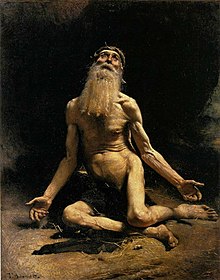
The Old Testament character of Job is famous as the poster boy for suffering, grief, and sorrow. A divine and devilish drama was taking place behind the curtain of this world, of which Job had absolutely no clue about. All he knew was that he lost everything – his family, his wealth, and his standing before others. The only thing left was his own life – and he was in such physical pain and emotional agony that he was ready to die.
Yet, the greatest pain of all seems to be the silence of God. Job has no idea, nothing to grab ahold of no earthly sense of why he was going through such intense and terrible suffering. His cries, tears, pleas, and expressions of deep hurt seemingly go un-noticed. Job felt truly alone in his horrible pain of body and spirit.
“We must learn to regard people less in the light of what they do or omit to do, and more in the light of what they suffer.”
Dietrich Bonhoeffer
Job’s story is as old as time – probably having taken place 4,000 years ago. And here we are, all these millennia later, knowing the story of why Job suffered, as well as the end of the story. But Job himself never knew why he suffered, even when God spoke and restored his health and wealth.
It is so extremely easy and normal to ask the question, “Why!?” When we are in the throes of emotional pain and our prayers seem to bounce off the ceiling, there is only trust left for us. We do what is unthinkable to others who have never known God – place our complete reliance and hope on the God for whom we know is not really sleeping or off on a vacation. We believe, even know, God is there. For whatever reasons which we might never know this side of heaven, God chooses to remain silent.
The genuineness of faith is not determined by giving the right answers to a theology questionnaire. Genuine faith is made strong through the trials, sufferings, pain, and lack of understanding in this life. We all suffer in some way. How we choose to respond to that suffering, either by cursing God and becoming bitter, or holding to God even tighter and becoming better, is totally up to you and me.
God of all creation, you see and survey all your creatures here on this earth. Sometimes I just do not understand what in the world you are doing or not doing. Yet today I choose to put my faith, hope, and love in you. I may not know what the heck I am doing, but you always work to accomplish your good purposes, through Jesus Christ, my Savior, along with the Holy Spirit. Amen.