2 Corinthians 4:13-5:1 – Do Not Lose Heart

It is written: “I believed; therefore, I have spoken.” Since we have that same spirit of faith, we also believe and therefore speak, because we know that the one who raised the Lord Jesus from the dead will also raise us with Jesus and present us with you to himself. All this is for your benefit, so that the grace that is reaching more and more people may cause thanksgiving to overflow to the glory of God.

Therefore, we do not lose heart. Though outwardly we are wasting away, yet inwardly we are being renewed day by day. For our light and momentary troubles are achieving for us an eternal glory that far outweighs them all. So, we fix our eyes not on what is seen, but on what is unseen, since what is seen is temporary, but what is unseen is eternal.

For we know that if the earthly tent we live in is destroyed, we have a building from God, an eternal house in heaven, not built by human hands. (New International Version)

We all face seasons and circumstances that stretch our faith and press the limits of what we can handle.

We have no promise from Scripture we will avoid trouble. 

Instead, Jesus promises his followers there will be adversity and stressful predicaments. 

The pressures of life can sometimes be so overwhelming, we might lapse into losing heart, either by chiding ourselves for the adversity and wishing things were different, or blaming others for our troubles, and believing that if they would just get their act together, all would be well with my soul. 

The ancient Corinthian Church had a bevy of relational issues and problems. Some they created themselves. Some came from other people. Other issues arose simply by living in a fallen world, surrounded by the effects of ever-present sinful crud. 

Yet, no matter the source or nature of the problem, the Corinthians needed a point of focus to direct their troubled hearts. They needed to be reminded of the grace they possessed in Jesus Christ.

Faith is a gift given by God. It is planted in the heart of the believer so that, over time, it will nurture, grow, and bear spiritual fruit. Out of that belief arises speaking words of hope and love that embrace the work of God in the life of the believer. The Apostle Paul said elsewhere to the Roman Church: 

If you openly declare that Jesus is Lord and believe in your heart that God raised him from the dead, you will be saved. For it is by believing in your heart that you are made right with God, and it is by openly declaring your faith that you are saved. (Romans 10:9-10, NLT)

Christ’s resurrection from death is both a spiritual and a physical reality. If we believe this truth in our hearts, we will be raised both spiritually and physically. Faith in Christ gives shape to the hope that, although we might be experiencing the effects of mortality and the fall of humanity, we are, at the same time, being spiritually renewed day by day. 

The very same afflictions causing our bodies to degenerate and challenging our spirits, are the same means to achieving a glorious, resurrected existence. There cannot be the glory of spiritual and bodily resurrection without a shameful death. Jesus absorbed the shame of the world’s violent ways onto himself so that we might be raised with him. 

However, this does not mean we will never experience difficulty in this present life. In fact, daily spiritual renewal can and does happen through adverse circumstances. There must be suffering before glory, both for Jesus and for us. Deliverance from sin, death, and hell is not an inoculation from trouble. Because it is the troubles of this life which teach us to trust in God, as well as weaning us from everything we previously trusted to deal with those troubles.

“Don’t let your hearts be troubled. Trust in God, and trust in me.”

Jesus (John 14:1, NIV)

So, we need to fix our gaze firmly on the unseen reality of faith and hope. All we see with our physical eyes is temporary. All that is unseen is eternal, especially and namely, God. Therefore, it is imperative we traffic in building heavenly treasure, learning to deal with the intangible and unseen dimensions of life.

We are to allow the physical to serve as a sign and seal of the spiritual realities they represent.

For example, Christians come to the Lord’s Table so that the tangible elements of bread and cup will bolster and fortify our faith with the grace that points to the intangible. The Table is to accomplish for us a spiritual renewal of lifting us up by God’s Spirit and joining us with Jesus. This union with Christ can never be taken away from us, even in death, because we have an eternal building from God which makes this present life look like a camping trip.

When I think of a person who is outwardly wasting away, yet inwardly being renewed, I think of Joni Eareckson Tada. She has been a paraplegic for fifty years, after an accident as a teenager in which she dove into shallow water and broke her neck. Afterwards, lying in a hospital for months unable to move, she had completely lost heart to the point of being suicidal. 

Joni could not even kill herself since she could not physically move. Finally, in her darkest moment, she cried to God with what she says was the most significant prayer she ever prayed: “Lord, if I can’t die, show me how to live.” And God did. Joni’s faith is as strong and robust as anyone’s, despite her infirmity and handicaps. She has learned to embrace her troubles as the means of growing her faith.

The path to accept, cope, and transcend our troubles and afflictions begins with acknowledging them. They only have power over us for ill if we ignore them or put up a false front to hide them. The Apostle Paul was open with the Corinthians about his life: 

We do not want you to be unaware, brothers and sisters, of the affliction we experienced in Asia; for we were so utterly, unbearably crushed that we despaired of life itself. Indeed, we felt that we had received the sentence of death so that we would rely not on ourselves but on God who raises the dead. (2 Corinthians 1:8-9, NRSV) 

Paul faced whippings, beatings, stoning, shipwreck, hunger, poverty, danger, and trouble, not to mention the stress of caring for fledgling churches. Through it all, Paul was transparent, and named his troubles so he could apply the poultice of God’s grace to his afflictions. 

It is our brokenness – not having it all together – which shows the grace of God to others.

Paul consistently described his life and ministry in apparent paradoxes: strength in weakness; glory through shame; life through death; riches through poverty. 

Although we experience the fallen nature of the world, God bends each situation toward divine purposes so that what seems to be our downfall becomes the means to our spiritual renewal.

Therefore, we do not lose heart. 

Holy Scripture encourages us not to give up because of hardship, since those very same troubles are the divine implements used to form us into solid followers of Jesus.

We need some stress. Just like a violin needing its strings adjusted to the right pressure, God will tune us with the right amount of stress we need to produce beautiful melodious music. God is the musician, and we are the instrument, not the other way around. 

We are to interpret our stress as God tuning us for good purposes. The pressure we experience becomes the means of glorious music in daily spiritual renewal for the life of the world.

Believers are being renewed daily into a valuable work of God. The stress and trouble we experience is very real and sometimes quite hard. Yet, we have the hope God will bend each circumstance for good purposes so that, even though we seem to be wasting away on the outside, on the inside those experiences are renewing us. 

When this present life is over, it is not the end; it is just the beginning.

God Almighty, you reign supreme, including over our stress and pressure in this present life. You have brought us in safety to this day. So, preserve us according to your mighty power, so that we might not fall into sin, nor be overcome by adversity. In all the situations of life, whether good or bad, direct us to the fulfilling of your purposes through Jesus Christ our Lord. Amen.


Luke 8:4-15 – Christ’s Parable of the Soils

While a large crowd was gathering and people were coming to Jesus from town after town, he told this parable: “A farmer went out to sow his seed. As he was scattering the seed, some fell along the path; it was trampled on, and the birds ate it up. Some fell on rocky ground, and when it came up, the plants withered because they had no moisture. Other seed fell among thorns, which grew up with it and choked the plants. Still other seed fell on good soil. It came up and yielded a crop, a hundred times more than was sown.”

When he said this, he called out, “Whoever has ears to hear, let them hear.”

His disciples asked him what this parable meant. He said, “The knowledge of the secrets of the kingdom of God has been given to you, but to others I speak in parables, so that,

“‘though seeing, they may not see;
    though hearing, they may not understand.’

“This is the meaning of the parable: The seed is the word of God. Those along the path are the ones who hear, and then the devil comes and takes away the word from their hearts, so that they may not believe and be saved. Those on the rocky ground are the ones who receive the word with joy when they hear it, but they have no root. They believe for a while, but in the time of testing they fall away. The seed that fell among thorns stands for those who hear, but as they go on their way they are choked by life’s worries, riches and pleasures, and they do not mature. But the seed on good soil stands for those with a noble and good heart, who hear the word, retain it, and by persevering produce a crop. (New International Version)

The Parable

“Whoever has ears, let them hear,” said Jesus. Truly hearing Christ’s words and listening with focused attention is paramount to the Christian life. Our ears are the soil of our lives. Ears attentive and devoted to listening to Jesus are good soil; ears distracted, inattentive, and stopped up with ear wax are bad soil. Receptive listening to the Word of God brings a fruitful harvest of righteousness, peace, and joy in the Holy Spirit. Genuinely believing what we hear from Jesus is crucial. God’s Word falls on four different soils….

  1. The seed on the path. A path is for walking, which is why the seed never takes root. Here there is no listening. When we act without listening, our actions will be misguided. 
  2. The seed on rocky soil.  Here there is no deep listening. A lack of attentive hearing results in a shallow person who perhaps relies more on Christian clichés or on their personality or abilities instead of the sown Word.
  3. The seed on the thorny soil. Here there is significant listening. However, there is too much listening to a cacophony of voices and not enough singular listening to the sown Word. Listening to the wrong voices will cause an unfruitful life. So, we must be careful to whom we are listening.
  4. The seed on good soil. A devoted listening to the Word without distraction leads to a productive, fruitful believer.

“There is a difference between listening and waiting for your turn to speak.”

Simon Sinek

The Nature of Parables

A parable is a genre of biblical literature. Parables are as much about concealing truth as they are conveying truth. A person must give focused attention to the story to learn from it, much like a good novel conveys truth about the human condition without being preachy or outright saying the truth. Or it’s much akin to a good movie relying on character development and the power of story for its message, instead of being a straightforward documentary.

Jesus neither strong-arms people nor puts them in a full nelson to force them into God’s will. We will miss out on God’s working, if we are looking for a big dramatic hoo-ha of an event. That’s because it comes as an awareness within people and works its way out. For those not intent on changing, they will find Christ’s words confusing. They might “hear” Jesus, yet fail to really listen, since they have their own ideas about how God ought to operate.

Yet, grace is still present. The very fact that Jesus addressed the crowd of people demonstrates he cared enough to communicate. He could have said, “Hey, you guys, get lost, I’m just going to interact with people who really listen to me.” Instead of coming at the crowd and bursting through the front door, Jesus mercifully came to them through the side door so that they would be able to receive the message. 

Puking the good news of Jesus all over people without really listening is a bad idea. Neither is being worried about saying something offensive, so nothing is said at all. A better approach is asking permission to tell your story of what Jesus means to you, or what you are learning from God’s Word.

The Parable Interpreted

The focus is the experience of the seed in a variety of soils. Outside powers acting on the Word – devouring birds, rocks, the burning sun, choking thorn-bushes – demonstrate the Word is central and needs to be received well:

  1. The path is the inability to hear God’s Word because of hard-heartedness. The devil snatches it before any real understanding can take place.
  2. The rocky soil is hearing just enough to respond with joy. But the person drops out when hard circumstances occur. “I didn’t sign up for this!” is their cry. They needed to count the cost of discipleship before responding to the message. This is merely a professing Christian, nothing more.  Rather than listening and internalizing the Word, there is only positive affirmation without any action or practice. So, tomorrow the message is gone and forgotten. When difficulty comes, there are no supporting words to draw from, so the person fades away, unable to navigate life successfully.
  3. The thorny soil also hears and responds to the message. This person is also a professing Christian, nothing more. The issue here is that they also listen to voices of worry and wealth. In a sort of spiritual attention-deficit-disorder, there is no ability to filter all the voices calling out, and so, no growth.
  4. Listening with the intention of understanding and putting into practice the message heard is what brings about fruit. Receiving the Word through careful listening brings about spiritual growth. God brings the growth when we focus on the Word. And when a whole group does this, then it creates a greenhouse effect in which people cannot help but grow in the Lord.

Conclusion to the Parable

The simple reception of God’s Word leads to fruitfulness. The first soil did not receive the Word, though it listened. The second received it with joy but under pressure let it go. The third received it with only one hand because the other hand was busy. Only the fourth soil received the Word with both hands.

Blessed is the one who does not walk in step with the wicked or stand in the way that sinners take or sit in the company of mockers, but whose delight is in the law of the Lord, and who meditates on his law, day and night. That person is like a tree planted by streams of water, which yields its fruit in season and whose leaf does not wither—whatever they do prospers. (Psalm 1:1-3, NIV)

The old adage that we were created with two ears and one mouth, so that we will listen twice as much talk, is a truism. It’s hard to receive any words of encouragement, help, or reproof if you’re tongue is flapping in the wind.

Careful listening, attention to memory, and patient application are the pathways to realizing an abundant spiritual harvest of righteousness and peace.

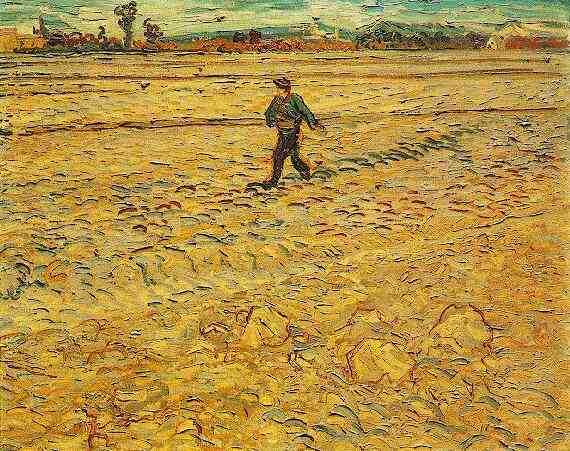
*Above paintings, The Sower by Vincent Van Gogh, 1881 & 1888

1 Corinthians 2:1-10 – Where Does the Power to Change Come From?

When I came to you, I did not come with eloquence or human wisdom as I proclaimed to you the testimony about God. For I resolved to know nothing while I was with you except Jesus Christ and him crucified. I came to you in weakness with great fear and trembling. My message and my preaching were not with wise and persuasive words, but with a demonstration of the Spirit’s power, so that your faith might not rest on human wisdom, but on God’s power.

We do, however, speak a message of wisdom among the mature, but not the wisdom of this age or of the rulers of this age, who are coming to nothing. No, we declare God’s wisdom, a mystery that has been hidden and that God destined for our glory before time began. None of the rulers of this age understood it, for if they had, they would not have crucified the Lord of glory. However, as it is written:

“What no eye has seen,
    what no ear has heard,
and what no human mind has conceived”—
    the things God has prepared for those who love him—

these are the things God has revealed to us by his Spirit.

The Spirit searches all things, even the deep things of God. (New International Version)

We need the Holy Spirit of God.

Without the Spirit’s help, Jesus is merely one of thousands of individuals crucified in history – only an example of someone martyred for his faith. Yet, Jesus was infinitely more. Christians discern Jesus as the Son of God and Savior of the world. 

Through Christ’s life, death, resurrection and ascension, people can be redeemed from empty lives, saved from destructive life-patterns, and given the kind of security and purpose which God intended from the beginning. The Spirit’s role is to take these redemptive events of Jesus and apply them to our lives. 

Thus, Christian Trinitarian theology understands we are unable to see the truth about the cross of Jesus Christ unless God the Holy Spirit, sent by God the Father and the Son, breaks into our lives and does an intervention, showing us our denial about how we are really doing – as well as our delusions about who we really are.

Admitting we need the Holy Spirit of God means the power of Christianity and the Christian life rests with Jesus Christ and him crucified, and not with us.

We are, in many ways, powerless. I realize this is not a popular message, especially in Western society. Tell the average American they are powerless, and they’ll think you’re off your rocker. It sounds ridiculous. Some would argue that we have done well, thank you very much, on our own. We have a couple of cars, a house, a job, and a family. After all, we worked hard, and we did it.

However, any worldly success we gain, and getting the things we want, may lead us to the delusion we have the power to do whatever we want.

Oh, sure, we might reason, we have problems just like everybody else. After all, we cannot control everything.  But we are not completely powerless just because we have difficult circumstances and a few problem people in our lives. God will step in a take-over where I leave off, right?…

Wrong. Apart from the Holy Spirit of God, we are unable to become Christians and live the Christian life. If we believe we manage our lives fine, with some help from God, then we might be in denial about how much we place ourselves at the center of the world. And believe we should be able to deal with whatever comes at us in life. When our consistent response to adversity, or the realization we are not handling something well, is to try and fix ourselves, we are living the delusion we have the power to change.

A reflexive response in asking Google to find answers to our problems; dealing privately with our personal issues; expecting our willpower to be enough; passively resigning ourselves to mediocre lives because we have tried to change or be different; then this means we are feeding the delusion we do not really need the Holy Spirit of God. But just need more effort or information to overcome my problems. And when more doesn’t solve our issues, we easily become discouraged.

We need the true power source of the Christian life. We need the Holy Spirit applying the work of Jesus Christ to our lives so that we can live a victorious life.

Unfortunately, it typically takes a tragedy or crisis to break our delusion of power – a bad marriage, a family member’s addiction, a runaway child, a terminal illness, a bankruptcy, a death. How bad do you and I need to hurt before we will admit we are not managing our lives well, at all, and that the real power to change resides with the Holy Spirit?

There is power in the cross of Jesus Christ. The Apostle Paul believed this with all his heart. Although Paul was an intelligent and learned person, he did not rely on his abilities but on proclaiming the power of Jesus and him crucified. The crucifixion of Christ was a past action with continuing and forceful ripples into the present time.

The cross of Jesus is more than an historical event; it is an ongoing reality to experience for victory over all the brokenness of this world and all the mess we have made of things putting ourselves at the center of the universe.

The Reformer, John Calvin, repeatedly instructed and encouraged his Geneva congregation that the Spirit joins us to Christ, assures us of salvation, and grows us in confidence through the Scriptures. Calvin, although a genius, did not rely on his intellect or abilities but insisted we need the Spirit’s witness to mature as followers of Jesus.

There are tough situations and incredibly sad realities which are mysteries beyond our comprehension. They defy simplistic answers and are greater than our attempts to explain them. Hard problems stretch our faith. And they ought to cause us to cry out to God and Christ’s church for help because we are powerless to manage our lives.

We absolutely and totally need the Holy Spirit of God. Without the Spirit, we are lost. But with the Spirit we experience the saving power of Christ’s cross to deal with everything in our lives.

The Serenity Prayer: God grant me the serenity to accept the things I cannot change; courage to change the things I can; and wisdom to know the difference.  Living one day at a time; enjoying one moment at a time; accepting hardships as the pathway to peace; taking, as Jesus did, this sinful world as it is, not as I would have it; trusting that he will make all things right if I surrender to his will; that I may be reasonably happy in this life and supremely happy with him forever in the next. Amen.

John 15:18-20, 26-27 – Moving in with Jesus

“If the world hates you, keep in mind that it hated me first. If you belonged to the world, it would love you as its own. As it is, you do not belong to the world, but I have chosen you out of the world. That is why the world hates you. Remember what I told you: ‘A servant is not greater than his master.’ If they persecuted me, they will persecute you also. If they obeyed my teaching, they will obey yours also…

When the Advocate comes, whom I will send to you from the Father—the Spirit of truth who goes out from the Father—he will testify about me. And you also must testify, for you have been with me from the beginning.” (New International Version)

Two characters: Jesus and Emmet

Scene:  Emmet is moving in with Jesus as a roommate.

Emmet enters….

“Nice digs, Jesus. Not quite what I was expecting – looks good and clean – but just ordinary.”

“I’m glad you decided to take up my offer and come live with me in my house, Emmet. Well, it’s actually my Father’s house.”

“Yeah, well, it wasn’t working out so well with my girlfriend, Jezebel. She was into a lot of weird stuff, like some crazy real estate schemes, especially with vineyards – the woman is obsessed with buying up vineyards. Besides, she told me she hates me. That really hurt.”

“Emmet, I think you will find I’m into a different kind of vineyard and real estate. And there isn’t any hate there. It’s called ‘the kingdom of God.’”

“Kingdom, huh?  Sounds like a pretty big gig to me, Jesus.”

“Oh, yes, it is. The biggest. You know, Emmet, by living and abiding with me here you will get to know all about the kingdom.”

Sounds groovy, man… or should I say, ‘Son of Man!’ Hey, Jesus, you got any beer and chips in this joint?  I’m starving.”

“No, sorry, I’m afraid not right now. But I do have some wine and some bread.”

“Well, okay, Jesus. I’m super hungry. I could go for about anything.”

Here you go Emmet.” (Jesus gives Emmet a wafer and communion cup – Emmet just stands there and looks at it). “Make yourself at home in my love, Emmet.”

“Um, hey, Jesus, not to be ungrateful or anything, but is this all you have?”

“Just try it, Emmet. I think you will find it rather satisfying.”

(Emmet takes the bread and drinks the cup). “Holy Communion, Jesus! Whoa! I’m actually full! What in the world is in that stuff, anyway?”

“There’s no world in it, at all, Emmet. I am the vine. You are the branch. When you drank, you ingested me.  You’re joined with me, and I with you. Apart from me you are always going to be hungry and thirsty, no matter how much other food you eat and how much beer you drink. But if you stay here and settle in with me, make this your permanent home and not just a place to hang your hat, you can be sure that I will always listen to you and do whatever you ask of me.”

“That’s heavy, man. Very cool. I can dig it!”

“I have told you this for a purpose, Emmet – that we might enjoy being roommates together. By the way, I have just one rule in my house that I expect to be obeyed, always: Love other people in the same way that I love you.  Never forget, Emmet: If you ever get locked-out of the house, it is love which opens the door to my place.  Remember, Emmet, that love is the key.”

“You know, Jesus, you’re kind of odd, but I like you, dude. I’m glad I chose to come here.”

“Emmet, you did not choose me; I chose you and brought you here because of my love. And I am sending you into the world to love. Remain here with me, abide with me in this place, and you will see things happen beyond what you can even think or imagine. Go, now, and bear the fruit of love in my kingdom, and when you come back, I’ll have a place for you to sleep and you will rest like you have never rested before.”

“I really appreciate your hospitality, Jesus. But what if I mess up? Or forget about your rule?”

“When you came here, Emmet, you probably saw someone standing just outside the door.”

“Yeah… I did see some dude who looked way out there, man, like he was from another universe, like maybe New Jersey, or something.”

“That was the Advocate. He will come whenever you mess up or forget about my love. The Advocate will help you remember the truth.”

(Jesus walks Emmet to the door). “There’s nothing to worry about. Just go and love others like I love you. Good-bye, Emmet.”

“Bye, Jesus. I’ll be back after I go spread some love around, just like you taught me….”

*Above Photo by Amina Filkins on Pexels.com