Psalm 101 – The Ethics of King David

I will sing to you, Lord!
    I will celebrate your kindness
    and your justice.
Please help me learn
    to do the right thing,
    and I will be honest and fair
    in my own kingdom.

I refuse to be corrupt
or to take part
    in anything crooked,
    and I won’t be dishonest
    or deceitful.

Anyone who spreads gossip
    will be silenced,
    and no one who is conceited
    will be my friend.

I will find trustworthy people
    to serve as my advisors,
    and only an honest person
    will serve as an official.

No one who cheats or lies
    will have a position
    in my royal court.
Each morning I will silence
    any lawbreakers I find
    in the countryside
    or in the city of the Lord. (Contemporary English Version)

King David was one serious dude when it came to dealing with wickedness and injustice. He had a zero tolerance policy toward people who were deceitful and proud. David was determined to deal with slanderous and arrogant people. He sought to establish a rule and reign based in his own personal integrity and practice of being a king who seeks after what is right and just.

And so, David refused to take a second look at corrupt people and things which degraded and debased others. He gathered around himself officials who genuinely care about kindness and justice.

David was not about to put up with anyone in his court who had personal agendas of power and privilege at the expense of the powerless.

For David, a diligent and conscientious application of God’s just and right law was absolutely necessary to a benevolent reign in which everyone felt secure and were able to enjoy the Promised Land. Corrupt officials had no place in the kingdom and would be summarily dealt with.

Unfortunately, there are far too many leaders in our world today who create cultures of fear, insecurity, and walking on eggshells. They are crafty and deceitful, actually using organizational codes of morality and ethics to hide their damaging and destructive effect on people.

We may not be kings like David, yet we can share his stance of not avoiding the evil in front of us and dealing with corruption, dishonesty, and disingenuous behavior from others, especially those in positions of power and authority. Toxic authority figures actively isolate us, making us feel stupid and incompetent and afraid to share our struggles with others, so that they can maintain all of the power. 

How, pray tell, might us lowly persons take on those with leverage and power over us, whether they be job bosses, church pastors, local politicians, or family members?

  • Do everything from a place of integrity. Seek the Lord in doing the right thing. Ultimate power belongs to God, not some puny person who is master of a small world.

Whoever walks in integrity walks securely, but whoever takes crooked paths will be found out. (Proverbs 10:9, NIV)

  • Refuse to play their game. Don’t resort to gossip, backbiting, or displays of your own supposed power. Be just, kind, wise, and, most of all, humble. Virtue will serve you well. Vice will not.

Gossip is spread by wicked people; they stir up trouble and break up friendships. (Proverbs 16:28, GNT)

  • Keep in mind that niceness is often used by corrupt leaders to keep others under their thumb. Dishonest and deceitful people are not necessarily bullying. They’ll use whatever means they can to get their way.

Flattery is nothing less than setting a trap. (Proverbs 29:5, CEV)

  • It is always our place to love, not judge. King Jesus is the Judge, not me, not you. Loving an unlovable person can only happen if we have a love for God which is able to see God’s image in every person we encounter, including that difficult leader. In the end, they will be held accountable – whether in this life, or in the one to come. Jesus said:

“You have heard that it was said, You must love your neighbor and hate your enemy. But I say to you, love your enemies and pray for those who harass you.” (Matthew 5:43-44, CEB)

  • Watch your back. Yes, we are to trust in the Lord. That doesn’t mean we implicitly trust everyone and/or every organization. Jesus said:

“Listen! I am sending you, and you will be like sheep among wolves. So be smart like snakes. But also, be like doves and don’t hurt anyone. Be careful!” (Matthew 10:16-17a, ERV)

We all, like King David of old, need an unequivocal commitment to a zero tolerance policy toward evil. It is simply unacceptable to flirt with it. Whatever we must do to remind ourselves of righteousness, and whatever boundaries we need to set, is most necessary, because no one who practices deceit will dwell in the Lord’s house.

Holy God of justice, I will make a covenant with my eyes to set before them no vile thing. Help me to be strong in your mighty power so that my daily walk of faith in Jesus is righteous, free of guilt, and enjoyable.  Amen.

John 4:7-26 – Living Water

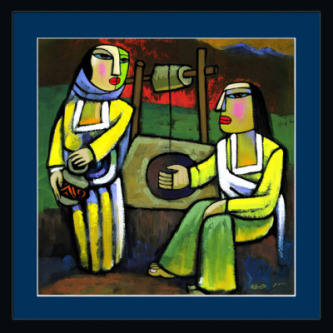
Samaritan Woman at the Well by He Qi

When a Samaritan woman came to draw water, Jesus said to her, “Will you give me a drink?” (His disciples had gone into the town to buy food.)

The Samaritan woman said to him, “You are a Jew, and I am a Samaritan woman. How can you ask me for a drink?” (For Jews do not associate with Samaritans.)

Jesus answered her, “If you knew the gift of God and who it is that asks you for a drink, you would have asked him, and he would have given you living water.”

“Sir,” the woman said, “you have nothing to draw with and the well is deep. Where can you get this living water? Are you greater than our father Jacob, who gave us the well and drank from it himself, as did also his sons and his livestock?”

Jesus answered, “Everyone who drinks this water will be thirsty again, but whoever drinks the water I give them will never thirst. Indeed, the water I give them will become in them a spring of water welling up to eternal life.”

The woman said to him, “Sir, give me this water so that I won’t get thirsty and have to keep coming here to draw water.”

He told her, “Go, call your husband and come back.”

“I have no husband,” she replied.

Jesus said to her, “You are right when you say you have no husband. The fact is, you have had five husbands, and the man you now have is not your husband. What you have just said is quite true.”

“Sir,” the woman said, “I can see that you are a prophet. Our ancestors worshiped on this mountain, but you Jews claim that the place where we must worship is in Jerusalem.”

“Woman,” Jesus replied, “believe me, a time is coming when you will worship the Father neither on this mountain nor in Jerusalem. You Samaritans worship what you do not know; we worship what we do know, for salvation is from the Jews. Yet a time is coming and has now come when the true worshipers will worship the Father in the Spirit and in truth, for they are the kind of worshipers the Father seeks. God is spirit, and his worshipers must worship in the Spirit and in truth.”

The woman said, “I know that Messiah” (called Christ) “is coming. When he comes, he will explain everything to us.”

Then Jesus declared, “I, the one speaking to you—I am he.” (New International Version)

Jesus and the Samaritan Woman by He Qi

Many years ago, I was the pastor of a small congregation north of Detroit, Michigan. Many of the people in the community viewed the big city as a place of disrepute. So, they avoided going into the heart of the great city as much as possible.

The locale of Samaria was viewed much the same way by many Jews back in Christ’s day. Samaritans were seen as untrustworthy, a mongrel people with a mix of Jewish and ancient Assyrian blood. And their religion was most suspect of all – an amalgam of Jewish and Gentile practices.

Jesus, however, didn’t avoid the territory. He confidently walked through Samaria and had no problem stopping to rest on his journey in a foreign area. That’s because Jesus didn’t class people into groups, nor did he attach adjectives to people, such as “those” Samaritans.

Jesus had no obstacles between himself and others.

Which is why an organic conversation happened between Jesus and a Samaritan woman. Christ simply saw a human being who happened to be a woman and a Samaritan. He acknowledged both her gender and her ethnicity without those being a problem. Not even Christ’s knowledge of her string of husbands was a problem in conversing with her.

Every time I read this narrative of Jesus interacting with the Samaritan woman, I wonder and use my imagination about all the non-verbal communication. I am sure the conversation was as much about Christ’s affect, gestures, and tone of voice, as it was his well placed words. I fully believe his verbal and non-verbal communication was perfectly congruent with each other, giving the woman a compelling sense that her ultimate needs could be met with the living well of a person in front of her.

Water gives life. And Jesus, as living water, gives new life. A bunch of failed relationships testified to the woman’s dissatisfaction. Even though we hear no more about her after this story in the Bible, we as readers get the overwhelming sense that the woman finally found satisfaction. The love which kept slipping through her fingers now had staying power.

I am sure the Samaritan woman discovered true worship, in spirit and in truth.

I still remember my first encounter, at least my first aware experience, with the living Christ. I am quite sure Jesus was near me for a long time, without me knowing his presence. Words will never truly capture the overwhelming sense of love, acceptance, mercy, kindness, and deep satisfaction – a contentment and gratification which has stuck with me now for decades.

Messiah, “Savior,” is an apt term for Jesus. He certainly saved me from myself. And Christ has never left me nor forsaken me – always there, always available, always loving with both tender love and tough love.

I’m glad that Jesus didn’t consider this earth like the city of Detroit – a place to avoid – but willingly came to encounter people like the Samaritan woman, and me. And this is the basis of true worship.

“Have faith in me, and you will have life-giving water flowing from deep inside you, just as the Scriptures say.” (John 7:38, CEV)

Lord Jesus, Son of God, Savior of humanity, there is a river flowing straight from your heart into mine — replenishing, renewing, sustaining. May you, as Living Water, be persistent in me, breaking through every barrier in its path. Send this hydro-power through the dark crevices of my heart like a mighty flood overcoming and pushing everything out of the way that blocks its path. I want my heart to be washed clean of any debris cluttering and blocking your life-giving flow. May your love overflow onto your people — your grace, your mercy — into the lives of those we encounter, to your glory and honor, in spirit, and in truth. Amen.

John 6:35-40 – The Bread of Life

I Am the Bread of Life by Joseph Matar

Jesus said, “I am the Bread of Life. The person who aligns with me hungers no more and thirsts no more, ever. I have told you this explicitly because even though you have seen me in action, you don’t really believe me. Every person the Father gives me eventually comes running to me. And once that person is with me, I hold on and don’t let go. I came down from heaven not to follow my own agenda but to accomplish the will of the One who sent me.

“This, in a nutshell, is that will: that everything handed over to me by the Father be completed—not a single detail missed—and at the wrap-up of time I have everything, and everyone put together, upright and whole. This is what my Father wants: that anyone who sees the Son and trusts who he is and what he does and then aligns with him will enter real life, eternal life. My part is to put them on their feet alive and whole at the completion of time.” (The Message)

Bread has always been a food staple throughout human history. Whereas many people today try and avoid bread because of either carbohydrates or gluten, a lack of bread in the ancient world usually meant people would starve to death. Bread is a big deal.

So, when Jesus gave a self-description as the Bread of Life, he was saying a lot.

The cup we use in the Lord’s Supper and for which we give thanks to God: when we drink from it, we are sharing in the blood of Christ. And the bread we break, when we eat it, we are sharing in the body of Christ. (1 Corinthians 10:16, GNT)

After the Israelites were delivered by God from their bondage in Egypt, and found themselves in the desert without food, the divine provision of manna – a unique kind of bread – literally showed up on the desert floor every morning. It was just enough for everyone for that day. Once the Israelites entered the Promised Land, the manna disappeared.

As Jesus entered fully into his earthly ministry, throngs of people began following him. At one point, the thousands of men, women, and children were together with nothing but a couple of fish and a few loaves of bread. Much like the miraculous provision of manna which sustained their ancestors centuries earlier, Jesus multiplied the measly morsels of bread into enough to feed the entire bunch, with leftovers.

Little is much when God is in it. Just a smidgeon of Jesus is enough to fill a crowd of growling stomachs.

The Lord Jesus is not like a loaf of bread bought in a grocery store which has all kinds of funky additives, loaded up with sugars, and questionable ingredients you can’t even pronounce. Christ is fortified with everything we need to thrive and flourish. Jesus is so packed with good stuff that a seemingly paltry communion wafer is filling and satisfying.

The bread that comes down from heaven isn’t like what your ancestors ate. They died, but whoever eats this bread will live forever. (John 6:58, CEV)

Just as bread is a simple mixture of water and flour, so partaking of Jesus is rather uncomplicated. There aren’t hoops to jump through or lengthy recipes to follow. If we simply align ourselves with Christ, come to him and believe, we will never be hungry again.

The world needs bread. They ask for bread. In response, Jesus gave them himself.

Give us the bread we need for today. (Matthew 6:11, CEB)

All the world has to offer, and of which so many humans strive to obtain and accumulate treasures on earth, money and possessions, does not bring ultimate satisfaction. The drive for more is never satiated. Humanity is afflicted with boredom, dissatisfaction, anxiety, and worry over losing what they have and fretting about how they can obtain just one more thing in the misguided belief their fear will finally melt.

But it doesn’t. So, like a hamster running in a wheel and going nowhere, there is the constant activity of racing thoughts and workaholic behavior to try and somehow keep ahead. Yet, authentic rest never comes. The more the striving, the more the anxiety.

There is a divine/human responsibility and cooperative at work. Jesus will hold us secure. And we need to let him do it, and fully align our lives according to Christ’s words and ways. The divine bread is available. God isn’t going to force feed us. We will need to take and eat.

It requires faith to take and eat. We might wonder: Will I like it? Is it really going to satisfy me? What if I’m allergic to it? Do I need some other food handy to eat in case I gag or vomit? Will there be pie? Mac & cheese? Bacon? (insert your own comfort food) Do I have to eat alone?

Try it. You’ll like it.

My own experience of having tasted much of what the world has to offer, and tasting the good flavor of God’s grace, I can say that I never want to go back to the gruel of guilt and shame.

I have tasted and seen that the Lord is good. And that is what I want for you, too.

Taste and see that the Lord is good; blessed is the one who takes refuge in him. (Psalm 34:8, NIV)

The bread is for me, and it is for you. There is plenty of bread for the life of everyone in the world. No rationing is necessary. This is the place of abundance.

“I am the living bread which came down from heaven. If anyone eats of this bread, he will live forever; and the bread that I shall give is My flesh, which I shall give for the life of the world.” (John 6:51, NKJV)

Almighty and everlasting God, I thank and praise you for feeding me with Jesus, the Bread of Life. Send your Holy Spirit so that I may by faith obtain and eternally enjoy your divine grace, the forgiveness of sins, unity with Christ, and everlasting life; through Jesus Christ my Lord. Amen.

Matthew 5:8 – Blessed Are the Pure in Heart

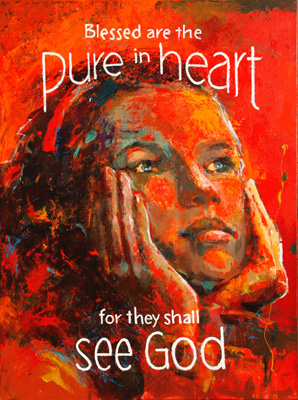
“Blessed are the pure in heart,
    for they will see God.” (NIV)

“You’re blessed when you get your inside world—your mind and heart—put right. Then you can see God in the outside world.” (MSG)

“What bliss you experience when your heart is pure. For then your eyes will open to see more and more of God.(TPT)

“A pure heart means a single heart, a heart in which only one desire lives: love.”

Peter Kreeft

An Impure Scenario

Suppose a young man courts a young woman. They get to know one another, fall in love, and get married. On their wedding day, as they leave the church building and speed away, the young couple reminisce about love and life.

But when the groom begins to speak about a future together, the bride, with a smile on her face says, “Okay, you can pull over now.” The groom, completely smitten with his new bride, does exactly what she asks. The young woman gets out of the car and, blowing a kiss, says, “This was fun. Maybe I’ll see you around sometime.”

“I don’t think this is funny,” says the groom. “Hey, we had a great time, right!?” the perky bride says. “Yes, responds the groom, “and it will last forever.” “Oh, you are such a darling,” the bride says, and with a wry smile, “but I’ll be in touch.”

“Huh, what!?” the confused groom says. “Yeah, I’ll call. We’ll get together,” says the bride without flinching. The groom, now also feeling heartsick says, “I don’t understand. What’s going on?”

“Dear, I just need my space. It’s not like I don’t care! I have other things to do. Other men to see….”

Yes, a ridiculous and improbable scenario. Yet one which is repeated every day, multiple times a day. For the groom is the Lord God almighty; and the bride is the church….

Purity and God

Purity is a big deal to God. The phrase, “pure in heart,” is Christ’s way of upholding the biblical call to holiness. To be pure is to have no mixed motives, no hidden agendas, and no side job of moonlighting with the world while being an upstanding kingdom citizen during the day. It isn’t letting Jesus court us and marry us, only to have us walk away and do whatever the heck we want. It’s not only impure and unholy. It’s plain wrong and messed up.

Through blessing the pure in heart, Jesus was connecting us to the Old Testament ethic of being holy. The book of Leviticus, rarely the focus of any preacher or parishioner alike, is completely given to the topic of holiness. The detailed laws about daily life, including what to wear and not wear, what to eat and not eat, even who to marry and not marry, were given for a reason.

God wanted the ancient Israelites to have daily reminders that they are a holy people. So, there was to be no mixing of fabrics, no meat and cheese together, no impurities introduced into any part of life. Everything about the Jewish lifestyle was to be holy, set apart to God, reminding the people that God is their husband, committed to them with responsibilities on the part of both. It was called a “covenant.”

Leviticus 19 leaves no stone unturned on the activities of life:

The Lord said to Moses, “Speak to the entire assembly of Israel and say to them: ‘Be holy because I, the Lord your God, am holy’….

Do not steal. Do not lie. Do not deceive one another. Do not swear falsely by my name and so profane the name of your God. I am the Lord. Do not defraud or rob your neighbor….

Do not pervert justice; do not show partiality to the poor or favoritism to the great but judge your neighbor fairly….

Do not go about spreading slander among your people. Do not do anything that endangers your neighbor’s life. I am the Lord. Do not hate a fellow Israelite in your heart. Rebuke your neighbor frankly so you will not share in their guilt. Do not seek revenge or bear a grudge against anyone among your people but love your neighbor as yourself. I am the Lord.

Do not mate different kinds of animals. Do not plant your field with two kinds of seed. Do not wear clothing woven of two kinds of material.” (Leviticus 19:1-2, 11-13, 15-19, NIV)

Yes, indeed, purity is a big deal to God. The “Holy” Spirit is the Divine Person completely devoted to doing only the will of the Father and Son – never going rogue. The Spirit is the One who effects sanctification, becoming holy, within the life of the believer. Each year we celebrate “Holy” Week, a stretch of days designed to be different than the rest – devoted to journeying with Jesus and not mixing with the fickle crowd who would scream at the end of the week, “Crucify him! Crucify him!”

Purity and Us

To follow Jesus in true righteousness is to be pure in heart, that is, set apart wholly and completely for him. Purity of heart is a fruit from the trunk of righteousness, which grew up in the soil of God’s grace, with roots of humility and meekness – all watered by the tears of godly mourning.

The pure in heart are those who acknowledge their sin, deal with it, and live with a clear and clean conscience before God and the world. They have an awareness of their wrongs and shortcomings without succumbing to self-criticism because of an equal awareness of God’s grace. They keep short accounts with others concerning what they have done or what they should have done. They are holy. They are sanctified. They are pure in heart.

The pure in heart will see God. They know they cannot make themselves pure, so they keep looking to Jesus for their forgiveness because they hunger for righteousness.

One cannot whitewash a wishy-washy commitment with Jesus and be pure. This blessed Beatitude has to do with our motives and what takes place in our thinking and in our hearts.  What do you think about when your mind slips into neutral?  Is it coveting after things or people, or does thinking go toward what is true, noble, right, pure, lovely, and admirable?  Sometimes we struggle with purity of heart because we are focused not on Jesus, but on our own performance and perfection instead of letting God fill our hungry hearts.

Purity results from true righteousness.  A stalk of corn might look good, but if you shuck it and it’s filled with worms, it isn’t going to be worth much. Legalistic righteousness and empty promises of doing better are concerned to look good, not to mention they are obsessed with performance, perfection, and possessions. 

But the righteousness of God fills our hungry hearts and makes us pure and holy, set apart for divine use and divine purposes. How, then, shall we live? What will we do?

The earth is the Lord’s, and everything in it,
    the world, and all who live in it;
for he founded it on the seas
    and established it on the waters.

Who may ascend the mountain of the Lord?
    Who may stand in his holy place?
The one who has clean hands and a pure heart,
    who does not trust in an idol
    or swear by a false god.

They will receive blessing from the Lord
    and vindication from God their Savior.
Such is the generation of those who seek him,
    who seek your face, God of Jacob. (Psalm 24:1-6, NIV)

The person with integrity shall see God. Those made pure with the cleansing blood of Jesus Christ will someday stand before God at the Last Judgment and there find mercy and acceptance.

So, for now, until that time, we daily have the opportunity to focus on our one true love with loyalty and commitment, enjoying God’s presence continually. Because the Lord will never leave us, nor forsake us, even when we sometimes forsake him.

Almighty God, to you all hearts are open, all desires known, and from you no secrets are hidden. Cleanse the thoughts of our hearts by the inspiration of your Holy Spirit, that we may perfectly love you, and worthily magnify your holy name, through Christ our Lord. Amen.