James 3:1-12 – Taming the Tongue

Not many of you should become teachers, my fellow believers, because you know that we who teach will be judged more strictly. We all stumble in many ways. Anyone who is never at fault in what they say is perfect, able to keep their whole body in check.

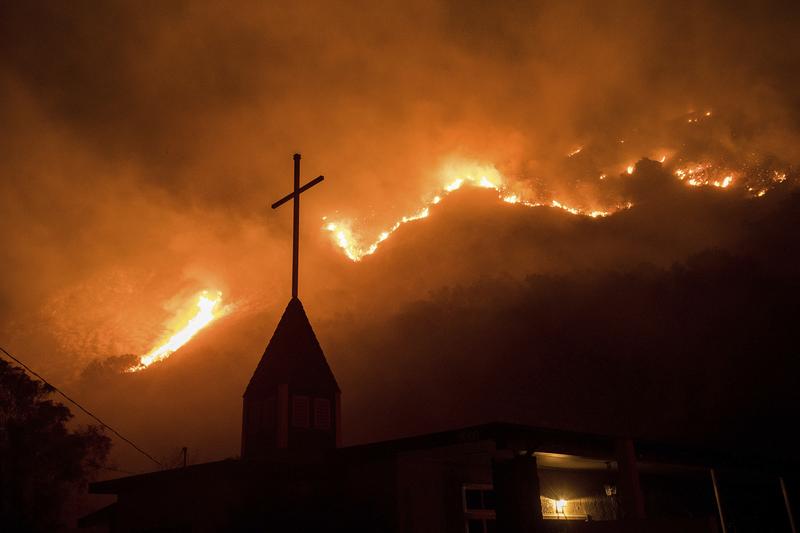
When we put bits into the mouths of horses to make them obey us, we can turn the whole animal. Or take ships as an example. Although they are so large and are driven by strong winds, they are steered by a very small rudder wherever the pilot wants to go. Likewise, the tongue is a small part of the body, but it makes great boasts. Consider what a great forest is set on fire by a small spark. The tongue also is a fire, a world of evil among the parts of the body. It corrupts the whole body, sets the whole course of one’s life on fire, and is itself set on fire by hell.

All kinds of animals, birds, reptiles and sea creatures are being tamed and have been tamed by mankind, but no human being can tame the tongue. It is a restless evil, full of deadly poison.

With the tongue we praise our Lord and Father, and with it we curse human beings, who have been made in God’s likeness. Out of the same mouth come praise and cursing. My brothers and sisters, this should not be. Can both fresh water and saltwater flow from the same spring? My brothers and sisters, can a fig tree bear olives, or a grapevine bear figs? Neither can a salt spring produce fresh water. (New International Version)

Words and speech are the most powerful tools we have in the Christian life. And the tongue is the means of forming the words and using the speech God gives us.

The problem is, we may too often underestimate the importance and the great power of the tongue to effect both good and evil. We might not believe that our particular words carry much weight.

Yet, in reality, our words are very powerful.  In fact, what we say with our tongues is either the vehicle of praise to God, or the ruin of another person. We must measure our words because the tongue is a beast to control and tame. 

The tongue is so powerful that it determines the direction of a person’s life.

The horse is a strong animal, and the strength of a horse must be respected at all times. Yet, a small woman, even a young girl who knows what she is doing with a bridle and a bit, can make a horse do whatever she wants. Ships can be massive and carry thousands of people and huge amounts of cargo. Yet, it is controlled and directed by the rudder – a very small piece of the ship.  In our own day, we know the devastating power of a very small handgun trigger which can literally snuff out a life in an instant.

Likewise, the tongue is quite small among the parts of the body. Yet, it sets the course of a person’s life and has the power to determine its destiny.  A rider who does not know how to handle a horse is in trouble.  An undisciplined pilot of a ship is in danger of shipwreck.  A gun owner loose with gun safety is a danger to others. And the loose, unbridled, untrained and undisciplined tongue is on a one way course to destruction.

The tongue is so powerful that it can destroy another person.

Like fire, the tongue has an awesome potential for harm. The great Chicago fire of 1871, one of the costliest disasters of the nineteenth-century, killed three hundred people and destroyed seventeen-thousand buildings.  All the destruction was started by Mrs. O’Leary’s cow kicking over a lantern in a barn. 

The Yellowstone National Park fire of 1988 burned for several months and completely destroyed nearly 800,000 acres of the park.  At the peak of the fire there were 9,000 firefighters battling the blaze. All the devastation was caused by one quick flash of lightning.

The largest fire in American history occurred in 1871 and began in northern Wisconsin. The fire created its own wind system and turned into a tornado, moving into the Upper Peninsula of Michigan. By the time it was over, 3.7 million acres were scorched with 2,500 people left dead. All the destruction was likely caused by a small meteorite.

Whenever we underestimate the power of our speech and allow a stray word to fly off the tongue, the spark has the potential to start a huge conflagration of evil. A firestorm of destruction can be set off with just a few uncontrolled words. 

Through gossip (saying something behind somebody’s back that you would not say to their face), flattery (saying something to someone’s face that you would not say behind their back), negative criticism, sarcastic humor, boasting, and a host of evil words, the tongue has the immense power to destroy life.  It is speech fueled and spread by Hell itself.

The tongue is so powerful that it cannot be tamed.

Animals can be tamed, even crocodiles.  I once took my oldest daughter to the circus, when she was a small girl, and watched as a guy had a trained crocodile open its mouth and stuck his head inside the crazy reptile! 

Yet, no one can tame the tongue. It is like a tarantula, biting its victim with paralyzing venom so that the arachnid can eat its prey alive. The untamed and uncontrolled tongue is like a poisonous spider which spreads its verbal venom, paralyzing other people and sucking the life out of them.

The Apostle James paints a hopeless picture because he wants to drive us to the grace of God for help. We cannot tame the tongue – but God can. When we begin to see the true nature of our speech, it reveals something of ourselves.

The tongue is so powerful that it exposes the duplicity of the heart.

Whatever comes out of our mouths reveals what is on the inside of our lives. If we can grasp the truth of this, I believe it could transform the way people talk to one another. Even more metaphors to communicate the point….

Salt water and fresh water cannot both come from the same spring. A fig tree cannot bear olives, and a grapevine is not going to produce figs. And whatever comes out of the mouth reveals the source. Evil words come from an evil source; good words come from a good source. 

A pattern of negative condescending speech is drawing from a well, pumping up words from the depths of Hell. Conversely, a continuous stream of helpful words that encourage and build up others, draws its nourishment from God’s Word.

Conclusion

The following are four ways to help bring the tongue under control:

  • Train your tongue for good. Speech is a skill to be developed. When starting an exercise regimen, we are deliberately training our bodies for health. When dieting, we are saying “yes” to certain foods, and “no” to others. The tongue needs to be trained to express gratitude, good news, and grace. And one of the best ways to do it is through speaking Scripture out loud in a daily regular regimen. Consider going on a fast from talking and seek only to be silent and listen for a specified amount of time.

Do not waste time arguing over godless ideas and old wives’ tales. Instead, train yourself to be godly. “Physical training is good, but training for godliness is much better, promising benefits in this life and in the life to come.” (1 Timothy 4:7-8, NLT)

Solid food is for the mature, for those whose faculties have been trained by practice to distinguish good from evil. (Hebrews 5:14, NRSV)

  • Read a chapter of Proverbs each day for a month. There are thirty one chapters in Proverbs, one for each day of the month. Pay attention to the power of words. Notice the difference between the speech of a wise person and the words of a fool – and take to heart the consequences of both approaches. 

You will say the wrong thing
    if you talk too much—
    so be sensible and watch
    what you say. (Proverbs 10:19, CEV)

Careless words stab like a sword,
    but wise words bring healing. (Proverbs 12:18, NCV)

  • Build friendships with people who are positive and encouraging. If a negative person keeps being negative, even after you have warned them more than once about it, you likely need a new relationship. 

Warn a quarrelsome person once or twice, but then be done with him. It’s obvious that such a person is out of line, rebellious against God. By persisting in divisiveness, he cuts himself off.  (Titus 3:10-11, MSG)

  • Listen and learn before speaking. A judgmental spirit often comes from misinterpreting another person’s words and/or actions. We can too often jump to conclusions about something or someone with only partial information and without the whole story.

Love never gives up.
Love cares more for others than for self.
Love doesn’t want what it doesn’t have.
Love doesn’t strut,
Doesn’t have a swelled head,
Doesn’t force itself on others,
Isn’t always “me first,”
Doesn’t fly off the handle,
Doesn’t keep score of the sins of others,
Doesn’t revel when others grovel,
Takes pleasure in the flowering of truth,
Puts up with anything,
Trusts God always,
Always looks for the best,
Never looks back,
But keeps going to the end. (1 Corinthians 13:4-7, MSG)

Right and Just God, teach us to speak wisely. Let us avoid useless thoughts and useless conversations. Help us to speak often of you. Grant that our words may never hurt others but always bring comfort to those in sorrow, and guidance to those in need. Take our tongues and make them yours. Take our minds and make them instruments of your goodness and a channel of truth. May you help us to use both words and silence in redemptive ways, through Jesus Christ our Redeemer. Amen.


Hebrews 11:17-22 – Faith Forward

Sacrifice of Abraham by He Qi

By faith Abraham, when God tested him, offered Isaac as a sacrifice. He who had embraced the promises was about to sacrifice his one and only son, even though God had said to him, “It is through Isaac that your offspring will be reckoned.” Abraham reasoned that God could even raise the dead, and so in a manner of speaking he did receive Isaac back from death.

By faith Isaac blessed Jacob and Esau in regard to their future.

By faith Jacob, when he was dying, blessed each of Joseph’s sons, and worshiped as he leaned on the top of his staff.

By faith Joseph, when his end was near, spoke about the exodus of the Israelites from Egypt and gave instructions concerning the burial of his bones. (New International Version)

Life requires faith.

To keep going, to endure and persevere, demands sustained faith over the course of a lifetime.

Faith is confidence in what we hope for and assurance about what we do not see. (Hebrews 11:1)

The biblical character, Abraham, let faith shape his actions. He obeyed God’s call on his life and left his home country to go somewhere he knew nothing about. And he did it with no GPS and no AAA tour books.

Even thought Abraham had a good life in his home city of Ur, he left, believing there was something better ahead.

After reaching the land which God led them to, Abraham, age 100 and his wife, Sarah, age 90, became parents. It happened because of faith. The two of them believed God’s promise of a child, even though it was biologically impossible.

Abraham kept his faith over the long haul of his life. He did it by looking ahead to the eternal city. Because Abraham had looked ahead on this earth and stepped out in faith, he was able to clearly discern that all his faith eggs were not in the earthly basket.

Against all odds, Abraham was convinced God was good for his promises and knew what he was doing.

Trust in the Lord with all your heart,
And lean not on your own understanding;
In all your ways acknowledge Him,
And He shall direct your paths.

Proverbs 3:5-6, NKJV

Isaac was the miracle child, the promised son born to Abraham and Sarah in their old age. One day, God came along and gave Abraham a very strange command: Take your son, the child of the promise, and go to the mountain and sacrifice him there. (Genesis 22:1-19)

“Huh? What the @#$&*!!” we might say. But it only seems perplexing and weird to us. Abraham listened and obeyed. He simply went about the business of saddling up the donkey, chopping some wood for the sacrifice, and took his only son with him on the journey to the mountain – with no questions or talk back to God.

While you and I might try and figure out if we really heard God or not, Abraham had a history of faith with God. He knew God’s voice as well as he knew his own. Abraham was well down the road of relationship with the God he served.

Today’s New Testament lesson gives us an insight into Abraham’s thought process, a line of thinking consistent with a person who has a regular habit of talking with God. Abraham was willing to follow through with sacrificing his beloved son because he was sure that God could raise people to life. Abraham believed death would not have the last word.

Abraham did not try and figure out God’s mind. He didn’t get into a debate with God about the contradiction of ethics he was being asked to do. He just obeyed. Abraham reasoned that it didn’t matter if Isaac were killed because God could raise him from death. This, of course, is not what happened. It was all a test of faith. Abraham knew beyond a shadow of a doubt that God is the Lord who provides.

You and I rarely know why we are facing the unwanted circumstances we are enduring. We don’t always know what in the world God is thinking. Yet, like Abraham, if we have a spiritual history of walking with God and hearing the Lord’s voice, we don’t hesitate to respond. We are convinced God will provide.

Obedience for the follower of Christ is not a burden but a privilege, even when we are being tested beyond our seeming emotional ability to do it.

Grant, O God, that we may never lose our way through self-will, and so end up in the far countries of the soul. May we never abandon the struggle, but endure to the end, and so be saved. May we never drop out of the race but press forward to the goal of our high calling. May we never choose the cheap and temporary path but let go of all but you. May we never take the easy way and never forget that sweat is the price of all things, and that without the cross, there cannot be the crown.

So, keep us and strengthen us by your grace so that no disobedience, weakness, or failure may stop us from entering into the blessedness which awaits those who are faithful in all the changes and chances of life, through Jesus Christ our Lord. Amen

Matthew 17:14-21 – Use Your Faith

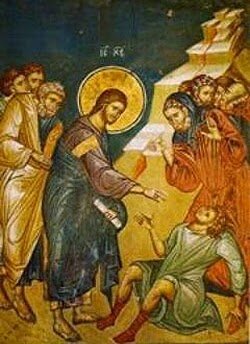
At the foot of the mountain, a large crowd was waiting for them. A man came and knelt before Jesus and said, “Lord, have mercy on my son. He has seizures and suffers terribly. He often falls into the fire or into the water. So, I brought him to your disciples, but they couldn’t heal him.”

Jesus said, “You faithless and corrupt people! How long must I be with you? How long must I put up with you? Bring the boy here to me.” Then Jesus rebuked the demon in the boy, and it left him. From that moment the boy was well.

Afterward the disciples asked Jesus privately, “Why couldn’t we cast out that demon?”

“You don’t have enough faith,” Jesus told them. “I tell you the truth, if you had faith even as small as a mustard seed, you could say to this mountain, ‘Move from here to there,’ and it would move. Nothing would be impossible.” (New Living Translation)

As we reflect on today’s Gospel lesson, let’s keep in mind that any time we see Jesus exorcising demons, we need to resist the idea that anyone having similar symptoms today is demonic in origin. Any chronic health condition a person experiences, without seeing any healing take place, does not necessarily mean the condition is due to the person’s lack of faith.

Conversely, it is also possible to relegate such healing accounts to a different time and place. My own view of Scripture, along with personal experience, informs me that demonization is real. We may underestimate how influential and widespread demonization occurs in this modern time and place.

The nature of faith is not located in its amount or intensity but in its object. All of life requires some faith. Even sitting in a chair. When I sit, the amount or intensity of my faith isn’t the issue – the object, the chair, is the issue. If a leg on the chair breaks and I flop to the floor, its not reasonable for me to conclude that it happened because of my lack of faith.

The disciples’ inability to heal the boy.

I’m not sure what is more difficult: to be the person suffering, or to observe a loved one suffering. The father is desperate and hurting, watching his son suffer with seizures. The man is utterly discouraged because Christ’s disciples were not able to help.

So, the desperate father approached Jesus and knelt, begging him to have mercy and help his son.

Our Lord’s response, I admit, is not likely what my response would be. I would be more like, “I’m so sorry this is happening to you. This is terrible. Let’s take care of this.” Jesus did honor the father’s request and healed the boy, but not before he had some words.

Jesus was exasperated, and he let everyone know about it. Why was he so disappointed?

Because his disciples knew better. The disciples were not ignorant or unable. They had what they needed to deal with the boy and his father. Jesus already equipped them to do this kind of ministry: 

Jesus called his twelve disciples together and gave them authority to cast out evil spirits and to heal every kind of disease and illness… “Heal the sick, raise the dead, cure those with leprosy, and cast out demons. Give as freely as you have received!” (Matthew 10:1, 8, NLT)

The reason for the disciples’ inability to heal was their lack of faith.

Jesus was perturbed with his disciples because they were not utilizing faith.

Jesus is bothered when believers don’t believe.

Up until this encounter, the disciples were healing people and doing the work Jesus gave them to do. Yet now they cannot. What changed? They relied on their own power, abilities, and experience, instead of relying on the power of God to heal. 

The Gospel of Mark includes Jesus saying that this kind of demon can only be dislodged through prayer (Mark 9:14-29). In short, the disciples didn’t pray. They didn’t tap into God’s power. They didn’t use the authority Jesus gave them. Rather, the disciples rested on their own laurels.

Their lack of prayer translated into a lack of power. 

If we are unable to do the work God has called us to do, it isn’t because we lack the authority or ability. It is a lack of faith.

Effective ministry happens because of faith.

The power of faith is in the person to whom it is directed. If we trust solely in ourselves, we will fail. However, if we trust in Jesus, then even the tiniest of faith will be able to do the impossible.

The power is not in particular words, or in a certain formula – the power is in faith rightly directed toward Jesus. Most demonic manifestations are much more subtle – such as thoughts of how I am not enough, how I have no right to try and help another, and how unable I am to do the will of God.

Conclusion

Here is a simple observation of Christ’s words: We are not told that if we have faith as big as a mountain that we can move one. Instead, Jesus tells us that if we have any faith at all, even as small as a tiny seed, directed toward God and not ourselves, the sky is the limit – we will have all the ability we need to do the will of God.

So, what is that impossible thing that could be done in your life with properly directed faith? 

What miracle, healing, or resistance to a bad spirit needs to take place around us? 

Discouragement is the most common tool of the devil in keeping us from realizing genuine manifestations of faith. Jesus has already accomplished victory over sin, death, and Satan. We must, then, claim all the will of God for today.

Resist the devil and he will flee from you (James 4:7). Step out in faith and do the will of God. The first step is always one of prayer….

High and Holy One, because your mercy is everlasting and your truth endures from generation to generation, show mercy to the sick and infirmed of either body or soul. Grant them deliverance from mental, emotional, spiritual, and physical illness. Blessed Lord, keep them under your care, for only in you can we live in safety and wellbeing. Visit them with your saving health. Do not let their hope be taken away, through Jesus Christ, our Lord. Amen.

Hebrews 12:3-13 – Interpret Your Circumstances Wisely

“The Kingdom Comes” by Bangladeshi artist Nikhil Halder, 1978

Consider him who endured such opposition from sinners, so that you will not grow weary and lose heart.

In your struggle against sin, you have not yet resisted to the point of shedding your blood. And have you completely forgotten this word of encouragement that addresses you as a father addresses his son? It says,

“My son, do not make light of the Lord’s discipline,
    and do not lose heart when he rebukes you,
because the Lord disciplines the one he loves,
    and he chastens everyone he accepts as his son.”

Endure hardship as discipline; God is treating you as his children. For what children are not disciplined by their father? If you are not disciplined—and everyone undergoes discipline—then you are not legitimate, not true sons and daughters at all. Moreover, we have all had human fathers who disciplined us, and we respected them for it. How much more should we submit to the Father of spirits and live! They disciplined us for a little while as they thought best; but God disciplines us for our good, in order that we may share in his holiness. No discipline seems pleasant at the time, but painful. Later on, however, it produces a harvest of righteousness and peace for those who have been trained by it.

Therefore, strengthen your feeble arms and weak knees. “Make level paths for your feet,” so that the lame may not be disabled, but rather healed. (New International Version)

Missed expectations often result in discouragement, even depression.

If we expect God to continually bless us with unending positive circumstances, we will, sooner or later, be confused and/or frustrated when life goes sideways.

The ancient Jewish Christians, for whom today’s New Testament lesson was addressed, faced opposition. Not only did they encounter the hardship of being Jews living in a Gentile world, but they also had to experience the difficulty of being Christians in a Jewish community.

Its one thing to put up with adversity for a few days or weeks. It is quite another thing altogether to deal with hard circumstances day after day, week after week, month after month, even year after year.

Where is God in all this negativity? When are the earthly blessings going to come? What the heck is going on here? Why are my prayers bouncing off the church ceiling?

Over time, the believers began to lose their joy. They started getting discouraged. The Jewish Christians, after beginning well in their faith, gradually slid into misinterpreting their circumstances as God being mean to them. Things got so bad, they even entertained the notion of returning to Judaism and leaving Christianity behind.

Their faith was shrinking.

However, their plight was very much seen by God. In fact, God was the One orchestrating the situations, as difficult as they were.

It is not our lack of resources, the disrespect, or the difficult people around us who are the problem. The issue is our interpretation of those events and persons.

The author of Hebrews invited the struggling believers to take a different interpretation of their hardship: They were experiencing divine discipline.

We are all responsible for our own children. As parents, we discipline them (ideally) for their own good. We know it will hurt temporarily. Yet, in the long run, the discipline will work out.

In fact, we understand this with all kinds of things. Everyday, people submit themselves to getting cut open, poked, prodded, and tested by doctors, surgeons, and healthcare workers because we know there needs to be temporary pain for permanent healing to occur.

It is the rare child who grows up without any discipline and becomes a productive citizen of society. It is the exceptional person who knows nothing of medical interventions for health and healing. And so, it is extremely unlikely that a Christian will experience holiness, righteousness, and live wisely in the world apart from some gut-wrenching, heart-breaking, and mind-bending circumstances for which they neither saw coming, nor ever asked for.

So, when the divine baseball bat whacks us upside the head, how will we interpret it?

Discipline is education by correction. God is the Father, treating us as family, as children who need to learn the ways of grace. God is the Divine Coach, exhorting us to work, run the laps, put in the reps, and reach beyond what we think we can do – knowing all along what our true capabilities are.

Godliness comes through discipline, training, and plain old fashioned hard work. Unless there is the suffering which comes through trials to our faith, Christianity is only a theory.

Before I suffered, I took the wrong way,
    but now I do what you say.
You are good and you do good.
    Teach me your statutes!
The arrogant cover me with their lies,
    but I guard your precepts with all my heart.
Their hearts are unfeeling, like blubber,
    but I rejoice in your Instruction.
My suffering was good for me,
    because through it I learned your statutes. (Psalm 119:67-71, CEB)

The appropriate response to difficult and adverse circumstances is to view them as God’s gracious guidance and correction. Rightly interpreting our life events gives us renewed resolve for the Christian marathon.

Endurance and perseverance are needed. Keeping good running form, consistent spiritual exercise, and maintaining liturgical rhythms, all help us face the adversity with energy, focus, and strength.

Christianity isn’t a matter of doing more. It is a way of life – a continuous evaluation of beliefs and thinking, addressing the shadows of the heart, and listening to the compassion deep in our gut.

Don’t give up. Keep going.

Be safe. Be strong. Be smart. Be spiritual. We are all in this together.

Thanks be to you, Lord Jesus Christ, for all the benefits which you have given us; for all the pain and insults you have borne for us. O most merciful redeemer, friend and brother, may we know you more clearly, love you more dearly, and follow you more nearly day by day. Amen.