
Accept One Another (Romans 15:7-13)

Christian Unity, by Gisele Bauche

Accept one another, then, just as Christ accepted you, in order to bring praise to God. For I tell you that Christ has become a servant of the Jews on behalf of God’s truth, so that the promises made to the patriarchs might be confirmed and, moreover, that the Gentiles might glorify God for his mercy. As it is written:

“Therefore I will praise you among the Gentiles;
    I will sing the praises of your name.”

Again, it says,

“Rejoice, you Gentiles, with his people.”

And again,

“Praise the Lord, all you Gentiles;
    let all the peoples extol him.”

And again, Isaiah says,

“The Root of Jesse will spring up,
    one who will arise to rule over the nations;
    in him the Gentiles will hope.”

May the God of hope fill you with all joy and peace as you trust in him, so that you may overflow with hope by the power of the Holy Spirit. (New International Version)

Anyone who desires to follow the pattern of Christ, actively seeks and promotes the acceptance of one another.

Jesus is the Christian’s model: Christ did not seek to be served, but to serve, and give himself for the benefit of others. The ministry of Christ was meant for the whole world, and not just for some persons. Christ’s mission and ministry included non-Jews, and not only his own Jewish people.

The person and work of Jesus Christ confirmed the promises made to the original Jewish patriarchs of Abraham, Isaac, and Jacob. Jesus did nothing brand new; he was simply upholding and actively seeking to accept Gentiles and bring them to God. This has always been true of God’s plan and purpose – which is why the Apostle Paul cited four different Old Testament passages.

All four references are to the Gentiles, to non-Jewish persons. And this is why Paul himself had a ministry to Gentiles. The biblical verses mentioned by the Apostle include Gentiles who offer praise to God; Gentiles engrafted alongside Jews as God’s people; and Gentiles who put their hope in the root of Jesse, the Messiah.

The good news of Jesus Christ is an inclusive – not exclusive – message. Thus, Christian ministry is designed to include others, to bring them into the fold of those who are redeemed by God.

Christian community is made up of all kinds of people from every race and ethnicity – without exception, and without favoritism.

The Apostle Paul made it clear to the Roman Church of both Jew and Gentile that his bedrock Christian ethic was one of inclusion and care for others. He supported his ethical understanding from Holy Scripture.

Paul was concerned that the Church include all sorts of Christ followers who may have some differing understandings and practices in living out their own Christian faith.

The Body of Christ is designed and meant to be big enough, strong enough, and resilient enough to handle all sorts of people who together want to follow Christ and serve others, like Jesus did.

The Apostle’s prayer is one of hope, having everyone in the church be accepting of one another. Paul wanted all Christians to work and worship together as the one people of God who live according to the pattern of Christ.

The Christian model of living is based not upon dietary laws or special days; it instead has it’s foundation in the example of Christ’s earthly ministry. All Christians are to:

  • glorify God together for the divine mercy shown to them
  • rejoice together as a unified voice expressing faith, hope, and love
  • share together in the hope that God’s promises are and will be fulfilled completely in Christ

God fills us with joy and peace, and causes us to overflow with hope by the power of the Holy Spirit – made possible because of the person and work of Jesus Christ.

Since God grants faith to whomever God wants to grant faith; and since the Holy Spirit fills whomever the Spirit wants to fill, we are, therefore, to accept those whom God has already accepted – without exception, and without prejudice.

For the Apostle Paul, the church’s identity was at stake. Paul was concerned for two questions:

  1. Will the church be, at its core, a community of redeemed persons by the grace of God who center all their lives around the person and work of Jesus?
  2. Or will the church be a community of opinionated individuals and groups all jockeying for position to have their way on how they believe things should go?

You can tell what a person’s identity is by their “identity markers.”

For the Jewish Christians, Sabbath-keeping, circumcision, food laws, and holding to certain days on the calendar marked their identity as God’s people. Those issues were so important that if you took them away, there would be an identity crisis; the people felt totally lost without their traditions.

For Gentile Christians, their identity was built around being more free-thinking. So, if you take away their freedom and ability to choose, the Gentiles will go nuts and have an identity meltdown. 

Paul’s answer was for both Jew and Gentile to accept one another and build their unity around Jesus, period. They needed to be sensitive to each other and focus on their shared identity of Jesus as the center of the Christian life.

It is very difficult to have hope, peace, and spiritual power, whenever there is disunity. The lack of acceptance is typically like a cancer which invades the Body and destroys it, unless there is a spiritual intervention.

Acceptance of others is more than a nice idea; and it doesn’t mean that we overlook differences of convictions or dogma. It just means that we choose to focus on what is most important. And for the Apostle Paul, that meant having a unity around the pattern of Christ.

Loving Lord, you came not to be served but to serve. Empower us to bless one another and our neighbors, so that your spirit of generosity, compassion, and selfless action transform us and the people in our midst. We pray together, as the one people of God, that you will guide us in your way; through Jesus Christ our Savior, in the strength of the Holy Spirit. Amen.

Mercy and Judgment (Revelation 8:1-5)

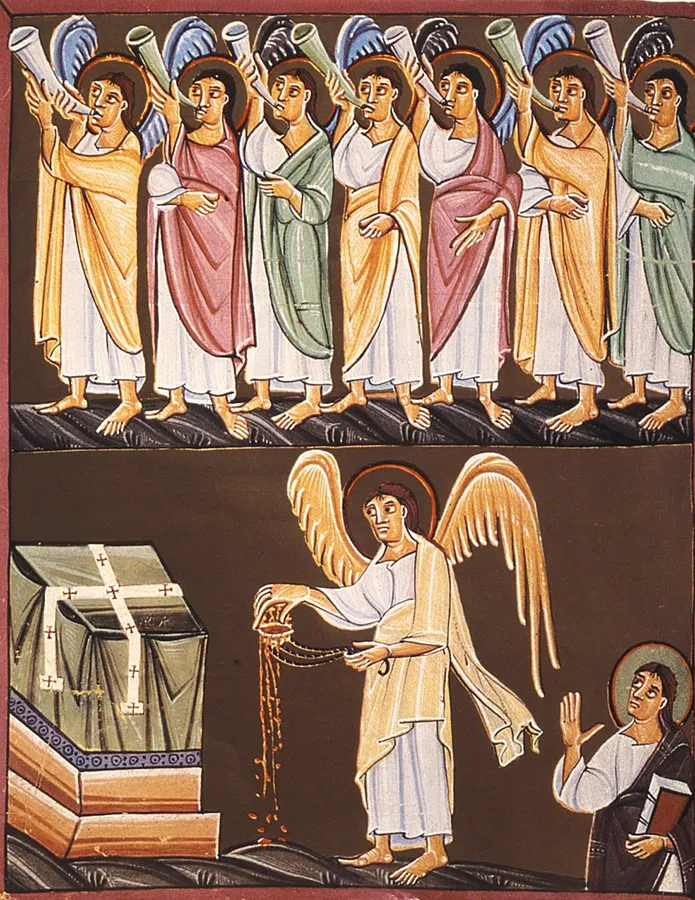
Seven angels with seven trumpets, and the angel with a censer, from the Bamberg Apocalypse, c.1020 C.E.

Then, when the Lamb opened the seventh seal, there was silence in heaven for about half an hour.

Then I saw the seven angels who stand before God, and seven trumpets were given to them. Another angel came and stood at the altar, and he held a gold bowl for burning incense. He was given a large amount of incense, in order to offer it on behalf of the prayers of all the saints on the gold altar in front of the throne. 

The smoke of the incense offered for the prayers of the saints rose up before God from the angel’s hand. Then the angel took the incense container and filled it with fire from the altar. He threw it down to the earth, and there were thunder, voices, lightning, and an earthquake. (Common English Bible)

When I was kid, growing up on a Midwest American farm, I remember times when severe weather was coming. I knew it was going to be bad whenever everything became still and there was complete silence: No wind, no birds singing, no insects chirping, nothing moving whatsoever. It was the eerie silence which precedes something big coming.

That is the way it will be in heaven when the seventh seal is opened. The silence is so quiet that you know a lot of noise and movement are about to happen. It’s not serene silence; it’s scary silent.

With the opening of the seventh seal, a climactic moment is reached. The silence is not only an anticipation of the coming drama, but is also a sign of reverence and awe.

The seventh seal initiates a series of woes: The seven trumpets. But before the trumpets begin, an angel appears. Standing before a heavenly altar, the angel mixes incense along with prayers from the people, then offers them on the altar.

These prayers of the people are for justice, and a longing for the kingdom to come, and God’s will to be done, on earth, as it is always done in heaven.

The imagery relates to us that God hears the prayers, and will act, according to the divine character and will.

The angel takes fire from the altar and hurls it down to earth, causing thunder and lightning, and an earthquake. In other words, the prayers are being answered; they are having an effect. Judgment on the earth begins with the blowing of the seven trumpets.

As we may expect, the incredible silence gives way to an equally incredible noise of weather and the earth moving. And the angel, serving as a quiet and contemplative high priest, now moves to becoming a judge upon the earth.

It turns out that mercy and judgment are not two contrasting concepts and actions; they are two sides of the very same coin. The altar of mercy becomes the source of judgment.

Whenever there is an injustice, we want (and expect) to have that act acknowledged and taken care of by a proper authority. To have a judge simply say that he/she is merciful and will acquit the guilty, does not work in every situation. Mercy only exists because of the presence of guilt and judgment.

God takes care of sin because God loves. An unloving deity would be unconcerned, random, and capricious in handling injustice. But not the God of the Bible. God shows mercy to the righteous, and will judge the wicked.

God’s mercy extends to the point of acquitting the guilty, if God so desires to do so. And everyone needs mercy, because we all have committed injustices in our lives.

Yet, by means of humble contrition and faith, we can mercifully discover gracious amnesty. This is why Jesus came, to take care of the sin issue once for all through the Cross.

We have been made holy by God’s will through the offering of Jesus Christ’s body once for all. (Hebrews 10:10, CEB)

In the time of the Apostle John’s vision, which is the Book of Revelation, Christians were facing persecution and martyrdom. The prayers of the suffering believers rose to heaven:

They cried out with a loud voice, “Holy and true Master, how long will you wait before you pass judgment? How long before you require justice for our blood, which was shed by those who live on earth?” (Revelation 6:10, CEB)

God’s response to the prayers of the saints is to send judgmental fire against the earth by the hand of the angel. In John’s apocalyptic vision, not only are the believers in Christ facing trials and tribulations for their faith, but the unbelieving persecutors who victimize the saints will be punished, as well.

If the persecutors use fiery elements against the believers, God can (and will) turn that fire back on the them. This is similar to the Book of Exodus, in which the plagues that struck and judged the Egyptians were, at the same time, a means of protecting and preserving the Israelites.

The Book of Revelation included in the Christian canon of scripture, not for the purpose of predicting the time or the season in which Jesus Christ will come back to judge the living and the dead. Rather, John’s Apocalypse is meant to encourage the followers of Christ that their suffering will not last forever; and neither will the arrogance of the wicked.

We don’t know when all of this end-of-the-age stuff is going to shake out. Which is why it is so important we learn to persevere through suffering. Because we might have to wait awhile.

Prayer for us then becomes not simply something we do if we have a bit of discretionary time; it becomes vital for us. We discern that we must speak with God. We are compelled to offer our prayers. We feel the great need to cry out and petition God for justice and righteousness.

It seems, if I don’t pray, I won’t make it. Therefore, I must pray. I will pray with all of my heart and soul, till I cannot pray anymore. And then I will pray some more, because I need God.

There is nothing easy about moving through suffering. It’s hard to persevere. It hurts to be the brunt of another’s violent tongue and/or hand. Yet, we do not experience this alone. The divine presence is with us. And that makes all the difference.

Oh God:
Give me strength to live another day;
Let me not turn coward before its difficulties, or fail in its duties;
Let me not lose faith in other people;
Keep me sweet and sound of heart, in spite of ingratitude, treachery, or meanness;
Preserve me from minding little stings, or giving them;
Help me to keep my heart clean, and to live so honestly and fearlessly that no outward failure can dishearten me, or take away the joy of conscious integrity;
Open wide the eyes of my soul that I may see good in all things;
Grant me this day some new vision of your truth;
Inspire me with the spirit of joy and gladness and make me the cup of strength to suffering souls; in the name of the strong Deliverer, our only Lord and Savior, Jesus Christ. Amen.

Directives For the Married and Divorced (1 Corinthians 7:10-16)

To the married I give this command—not I but the Lord—that the wife should not separate from her husband (but if she does separate, let her remain unmarried or else be reconciled to her husband) and that the husband should not divorce his wife.

To the rest I say—I and not the Lord—that if any brother has a wife who is an unbeliever and she consents to live with him, he should not divorce her. And if any woman has a husband who is an unbeliever and he consents to live with her, she should not divorce the husband. 

For the unbelieving husband is made holy through his wife, and the unbelieving wife is made holy through the brother. Otherwise, your children would be unclean, but as it is, they are holy. But if the unbelieving partner separates, let it be so; in such a case the brother or sister is not bound. It is to peace that God has called us. Wife, for all you know, you might save your husband. Husband, for all you know, you might save your wife. (New Revised Standard Version)

Having specifically addressed questions about sex; and having directly talked to the Christians in Corinth who were single; the Apostle Paul then turned to the married persons in the church. He gave directions about their concerns of divorce and how to handle a spouse who does not share the believing spouse’s Christian beliefs.

Divorce

Divorce is one of those things that no one plans on happening when they are married; and yet, it happens. The Apostle was realistic about the situation. He upheld the sanctity of marriage, while recognizing that the ideal of two people remaining together and blessing one another doesn’t always happen.

I find it interesting, as well as gracious and understanding, that Paul neither condemns nor denounces the divorced person. He assumes that both spouses have responsibility, and both can take initiative as partners in a marriage.

A Christian married to an unbelieving partner, according to Paul, ought to remain married. As long as the non-believing spouse is willing to remain in such a marriage, then it should continue.

The Apostle’s rationale is that peace, not divorce, needs to be the controlling characteristic of both the marriage and of the Christian life.

“Mixed” Marriage

Furthermore, Paul believed that Christians are not defiled by pagan spouses. This is important when it comes to the children of a Christian and non-Christian marriage. The relationship is sanctified by the presence of both the believing spouse and the Holy Spirit.

In addition, the Apostle saw that the Christian spouse is in a special position for God to work through them to the unbelieving spouse. On this point, Paul is sanguine and optimistic. Instead of worrying about impurity for the Christian, he foresaw an opportunity for purity in the non-Christian.

The Apostle Paul’s realism reminds us that if we are looking for ultimate satisfaction through marriage (or singleness and celibacy) it will never be found.

That’s because, as Christians, contentment and peace comes through giving our lives to serve the Lord Jesus in love. To love another, and offer the gift of self-sacrificial service to them, is the ultimate path to the way of Christ.

In losing our lives, we find them; in being last, we are promoted to first.

Marriage is beautiful. Divorce is ugly. Sometimes, despite a believer’s greatest efforts at being peaceful and loving, a divorce occurs. It takes two to have a marriage. There are times when the believing person must let their spouse go, that is, if that spouse wants to go.

Although divorce can be ugly and sad, full of broken dreams, and littered with missed expectations, it doesn’t need to stay that way. The divorced person, becoming single, now has the opportunity to bring something beautiful out of the brokenness.

Kintsugi

“Kintsugi” is a Japanese term for the art of repairing broken objects. The word literally means to “join with gold.” This art form uses a particular lacquer to reattach broken pieces. Then the newly attached joints are decorated with gold (or silver) powder.

The working idea behind the art of kintsugi is to embrace the flaws and the imperfections. By doing so, the artist can create a beautiful piece of art, stronger than the original.

Applying this to relationships, people no longer have to simply live with the shame of a broken marriage. We can assign value to people who are divorced, and stop trying to hide the relational damage. Through intentional efforts on healing, the scars left behind can truly become a source of beauty – instead of permanent ugliness.

Ikigai

Another Japanese concept which can be relevant for us is “ikigai.” It refers to having a reason for living, a sense of purpose and meaning to life. The idea behind ikigai is to help people find what is truly important to them, and then to live a life full of joy and purpose. Notice the concept is based on that which is internal – fulfillment, satisfaction, joy, and meaning – instead of external factors such as money, fame, power, or position.

Jesus joyfully lived his life on this earth to serve others. He came not to be served, but to serve, and to give his life as a ransom for many (Mark 10:45). If marriage was the ideal for everyone in this world, I’m quite sure Jesus would have modeled that for us by getting married. But he didn’t.

Neither marriage, nor singleness, is what really counts. Faith, expressing itself through love, is what actually counts. (Galatians 5:6)

And when Jesus was broken, the result became the salvation of the world. By his wounds, we are healed. (Isaiah 53:5)

All of this demonstrates for us where and what we are to assign meaning. And just because things don’t work out like we want, and leaves us in a state of brokenness, our lives can be transformed into a beauty beyond what we could have imagined.

This is the strength and ability of Christianity. Methinks we ought to let it have its way in our lives.

Almighty and everlasting God, the One who makes us whole in our brokenness, calls us to deeper faith, and delivers us from all things that hinder our devotion to you: Hear our prayer, Lord, and break open all we hold back from you, so that we may see a vision of your helping and healing presence in our lives and in our world, through Jesus Christ, in the power of the Holy Spirit. Amen.

Questions About Sex (1 Corinthians 7:1-9)

Now regarding the questions you asked in your letter. Yes, it is good to abstain from sexual relations. But because there is so much sexual immorality, each man should have his own wife, and each woman should have her own husband.

The husband should fulfill his wife’s sexual needs, and the wife should fulfill her husband’s needs. The wife gives authority over her body to her husband, and the husband gives authority over his body to his wife.

Do not deprive each other of sexual relations, unless you both agree to refrain from sexual intimacy for a limited time so you can give yourselves more completely to prayer. Afterward, you should come together again so that Satan won’t be able to tempt you because of your lack of self-control. I say this as a concession, not as a command. But I wish everyone were single, just as I am. Yet each person has a special gift from God, of one kind or another.

So I say to those who aren’t married and to widows—it’s better to stay unmarried, just as I am. But if they can’t control themselves, they should go ahead and marry. It’s better to marry than to burn with lust. (New Living Translation)

After getting into several issues of interpersonal relations within the church, the Apostle Paul turned his attention to matters the Corinthian congregation had questions about. Primary among them were issues of sex and marriage.

Within an ancient port city that was rife with all sorts of sexual practices and immorality, it was inevitable that the Corinthian Christians would wonder about the nature of sex and the marital relationship. Is it okay to have sex? Is sex good? What’s sex supposed to be like in marriage? How am I to treat my spouse when it comes to sex?

It seems every culture in every era has plenty of questions about sex and marriage.

The Apostle’s answer to the Corinthian believers is that sex is a good thing, that is, within a proper context. Sex is similar to fire. They’re both good, but they both have an incredible potential for destruction if there are not some solid boundaries and limits to them.

And that’s where marriage comes in and has a significant role for us as sexual beings. Marriage is also a good thing; it’s good to have a marital partner to share life with and to consummate a loving relationship with the intimacy of sex.

Our sexual drives are strong. After all, we were created with both the desire and the bodily equipment for sex. And marriage is a sacred institution which is strong enough to provide those boundaries and limits that we need to enjoy sex without harming others and ourselves.

In a world full of all manner of sexual deviancy and disorder that destroys many people, the marriage relationship is, ideally, a safe place for sexual expression and enjoyment.

For that good to happen, it is most necessary for the marriage bed to be a place of mutual love, of equal acceptance and sharing. Sex always turns bad when it is forced or coerced. It must be an agreed upon activity, or it moves into the place of covetousness, greed, and selfishness.

Again, ideally, marital relations are an opportunity for the marriage partners to think about and satisfy one another. In other words, the best sex happens when each partner considers what is best for the other.

The marriage bed is not the place to insist on your way. Rather, marriage, at its heart, is a deliberate and volitional decision to serve the other person – whether in bed, or out of bed.

It’s not uncommon for individuals who come to Christ out of a culture awash in unhealthy sexual practices to question if sex is good, or not; and whether one ought to abstain from sex, even if already married.

The Apostle Paul’s counsel is that abstinence from sex between two married partners is good – but only for an agreed upon period of time, and only for the purpose of prayer and fasting. In other words, if and when a couple agrees to forego sex for a time, spiritual practices must replace sexual practice. Without a clear plan, married couples can cause one another more harm than good.

Always know when to come back together again. That’s because our old adversary, Satan, is far too crafty in arranging temptations to derail us from the good gift of sex, and the good institution of marriage.

Paul made it clear that he was not pronouncing some ex cathedra instruction concerning abstinence for couples; he was only answering a question and providing some helpful counsel in order to maintain legitimate relations with each other. Nobody is under obligation to abstain, let alone be celibate.

However, the Apostle, an unmarried and celibate person himself, wanted to point out that there are advantages to the celibate life. I must say, I cannot disagree with Paul’s observation that life is whole lot simpler being single than married!

Yet, Paul also understood that the celibate single life is not for everyone. He gave the sage teaching that both marriage and celibacy are gifts from God. One is not necessarily better than the other.

Unmarried persons are not in a lesser class of people simply because they are single. And if they have the ability to manage their desires and emotions when it comes to sex and relationships, then Paul would say, more power to them. There is no need to be married, just to be married.

Conversely, however, there is certainly no need to be single and celibate, as if this were some superior spiritual situation. Believing that singleness is necessary for spiritual commitment, or mandating that an entire group of people must be single and celibate in order to serve Christ, is completely foreign to the Apostle Paul’s line of thinking.

Any single person who discovers they are swimming in sea of sexual desire ought to marry, rather than be frustrated and struggle with self-control. Imposing unnecessary suffering on oneself is not at all spiritual or preferable – it’s masochistic, and helps no one.

The reality of married and non-married relationships is that they both have their advantages and their disadvantages. Both marriage and singleness are good. Both sex and celibacy are gifts to receive with gladness and joy.

So, make sure to unpack your gift well.

Holy God, in the midst of our sexualized world of insanity and disordered loves, I ask for your mercy and grace to be pure and holy, just as You are holy. Enable us all to live into healthy forms of sexual relations, without succumbing to the sexual immorality all around us.

Almighty God, I thank you for the gift of sex and marriage, as well as the gift of singleness and celibacy. May Your healing love meet us in our sexual brokenness, and Your compassion overflow to the sexually oppressed.

Blessed God, I am grateful for Your blessing upon us, for never shaming nor humiliating us, but making us pure and holy in Jesus Christ our Lord, through the enablement of the Holy Spirit. Amen.