John 18:33-37 – Worship Christ the King

14th century painting of Jesus standing before Pilate by Italian artist Duccio di Buoninsegna

Pilate then went back inside the palace, summoned Jesus and asked him, “Are you the king of the Jews?”

“Is that your own idea,” Jesus asked, “or did others talk to you about me?”

Am I a Jew?” Pilate replied. “Your own people and chief priests handed you over to me. What is it you have done?”

Jesus said, “My kingdom is not of this world. If it were, my servants would fight to prevent my arrest by the Jewish leaders. But now my kingdom is from another place.”

“You are a king, then!” said Pilate.

Jesus answered, “You say that I am a king. In fact, the reason I was born and came into the world is to testify to the truth. Everyone on the side of truth listens to me.” (New International Version)

In Christianity, to worship God means we praise the person and work of Christ and are also spiritually formed through that adoration. Christ the King Sunday focuses our worship on Jesus Christ’s reign over the entire world. It is a proclamation that everything and everyone in all creation is subservient to King Jesus. Furthermore, it is an invitation to actively enjoy Christ’s gracious and benevolent rule over us.

Jesus came to this earth to bring connection and intimacy to God and humanity. We all have relationships in which we want to be closer.

  • A parent might be dissatisfied, and sad, that one of their children is estranged from them, because they want intimacy.
  • A spouse may want to have a more relationally intimate marriage, having been distant for too many years.
  • A teenagers or twenty-something might want to get closer to that special someone. 
  • A friend might be keeping their distance. And although you have conversations with them, they only let you in so far.

We want to go deeper, and it isn’t happening because the other party is not willing.

In this we reflect the image of God within us because God feels that same longing and desire to move deeper and closer to us. The Lord desires intimacy, yet we might keep treating him like he is some untouchable monarch like Queen Elizabeth – as if there is no chance of really getting close, and we wonder if there is any real power there to make a difference. 

However, God is not a ruling figurehead, and does not want a casual superficial relationship with us. Christ’s kingship moves closer to people, not further away. Everything Jesus did on this earth was to bring people closer to God because God wants a personal and familiar relationship with us. 

Jesus does not want us estranged from God, and he has gone to the greatest lengths possible to make that close relationship possible and real through the cross, resurrection, ascension, and a kingly reign which is near to us. The kingdom of God, with Jesus as King, is a kingdom of closeness and fellowship with the divine.

Christ the King Sunday appropriately challenges us to consider what it means to say that Jesus Christ is the Lord of our life. Jesus Christ, as our Lord and King, means much more than God calling the shots and issuing commands; it means Christ uses his lordship to satisfy his longing to be with us.

Our Gospel lesson for today plunges us into an event we associate with Holy Week. Christ has been arrested by the conniving of his enemies. Since the religious authorities could not put anyone to death, they bring Jesus to the Roman governor, Pontius Pilate, in the hope he will do their dirty work for them. 
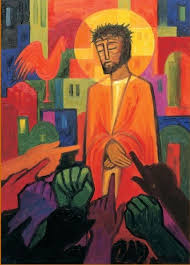
Jesus condemned to death, painting by the Benedictine Sisters of Turvey Abbey

The scene takes place early in the morning at Pilate’s palace. Pilate doesn’t like the Jewish authorities because they put a dent in his career plans through their constant complaints about him to his supervisors in Rome. For purely political reasons, Pilate decides he will satisfy their demand and interview this Jesus who they claim is an enemy of Rome.

The prisoner, Jesus of Nazareth, is brought to Pilate. He is a mess. Christ’s clothes are stained with dirt and blood. His face is bruised and haggard. He has not slept all night. Pilate has heard of Jesus, and so he’s curious to make a personal evaluation of him. Jesus looks nothing like a king to Pilate.

Pilate, in contrast, looks the image of a worldly leader with his power suit on and all the strength of Rome behind him. He hardly has time for this sideshow, this pathetic presentation of leadership in front of him. Jesus looks like nothing more than a kingly wannabe. There is nothing from Christ’s outward appearance that gives any impression he is qualified to be a leader of anybody. We can almost picture Pilate rolling his eyes, saying “so you are the King of the Jews?”

What follows is a strange, convoluted conversation about kingship and truth with a contrast between this world and a world to come. Repeatedly, Jesus makes it clear his kingdom is not of this world. Two thousand years have passed since that dialogue between Jesus and Pilate, yet the same issue remains.

The issue is this: Jesus is calling all of us to follow him – to put his Kingdom first in our lives. In Pilate, we have a symbol of worldly power, which is arbitrary, unprincipled, self-serving, and brutal. Pilate knows the right thing to do but chooses the path of least resistance. He caves to the political pressure, denying the truth which is right under his prominent Roman nose.

Earthly power seeks its own ends. It wants to hold onto control and call the shots. Conversely, Christ’s kingly power is used to serve, to wash feet and meet needs, to move closer to people. Earthly kingdoms use violence to conquer and maintain order and control its subjects. In stark contrast, Christ’s kingdom uses love to transform and unify people around Jesus so that the subjects are with the king and enjoy his rule and reign.

Christ’s kingdom is not of this world. It is counter-cultural and counter-intuitive to how every other leadership structure works on earth. It is an upside-down kingdom that seems like it won’t work or make sense: The way up is down; to be great is not to work for a high position, suck up to the boss, and climb the ladder of wealth and success. Rather, it is to embrace humility and be a servant.

In God’s kingdom, the way to pursue truth is not in forming original ideas and expressing opinions but is found in a person. Truth-seeking disciples will listen to this one voice of Jesus, and filter-out all others. It is a voice calling for submission to his lordship, and to do so because it brings us into an intimate relationship with God.
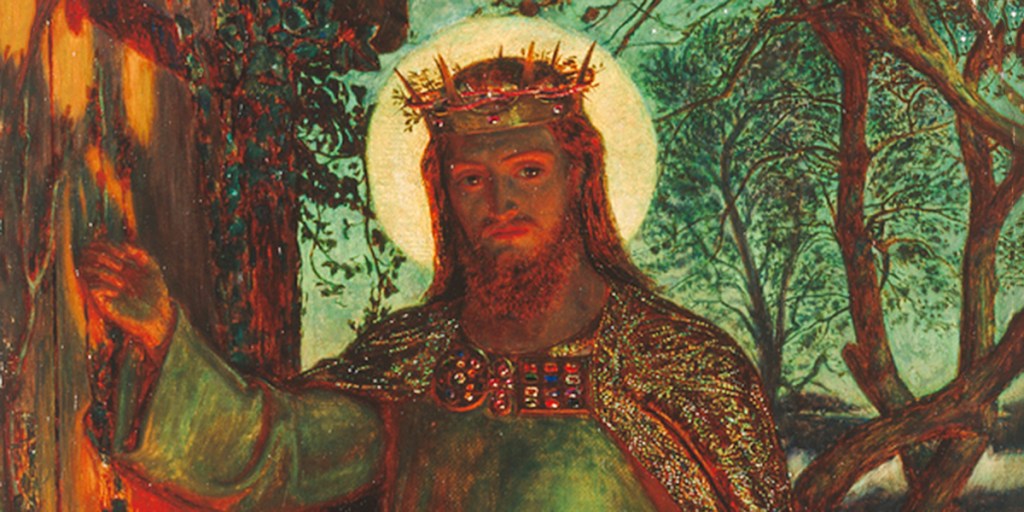
The Light of the World, by English artist William Holman Hunt, 1852

The message of our crucified Savior reigning as King in our lives is not that, having suffered for us, Jesus will somehow keep us from facing difficult times. Instead, Jesus faced a horrible death so that our own tough times can triumph with God’s power to save us and move deeper into our lives. God’s presence and promise is what sustains us, not the avoidance of suffering. Christ as our King means God is with us.

Black Friday and Cyber Monday are almost upon us. This season demonstrates a contrast between two kingdoms. The kingdom of this world calls on us to demonstrate our worth and gain meaningful relationship through grabbing control and obtaining stuff. The pressure in seeking the perfect gift at the perfect price in the hope that if we can bag it, wrap it, and get it under the tree, then we will be perfect, and the perfect family Christmas will happen, and relationships will be great, and everyone will act like I want. Right!?

In contrast, the kingdom Jesus describes assures us we don’t have to prove our worth through endless accomplishments and generous gifts. We don’t need to have the perfect Christmas experience to gain our deepest relational needs. Because, in our baptism, we have been accepted; we are sons and daughters of the living God; and we do not need to achieve greatness through financially and emotionally bleeding ourselves.

In his conversation with Pilate, Jesus said: “My kingdom is not of this world.” When Christians say Jesus Christ is our King, we acknowledge we are his subjects and that we march to the beat of a different drum. The heart of this relationship is our dependence on Jesus who came that we might have life and have it in abundance.

On this Sunday, followers of Jesus Christ boldly state our confidence that, at the end of time, Jesus will come again as King and Ruler of all. 

Blessed are those who see the truth by faith and not by sight. Blessed are those who say “Jesus is the King and the Lord of Life” without rolling their eyes or with a selfish agenda but with a sincere conviction that they belong to Jesus and want to be ever closer to him who is the Way, the Truth, and the Life.

Almighty God, everlasting heavenly Father, you break the power of evil and make all things new in your Son Jesus Christ, the King of the universe. Our confidence is firmly in you, Lord Jesus, knowing you will redeem all things and make all things new. 

We affirm that our security is not in personal abilities, clever plans, or lucrative jobs; our security is in you alone. Your creation still groans with the pain of living in a fallen world. But you have conquered sin through your love, and it is to your love we rely upon. May all things in heaven and on earth recognize the glory of your kingly rule and never cease to praise you. We ask this through our Lord Jesus Christ, your Son, who lives and reigns with you and the Holy Spirit, one God, now and forever. Amen.

John 3:31-36 – Believe the Son

The Trinity by Alex Rapoport, 1994

God’s Son comes from heaven and is above all others. Everyone who comes from the earth belongs to the earth and speaks about earthly things. The one who comes from heaven is above all others. He speaks about what he has seen and heard, and yet no one believes him. But everyone who does believe him has shown that God is truthful. The Son was sent to speak God’s message, and he has been given the full power of God’s Spirit.

The Father loves the Son and has given him everything. Everyone who has faith in the Son has eternal life. But no one who rejects him will ever share in that life, and God will be angry with them forever. (Contemporary English Version)

When Jesus ascended to heaven, he left instructions to his disciples to pray and to witness (Acts 1:1-11). Jesus asks of us what he himself does or has already done. The life and ministry of Christ on this earth was marked continually with prayer and bearing witness. Just as Jesus bore witness to what he saw and heard as the Divine Word, so his followers are to do likewise. The evidence and the veracity of Christ’s witness is the giving of God’s Spirit – the One whom confirms this testimony to us.

I, personally, have found Jesus to be precisely whom he claims to be. I have come to accept his testimony as gracious, truthful, and life-giving. I have wholeheartedly embraced the New Testament Gospel accounts of his birth, life, teaching, death, resurrection, and ascension. This belief came neither quickly nor easily for me – it resulted from an honest straightforward reading of the Bible, along with the gracious wooing of the Holy Spirit.

It really isn’t my job to convince you of Jesus Christ’s authenticity and trustworthiness. That is the work of the Holy Spirit. Instead, it is my task to bear witness of the things I have seen and heard concerning Jesus. 

My life has been thoroughly turned upside-down because of Jesus. With Jesus, I have been invited into the life of God. By the wounds of Jesus, I have experienced healing of damaged emotions and recovery from spiritual hurts inflicted by others. Through union with Christ, I have grace and forgiveness of things I have done and left undone. With Brother Jesus as my friend and companion, I enjoy loving attention and am never dismissed by him.

The Trinity by Jyoti Sahi

For those who have not read the Gospel accounts and refuse Christ, then, for honesty’s sake, please have the integrity to give Jesus a hearing before you dismiss him with a slight of hand. It is one thing to genuinely no little about Jesus, and it is quite another thing to ignore him when you have knowledge about how to discover him.

For those of us who have read the New Testament Gospels and accept the testimony of Jesus, we come back again and again to his life-giving words and seek continually to follow him in his way of mercy, purity, and peace. We bear witness to how Jesus has changed our lives and offers a life worth living.

Everyone with faith in Jesus has a life-giving connection with God. Those who don’t, don’t. If you disagree with this, then contend with Jesus himself. Give him a hearing. Watch him in action. Observe how he deals with people. See if he lives up to his words. Then, bear witness to what you have seen and heard.

Christian faith is a complete trust in the person and work of Jesus Christ as Lord and Savior. Because God has been revealed as faithful through steadfast love, the Lord gifts people with faith to know the Divine.

Faith, a noun, is closely accompanied by it’s verb, believe. Together, as identical twin sisters, they let us know that both knowledge and action are needed. We need information in knowing what step to take, and an active commitment to actually take that step.

Others’ faith in Jesus led to a man’s healing of both body and soul:

And behold, some people brought to him a paralytic, lying on a bed. And when Jesus saw their faith, he said to the paralytic, “Take heart, my son; your sins are forgiven.” (Matthew 9:2, ESV)

The size of faith is irrelevant; even a smidge of Jesus has incredible power:

“I [Jesus] assure you that if you have faith the size of a mustard seed, you could say to this mountain, ‘Go from here to there,’ and it will go. There will be nothing that you can’t do.” (Matthew 17:20, CEV)

Human weakness and inability is no problem because of faith in Christ:

Everyone who believes has God’s approval through faith in Jesus Christ…. We conclude that a person has God’s approval by faith, not by his own efforts.

Romans 3:22, 28, GW

A person acts upon knowledge of Jesus with total trust in Christ’s finished work of deliverance from all which is evil:

It’s the word of faith that welcomes God to go to work and set things right for us. This is the core of our preaching. Say the welcoming word to God — “Jesus is my Master”— embracing, body and soul, God’s work of doing in us what he did in raising Jesus from the dead. That’s it. You’re not “doing” anything; you’re simply calling out to God, trusting him to do it for you. That’s salvation. With your whole being you embrace God setting things right, and then you say it, right out loud: “God has set everything right between him and me!” (Romans 10:9-12, MSG)

Faith is not an event; it is continual trust in the person and work of Christ for practical living and compassionate serving:

I have been crucified with Christ; and it is no longer I who live, but it is Christ who lives in me. And the life I now live in the flesh I live by faith in the Son of God, who loved me and gave himself for me. (Galatians 2:19b-20, NRSV)

Outward rituals only have their proper place as they help inform belief in order to engage in loving actions:

For in Christ Jesus, neither circumcision nor uncircumcision counts for anything, but only faith working through love. (Galatians 5:6, NAB)

You are saved by God’s grace because of your faith. This salvation is God’s gift. It’s not something you possessed. It’s not something you did that you can be proud of. Instead, we are God’s accomplishment, created in Christ Jesus to do good things. God planned for these good things to be the way that we live our lives. (Ephesians 2:8-10, CEB)

Understanding and experience go together like a hand in a glove:

I keep hearing about your faith in the Lord Jesus and your love for all of God’s people.  And I am praying that you will put into action the generosity that comes from your faith as you understand and experience all the good things we have in Christ. (Philemon 5-6, NLT)

Absolute certainty isn’t in the realm of Christian spirituality – there’s always more information one could obtain. Faith discerns, intuits, and knows God is there, and orders it’s steps accordingly with faithful activity:

And without faith it is impossible to please God, for whoever would approach him must believe that he exists and that he rewards those who seek him. (Hebrews 11:6, NRSV)

My brothers and sisters, if people say they have faith, but do nothing, their faith is worth nothing. Can faith like that save them?… Just as a person’s body that does not have a spirit is dead, so faith that does nothing is dead! (James 2:14, 26, NCV)

In the power of the Spirit and in union with Christ, I pray to you, the God and Father of all:

For empowerment by the Spirit, that I may be a faithful witness

For those who wait on You, that they may find renewal

For all people, that they may acknowledge the kingdom of the ascended Christ

For all who are struggling with broken relationships

I commend myself and all for whom I pray, to Your mercy and protection through Jesus Christ, my Lord and Savior. Amen.

Acts 7:54-8:1 – Humility and Hubris

A 10th century depiction of Stephen’s martyrdom

When the members of the Sanhedrin heard this, they were furious and gnashed their teeth at him. But Stephen, full of the Holy Spirit, looked up to heaven and saw the glory of God, and Jesus standing at the right hand of God. “Look,” he said, “I see heaven open and the Son of Man standing at the right hand of God.”

At this they covered their ears and, yelling at the top of their voices, they all rushed at him, dragged him out of the city and began to stone him. Meanwhile, the witnesses laid their coats at the feet of a young man named Saul.

While they were stoning him, Stephen prayed, “Lord Jesus, receive my spirit.” Then he fell on his knees and cried out, “Lord, do not hold this sin against them.” When he had said this, he fell asleep.

And Saul approved of their killing him.

On that day a great persecution broke out against the church in Jerusalem, and all except the apostles were scattered throughout Judea and Samaria. (New International Version)

Although I am a trained in biblical exegesis and hermeneutics (interpreting Scripture) I believe that most insights come from making simple observations about the text. So, I want to point out: Stephen was not martyred by the Romans, a religiously pagan group, or Gentile people; he was martyred by those of his own ethnicity, by the people of God.

They weren’t simply unhappy with Stephen. The Sanhedrin (the Jewish ruling council) were incensed with him, so mad that they were grinding their teeth at him. The council truly believed Stephen was a blasphemer of God, that what he was saying was so subversive and religiously radical, they could stone him to death with a clear conscience, as if it were upholding God and God’s Law.

The result was not only the death of a humble man; it also sparked an intense persecution against the church which caused a new Christian diaspora. Many believers in Jesus now found themselves as Christian refugees trying to eke out a living and worshiping Christ in foreign places.

I wish I could say the greatest opposition I’ve ever experienced as a Christian came from non-Christians who simply misunderstood and misinterpreted me. However, my most hurtful wounds have come from the hands of church folk, believing they were acting on God’s behalf by exacting an emotional martyrdom upon me with the stones of gossip, slander, backbiting, blame-shifting, and outright lying.

Never look down on anybody unless you’re helping them up.

Whenever I encounter persons who no longer attend church and have no intention of ever returning to any local congregation, I get it. I understand. I’ve been there. Yet, although the church is sometimes like a woman of disrepute, I still love her, and will do whatever I can to edify her and not repay evil with evil.

Stoning a believer, either actually with physical rocks or virtually with metaphorical stones, is akin to persecuting Jesus himself. That’s because Christ so closely identifies with his people that it is as if he is a head, and his followers are a body – joined together in a vital union.

So, when Christ’s Body is subjected to hermeneutical hubris in which one group of people insists there is only one way to interpret Scripture, and then uses it’s authority and structures of power to force compliance on another group, the result is persecution.

And that is precisely why Christians can abuse other Christians.

Rather than discerning that all Christians belong to God, one narrow-minded and small-hearted group excludes all other groups who disagree with them as blaspheming the name of Christ.

Insisting, for example, that a literal interpretation in the only means of understanding the Bible’s authority is to ignore and abuse the actual and real authority which exists with the Bible. I am in no way encouraging an “anything goes” type of approach to Holy Scripture that lets it say whatever you want it to say. 

What I am stating is that the biblical writers themselves employed different methods of interpretation, as well as the early church fathers (which is one reason I hold to the interpretive guides of the ancient Christian creeds, i.e. The Apostles’ Creed and Nicene Creed).

Far too often churches stick to a particular interpretation because they believe they are keeping biblical fidelity. This is many times born of a fear that Christendom will be lost, and society will sink into an abyss of egregious sin. The irony is that many churches are sinking into forms of abusive and ungracious behavior by fighting battles that Scripture itself never calls them to fight.

The binary thinking of “I’m right and you’re wrong” is not an approach you’ll find in God’s Holy Word.

Even if the Sanhedrin in Stephen’s day intended on upholding the holiness of their God and the rightness of their cause, the impact it had on the church was death and diaspora.

Unfortunately, throughout Christian history, the tables have too often turned with Christians persecuting Jews. I myself would like to avoid being the persecutor. If I kill anything, may it be putting to death my own sin.

Gracious God, as your Son humbled himself on this earth, so may your church walk continually in such humility that believers everywhere work together in unity for the sake of gospel of grace as a blessing to the world in the power of your Holy Spirit. Amen.

Hebrews 10:32-39 – Believe, Be Patient, and Remember

Remember those earlier days after you had received the light, when you endured in a great conflict full of suffering. Sometimes you were publicly exposed to insult and persecution; at other times you stood side by side with those who were so treated. You suffered along with those in prison and joyfully accepted the confiscation of your property, because you knew that you yourselves had better and lasting possessions. So do not throw away your confidence; it will be richly rewarded.

You need to persevere so that when you have done the will of God, you will receive what he has promised. For,

“In just a little while,
    he who is coming will come
    and will not delay.”

And,

“But my righteous one will live by faith.
    And I take no pleasure
    in the one who shrinks back.”

But we do not belong to those who shrink back and are destroyed, but to those who have faith and are saved. (New International Version)

Sometimes we get stuck in our troubles. We might get lost in adversity and cannot see either how we got here or a way out. This is hopelessness. Without a confident expectation of better days ahead, while in the throes of difficulty, a failure of faith can too easily happen.

To realize better days, it’s important to remember the earlier days. I’m not talking about living in the past and wishing it were the 1950s again with Beaver Cleaver across the street. This is not about believing that the past was the good old days, and the present is no good. Rather, I’m referring to remembering the ways we endured and persevered with joy in past experiences.

The original Christian recipients of the message of Hebrews needed to recall the various ways they stood firm and tall in their faith, despite the adversity. They were insulted and persecuted, showing solidarity to others in similar situations. They were attentive to prisoners and sought to meet their needs. And they actually responded to the confiscation of their property with joy because they knew there was more than this present life.

God blesses those who patiently endure testing and temptation. Afterward they will receive the crown of life that God has promised to those who love him.

James 1:12, NLT

The believers needed to reconnect with their purpose, with their why. The reason they had such incredible attitudes while enduring hard things is because they were pursuing heavenly treasure. Their earthly possessions were merely temporary things, not of eternal value. It is people who have eternal value, and the believers willingly focused efforts in helping others.

However, the Christians eventually, over time, lost their focus and could only see the pain and the difficulty. They became disconnected with their purpose. And so, they were in danger of losing their faith and becoming utterly hopeless.

Remember what God has done for you. Affirm what is right, just, and true. Embrace faith and patience. That’s what the prophet Habakkuk did. And his resilience helped to bring proper perspective to present troubles.

“Nothing that is worth doing can be achieved in a lifetime; therefore, we must be saved by hope.”

Reinhold Niebuhr

Habakkuk was distressed over the corruption of his fellow Israelites. So, he complained to God about it. God responded by informing Habakkuk that judgment was coming to Israel through the Babylonians. This was neither what Habakkuk expected nor wanted. The prophet grumbled even more because the Babylonians were more corrupt than the Israelites. “The Babylonians need judgment, too!” believed Habakkuk. 

Habakkuk struggled to come to terms with what God was doing, and not doing. Finally, he concluded the matter by reconnecting with his faith: 

Even though the fig trees have no blossoms,
    and there are no grapes on the vines;
even though the olive crop fails,
    and the fields lie empty and barren;
even though the flocks die in the fields,
    and the cattle barns are empty,
yet I will rejoice in the Lord!
    I will be joyful in the God of my salvation!
The Sovereign Lord is my strength!
    He makes me as surefooted as a deer,
    able to tread upon the heights. (Habakkuk 3:17-19, NLT)

One of the most significant faith experiences we can ever have, is to come to the point of complete trust in God so that our happiness is not dependent upon good circumstances. The truth is that the Christian’s joy and spiritual security is independent of what is going on around us. Even though situations might be difficult and even evil, believers can still rejoice because we do not need everything to go our way in order to experience happiness.

Faith, patience, and joy are neither cheap, nor easy. It requires daily affirmations of faith and patience. It requires remembering. There is a reward ahead if we persevere to the end.

We can remain patient, express faith, kindle hope, and remember necessary things whenever we stop doing unimportant things which do not add value to our ultimate goals; be mindful of those things which are most important to us; and move through life at a pace of hope, not anxiety.

God, give us grace to accept with serenity
the things that cannot be changed,
Courage to change the things
which should be changed,
and the Wisdom to distinguish
the one from the other.

Living one day at a time,
Enjoying one moment at a time,
Accepting hardship as a pathway to peace,
Taking, as Jesus did,
This sinful world as it is,
Not as I would have it,
Trusting that You will make all things right,
If I surrender to Your will,
So that I may be reasonably happy in this life,
And supremely happy with You forever in the next.

Amen.