Luke 22:24-30 – Just Shadow Jesus

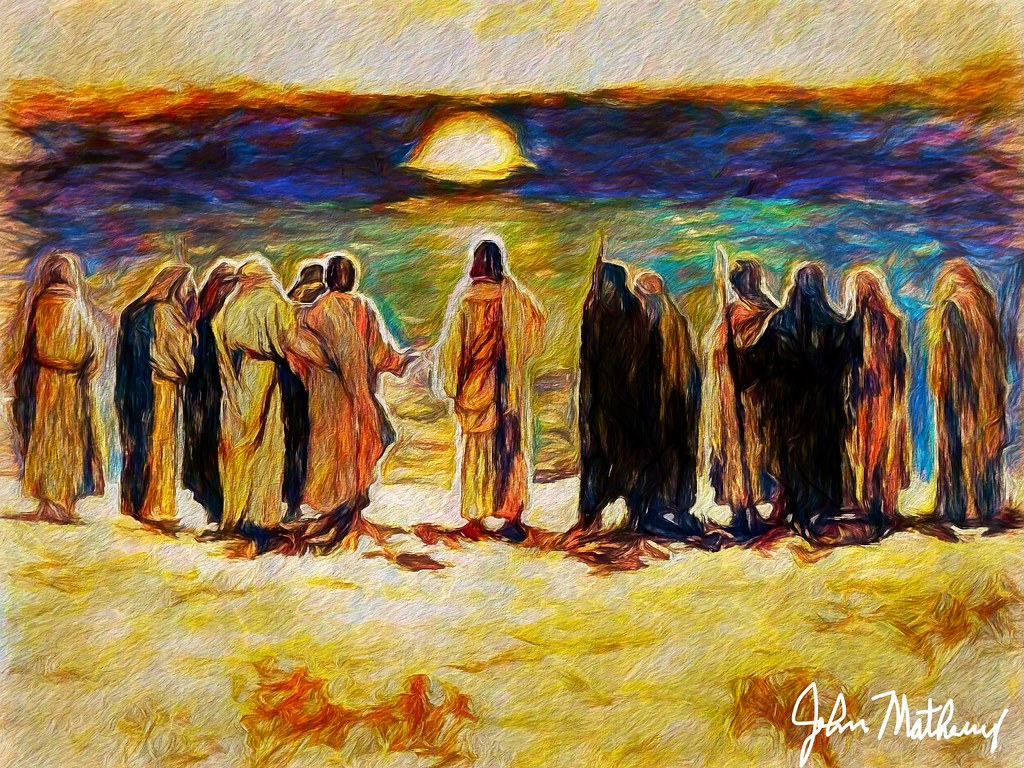
Digital painting of Jesus and the disciples by John Mathews

A dispute also arose among them as to which of them was considered to be greatest. Jesus said to them, “The kings of the Gentiles lord it over them; and those who exercise authority over them call themselves Benefactors. But you are not to be like that. Instead, the greatest among you should be like the youngest, and the one who rules like the one who serves. For who is greater, the one who is at the table or the one who serves? Is it not the one who is at the table? But I am among you as one who serves. You are those who have stood by me in my trials. And I confer on you a kingdom, just as my Father conferred one on me, so that you may eat and drink at my table in my kingdom and sit on thrones, judging the twelve tribes of Israel. (NIV)

Jesus is a different sort of leader.

While the kings of his day were concerned with power and using their authority to ensure even more power and privilege, Jesus went about things differently. In a world of patronage where it was necessary for the lower classes to connect with and suck-up to the higher classes, Jesus operated by a different system.

Jesus, Lord of the universe, King of creation, absolute Leader of the Church, and Ruler over God’s realm was and is a servant of the people.

“Follow my example: Even the Son of Man did not come for people to serve him. He came to serve others and to give his life to save many people.”

mark 10:45, erv

On the surface, striving to be the best might seem noble and good. Yes, working toward being the greatest might motivate us to do all things with excellence. It can solve a lot of problems and issues. On the other hand, it may also result in attitudes and behavior which fosters unhealthy competition and an inordinate focus on becoming the greatest.

Think about it. Not everyone can be the greatest. If everyone is, nobody is. This results in lower self-esteem for nearly everybody. And it creates ripe conditions for leadership paranoia in which the greatest is always looking over their shoulder worrying about being toppled from their lofty position. At the least, all this ballyhoo about greatness only takes away from caring for the people who most need our efforts – family members get the shaft from someone with an imbalanced life who is laser-focused on getting to the top and staying there.

It’s as if a person is living a one-dimensional existence in a three-dimensional world. It won’t work. Fortunately, we don’t have to live like that.

Jesus shows us a better way.

Jesus was present to his disciples. He is present to us in the person of the Holy Spirit. Christ encouraged relational connections and using one’s gifts, talents, and abilities for the common good of all people. For Jesus Christ, the dynamics of power and authority are not to be leveraged for personal greatness but for collective uplift. Authority is to be carefully applied for everyone’s benefit, including those we think don’t deserve it.

The disciples understood far too little about the community their leader was trying to build. Judas Iscariot is likely the one disciple who first realized what Jesus was truly up to. The greatest are the least and the least are the greatest. It wasn’t what Judas signed up for, so he cut his losses and betrayed Jesus.

True exaltation is a gift of grace. The kingdom of God turns on mercy and operates on the economy of grace. It is those who faithfully serve who will sit with Jesus, the ultimate Servant, at the table. Peacocks and pretenders will never realize their dream to be the center of attention.

In a great twist of irony, those who wish to compete and occupy a high standing will discover they have worked to obtain the lowest rung on the ladder leaning against the wall of Satan’s kingdom.

Jesus consistently, patiently, and carefully established the kingdom of God on earth. He went about his task in a manner none of us would even consider. He focused on character, not skills; willing hearts, not intelligent brains; new life, not reformed habits. On the job orientation involved following Jesus around everywhere.

Just shadow Jesus.

Here I am washing your feet. Do the same. Here I am being present to and serving the poor, the lonely, the outcast, the moral failure, and the lowest of society. Do the same. Here I am showing sacrificial self-emptying unconditional love. Do the same. Just shadow me. Do what I do, period.

An obsession with greatness will inevitably lead to petty kingdom building enterprises. Instead, we are to love the neighbor next to us. We make room at the committee table for somebody who looks, acts, and talks different than me. We freely let Jesus live through us, thus, giving the gift of him to those we encounter. We purposely look for ways to serve underprivileged communities rather than use the people living there in ways to make us look better.

Indeed, this following Jesus thing is subversive – even for many professing Christians.

What will you do?

Go in peace to love and serve the Lord, in the name of Christ. Amen.

The Humble Leader


            In this Advent season as we anticipate Christmas, I have been reflecting on the great importance of humility.  Since Jesus humbled himself and became one of us, it seems to me that Christian leadership and church ministry really ought to take some cues from the posture of our Lord.
 
Humility is the queen of all Christian virtue, especially that of leadership.  Yet, humility is one of the hardest virtues to practice because it requires that we willingly put aside pride, ego, and personal agendas in order to embrace God’s agenda.  Being poor in spirit (Matthew 5:3), becoming like a little child (Matthew 18:3), and thinking of others as better than ourselves (Philippians 2:3) are the cornerstones to becoming open to what God has for us.  To be a humble leader means to be obsessed with seeking God’s will and way in everything, and then to have the courage to lead others in God’s direction despite resistance and opposition from those who want to follow a different path.
 
            Therefore our task as Christ followers is to be consumed with seeking God’s direction rather than living purely according to our instincts, pragmatic desires, and personal views.  We continually need a radical openness to God.  We must work to develop an ever-deepening awareness of where God is leading us.  God is up to something and He has plans for us and our community.  Humility allows us to listen well to God’s Spirit.
 
            But being open to God is not quite as easy as it sounds.  We need to recognize that not everyone is open to God.  There are those, maybe even including ourselves, whom are closed to God.  If our focus is more on creating safety and security, trying to do enough good deeds to be recognized by God and others, and having the church be what we want it to be, then we have become closed to what God wants.  This comes out in a couple of different ways.
 
            First, people who want to maintain tradition at all costs may be closed to God.  When doing things the way we have always done them makes us feel safe and secure, then anything that threatens that security makes us angry.  This is the place where folks practice either fight or flight – they wage either a holy war or just leave.  Living with uncertainty and ambiguity is too much for them.  But that is what it takes if we are going to follow God.  Like Abraham, we are called to move and change without always knowing where we are going.
 
            Second, it is not just members trying to maintain traditions who can be closed to God.  Those who want to get rid of traditions can be just as closed off to God.  Sometimes folks who want new or different music, spiritual practices, and ministries desire to create a church of their own making to serve them and their needs, and not a church that focuses on what God is calling them to do.  Like Timothy, we are to hold onto the great deposit of doctrine and heritage given to us and not always be looking for the next new thing to turn things around.


            So, what to do?  Have the humility as leaders to continually and constantly ask the question: “What is God’s will?”  We need to practice leadership that is incredibly open to God.  This allows us to lead from a position of faith, and not fear.  This helps us to let God flow in and through us, rather than willfully insisting it should be our way or the highway.  This enables us to practice hope and love, and not rely on our own strength and desires.  Humble leadership which is open to God makes prayer and discernment the foundation of what we do, always seeking what God wants and then leading others in that direction by inviting them to the same kind of prayerful process.  We must read our Bibles as if our lives depended on it, and pray like there is no tomorrow.


            If we have humility and a deep openness to God; a conviction that we are primarily called to follow Jesus Christ; a willingness to let God’s power flow through us; and, a determined readiness to move people lovingly and graciously in God’s direction, then amazing things can happen in our churches.  Let our prayer together be this:  “I’m yours, God, no matter where you call me to go, what you call me to do, and how you call me to be.  I will seek your will and way as I lead others to do the same.”

Put Yourself Out There


“I can’t offer the Lord my God a sacrifice that I got for nothing.” (2 Samuel 24:24).
 
            This seems to be one of those “lost” verses of the Bible.  No one really wants to sacrifice.  Anybody who has been around church for any length of time knows that the church is all for change – that is, everyone else should change to conform to the way we are already doing things.  People are not looking to change themselves – to offer God a sacrifice that is costly.  In fact, we want pastors and church leaders who will offer change with a minimal sacrifice on our part.  We want assurances and certainties that there will be changes made that will not disturb us, but will affect others.  After all, it’s the world that’s going to hell, not us.  They are the ones who need to change, not us, right!?
 
            Um, wrong.  Jesus did not die on the cross so that we could avoid the cost of discipleship.  The Holy Spirit was not given to us in order to fulfill all our ideas of how church and life should operate.  No, we are called to a radical life of following Jesus in a sacrificial life.  Taking up our crosses and following Jesus daily does not mean that we are suffering through media bias, or have to put up with mediocre preaching and/or pastoral care.  It means that there are demands on our lives as Christians to live sacrificially, giving our very lives for the sake of Jesus. 
 
            Let’s face it.  Living the Christian life and committing ourselves to a life of following Christ is dangerous business.  Following God got Daniel in the lions’ den; Isaac on the altar; and, Paul at the end of a whole lot of stones being thrown.  But we have no record of Daniel, Abraham, or Paul whining about how hard it all was; or, how much they would have to give up to actually change and live for God.  In fact, we get just the opposite:  “Christ has shown me that what I once thought was valuable is worthless.  Nothing is as wonderful as knowing Christ Jesus my Lord.  I have given up everything and count it all as garbage” (Philippians 3:7-8).
 
            Let’s be honest with ourselves:  We don’t put ourselves out there and live for God with complete abandon because we are afraid, risk-averse, and just do not consider it worth committing to some church thing that may or may not pan-out for me.  What we need to hear, and what we want to hear, are often two very different things.  When parishioners simply look to pastors and leaders for easy answers and simple solutions to the complex challenges of our world, the church ends up with dysfunction.  If our concept of leadership is expecting a pastor, elder, or ministry leader to solve problems with no ramifications for ourselves, then it ought to be no surprise when churches do nothing but routine management instead of boldly reaching others with the gospel of Jesus Christ.
 
            I’m not delusional.  I get it that congregations rarely hire pastors to disturb their lives.  Members expect that pastors will use their authority to provide them with right answers, and not to confront them with the need for growth, change, and completely wrapping their entire lives around the person and work of Jesus.  But the work of ministry demands disturbing people – just doing so at a rate they can absorb.  Even then, after all has been done with discernment and love, it could still all implode like a house of cards.  After all, Jesus was perfect and he ended up being killed by people who could not absorb the life he was calling them to live.


            So, you and I have a decision to make.  Will we be the kind of leaders that shrink from the rigors of ministry, fearing what people will think of us?  Or, will we be leaders who embrace the good news of Jesus and seek to orient all of church ministry around Father, Son, and Spirit?  Put yourself out there.  For we all really play to an audience of One.

The Making of a Leader


            If you are in a church, no matter whether a pastor, an elder or deacon, a member, and/or a regular attender or friend of the church – other people are making an example of you.  Yes, people are watching; they see what you do, what you say, how you act, and your attitude toward most things.  Church leaders, especially, are to be good examples to the Body of Christ (1 Peter 5:3).  Maybe you don’t think of yourself as an example to others, or think that more ordinary parishioners have that kind of influence.  But leadership isn’t really about having a position or possessing power; it is about the actions and/or inactions you take.
 
            No matter your position in the church, you have to take responsibility for the quality of your Christian life.  If you are in any kind of leadership role, you have to decide how good a leader you want to be.  Before you get too uppity about this and get your clerical robes (or skinny jeans and v-neck t-shirt) in a bunch, know that I am in this with you.  I am not speaking as an expert, but as one who is in continuous education every day through actual practice and constant learning.  If you desire the proficient expert, I’m not your guy.  But if you want a perspective from a common pastor in a non-descript congregation, then keep reading.
 
            I used to get discouraged about the reality that I wasn’t a born leader.  But then I came to my senses and remembered that I was born.  I’m here, so my mother must have given birth to me.  Everyone is born.  Rather, it’s a matter of what we do with what we have before we die that makes all the difference.  There is no evidence that people are predisposed with a leadership gene imprinted on their DNA.  Yes, in the church there are gifts of leadership given by the Holy Spirit.  But that doesn’t get any of us off the hook of leadership any more than not having a gift of teaching means we don’t have to instruct our kids.
 
            What I’m getting at is this:  leadership can be learned.  It is a skill and ability like most anything else in life.  Therefore, it must be developed and honed, even if one seems prone to be a leader.  If I’m right, or at least you think I’m on to something here, then good leadership means being a good learner.  The thing that really exemplifies good leaders is lots and lots of practice.  It’s been estimated that about 10,000 hours of deliberate practice over a period of 10 years is what it takes to achieve the highest level of proficiency.  Okay, now maybe I’ve lost you.  But this is the price of leadership.  It doesn’t just happen.  Men and women of God don’t just get zapped by the Spirit like some divine magic trick and become automatically great leaders.  God calls, molds, develops, mentors, and shapes individuals of all kinds for his purposes for leadership.  That’s why there are so many exhortations in Scripture to be examples, follow godly examples, and mimic sound doctrine.  Making disciples isn’t like making microwave popcorn.  It’s much more like the outdoor smoker; go low and slow and let the meat cook just right.
 
            Since leadership is a learned art, then failure is inevitable.  We practice anything to get better at it.  We do it, blow it, learn from our mistakes then try it again – over and over and over again.  Grace comes into the equation because we must allow people the freedom to try and fail without beating them up over their mistakes.  No one wants to even try if they know they’ll get slapped if they fail.  Of all the places on planet earth, the church really ought to be a place where folks can experiment, try, implement ideas, and learn from their failures.  The fact that we don’t typically think of the church this way says a lot.


            Intelligence is helpful; talking a good line never hurts; confidence is beneficial; but taking the time to practice the skills of leadership with dedicated work and focused motivation is the one thing that anyone can do.  Be encouraged to know that Christian sanctification is a process; church leadership can be developed and learned.  If you desire to be a better example, work at it with all your heart.