Self-Denial (Mark 8:27-38)

“Let him take up his cross and follow me.”

Jesus went on with his disciples to the villages of Caesarea Philippi, and on the way he asked his disciples, “Who do people say that I am?” And they answered him, “John the Baptist; and others, Elijah; and still others, one of the prophets.” He asked them, “But who do you say that I am?” Peter answered him, “You are the Messiah.” And he sternly ordered them not to tell anyone about him.

Then he began to teach them that the Son of Man must undergo great suffering and be rejected by the elders, the chief priests, and the scribes and be killed and after three days rise again. He said all this quite openly. And Peter took him aside and began to rebuke him. But turning and looking at his disciples, he rebuked Peter and said, “Get behind me, Satan! For you are setting your mind not on divine things but on human things.”

He called the crowd with his disciples and said to them, “If any wish to come after me, let them deny themselves and take up their cross and follow me. For those who want to save their life will lose it, and those who lose their life for my sake, and for the sake of the gospel, will save it. For what will it profit them to gain the whole world and forfeit their life? Indeed, what can they give in return for their life? Those who are ashamed of me and of my words in this adulterous and sinful generation, of them the Son of Man will also be ashamed when he comes in the glory of his Father with the holy angels.” (New Revised Standard Version)

It is quite common for English translations of Holy Scripture to smooth over some of the rough edges of the biblical text. In today’s Gospel lesson, there are three instances of a Greek word (ἐπιτιμάω, pronounced ep-ee-ti-MA-o) getting a somewhat tepid translation into English:

  1. Jesus “sternly ordered” them not to tell anyone about him (8:30)
  2. Peter took Jesus aside and began to “rebuke” him (8:32)
  3. Jesus “rebuked” Peter (8:33)

These are accurate translations; it’s just that the Greek word’s punch isn’t quite there for us as English readers. “Sternly ordered” and “rebuke” are strong English words, yet they must go further. For a more vernacular reading, I would frame the verses this way:

  1. Jesus made it very clear to the disciples to “shut up” about him. In my family growing up, “shut up” was the one word we were never to say without severe consequences. Swear words typically were fine; “shut up” was not. 
  2. Peter took Jesus aside and told him to “shut up.” Now you can see how much more forceful the word is. Imagine saying that to Jesus! 
  3. Jesus told Peter to “shut up.” Christ took up his authority and let Peter know who was really in charge, and perhaps more importantly, let Satan know that he is to “shut up” and keep his sinister mouth quiet.

The strong language is necessary because Jesus was quite strongly upsetting the apple cart and being the sort of Messiah that nobody expected, and frankly, did not want to see.

Messianic hope in the first century did not include things like being crucified, and no less, by religious leaders. Folks believed the opposite would be true. Messiah would come, affirm the religious status quo, and crucify the wretched Romans, thereby setting up Jewish rule with no more Gentile interference and persecution.

But Jesus was insistent about the way of the cross, and was not about to sidestep his ultimate mission of suffering and death. This was not just being killed; it was terrible torture and human degradation.

What’s more, to follow Jesus is to follow the way of the cross. Self-denial, ironically and paradoxically, is the true way of finding oneself and becoming awake and aware of how the universe works.

Yet another less than stellar English translation is “life.” For those who want to save their life will lose it, and those who lose their life for my sake, and for the sake of the gospel, will save it (8:35).

The typical Greek word for life was not used by the Gospel writer Mark; instead he used a word which denoted the substance of a person’s life, the essence of one’s innermost personhood: “soul” (Greek ψυχή, transliterated psyche)

It was necessary for Jesus to give himself for us. His self-denial and horrible martyrdom was the way to save our souls. Humanity is in such a dark predicament that they cannot save themselves; we need someone to deliver us, to save our innermost selves.

But, of course, that doesn’t stop so many of us humans from trying to save ourselves anyway. Knowledge and education, perfectionism and achievement, hard work and effort, money and resources, political power and control, are all the typical ways of trying to psychologically (or psyche-logically) make our souls, our inner person, feel as if there is freedom and happiness.

Yet, it doesn’t take long for those on the committed path of self-improvement to realize that they have only imposed a greater burden on themselves which keeps them in their immaterial shackles.

Instead, we must accept Christ’s authority over our lives, and over our souls. The stark reality is that we need a Savior, and that savior is not you nor me. And neither health nor wealth will get us anywhere with our soul.

It is imperative that we walk in the way of Jesus. It is the way of suffering. Yet, the suffering leads to glory; the crucifixion results in resurrection.

In giving your soul, you find it. In giving yourself to Jesus, you will discover the key to the soul’s freedom and happiness. Furthermore, in losing yourself for the sake of others, you find the soul’s real mission on this earth.

The only path to overcoming shame is by reframing it and embracing it, just as the Lord Jesus did:

Fix your eyes on Jesus, the pioneer and perfecter of faith. For the joy set before him he endured the cross, scorning its shame, and sat down at the right hand of the throne of God. (Hebrews 12:2, NIV)

Perhaps many of us need to “shut up” long enough to listen well to Jesus, and discover in him what our inner self has been searching for so long to find.

Blessed Lord, give us grace to deny ourselves, to take up our cross daily, and to follow Christ; to discipline our bodies and keep them under control. Keep us from being lovers of ourselves, and from being wise in our own eyes and leaning to our own understanding. Help us to seek, not our own good only, but also the good of our neighbor. And grant that we may not live to ourselves or die to ourselves, but whether we live or die, we may be the Lord’s, and may live and die to him. Amen.

Living Bread from Heaven (John 6:51-58)

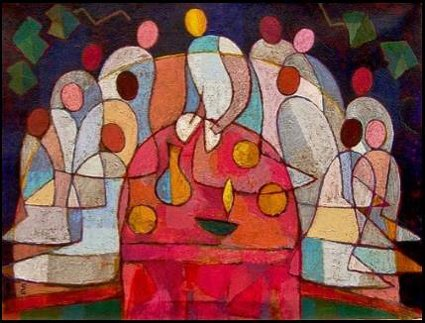
Art by Nigel Wynter (1957-2024)

I am the living bread that came down from heaven. Whoever eats of this bread will live forever, and the bread that I will give for the life of the world is my flesh.”

The Jews then disputed among themselves, saying, “How can this man give us his flesh to eat?” 

So Jesus said to them, “Very truly, I tell you, unless you eat the flesh of the Son of Man and drink his blood, you have no life in you. Those who eat my flesh and drink my blood have eternal life, and I will raise them up on the last day, for my flesh is true food, and my blood is true drink. Those who eat my flesh and drink my blood abide in me and I in them. Just as the living Father sent me and I live because of the Father, so whoever eats me will live because of me. This is the bread that came down from heaven, not like that which the ancestors ate, and they died. But the one who eats this bread will live forever.” (New Revised Standard Version)

To the religious leaders of Christ’s day, Jesus was making more noise than a couple of skeletons dancing on a tin roof. And they neither liked it, nor appreciated him drawing so much attention to himself.

Tensions had been escalating between Jesus and the religious establishment. The atmosphere was thick with grumbling leaders, as they tried to make some sense of Christ’s words to them.

Jesus offering his body for people to eat was causing far too much noise for the Jewish leaders. What in the world is this guy talking about?

Rather than making the meaning clear for them, Jesus added drinking his blood to the discussion. What’s more, Christ got up in their grill and confronted them with a choice, instead of a straightforward explanation.

Using some good old double negative language, Jesus flatly stated that there’s no life without any eating of his flesh and drinking of his blood. Then conversely, stated positively, Jesus affirmed that eternal life is found in those who eat his flesh and drink his blood.

This was next level communication of Jesus to the religious leaders. Earlier, Christ let them know that they needed to make the choice of coming to himself, of engaging in a life-giving relationship with him.

Yet now, it’s a matter of outright participation in Jesus, of eating and drinking the body and blood of Christ. Both the choice of relationship and of participation are radical decisions, which requires ditching some old traditions, and beginning some new ones.

Christ’s words are difficult, because they demand a change in thinking and behavior. Indeed, his words demand a change in our very way of being.

Christian discipleship requires that we stop the false ways of being in this world, and start a different way of being, according to the true self. In other words, Jesus was insisting on repentance and faith.

We are all on the hook to not just talk some theology and take some communion elements. It’s a lot more involved than that. Jesus demands our very lives, and not simply to sign off on some doctrinal statement about him. It’s about life itself, the power of life and death.

By eating and drinking Christ, there is meaningful relational connection, and ongoing participation in his life and ministry.

None of this is about literal cannibalism, and not even about actual bread and wine. This is deep metaphorical stuff which is meant to convey to us who Jesus is and how we can be related to him.

When we ingest food and drink, it goes into us and throughout our entire body. You cannot get much closer to something than by eating it and having it inside you. Just as eating bread goes to our very core and helps sustain life, so ingestingJesus is about allowing him to be as close to us as possible, into the very depths of our soul.

And by taking Christ into us, we will truly live and connect; and not be separated and die.

Art by Soiche Watanabe

We can no more spiritually live without taking Jesus into us, as we could live without eating on a regular basis. Christ is our breakfast, lunch, and dinner; our midnight snack and our birthday cake. Jesus is all that, and more.

Perhaps you are wondering why Jesus didn’t just state plainly who he is, why he came, and what will happen. Because it’s too much to handle.

We don’t simply accept Jesus into our heart, and then go on our merry way. Jesus Christ is someone to search for and discover, as if we were looking for fresh water or for the best baguette in the world.

Anyone can affirm a few belief statements, or do some good deeds. But it takes real courage to go hard after the spiritual life and find out what it’s all about:

It requires some solid bravery to explore the depths of your own true self and face the internal crud that’s been hiding in the shadows of your soul.

It demands identifying the bogus ways we prop up a false self for others to see – wanting to control how people view us and treat us.

It takes some real chutzpah to pursue the God life without worrying about where it will take you or who it will upset.

Jesus is a force to contend with. He is the Son of God, sent from above, to provide the world with real spiritual food and drink. Christ is the one who sustains life, and makes abundance possible. He is the Lord who speaks, calls out, and draws us to himself.

Jesus Christ helps us fit, even though we come from the island of misfit toys.

Even more pertinent than the question of “Who is Jesus?” is the probing question, “And what will you do with him?”

Christ cannot fit into your neat theological system, your tidy doctrinal statements, and on your nicely cleaned coffee table within the attractive Bible. Sooner or later, we all must contend with the divine force which gives life to everything. We cannot get away from him.

So, go after Jesus. Find out who he is. Determine how to deal with a mercy so powerful that it melts away guilt and shame as if it were in a 500 degree oven. After all, it’s better to have a tasty loaf of bread than to become a hard slice of burnt toast.

But let’s not worry about how hot it is in here, but how noisy it’s getting.

Gracious Lord, move us, your people, to experience your love more deeply. Fill us with the energy that comes from a desire for service. Connect us with creation to care for your world. Engage us in the scriptures and increase our knowledge of you. Raise up your power and come among us. May your bountiful grace and mercy equip us. Amen.

I Am the Bread of Life (John 6:35, 41-51)

Ethiopian Orthodox depiction of Jesus sharing with the disciples

Jesus said to them, “I am the bread of life. Whoever comes to me will never be hungry, and whoever believes in me will never be thirsty…

Then the Jews began to complain about him because he said, “I am the bread that came down from heaven.” They were saying, “Is not this Jesus, the son of Joseph, whose father and mother we know? How can he now say, ‘I have come down from heaven’?” 

Jesus answered them, “Do not complain among yourselves. No one can come to me unless drawn by the Father who sent me, and I will raise that person up on the last day. It is written in the prophets, ‘And they shall all be taught by God.’ Everyone who has heard and learned from the Father comes to me. Not that anyone has seen the Father except the one who is from God; he has seen the Father. Very truly, I tell you, whoever believes has eternal life. I am the bread of life. Your ancestors ate the manna in the wilderness, and they died. This is the bread that comes down from heaven, so that one may eat of it and not die. I am the living bread that came down from heaven. Whoever eats of this bread will live forever, and the bread that I will give for the life of the world is my flesh.” (New Revised Standard Version)

The lesson for today begins with the first of seven “I am” statements in John’s Gospel from Jesus:

  1. “I am the bread of life. Whoever comes to me will never be hungry, and whoever believes in me will never be thirsty.” (John 6:35)
  2. “I am the light of the world. Whoever follows me will never walk in darkness but will have the light of life.” (John 8:12)
  3. “I am the gate. Whoever enters by me will be saved and will come in and go out and find pasture.” (John 10:9)
  4.  “I am the good shepherd. The good shepherd lays down his life for the sheep.” (John 10:11)
  5. “I am the resurrection and the life. Those who believe in me, even though they die, will live,and everyone who lives and believes in me will never die.” (John 11:25-26)
  6. “I am the way and the truth and the life. No one comes to the Father except through me.” (John 14:6)
  7. “I am the true vine, and my Father is the vine-grower. He removes every branch in me that bears no fruit. Every branch that bears fruit he prunes to make it bear more fruit. I am the vine.” (John 15:1-2)

Also, for the first time in the Gospel of John, the Jews are named and identified as the ones who cause conflict for Jesus. John, of course, did not mean every single Jew; he was referring chiefly to the Jewish religious establishment, the leaders. And even then, he, of course, was not making reference to every single rabbi or person in the ruling council.

It’s important to say that, because Jews throughout the centuries have had far too much persecution from Christians who think all Jews have it in for Jesus. So, please, exercise some plain common sense and basic human kindness when it comes to reading the New Testament Gospels; they are most definitely not anti-Semitic.

The religious leaders were taking issue with the claims of Jesus, his “I am” statement. They argued that Jesus was a plain ordinary Jew from a typical Jewish family. There’s no need, the authorities contended, for Jesus to think of himself any other way than a common Jew.

Instead of entertaining the complaint against him, Jesus pointed to God the Father. God initiated the action by sending Jesus; and takes action by drawing people to Jesus. And Christ does his part by raising those people up at the last day; and teaching them about God’s actions of deliverance.

When it comes to the earthly ministry of Jesus, seeing is believing, and hearing is learning. Trust what you see with Jesus; and believe it. Have faith in what you hear from Jesus; and learn from it.

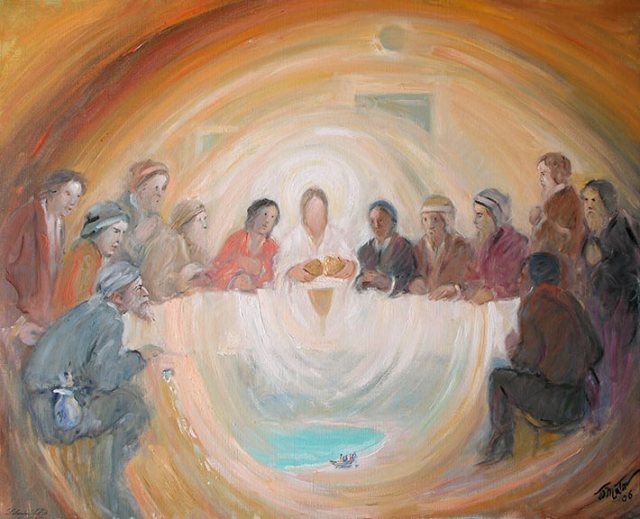
I Am the Bread of Life, by Joseph Matar

I like Jesus. I like metaphors. Jesus is a metaphor guy. I like that. Jesus said that he is the bread of life. Those who come to Jesus are satisfied. Those who eat him, live forever. This isn’t cannibalism, it’s a metaphor. The bread that Jesus gives for the life of the world is his flesh.

Metaphors help us relate to the concept, and grasp the message. If you’re hungry, just looking at a loaf of bread isn’t going to help you be satisfied. Obviously, you have to eat the bread and do more than see it, smell it, and touch it.

What’s more, people do more than eat once. We eat repeatedly, every day, at least a few times a day, in order to be healthy and alive.

Come and see Jesus. But do more than that. Ingest him. Take Jesus into your life. Let the bread of life come into you and thoroughly satisfy you. And do it every day. Do it several times a day. Make sure your soul is continually full of Jesus.

Then, you will have life to the full, an abundant life, filled with good things and right relationships.

Jesus is the bread of life. He is the great “I am.” And so much more.

Yet, perhaps at first glance, Jesus is just one person amongst a panoply of historical characters and religious figures. However, if we will but taste Jesus, we will come to see something very different about him. He’s more than a human being, more than a compelling teacher, and more than a miracle worker.

Jesus may appear, to many, as nothing more than a common person. But there’s really nothing ordinary about him, at all. Taking the time to have a good look at the Gospel of John, and watching Jesus move from village to village, and person to person will help us see a rather uncommon person who was no ordinary human being.

He moved to the beat of a different drum, and danced an alternative jig. And if we observe more closely, we can see the other two dance partners with him.

And with our two ears, when he says, “I am,” we can respond with an emphatic, “He is.”

Merciful Father, you heard the prayers of your people in the wilderness and fed them bread from heaven despite their sin. Graciously hear us today and feed us, too, with the Bread of Life from heaven, our Lord Jesus Christ, who lives and reigns with you and the Holy Spirit, one God, now and forever. Amen.

The Feeding of the Four Thousand (Mark 8:1-8)

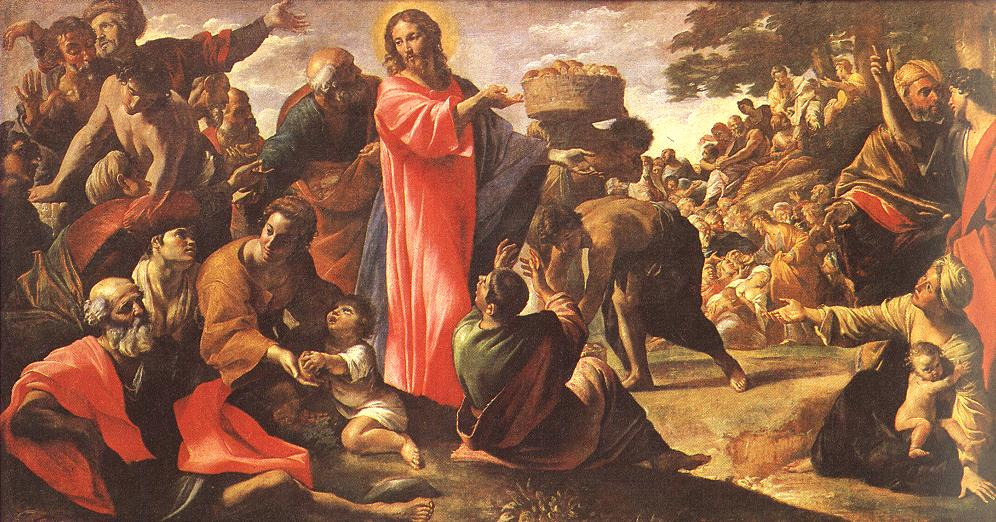
Miracle of the Loaves and Fishes, by Giovanni Lanfranco, c.1620

In those days when there was again a great crowd without anything to eat, he called his disciples and said to them, “I have compassion for the crowd because they have been with me now for three days and have nothing to eat. If I send them away hungry to their homes, they will faint on the way—and some of them have come from a great distance.” 

His disciples replied, “How can one feed these people with bread here in the desert?” He asked them, “How many loaves do you have?” They said, “Seven.” 

Then he ordered the crowd to sit down on the ground, and he took the seven loaves, and after giving thanks he broke them and gave them to his disciples to distribute, and they distributed them to the crowd. They had also a few small fish, and after blessing them he ordered that these, too, should be distributed. 

They ate and were filled, and they took up the broken pieces left over, seven baskets full. Now there were about four thousand people. And he sent them away. And immediately he got into the boat with his disciples and went to the district of Dalmanutha. (New Revised Standard Version)

This was an incredible miracle by Jesus. And it was also an incredible lack of faith on the part of his disciples. Christ had already taught them an important faith lesson by feeding 5,000 people earlier. You’d think they would have gotten it right this time.

It appears that the disciples were anxious about the situation. After all, whenever we are given to anxiety within a stressful circumstance, we typically are not thinking wisely about what to do.

There simply was no evidence that the disciples were tapping into their wise minds – even though they could have. And there’s where the rub is: Do we have the wherewithal to pause, in order to connect with what and who we know?

Let’s notice in the story that Jesus did not seem at all perturbed by the disciples’ small faith. And he certainly was not hindered in any way by the meager supply of food which was on hand. So, a remedial lesson was provided.

All the food the disciples pulled together was given to Jesus. It wasn’t much for thousands of people. Seven loaves of bread and a few fish. Yet, Christ transformed it into enough to feed the entire crowd of mostly Gentiles, without depriving the disciples of their share. They collected enough to fill seven baskets large enough to hold a man.

So there’s the lesson redone and restated, but with a different twist. Whereas the earlier miracle of food was provided for mostly Jews, the feeding of the four thousand consisted of nearly all Gentiles.

Perhaps the disciples did not really want a miracle to begin with. Maybe they believed their ministry ought to be with Israel, and not the heathen nations around them. It could be that Christ’s disciples simply did not want to be in Gentile territory at all, let alone have to engage in ministry to them, up close and personal.

So, we may be dealing with something more than an issue of faith; we might be looking at plain old fashioned prejudice against another group of people. Discriminatory behavior shrinks one’s faith and makes it small – whereas including others, and seeing their inherent worth as God’s image-bearing creatures, increases our faith and helps it grow large.

Jesus had a heart big enough, a mind open enough, and more than enough ability to make the miracle of food happen. In other words, Christ wanted to do it. He had compassion on the people, regardless of the fact that they were not like him.

It could be that a lesson in prejudice was the teaching he wanted them to get a hold of.

We see in today’s story a trajectory of inclusion, that the kingdom of God is meant to be full of diverse people from every nation, race, and background. Jesus purposely went to the Decapolis, a geographical region with a lot of different people – mostly non-Jews.

The Decapolis (which means “Ten Cities”) was a group of ten Hellenistic cities. It was a center of Greek and Roman culture, in a region mostly populated by Jews and Arameans. Each city functioned as a sort of city-state which was dependent upon Rome. There was enough diversity within the Decapolis itself which seemed to prevent them from working together as an organized region.

When it comes to Christian ministry, there are often two issues going on, namely because ministry is all about working with people. One is that we may have a problem, like the disciples of old, in going to a place we’ve never been before – and really don’t ever want to go. We have particular ideas about the people who live there and what they’re like – and we’d rather not have to deal with them.

The second issue is that we may have a problem with ourselves. Unlike the first issue in which we wonder why Jesus would care about those people, the second is wondering if Jesus really cares about me.

In this, you have no problem believing that Jesus would go to the Decapolis and have compassion on the Gentiles. But you struggle with God caring for you, and that Jesus could ever use you in ministry to people like those in the Decapolis. You can think of all sorts of other people who could do the job much better than yourself.

Since you know yourself pretty well, you understand your own doubts, weaknesses, and sins; and have a hard time trusting that the Lord could or would want to involve you in any ministry.

We, of course, could read today’s Gospel lesson from either of the two issues. Yet, we probably need not make it an either/or issue; it may be more of a both/and issue.

That is, Christ’s disciples – including those past and present – likely struggle with both: We continually keep finding that we have personal prejudices which prevent us from reaching out to particular people; and we also have personal insecurities and inhibitions about God truly loving us enough to use us in effective ministry.

Within the story of Jesus feeding the four thousand, both issues can find their resolution. The fact of the matter is that Jesus cared about the people in the region of the Decapolis, and created a miracle in order to take care of them; and, Jesus used a group of men who probably were likely prejudiced, and also insecure about being used for such a ministry.

May you know that you are infinitely loved by God – and loved alongside all sorts of other people, as well, from everywhere in every place. And may you understand that God has you on this earth to be a blessing to all kinds of persons.

May it be so, to the glory of God. Amen.