Revelation 7:9-17 – Persevering to the End

After this I looked, and there was a great crowd that no one could number. They were from every nation, tribe, people, and language. They were standing before the throne and before the Lamb. They wore white robes and held palm branches in their hands. They cried out with a loud voice:

“Victory belongs to our God
        who sits on the throne,
            and to the Lamb.”

All the angels stood in a circle around the throne, and around the elders and the four living creatures. They fell facedown before the throne and worshipped God, saying,

“Amen! Blessing and glory
        and wisdom and thanksgiving
        and honor and power and might
            be to our God forever and always. Amen.”

Then one of the elders said to me, “Who are these people wearing white robes, and where did they come from?”

I said to him, “Sir, you know.”

Then he said to me, “These people have come out of great hardship. They have washed their robes and made them white in the Lamb’s blood. This is the reason they are before God’s throne. They worship him day and night in his temple, and the one seated on the throne will shelter them. They won’t hunger or thirst anymore. No sun or scorching heat will beat down on them because the Lamb who is in the midst of the throne will shepherd them. He will lead them to the springs of life-giving water, and God will wipe away every tear from their eyes.” (Common English Bible)

There is a day coming when followers of Jesus will see him face to face. Believers will serve the Lord continually. God’s very presence will be their permanent shelter. It will be a glorious time of unending peace, harmony, and rest.

There shall be no more worrying about how to make ends meet, where we are going to get our needs met, and anxiety about the future. Injustice will be a thing of the past. Unending love and light will replace it.

First, however, before this permanent Sabbath, there will be trouble, hardship, trial, and even martyrdom. There is presently pain and suffering. Like a woman in labor, this must take place before there is the glory of new life. 

“A hero is an ordinary individual who finds the strength to persevere and endure in spite of overwhelming obstacles.”

Christopher Reeve

Sometimes the difficult circumstances of life seem to have no end. Yet, they will eventually pass, and we must continually keep this in mind. Christians have the hope of God’s pastoral presence forever guarding and keeping our lives if we endure to the end.

Perseverance, endurance, and pushing through hard situations are necessary to realize the finish line. We cannot just sit here on earth in some sort of holding pattern waiting for the end to occur. Just as an athlete must go into strict training in order to run the race well, finish strong, and cross the line, so we as Christians are to be in training – utilizing an array of spiritual practices that will fortify our souls to keep going and finish the race. 

The book of Revelation was a vision of the Apostle John given to believers in hardship who needed to persevere. Giving them a glimpse of the glorious ending was one way of helping them in the present to live for Jesus Christ, despite the pain.

Since the Christian life is not a sprint but a marathon, here are some ways we can build a enduring and persevering spirit until Christ returns:

Don’t be afraid to fail.

That’s because, for the believer, we know the ending. We may feel like colossal failures, at times, yet, because the Lord is with us, we have nothing to fear. Being secure in our identity as God’s people enables us to step out and engage the world.

When I am afraid,
    I put my trust in you.
I trust God, so I am not afraid of what people can do to me!
    I praise God for his promise to me. (Psalm 56:3-4, ERV)

Take small steps of faith.

We can incrementally improve ourselves daily through our growth in grace. We don’t need to always do big things for God. We can do small acts of kindness with big love.

Continue to grow in the grace and knowledge of our Lord and Savior Jesus Christ. To him be the glory, now and forever! Amen. (2 Peter 3:18, GNT)

Love the Lord your God with all your heart, all your soul, all your mind, and all your strength.’The second most important command is this: ‘Love your neighbor the same as you love yourself.’ These two commands are the most important. (Mark 12:30-31, ERV)

Identify the resistance.

Name the obstacles, impediments, and challenges to perseverance. Our awareness of what hinders us gives us the power to choose how to handle it.

We should remove from our lives anything that would slow us down and the sin that so often makes us fall. We must never stop looking to Jesus. He is the leader of our faith, and he is the one who makes our faith complete. (Hebrews 12:1-2, ERV)

Practice good self-care.

The body, mind, emotions, and spirit are our vehicles to doing the will of God. So, it is imperative we steward these precious gifts of humanity with care. The only way we will make it over the long haul of our lives is through paying attention to this.

God has made us what we are. In Christ Jesus, God made us new people so that we would spend our lives doing the good things he had already planned for us to do. (Ephesians 2:10, ERV)

Surely you know that you are God’s temple and that God’s Spirit lives in you! (1 Corinthians 3:16, GNT)

Know why you are persevering.

Losing connection with why we do what we do leads to dropping out and giving up. Yet, when we can maintain what is most important to us, it helps us push through all the sticky points of our lives.

So, if you eat, or if you drink, or if you do anything, do it for the glory of God. (1 Corinthians 10:31, ERV)

Whatever you do, whether in speech or action, do it all in the name of the Lord Jesus and give thanks to God the Father through him. (Colossians 3:17, CEB)

Patient God, you tediously work until your plans and purposes are accomplished.  As you are slowly bringing your kingdom to the world, strengthen me so that I do not give up.  Help me to persevere, living and loving like Jesus, to his glory.  Amen.

Hebrews 4:12-16 – Jesus Is Our Great High Priest

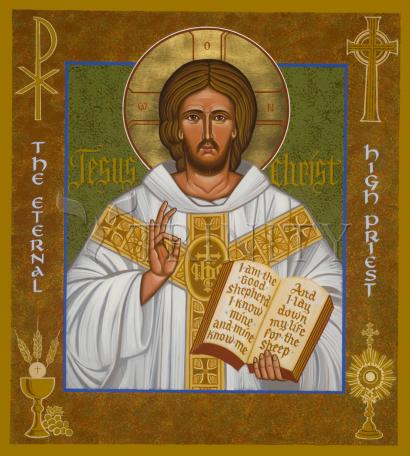
Jesus, the Eternal High Priest, by Joan Cole

For the word of God is alive and active. Sharper than any double-edged sword, it penetrates even to dividing soul and spirit, joints and marrow; it judges the thoughts and attitudes of the heart. Nothing in all creation is hidden from God’s sight. Everything is uncovered and laid bare before the eyes of him to whom we must give account.

Therefore, since we have a great high priest who has ascended into heaven, Jesus the Son of God, let us hold firmly to the faith we profess. For we do not have a high priest who is unable to empathize with our weaknesses, but we have one who has been tempted in every way, just as we are—yet he did not sin. Let us then approach God’s throne of grace with confidence, so that we may receive mercy and find grace to help us in our time of need. (New International Version)

Church Persecution and Christian Suffering

The book of Hebrews was originally a sermon preached to a group of believers who had come to Christ out of Judaism. From the book of Acts, we know there were thousands of Jewish Christians who were dispersed from Jerusalem when Stephen was martyred.  A great persecution broke out, and many believers fled west to places like Galatia, Ephesus, Greece and Rome. 

The Jewish believers were immigrants in a foreign land, looking to practice their faith without harm. Yet, their experience was anything but ideal. These followers of Christ found fellow ethnic Jews in the places where they went, yet those Jews had no use for these people that they believed were in some sort of aberrant cult.

What is more, the surrounding Gentile culture did not understand Christianity, at all, and many of those who held to pagan religions bought into rumors, such as, that Christians were cannibals who ate at what’s called the Lord’s Table.

So, here we have a situation where these displaced Christians had no respect from both Jews and Gentiles. As a result, they had a difficult time carrying out business because no one trusted them. They were essentially alone in the world. 

Losing Their Grip

Initially, they embraced their identity as Christians and held up quite well under the stress. However, over time, their resolve began to slowly erode. The followers of Jesus began to question their adverse situation. 

They began listening to their fellow Jews throw doubts on their faith. The hard life was not improving, maybe even becoming worse.  Eventually, the church came to a point where they began re-considering their whole way of life as Christians, and their faith commitment started slipping. The Christians actually considered leaving the Church and Christianity and going back to their old life in Judaism.

The Message of Hebrews

It was at this point that a vigorous believer in Jesus came to town, saw the situation of the church, and preached a spirited message to them. The preacher called them to hold tight to their commitment – to see Jesus afresh and anew as superior over all the Old Testament, as the fulfillment of all the promises of God. 

So, then, throughout the book of Hebrews we have this wonderful explanation and exposition of how to make sense of Jesus and the Old Testament, and of what Jesus really means to the church. Throughout his sermon, the preacher occasionally paused his teaching and gave the people a stiff warning about falling away from Christ. He called the church to be bold and confident in Christ, to stand up to the suffering, and to confront their temptations so that they would persevere in their commitment to Jesus Christ for the rest of their lives.

God’s Word and Work

We pick up the teaching and the exhortation in chapter four. Hebrews 4:12-16 is composed of two distinct sections that are paired together for a reason.  Verses 12-13 give us a graphic visual of the penetrating work of God’s Word, of the reality that God can get deep inside us. The next section, verses 14-16, lays out God’s response to our being under divine scrutiny – that there is grace and mercy available because of Jesus, our great high priest who is superior to every priest of the Old Testament to the point of being the last and permanent priest forever! 

These verses are bound together because we all need to struggle with the tension between God’s Word to us, and our words to God; between God’s judgment that opens our souls on a spiritual operating table, and God’s grace which jumpstarts our broken hearts. Our most fundamental need is for God’s mercy in Jesus Christ.

The Christian Life

It is important that our outer lives and our inner lives match each other. Whenever the two are out of sync, we come under the judgment of God’s Word. These early Hebrew Christians had slowly drifted from the truth so that their inner and outer lives did not line up well.

Some of them still performed the outward duties of being a Christian yet were inwardly despising their hard situation. A growing vacuum developed on their insides as they slowly started letting go of Jesus as their object of devotion. Their hearts began to harden because of their hard lives. 

On the other hand, there were other Hebrew Christians who began drifting in a different way. Inwardly, they tried to maintain their devotion and commitment to Christ. Yet these believers began compromising their outward life to match the culture around them. In both cases of hardening inwardly, and of compromising outwardly, they each shared the situation of drifting away from their original commitment to Christ.

Even today, it is a real temptation to try and avoid suffering, to grow weary of our present circumstances and look for a way to get out from under the pain and find a quick fix.  Whenever we find ourselves in such a situation, the remedy is to be reminded that we must continue to hold firmly to the faith we profess because of who Jesus is.

15th Century Orthodox icon of Christ the Great High Priest

Jesus As Permanent High Priest

Jesus is our great high priest. In the Old Testament, among the twelve tribes of the ancient Israelites, the tribe of Levi made up the class of priests. One of those Levites, always a descendent of the original Levite priest, Aaron, had the task of once a year entering a place called the Holy of Holies, which was at the center of the Temple, to offer a bloody sacrifice on behalf of the people, to atone for their sins from the previous year.

Jesus is our great and ultimate high priest. He did not enter the temporary sacrificial system to deal with sins for only a year. Jesus not only took on the role of high priest, but became the sacrifice, as well. As a result, we now have a thorough and permanent forgiveness of sins through Christ. So, the Hebrew Christian who considered going back to an old outdated system needed to be brought back to his senses and embrace again the once-for-all sacrifice of Jesus. 

As they considered Jesus, the believers needed to remember that Christ was not so far removed from them that the church could not relate to Jesus. Rather, Jesus is able to sympathize with each and every trouble, trial, and temptation we face because he faced the very same kind of sufferings. 

The only difference between Christ and his followers is that Jesus did not succumb to the trouble, but persevered and secured for us deliverance from sin, death, and hell. Jesus is the One who deserves every bit of our commitment, allegiance, and devotion. Christ is the One whom we are to worship inside and out.

Approaching God with Boldness

Let us then approach Jesus with confidence, with boldness, knowing that with him there is mercy and grace. Jesus not only suffered for us in the past; he also suffers with us now, in the present. We, as believers, are in union with Jesus. Christ is our great high priest, the One intimately involved in every nook and cranny of our lives. He knows what you and I are going through and is ready to give grace to help right now. 

Approaching Jesus has nothing to do with being good enough to do so. Coming to Jesus is about grace. Whenever we drift from Jesus and are confronted with God’s Word cutting us to the heart, the end result is not wrath or judgment; the result is mercy and grace.

Like the early Hebrew Christians, we all face situations out of our control that wear us down and cause us to become weary. In our tired state, we can be tempted to let our commitment to Christ slide in some small way. Over time, the small compromises of faith can snowball into a big slide away from God. 

Yet, Jesus is not sitting in heaven frustrated or confounded. God is not looking for a reason to punish people. It is just the opposite. Jesus, the Son of God, our great high priest, is looking for a reason to give grace and help us in our time of need. Christ is waiting for us to approach the throne of grace with confidence. Right now, Jesus is alive. He is scanning the world and the church, looking to extend mercy to those who need it. 

Asking for Help

We must avoid a spiritual hardening of heart which estranges us from approaching Jesus. Every one of us needs help. We are not God. We have weaknesses. We have confusion. We have limitations of all kinds. We need help.  And every one of us has something else: guilt and shame. At the bottom of our hearts, we feel undeserving, and so, avoid coming to Jesus. Yet, we need with family, loneliness, work, health, finances.

So, what to do? I can try to deny it all and be a superman who doesn’t need any help. I can try to drown it all with alcohol. I can be obsessive and compulsive about controlling events and/or people. I can simply succumb to discouragement. Here is what God declares: Jesus Christ became a High Priest to shatter despair with hope, to rescue that drowning person and that anxious individual.

God planned for a High Priest, a Savior, a Redeemer, and a gracious Helper. You and I are not trapped. We have Jesus. 

The book of Hebrews is all about a call to commitment – an invitation to come to Jesus.  And it is the most important invitation you will ever receive. Let us approach the throne of grace with confidence….

This is the confidence we have in approaching God: That if we ask anything according to his will, he hears us.  And if we know that he hears us – whatever we ask – we know that we have what we asked of him. Spirit of God, lead us into your will. Help us in all things. Fill our hearts and lives to overflowing with divine mercy and grace so that what comes out of our mouths and the actions we do are compassionate, kind, and good, through our great High Priest, Jesus Christ. Amen.

1 John 2:18-25 – Who Is the Antichrist?

Dear children, this is the last hour; and as you have heard that the antichrist is coming, even now many antichrists have come. This is how we know it is the last hour. They went out from us, but they did not really belong to us. For if they had belonged to us, they would have remained with us; but their going showed that none of them belonged to us.

But you have an anointing from the Holy One, and all of you know the truth. I do not write to you because you do not know the truth, but because you do know it and because no lie comes from the truth. Who is the liar? It is whoever denies that Jesus is the Christ. Such a person is the antichrist—denying the Father and the Son. No one who denies the Son has the Father; whoever acknowledges the Son has the Father also.

As for you, see that what you have heard from the beginning remains in you. If it does, you also will remain in the Son and in the Father. And this is what he promised us—eternal life. (New International Version)

Throughout Christian history there have been churches, ministers, and individuals who have advanced certain persons as being the “antichrist,” enemies of Christ and his followers.  

Attempting to identify a particular enemy comes from a theological disposition that believes an antichrist is the first link in a chain of end-times events. Typically, a ruthless or dictatorial ruler, like Mussolini, Hitler, or Stalin received the label of “antichrist.” 

For some Protestants, the papacy continually gets set apart as being the antichrist. Seems like, ever since the Reformation, the Pope has received the dubious title from anti-Catholics. Today, it is standard fare for some evangelical end-times watchers to bemoan the state of the world and lay the blame in a particular person who is outside their own little group. 

Yet, the term “antichrist” has not typically been used as a title for one enemy setting-off a bomb of world-ending trauma. The earliest church, following the teaching of the Apostle John, understood antichrist not as an individual, but as a class of people who deny Jesus is the Christ. 

Indeed, John plainly said the antichrist is anyone who forsakes the Father and the Son. What is so disturbing about John’s talk of antichrist is that these persons arise from within the church, not outside of it.   

It has become too vogue in some circles of Christian evangelicalism to identify and label enemies outside their small groups, leading to a xenophobic attitude of distrust and finger-pointing toward all kinds of people.  

The fingers, however, must first be directed within our own house. It behooves us all to take up the instruction of John to internalize and remember sound teaching. If what you heard from the beginning abides in you, then you too will abide in the Son and in the Father.   

We are to embrace basic core cardinal truth given us. Then we will not be deceived by some supposed enlightened teacher who detracts from Trinitarian theology.   

It is the last hour – but not because of some politician, tyrant, or even religious figure. It is the end-times because Jesus has accomplished redemption for us, and the only event left is the return of Christ to judge the living and the dead.   

Therefore, we must all live with the possibility and tension that it could be today. We are to be prepared. That preparation comes through proclaiming Jesus in all we say and do – not by obnoxiously foaming at the mouth, fearmongering, or pointing fingers at those we don’t like. Rather, we emulate our Lord in the way of loving God and neighbor. 

When a person or group gets labeled by us as “enemy” or “antichrist” then our hate for them seems divinely justified and sanctioned. God, however, is the judge; not us. We are to follow the ethical instruction of Jesus to love our enemies, not curse them through slapping a moniker of “monster,” “devil,” “animal,” or some other non-human label on them. 

Weaponizing words in a verbal war which supposedly defends Christianity only shifts the focus off Jesus and onto how horrible another is. One of the great problems of our world, including many corners of Christianity, is the assumption we already know what another believes. So, we fail to listen. We do not care as we ought because we’ve already formed our judgments. 

“The moment someone attaches you to a philosophy or a movement, then they assign all the baggage and all the rest of the philosophy that goes with it to you. And when you want to have a conversation, they will assert that they already know everything important there is to know about you because of that association. And that’s not the way to have a conversation.”

Neil deGrasse Tyson

Within Christianity, there is much more we have in common with one another across the various traditions than that which is different. Yes, spiritual charlatans exist. Let’s just make sure we have done our due diligence in listening to another and being curious before we form our opinions. 

Despite our differences, the exchange of ideas and debate among various Christian groups in the early centuries of the church helped to clarify and form orthodox Christology. While it may be difficult to avoid labeling individuals in an increasingly complex society, we must act in good faith. 

Mighty God, you sent the Son to this earth to fulfill all your good promises. Let me embrace Jesus so fully and completely that the truth of his reality comes pouring out of me in every area of my life.  In his name I pray. Amen. 

1 Peter 1:3-9 – Be Joyful in Suffering

Praise be to the God and Father of our Lord Jesus Christ! In his great mercy he has given us new birth into a living hope through the resurrection of Jesus Christ from the dead, and into an inheritance that can never perish, spoil or fade. This inheritance is kept in heaven for you, who through faith are shielded by God’s power until the coming of the salvation that is ready to be revealed in the last time. In all this you greatly rejoice, though now for a little while you may have had to suffer grief in all kinds of trials. These have come so that the proven genuineness of your faith—of greater worth than gold, which perishes even though refined by fire—may result in praise, glory and honor when Jesus Christ is revealed. Though you have not seen him, you love him; and even though you do not see him now, you believe in him and are filled with an inexpressible and glorious joy, for you are receiving the end result of your faith, the salvation of your souls. (New International Version)

One of my favorite stories is Victor Hugo’s Les Miserables. It’s a story of grace and new life. The main character is Jean Valjean, who spends nineteen years in jail for stealing a loaf of bread for his starving family.  The experience in prison caused him to become a bitter man. 

By the time he is released, Valjean is hard, angry, and cynical. Since ex-convicts were not treated well in nineteenth-century France, Jean Valjean had nowhere to go. In desperation, he seeks lodging one night at the home of a Catholic bishop, who treats him with genuine kindness, which Valjean sees only as an opportunity to exploit. 

In the middle of the night, Jean Valjean steals the bishop’s silver and leaves. The next day, however, he is caught by the police. When they bring Jean back to the bishop’s house for identification, the police are surprised when the bishop hands two silver candlesticks to Valjean, implying that he had given the stolen silver to him, saying, “You forgot these.” 

After dismissing the police, the bishop turns to Jean Valjean and says, “I have bought your soul for God.” In that moment, by the bishop’s act of mercy, Valjean’s bitterness is broken.

Jean Valjean’s forgiveness is the beginning of a new life. The bulk of Victor Hugo’s novel demonstrates the utter power of a redeemed life. Jean chooses the way of mercy, as the bishop had done. 

Valjean raises an orphan, spares the life of a parole officer who spent fifteen years hunting him, and saves his future son-in-law from death, even though it nearly cost him his own life. There are trials and temptations for Valjean all along the way. 

What keeps Jean Valjean pursuing his new life is mercy. Whereas before, he responded to mercy with a brooding melancholy and inner anger, now – after being shown grace – Valjean responds to each case of unjust suffering with both mercy and joy, deeply thankful for the chance to live a new life full of grace.

Suffering and joy. They, at first glance, may seem to be opposites. Christianity views suffering as an occasion for joy, and not just empty meaningless grief. 

“A gracious soul may look through the darkest cloud and see God smiling on him.”

Thomas Brooks (1608-1680)

Followers of Jesus imitate their Savior through walking in the way of suffering. These sufferings are trials to our faith and the means by which our faith is developed, used, and strengthened. Just as gold is refined by being put through fire, so our faith is refined and proven genuine through the purging fires of life’s trials and troubles. 

Walking in the way of the Lord Jesus, adversity is our Teacher, helping us to know Christ better and appreciate the great deliverance from sin, death, and hell we possess in Jesus.

Adversity has a positive effect of making faith genuine. Every generation of Christians must come to grips with faith. Belief is not only a matter of confession with the lips; faith is also proven primarily through suffering. So, we must walk-the-talk, as well as talk-the-walk. 

Faith is like a new car – it is meant to be occupied, used, and driven – and not to only sit in the garage and be admired. A car is meant to be on the road, and if it does not perform well, we say it’s a lemon and we get another car. 

Cars are the vehicles getting us from point A to point B. And, hopefully, we enjoy the ride without being frustrated and having road rage. It is unrealistic, as drivers, to believe we will never have to drive in adverse road conditions. We know it is silly to believe the weather must always conform to our driving habits. 

Good drivers are good drivers because they drive a lot and have driven in nearly every road condition there is.  Mature Christians are those followers of Jesus who live their faith each and every day and, since they allow their faith to take them places, have seen all kinds of adversity, trials, and suffering along the road of life.

They have learned through all their troubles and trials to enjoy what God is doing in their lives instead of being frustrated and have faith-fury. Such Christians have the confidence they are receiving the goal of their faith, the salvation of their souls. They understand their faith grows and develops as they face the challenges of life every day with a firm commitment to their Lord Jesus.

There are times we feel overwhelmed by our circumstances and wonder how to get through them. Yet, no matter what happens, we still love Jesus and believe him, even though we don’t see him. Like Jean Valjean, we keep living our lives with joy knowing that mercy shapes our lives with purpose and meaning.

Peter could praise God because his life was transformed by the grace and mercy of Jesus. Peter went from an impulsive and fearful fisherman who denied the Lord three times, to a confident and courageous witness of Christ because he was regenerated, restored, and renewed by grace. He joyfully endured suffering and opposition because his faith was precious to him. 

There can be a tendency for many Christians to show a flat and staid attitude through the trials of life – trying to keep a stiff upper lip and endure. However, taking the approach of “It is what it is” only works for so long. 

Eventually “My God, my God, why have you forsaken me!” is a more appropriate response to trouble. It is precisely during those times when human hope fades that we rejoice – even though the rejoicing is through tears – in the living hope kept for us.

This gracious inheritance of hope is imperishable, undefiled, and unfading. That means we can live through a difficult day or week or month or even, dear God, a year or longer with spiritual endurance. We can persevere through a worldwide trial of pandemic. We can do more than survive – we can thrive through having our faith muscle stretched and strengthened. We are not alone. We all suffer together.

Our shared value of the risen Christ is the fuel that keeps our car of faith running. It is what transcends the stoic attitude of unfeeling endurance to a joyful flourishing of faith. 

Eventually, suffering will have done its work and we will be with Christ forever. Until that day, let’s not hunker down and stay in the garage of life. Let us explore all that God has for us, embracing both the meaning and the mystery of faith. Since our salvation is assured, let us live with confidence and run the race marked out for us. 

Let us not be complacent or slow in doing the will of God, but work for God’s kingdom purposes on this earth, in this age, while it is still called Today. And let us allow the trials of this age to do their work in us, responding to them with joy knowing that our faith is being strengthened for the benefit of blessing the world. 

To God be the glory. Even in suffering.

Blessed Lord, you created us and lovingly care for us. We accept all our sufferings willingly, and as truly obedient children we resign ourselves to your holy will. Give us the strength to accept your loving visitation to us through adversity, and never let us grieve your heart by giving-in to impatience and discouragement. We offer you all our pains to be used for your honor and glory.

Brother Jesus, you loved us so much as to suffer and die for our deliverance from sin. Through the love we have for you, we willingly offer all that we have ever suffered in the past, am now suffering, and will suffer in the future. We are grateful that your love enables us to suffer with joy. Because you suffered, we have new life in the name of Jesus who taught us to pray. Amen.