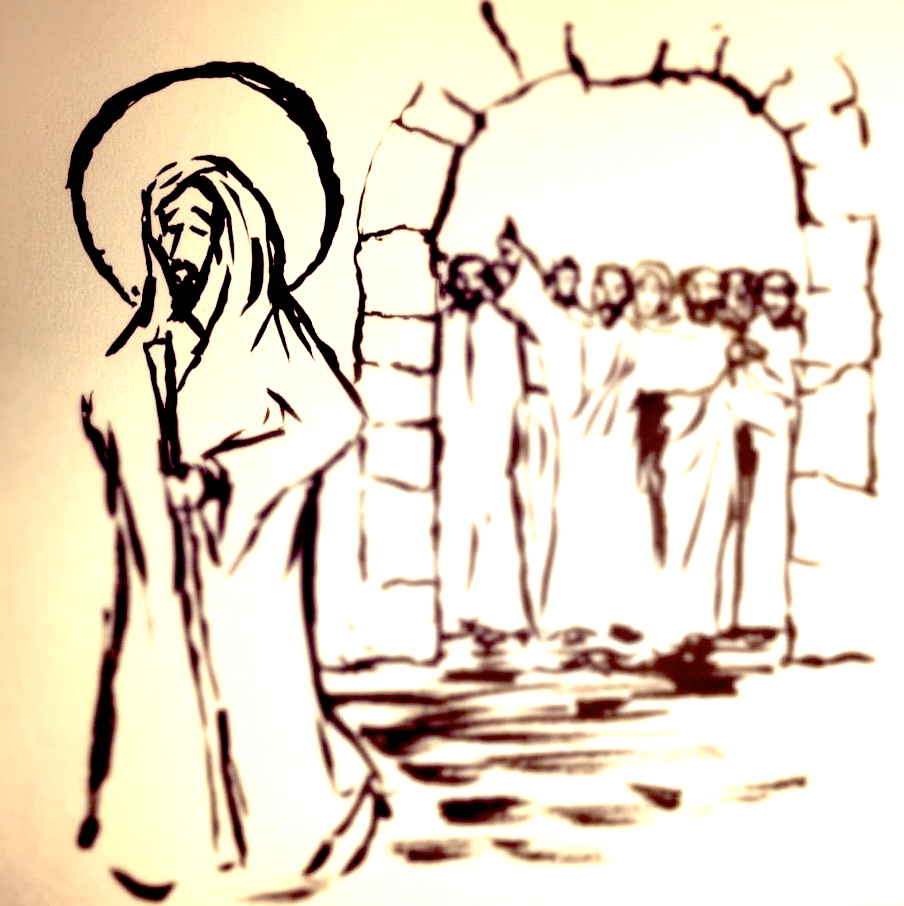
Don’t Let Rejection Get the Best of You (Mark 6:1-13)

He left that place and came to his hometown, and his disciples followed him. On the Sabbath he began to teach in the synagogue, and many who heard him were astounded. They said, “Where did this man get all this? What is this wisdom that has been given to him? What deeds of power are being done by his hands! Is not this the carpenter, the son of Mary and brother of James and Joses and Judas and Simon, and are not his sisters here with us?” And they took offense at him. 

Then Jesus said to them, “Prophets are not without honor, except in their hometown and among their own kin and in their own house.” And he could do no deed of power there, except that he laid his hands on a few sick people and cured them. And he was amazed at their unbelief.

Then he went about among the villages teaching. He called the twelve and began to send them out two by two and gave them authority over the unclean spirits. He ordered them to take nothing for their journey except a staff: no bread, no bag, no money in their belts, but to wear sandals and not to put on two tunics. 

He said to them, “Wherever you enter a house, stay there until you leave the place. If any place will not welcome you and they refuse to hear you, as you leave, shake off the dust that is on your feet as a testimony against them.” So they went out and proclaimed that all should repent. They cast out many demons and anointed with oil many who were sick and cured them. (New Revised Standard Version)

Homecooked Rejection

Jesus was well into his ministry, with the disciples in tow, and had made quite a splash around Judea. Eventually, he made it back to the region of Galilee and to his hometown. Having grown up in a small town myself, I can testify how any sort of celebrity status from one of their own is a really big deal. Anticipation was high amongst the townsfolk.

Knowing Jesus as they did, the people were downright slack-jawed at his wisdom and the way he taught – which is also a typical response of the hometown boy made popular. The town knew Jesus differently – as simply another nice, but normal, Jewish kid from a nice but scandalous family.

The homecoming turned sour as the crowd believed they knew more than Jesus. After all, they knew him as a little kid. And they knew where he came from. He’s the carpenter, the son of Mary. They remembered what was up with Jesus. Mary and Joseph weren’t yet together and she ended up pregnant. This guy is no Son of God, but son of who knows?

They took offense at Jesus. He was the one with the curious conception and birth. And now he was trying to teach them, the ones who “really knew” his origins – or so they thought.

Jesus was just too uppity for the hometown folks. He considered himself more than the people he grew up with would concede. By providing the self-reference of “prophet,” Jesus was placing himself in the company of many revered men of God who went against the grain of their own contemporary cultures. And the folks in Galilee most certainly did not think they needed a prophet, especially one with illegitimate origins.

For the townsfolk, Jesus was claiming more honor and status for himself than was warranted in the old hometown. It meant that others got knocked down to size. So the people in the town were not having it. They took offense.

Ironically, the people who ought to know better, don’t. Jesus was amazed at their lack of faith, their unbelief. So little could be done in such a place as this. After all, you cannot heal someone if they believe they don’t need healing.

Heaven-sent Mission

Rejection didn’t stop Christ’s mission on this earth. Jesus prepared his disciples for their initial ministry, sending them in pairs. Up to this point, he taught them about God’s kingdom, handled a good deal of one-on-one instruction, and demonstrated for them what healing is like and why he did it. And they also needed to understand that rejection from others is part of the ministry.

Jesus instructed the disciples to take only a few essentials; the hospitality of others would be a significant aspect of their ministry – especially since much of their work would take place from household to household. Synagogues were not always receptive places to a new kind of ministry. So, the grassroots efforts of the disciple pairs were important.

Rejection and judgment tend to go hand-in-hand. Those who spurned the disciples were judging the veracity of their work. And also, that same rejection was a sign for the disciples to not spin their wheels trying to persuade the already convinced. Instead, the disciples were to do their own action of shaking the dust off their feet, letting the stubborn people know they were not carrying the bad judgments with them.

All in all, Christ’s disciples had an effective ministry and a positive experience. They were able to bring their message and healing to many.

We can observe through this story that rejection from others and a failure to make inroads with some is not necessarily a reflection on us. Some people are going to misunderstand us and make judgments about us, regardless of how well we go about our work.

After all, if Jesus experienced it, how much more will we? Don’t let rejection get the best of you.

To never face rejection and judgment may be a sign that little to no action is actually taking place – or maybe that the avoidance of conflict is assigned a value much too high than Jesus would give it.

If you are working toward loving both God and neighbor, showing justice and mercy in all you do, then any sort of rejection isn’t worth getting upset about.

Gracious God, I release my grip on needing to be understood by everyone, and instead choose to hold onto you and your grace. Therefore:

  • I lay down my need to understand why things happen the way they do.
  • I lay down my fears about others judging me.
  • I lay down my desire to prove my worth.
  • I lay down my resistance to suffering.

I take up my cross daily, and seek to walk according to your ways, and to live into your words; through Jesus Christ my Lord, in the enablement of the Holy Spirit. Amen.

The Logic of Faith and Prayer (Mark 9:14-29)

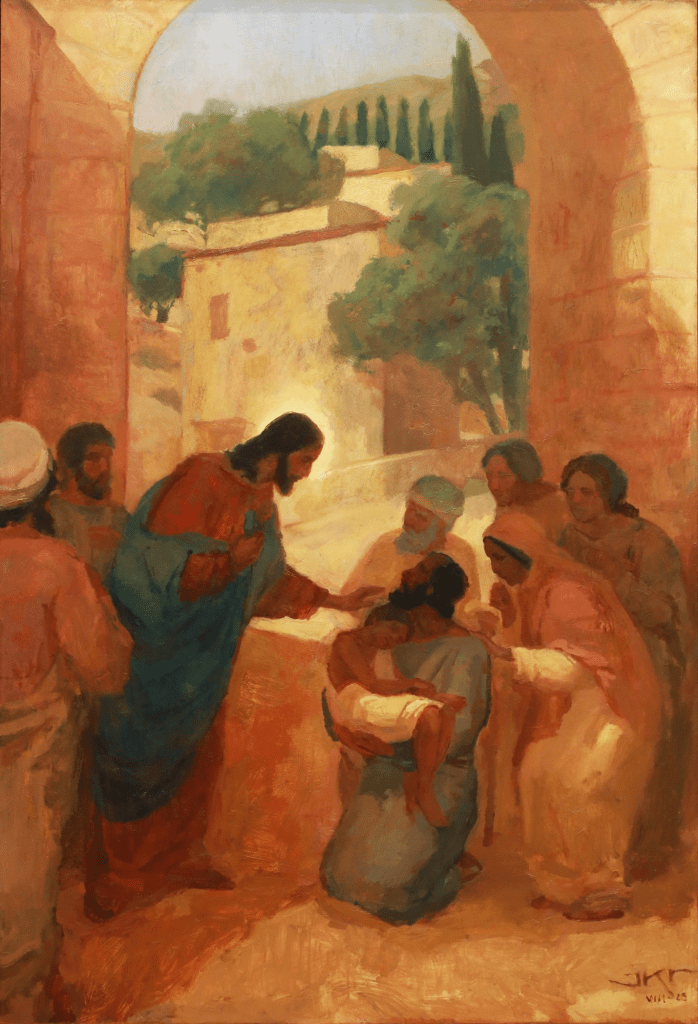
Help Thou My Unbelief, by J. Kirk Richards

When they came to the other disciples, they saw a large crowd around them and the teachers of the law arguing with them. As soon as all the people saw Jesus, they were overwhelmed with wonder and ran to greet him.

“What are you arguing with them about?” he asked.

A man in the crowd answered, “Teacher, I brought you my son, who is possessed by a spirit that has robbed him of speech. Whenever it seizes him, it throws him to the ground. He foams at the mouth, gnashes his teeth and becomes rigid. I asked your disciples to drive out the spirit, but they could not.”

“You unbelieving generation,” Jesus replied, “how long shall I stay with you? How long shall I put up with you? Bring the boy to me.”

So they brought him. When the spirit saw Jesus, it immediately threw the boy into a convulsion. He fell to the ground and rolled around, foaming at the mouth.

Jesus asked the boy’s father, “How long has he been like this?”

“From childhood,” he answered. “It has often thrown him into fire or water to kill him. But if you can do anything, take pity on us and help us.”

“‘If you can’?” said Jesus. “Everything is possible for one who believes.”

Immediately the boy’s father exclaimed, “I do believe; help me overcome my unbelief!”

When Jesus saw that a crowd was running to the scene, he rebuked the impure spirit. “You deaf and mute spirit,” he said, “I command you, come out of him and never enter him again.”

The spirit shrieked, convulsed him violently and came out. The boy looked so much like a corpse that many said, “He’s dead.” But Jesus took him by the hand and lifted him to his feet, and he stood up.

After Jesus had gone indoors, his disciples asked him privately, “Why couldn’t we drive it out?”

He replied, “This kind can come out only by prayer.” (New International Version)

Please, stick with me here, on what I see as the logic which undergirds this story:

God has authority over everything. God is powerful. Therefore, God can do the miraculous.

Humans have limited authority over some things. Humanity is sometimes strong, yet often weak. Therefore, humans must look outside themselves for a miracle.

God created people. Humans reflect the divine image and likeness of God. Therefore, God and humanity are inextricably linked.

God has miraculous power. Humans can have confidence (faith and hope) in God’s power. Therefore, miracles can happen when God’s power meets human confidence in that power.

God is personal. Humans are personal. Therefore, humans can know God.

God listens to human prayers. Humans have the ability to pray to God. Therefore, God’s power and human faith in that power are very much connected to each other.

Since God is authoritative, powerful, and personal, then God’s choice and ability to effect miracles is not an impersonal force which can be used and manipulated by humans, but rather is a gift to be prayed for and received with gratitude to God.

This then, is why Jesus seems exasperated with the experience of a botched exorcism, because:

  1. The father and the crowd have a profound lack of faith in God’s authority and power to personally effect the miraculous.
  2. The disciples have a disappointing lack of prayer in their own ministry.

The father of the son with the bad spirit was understandably desperate. And, on top it, disappointed with the disciples’ inability to do anything about the situation. The issue, however, is never about God’s ability – which is where the father went in talking to Jesus.

“If you are able” expresses little confidence in Christ.

Jesus emphatically replied that everything can be done for the one who believes. To which the father, still desperate, but then adding a healthy dose of honesty, confessed: “I believe; help my unbelief!”

That was all Jesus needed. The father’s humble and honest confession opened the soul’s door to receive the gift of faith. And the boy was rid of the bad spirit.

Furthermore, the father was also rid of his own bad spirit. The man was not demonized, like his son, nevertheless he possessed a spirit of ill confidence. The encounter with Jesus changed him, as well. It wasn’t just one person who walked away healed; both a father and a son were healed.

As often happened, the disciples left the scene with Jesus scratching their heads. They couldn’t figure out their own inability and failure to help the desperate father and his demonized son.

The bad spirit was indeed a stubborn one, and quite hard to deal with. Jesus told his disciples that one like this can only come out for those who nurture the spiritual habit of prayer.

Essentially, Jesus was saying that the vital connection between God and humans is dependent upon God. People don’t give orders to God, or act as the keepers and manipulators of divine power, like the ancient magicians did with their gods.

Rather, humans pray and ask for what they need, based upon the quality of their connection with God. This isn’t about the level of faith; it’s about whether there is any connection.

I can have lots of faith that my desk lamp will illuminate if I tell it to, but it won’t light unless I plug it in and turn it on. And if I do that, and the lamp will not turn on, then I know there is a problem with the connection – and not with my level of faith in making the lamp light up.

Everything in life must be maintained well, and taken care of. If it isn’t, it will eventually stop working, and may even fall into complete disrepair.

Faith and prayer are not simply tools which we wield with our own authority and autonomy. They must be developed and used with care for where they’ve come from.

Our prayers are opportunities for us to establish and maintain our vital connection with God via faith. Then, whenever we are in dire straits, the confidence is there, because of our connection with the Lord; nothing is hindering the power from flowing and lighting up the situation.

At its heart, Christianity is a relationship with God through Jesus Christ in the power of the Holy Spirit. And that relational connection has been brought about God, not me; and the means to maintain the relationship is from God, not me. Yet, we get to enjoy this beautiful access.

So, take advantage of it.

O Lord, our blessed Companion in life and death, your love is steadfast and never ends. Our wondering and weeping may linger in the night, but you give joy in the morning. Touch us with your healing grace so that, restored to wholeness, we may live our calling as your faithful resurrected people. Amen.

For the Love of God, Not Money (2 Corinthians 8:1-7)

And now, brothers and sisters, we want you to know about the grace that God has given the Macedonian churches. In the midst of a very severe trial, their overflowing joy and their extreme poverty welled up in rich generosity. 

For I testify that they gave as much as they were able, and even beyond their ability. Entirely on their own, they urgently pleaded with us for the privilege of sharing in this service to the Lord’s people. 

And they exceeded our expectations: They gave themselves first of all to the Lord, and then by the will of God also to us. So we urged Titus, just as he had earlier made a beginning, to bring also to completion this act of grace on your part. 

But since you excel in everything—in faith, in speech, in knowledge, in complete earnestness and in the love we have kindled in you—see that you also excel in this grace of giving. (New International Version)

I’ll be honest: As a preacher and pastor, I don’t much like talking about money. Yet, money is always an issue, especially in churches.

Although there are contemporary pastors and churches who deal with millions of dollars, the vast majority of believers and faith communities struggle from Sunday to Sunday. Money is a topic that has to be addressed and talked about.

So, even though there are plenty of abuses out there when it comes to money, it’s good to gain a more biblical, reasonable, and compassionate view of financial resources.

Holy Scripture does not condemn economic wealth; but it does warn us against the love of money, and centering our lives around it. Perhaps Jesus said it best:

“No one can serve two masters. Either you will hate the one and love the other, or you will be loyal to the one and have contempt for the other. You cannot serve God and wealth.”

Jesus (Matthew 6:24, CEB)

Jesus clarified the issue of money as a matter of our values and commitments. To possess money in and of itself is neither good nor bad; it’s whether money is the master you serve, or God is, with money being a tool to serve the Lord.

In writing to Timothy about how to instruct the Ephesian Church concerning money, the Apostle Paul framed the issue this way:

But people who are trying to get rich fall into temptation. They are trapped by many stupid and harmful passions that plunge people into ruin and destruction. The love of money is the root of all kinds of evil. Some have wandered away from the faith and have impaled themselves with a lot of pain because they made money their goal. (1 Timothy 6:9-10, CEB)

Financial resources are tools to be used, not only in providing for oneself and one’s family, but also to do good and to think of the common good of all people.

And that is exactly what the Apostle Paul was intent on doing. He was gathering a collection for the believers in Jerusalem. So, he took some space (2 Corinthians 8-9) in writing to the Corinthian Church for addressing this issue, as well as money and wealth in general.

Paul unabashedly called upon the Corinthian Christians to give, and considered it their obligation to do so.

The Apostle broached the subject by challenging the Corinthians to follow the example of the Macedonian churches. Paul fully embraced his training in rhetoric in using the technique of comparison to evoke competition between Corinth and Macedonia.

He did so by alluding to the generosity of the Macedonians. Even though the Macedonian believers were themselves experiencing a severe ordeal of affliction and even poverty, they voluntarily gave quite generously.

What’s more, the Macedonians gave well beyond their means. Paul didn’t ask them to do that; and nobody expected it of them. If anything, the churches in Macedonia could have probably received a collection of money and resources themselves. Yet, instead, they stretched themselves financially and gave.

The motivation to give from such meager resources, and in such a difficult situation, was an overflow of the believers’ hearts. In other words, they really wanted to give, so they did. The Macedonian Christians discerned that their true calling was to give of themselves to the Lord, and therefore, to also give of themselves to the Apostle Paul.

So then, Paul encouraged the Corinthian Christians to demonstrate their own commitment and loyalty to both God and to the Apostle. Titus would show up in Corinth to receive the collection, and Paul expected them to be generous – mainly because he knew they could do so, and therefore, ought to do so.

Paul established the church in Corinth. He spent a good deal of time there amongst the people and the city. He knew them well. And Paul was often frustrated with them, even sometimes using sarcasm to get his point across.

I wonder if he was a bit sarcastic, appealing to the Corinthians’ sense of pride in their city and their wealth. After all, the Corinthians excelled in everything else – such gifted people! (or so they always thought). Surely, they would also take full advantage of this opportunity to excel in giving, and be as generous as they possibly could!

Throughout my years of pastoral ministry, I have found in every place I’ve been, ironically, that those with little give much; and those with much give little.

Indeed, the wealthy are able to give much more than the poor. But I have never seen a rich person give everything they have for a cause, whereas many times, I have seen a person in poverty give everything they have for another. That’s also the observation Jesus made when folks were giving their offerings at the Temple:

Jesus sat across from the collection box for the temple treasury and observed how the crowd gave their money. Many rich people were throwing in lots of money. One poor widow came forward and put in two small copper coins worth a penny.

Jesus called his disciples to him and said, “I assure you that this poor widow has put in more than everyone who’s been putting money in the treasury. All of them are giving out of their spare change. But she from her hopeless poverty has given everything she had, even what she needed to live on.” (Mark 12:41-44, CEB)

Indeed, money is very much needed in this life. And money isn’t everything. Economic wealth, financial resources, and money are temporary. God and relationships are permanent. Life is eternal, at least for those who haven’t centered their lives around money as their god.

Money is to be used for good in this world. It is a tool. So, let’s use it with wisdom and a generous heart, putting it in it’s proper place in our lives.

Lord of our lives, teach us how to use our money and our possessions. Deliver us from stinginess and wasteful extravagance; inspire our giving with the spirit of true generosity. Help us always to remember your generous love for us, that we may be wise and faithful stewards of the good gifts you have given us. Amen.

From the Overflow of the Heart, the Mouth Speaks (Luke 6:43-45)

Jesus said, “A healthy tree does not bear bad fruit, nor does a poor tree bear good fruit. Every tree is known by the fruit it bears; you do not pick figs from thorn bushes or gather grapes from bramble bushes. A good person brings good out of the treasure of good things in his heart; a bad person brings bad out of his treasure of bad things. For the mouth speaks what the heart is full of.” (Good News Translation)

I often find public confessions on television to be a rather disingenuous affair. Typically, celebrity apologies only take shape when one has been caught saying something and are called on the carpet.

Then, when the apology finally comes, it’s predictably odd and incongruent. The person says something to the tune of, “I’m sorry if I hurt anybody by what I said. Saying that really wasn’t me. I’m not really like that.”

Well, apparently you are! The offending words came out of your mouth, not somebody else’s. It is a lot easier, however, to see a problem in another and name it. To see and deal with our own stuff is different.

Just the other day, I made an off-the-cuff comment to a colleague. The person has an unusual first name (from my perspective) and so I blurted a quick pun of it in front of others when I greeted them. I thought nothing of it.

But later in the day, the person came to me privately. They gently let me know that my pun of their name was hurtful. My only saving grace was that I listened, didn’t go off on an explanation of why I said it, and offered a heartfelt apology with the promise to not use their name in that way again.

Jesus said that out of the overflow of the heart the mouth speaks. The words we say out loud betray what is truly inside us. In truth, I said what I said to my colleague, because I find their name to be strange. What was actually inside me came out of my mouth. And I’m an introvert. I can’t even imagine what extroverts have to go through!

To illustrate his point, Jesus used the metaphor of a tree. If the roots, the trunk, and the branches are good and healthy, then you can be sure the tree will produce good healthy fruit. However, if the tree is diseased, or infested with insects and rotting from the inside out, then no one can expect anything other than bad fruit that is not fit to consume.

Good Tree and Bad Tree, by Bible Art

If the fruit is bad, the tree is bad. If the words are hateful, sarcastic, passive-aggressive, manipulative, conniving, racist, hurtful, ignorant, mean, unjust, foolish, and either subtly or overtly abusive, then the person has a dark heart and is need of redemption, not excuses.

Conversely, if the words are affirming, encouraging, loving, compassionate, gentle, caring, direct, helpful, peaceful, kind, giving hope and life, then there is a good heart behind it.

Yes, bad hearts can parrot good words. However, those words are not genuine but mere rote recitations to achieve some sort of personal agenda.

And, of course, good people will occasionally say dumb or hurtful words – as I did with my colleague. In such times, let it be a reminder that we all have some shadowy places within our hearts – and that we must depend on God’s grace to enlighten those dark spaces.

It is best to observe patterns rather than focus on isolated events where either good or bad words were said. A consistent pattern of invalidating another’s experiences or feelings; intimidating or threatening others; dismissing or discounting someone’s input; or being unnecessarily blunt, are all major red flags pointing to a severe heart issue.

Evil does exist in the world. And if we are not vigilant to its insidious role in the crafting of words, wickedness can easily smack us upside the head when we aren’t looking.

The heart cannot be concealed forever. Eventually, the virtuous person will be shown as such by the stream of speech which pours forth from their heart, as if it were living water for others to drink and enjoy. Their words reflect their good character.

The wicked person, however, cannot keep the bad words down. Those vile words sit in the soul, poisoning and making the person ill. Then, all of a sudden, the evil words come up and out with a great vomitous heave and spew impurity and unholiness all over the innocent. Their words betray their foolish and poor character.

Every tree that does not bear good fruit will be cut down and thrown into the fire. The wicked heart will not be able to speak ill of others with impunity forever. They will be called to account for their abusive words, whether overtly violent, or subtly undermining.

The righteous heart, however, shall experience divine pleasure and reward, as if the careful construction of helpful and building up words win first-prize at the great heavenly fair.

The good person loves and does not hate. They are so far from harming anyone that they even pray and wish well for their enemies. They pray for blessings on those who curse them. There is an honest striving to speak good words to everyone, regardless of who they are.

The upright heart thinks the best of everyone and holds nothing over someone else’s head. A good heart condemns no one, leaving all judgment to God alone. It is patient with the most exasperating of people, praying they might come to their senses and become spiritually healthy.

The righteous are able to use their speech to admonish their neighbor with care and affection. They freely forgive, happily give, liberally encourage, and use their tongue to speak words of life. Indeed, their speech is wise, humble, full of grace, and above all, loving.

If there is a problem with words, it will not do to simply change the speech. That’s because it is a heart issue. And the heart must be willing to change and be transformed by sheer mercy.

Fortunately, God is the expert on renovating dilapidated hearts and performing effective heart transplants.

Jesus is the gracious carpenter. God is the divine surgeon. The Holy Spirit is the energetic power source. They are ready for the work. Will you consent to let them in?

Almighty God, to you all hearts are open, all desires known, and from you no secrets are hid: Cleanse the thoughts of our hearts by the inspiration of your Holy Spirit so that we may perfectly love you, and worthily magnify your holy Name; through Christ our Lord. Amen.