Mark 10:42-45 – True Leadership

Jesus called them together and said, “You know that those who are regarded as rulers of the Gentiles lord it over them, and their high officials exercise authority over them. Not so with you. Instead, whoever wants to become great among you must be your servant, and whoever wants to be first must be slave of all. For even the Son of Man did not come to be served, but to serve, and to give his life as a ransom for many.” (New International Version)

Leadership as Service

I remember a time when all politicians, government officials, and police were known as “public servants.” It was routinely assumed that such persons served the common good of all persons, regardless of who they are. I am also not delusional about the fact that, back in the day, just as today, there are those who served themselves first. However, at least, the ideal and vision of service was continually before the people.

Power is to be wielded for the benefit of the powerless. Authority is to be used to help those who cannot help themselves. Contemporary understandings of authority for many people today often do not have the common good as their guiding principles of leadership.

Misuse of Leadership

Rather, authority becomes the means of convincing others of the leader’s opinion or position. Power is used to influence, even arm-twist people toward the leader’s ideas. What’s more, those who enabled the leader to come to power expect that leader to use authority to benefit a particular agenda and only one slice of the human population. Lost is the vision of meeting needs for everyone, not just a certain constituency.

The ultimate use of power is to share it, even lay it down. Jesus did it in his incarnation, life, and death. He only took it up again after his mission was finished. We are to follow his cues on power and authority. We have opportunities galore to follow Christ in his leadership practice. For example, I once lived in a community with a large single parent family population. After talking with the elders of my church about this situation, they became excited about the prospects of reaching moms and children struggling to make it day to day.

The discussion did a hard turn of direction when I suggested we have some of those moms come in, sit around the table with us, and dictate what would constitute effective ministry which meets their needs. I was intentionally proposing that we, as church authority figures, share our power with the moms. The elders weren’t having it. One of them said outright, “Well, we can’t do that! We know better!” (than the moms do)

Whenever those in power and authority believe it is their mandate to make decisions without even having conversations with those whom those decisions effect, then they have become masters of small worlds, lords of folly, and ideational bullies. It is not the way of Jesus.

Appropriate Use of Leadership

Proper use of authority doesn’t mean we boss people around. It means we do what we need to do to help everyone in our scope of power. Taking charge must always begin with self. The self-control and self-discipline of the leader is the basis of leadership.

The heart of Christianity is loving service to one another as Christians, and humble service to a world which doesn’t believe, or act like us. Christian leaders are to focus on others’ well-being, success, and growth. They are to value character over career.

Christian disciples follow Jesus in the use of power and authority through:

  • Taking a humble posture of consulting and collaborating with others. And when decisions are made, they maintain relational connections.
  • Including others, and never vilifying or casting blame when stating a case for something.
  • Dealing with trouble and working to clear a toxic environment of noxious attitudes.
  • Directly confronting those they have an issue with, without creating destructive triangles to diffuse responsibility.
  • Encouraging a healthy dynamic of love and service which seeks listening before acting.

Leadership is more about being than about doing. Responsible use of authority comes from the person who understands themselves, is curious about others, and seeks to wisely apply Christ’s compassion to meet human need.

The Leadership of Jesus

Jesus healed people and delivered them from evil, sometimes at great risk to himself. He continually eschewed the perks of power to single-mindedly pursue the Father’s will. Even in his selection of disciples, Jesus purposely overlooked others to choose a rather motley band of men made up of uneducated country bumpkins, the poor, and the overzealous.

The Lord Jesus proclaimed a kingdom that belongs to children, using power to drive out demons and forgive sins. Christ delegated his authority to the disciples to do this same sort of work.

Jesus isn’t offering leadership theories; he is offering himself. Christ is our model of the appropriate use of power. Therefore, humbling ourselves must become our ambition! Our Lord, the ultimate authority above all authorities, humbled himself. Though being powerfully divine, he took the form of a servant, and became obedient to death, even the particularly shameful death on a cross—the ultimate humiliation. Yet God exalted Jesus Christ as Lord of the universe. (Phil 2:5-11)

Will you divest yourself of the pride in believing you know what is best for everyone around you? Will you cease speaking and start listening? Will you follow Jesus to the risky place of sharing power and authority with the powerless?

God, I am far too often influenced by what others think of me. I am always pretending to be either richer or smarter or nicer than I really am. Please prevent me from trying to attract attention. Don’t let me gloat over praise on one hand or be discouraged by criticism on the other. Nor let me waste time weaving imaginary situations in which the most heroic, charming, witty person present is myself. Show me how to be humble of heart, like you. Amen.


Mark 6:30-34 – The Ethics of Rest and Work

The apostles gathered around Jesus and reported to him all they had done and taught. Then, because so many people were coming and going that they did not even have a chance to eat, he said to them, “Come with me by yourselves to a quiet place and get some rest.”

So, they went away by themselves in a boat to a solitary place. But many who saw them leaving recognized them and ran on foot from all the towns and got there ahead of them. When Jesus landed and saw a large crowd, he had compassion on them, because they were like sheep without a shepherd. So, he began teaching them many things. (NIV)

The Protestant work ethic is a real thing.

Although the German sociologist, Max Weber, coined the term, the idea has been around since the Reformation. Since I’m an old white Protestant minister with Northern European heritage, I can testify firsthand that phrases like “quiet place,” “get some rest,” and “solitary place” aren’t in my tribe’s vocabulary.

The typical understanding of sin in the Protestant work ethic is laziness, sloth, procrastination, and disorder. Heck, even sleeping and eating are viewed more as necessary evils than healthy practices. Hard industrious work is considered a high value. All other activities fall underneath it.

So, it is not surprising that today’s Gospel lesson rarely gets attention from anybody, especially with people who share my heritage. Yet, there it is in Holy Scripture for all to read. And I can’t think of any better or sage advice to give my fellow Protestant Christians as “get some rest.”

Having heard my share of folks, after me insisting they practice some self-care, say goofy things like, “I’ll have plenty of time to rest when I die,” I now go full-frontal retort with my own words that go something like, “And that death will happen a lot sooner than you think, if you don’t obey the Lord through solitude and rest.”

Moving from guilt to grace.

Although I know better, I often find myself burning the candle at both ends. Its far too easy for me to forget eating lunch because of work. And I sometimes catch myself wanting to justify to others the reason for putting my feet up for a few minutes. Make no mistake about it: The Protestant work ethic is mostly motivated by guilt, not grace.

Perhaps we need to say the phrase of Jesus out loud, using several different versions of the Bible. Go ahead. Say the following, slowly… gently… as if Christ himself were speaking directly to you….

“Come with me by yourselves to a quiet place and get some rest.” (NIV)

“Come, let’s take a break and find a secluded place where you can rest a while.” (TPT)

“Come away to a deserted place all by yourselves and rest a while.” (NRSV)

“Come with me privately to an isolated place and rest a while.” (NET)

“Let’s go off by ourselves to a quiet place and rest awhile.” (NLT)

“Let’s go to a place where we can be alone and get some rest.”

Jesus (Mark 6:31, CEV)

I want us to see what a gracious invitation we are being extended by our Lord. This is the same Lord who said:

“Come to me, all you who are struggling hard and carrying heavy loads, and I will give you rest. Put on my yoke and learn from me. I’m gentle and humble. And you will find rest for yourselves. My yoke is easy to bear, and my burden is light.” (Matthew 11:28-30, CEB)

At odds with Christian discipleship.

It is high time we see that much of the Protestant work ethic is at odds with Christian discipleship. Although the ethic rightly lifts the need for faith to be expressed in diligence, discipline, and frugality, it elevates hard work as a visible sign of God’s grace. So, ironically, people end up working their tails off to prove the grace in their lives. And it has created a false self for many who are fearful of being seen by others as slothful and irreligious.

For example, I once had an elderly parishioner who often told me how little sleep she got, the part-time job she held, and the many volunteer opportunities she regularly engaged. I thought it odd that an older person could truly do so much without much rest. And my hunch proved spot on. Turns out she fudged on how many hours she really worked and slept, sometimes outright lying to me.

This lady felt compelled to prove to me, her Pastor, that she was on the straight and narrow, doing the things a good Protestant Christian does. What is sad about this is that the stories are multiplied with many other dear people obsessively relating to me untrue facts about themselves so that I will accept and affirm their superior religiosity expressed in hard work.

However, the axis of the world does not spin on effort and working harder but on grace and love. Behind all the posturing and continually striving for an almost superhuman work ethic are terribly insecure folk who need to rest in the grace of God in Christ.

Embracing both work and rest.

None of this is to say that work is somehow bad. No, work is inherently good. Adam and Eve were placed in the Garden of Eden to work it and tend to it. We need not denigrate work to emphasize rest. Whereas you might doth protest that younger generations today have no idea what hard work is, I will pushback by saying they intuitively see the foolishness of the Protestant work ethic and want to steer clear of it.

Millennials, I argue, are ready to roll up their sleeves and work hard. They just need a bit of direction from us older generations. And that guidance cannot be in the form of disparaging them. Rather it needs to be gracious, forging real mentoring relationships which are helpful.

So, let’s get a hold of what Jesus did: He worked, yes, worked, to get his disciples to a place of rest and refreshment. Christ wanted nothing to do with compulsively working without proper care of body and soul. Rest must come before work. We do well to follow his example.

Be present, O merciful God, and give us refreshment through the anxieties of the day and the silent hours of the night so that we who are wearied by the changes and chances of this fleeting world may rest upon your eternal changelessness, through Jesus Christ our Lord. Amen.

Luke 22:24-30 – Just Shadow Jesus

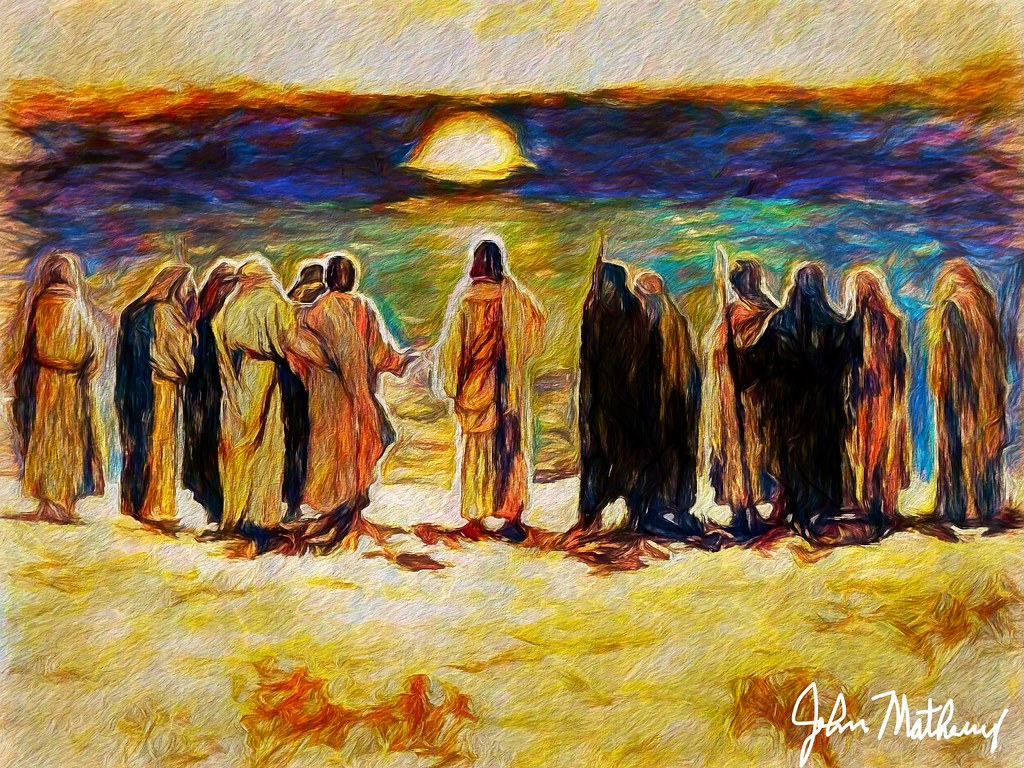
Digital painting of Jesus and the disciples by John Mathews

A dispute also arose among them as to which of them was considered to be greatest. Jesus said to them, “The kings of the Gentiles lord it over them; and those who exercise authority over them call themselves Benefactors. But you are not to be like that. Instead, the greatest among you should be like the youngest, and the one who rules like the one who serves. For who is greater, the one who is at the table or the one who serves? Is it not the one who is at the table? But I am among you as one who serves. You are those who have stood by me in my trials. And I confer on you a kingdom, just as my Father conferred one on me, so that you may eat and drink at my table in my kingdom and sit on thrones, judging the twelve tribes of Israel. (NIV)

Jesus is a different sort of leader.

While the kings of his day were concerned with power and using their authority to ensure even more power and privilege, Jesus went about things differently. In a world of patronage where it was necessary for the lower classes to connect with and suck-up to the higher classes, Jesus operated by a different system.

Jesus, Lord of the universe, King of creation, absolute Leader of the Church, and Ruler over God’s realm was and is a servant of the people.

“Follow my example: Even the Son of Man did not come for people to serve him. He came to serve others and to give his life to save many people.”

mark 10:45, erv

On the surface, striving to be the best might seem noble and good. Yes, working toward being the greatest might motivate us to do all things with excellence. It can solve a lot of problems and issues. On the other hand, it may also result in attitudes and behavior which fosters unhealthy competition and an inordinate focus on becoming the greatest.

Think about it. Not everyone can be the greatest. If everyone is, nobody is. This results in lower self-esteem for nearly everybody. And it creates ripe conditions for leadership paranoia in which the greatest is always looking over their shoulder worrying about being toppled from their lofty position. At the least, all this ballyhoo about greatness only takes away from caring for the people who most need our efforts – family members get the shaft from someone with an imbalanced life who is laser-focused on getting to the top and staying there.

It’s as if a person is living a one-dimensional existence in a three-dimensional world. It won’t work. Fortunately, we don’t have to live like that.

Jesus shows us a better way.

Jesus was present to his disciples. He is present to us in the person of the Holy Spirit. Christ encouraged relational connections and using one’s gifts, talents, and abilities for the common good of all people. For Jesus Christ, the dynamics of power and authority are not to be leveraged for personal greatness but for collective uplift. Authority is to be carefully applied for everyone’s benefit, including those we think don’t deserve it.

The disciples understood far too little about the community their leader was trying to build. Judas Iscariot is likely the one disciple who first realized what Jesus was truly up to. The greatest are the least and the least are the greatest. It wasn’t what Judas signed up for, so he cut his losses and betrayed Jesus.

True exaltation is a gift of grace. The kingdom of God turns on mercy and operates on the economy of grace. It is those who faithfully serve who will sit with Jesus, the ultimate Servant, at the table. Peacocks and pretenders will never realize their dream to be the center of attention.

In a great twist of irony, those who wish to compete and occupy a high standing will discover they have worked to obtain the lowest rung on the ladder leaning against the wall of Satan’s kingdom.

Jesus consistently, patiently, and carefully established the kingdom of God on earth. He went about his task in a manner none of us would even consider. He focused on character, not skills; willing hearts, not intelligent brains; new life, not reformed habits. On the job orientation involved following Jesus around everywhere.

Just shadow Jesus.

Here I am washing your feet. Do the same. Here I am being present to and serving the poor, the lonely, the outcast, the moral failure, and the lowest of society. Do the same. Here I am showing sacrificial self-emptying unconditional love. Do the same. Just shadow me. Do what I do, period.

An obsession with greatness will inevitably lead to petty kingdom building enterprises. Instead, we are to love the neighbor next to us. We make room at the committee table for somebody who looks, acts, and talks different than me. We freely let Jesus live through us, thus, giving the gift of him to those we encounter. We purposely look for ways to serve underprivileged communities rather than use the people living there in ways to make us look better.

Indeed, this following Jesus thing is subversive – even for many professing Christians.

What will you do?

Go in peace to love and serve the Lord, in the name of Christ. Amen.

1 John 1:1-2:2 – Walking in the Light without Fumbling in the Darkness

Welcome, friends! Today we consider three important words to help us relieve our emotional and spiritual pain, as well as enabling us to experience joy and new life. Click the videos below and let us worship our risen Lord….

1 John 1:1-2:2, Pastor Tim Ehrhardt

O God, who in Jesus Christ called us out of darkness into your marvelous light; enable us always to declare your wonderful deeds, thank you for your steadfast love, and praise you with heart, soul, mind, and strength, now and forever. Amen, and amen.