Mark 6:35-44 – You Want Us To Do What?

Late in the afternoon his disciples came to him and said, “This is a remote place, and it’s already getting late. Send the crowds away so they can go to the nearby farms and villages and buy something to eat.”

But Jesus said, “You feed them.”

“With what?” they asked. “We’d have to work for months to earn enough money to buy food for all these people!”

“How much bread do you have?” he asked. “Go and find out.”

They came back and reported, “We have five loaves of bread and two fish.”

Then Jesus told the disciples to have the people sit down in groups on the green grass. So, they sat down in groups of fifty or a hundred.

Jesus took the five loaves and two fish, looked up toward heaven, and blessed them. Then, breaking the loaves into pieces, he kept giving the bread to the disciples so they could distribute it to the people. He also divided the fish for everyone to share. They all ate as much as they wanted, and afterward, the disciples picked up twelve baskets of leftover bread and fish. A total of 5,000 men and their families were fed. (New Living Translation)

I once knew a dear church lady who made a pan of lasagna for a local soup kitchen. When she showed up, it turned out, other church ladies didn’t. Hers was to be one pan amongst many. Instead, it was the only one. When a long line formed of hungry impoverished people, she felt both compassion and heartsick. Her immediate thought was to go and buy several pans of lasagna. But she knew it would take too long, and she wasn’t even sure she could find enough to feed everyone.

So, rather than turning the people away, the dear woman looked up to heaven, uttered a prayer of thanksgiving to God for what little she had, and began serving. She said, “I just kept sticking my spatula into the pan, and lasagna kept coming out. By the time the last person in line came, I served the last of it. I can’t explain it. It just happened.”

No one left hungry.

Today’s Gospel lesson of Jesus feeding the five thousand men and their families is not just a nice account of something that happened a long time ago. Jesus is still doing miracles. The Lord is still expanding his benevolent reach all across God’s big world.

Jesus takes our meager resources and turns them into something with a large impact on a lot of people. For this to happen, all we need to do is follow our Lord’s simple instructions: “You feed them.” 

“But Jesus! I don’t have much money. I’m not a good organizer. I can’t do what you’re asking!”

“I don’t…” “I’m not…” “I can’t…” Jesus hears it every day.

Jesus really doesn’t want to hear about our “buts.” Maybe we ought to take the word “but” out of our language altogether. That’s because it’s not about us, at all.

Jesus can multiply whatever little we have to accomplish his benevolent work through us. 

Jesus could clearly do miracles without us having any involvement. Yet, he deliberately chooses to use us and our drop-in-the-bucket resources to participate in his work. Jesus wants to use our minds, our mouths, and the very marrow of our being to effect a miracle.

Our work is to bring Jesus our five small loaves and two fish. He’ll do the rest.

It is the compassion of Jesus which motivates him to miracles.

The crowd did not leave him alone. Rather than being annoyed by the situation because it was not on his agenda to deal with any people, Jesus looked at the large group of people and had compassion on them.  His heart went out to them.

God does not begrudgingly deal with us, as if we are an interruption to his day.

All these hungry people. What to do about it? “You feed them,” Jesus says. I perhaps detect a hint of sarcasm in the tone of the disciples reply: “We have only five loaves of bread and two fish.”  Their math was way off because they did not count Jesus. 

Through simple prayer and active obedience, we must give Jesus what we have, no matter how little or insignificant.

In this contemporary era, much of what we do is concerned to be reasonable and rational with a strong scientific or proven base for engaging ministry. Although I don’t have much of a stomach for believers who incessantly want a miracle for everything and see devils under every rock, I equally have no stomach for doing ministry as if it were an Enlightenment project, completely drained of all faith and the possibility of seeing God work in ways that are incomprehensible to our modern sensibilities.

Indeed, looking out at all the vast Western resources have accomplished with money and buildings and programs, it makes me want to explain, “This is amazing! It is incredible what we know-how American Christians can do without God!” 

I am curious what Christ’s Church would look like if we were to have an underlying presupposition and assumption that God is still in the business of doing miracles? I wonder: Would it impact the way we pray, and the way we act? 

What if we altogether forsook shame and had the boldness to say, “This might sound crazy, but what if we…”

  • “Found everyone in our city who needs food and go love on them and feed them” (instead of just going the rational route of only supplying the food pantry).
  • “Used our property to create a community garden and seek to help people grow their own food.” (instead of just giving out some food cards).
  • “Built a smart robot to plant the fields of disabled farmers and gave them the rights to the tech we developed.” (am I getting too crazy yet!?). 

In the kingdom of God, there are no boundaries – only unlimited opportunities to give our small ideas, little bits of strength, and puny resources to Jesus so that he can take it and feed the world.

Jesus is perfectly able to do his work without us and without what we have. However, he wants to use us and our meager resources to accomplish the miraculous meeting of needs far beyond what we could ever imagine. 

We too often do nothing. That’s because we mistakenly believe God either cannot or does not want to use me or what I have.

It just won’t do to stand afar off and expect God to work without us giving what we have, whether that something is time, money, conversation, food, hospitality, or whatever. Our excuses won’t do for Jesus – my home is too small, it is not clean enough, I don’t have enough money, I am not smart enough, my schedule won’t allow it, I don’t have enough resources…. All you need is something, no matter how seemingly insignificant it is.

You want me to do what? Feed thousands? The real pre-miracle work for many people is to be open, real, and transparent enough to believe Christ can do a miracle through confessing sin, participating in a ministry, having a spiritual conversation with somebody different than me, or just saying what I actually think and feel.  

The question is never, “Can God use me?” The real question is, “What miracle does Jesus want to do through me and through his Church?”

It was no accident when Jesus distributed the bread that it sounds a lot like communion.

The Lord’s Supper may seem to be irrelevant to some – as if it is only a way to remember Jesus, a mere regular ritual. Yet, God’s design is much bigger. Jesus wants to do a miracle through the distribution and ingestion of the common elements of bread and wine – a miracle of healing, a miracle of bringing true satisfaction the world can never give. 

It isn’t realistic to expect that Jesus can use the Table to feed and reach thousands. However, we don’t serve a God who is limited to work through rational means by only using our five senses. 

We serve a God who does unexpected miracles within the life of the community.

Lord, I believe. Help me in my unbelief! I open my mind and heart believing in your infinite power and possibility. I believe in your constant expression of perfect good in and through me. I know that with you all things are possible. All that I am, all I was, and all I hope to be I give to you. I am yours. Amen.

*Above painting: Feeding of the 5,000 by Laura James

**Above: Ethiopian Orthodox Church depiction of Christ feeding the 5,000

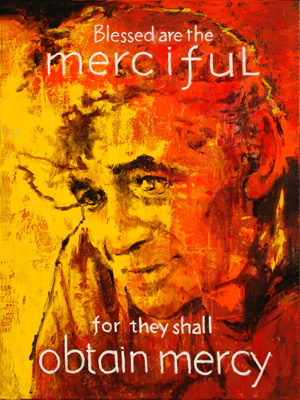
Blessed are the Merciful

Welcome, friends! The world cannot stand up under judgment, criticism, and unkindness. Instead, the earth spins on the axis of mercy. Everyone needs basic human kindness, compassion, and grace. Click the videos below, and let’s explore the blessing of mercy….

Matthew 5:7, Pastor Tim Ehrhardt

We do not presume to come to you, O merciful Lord,
trusting in our own righteousness,
but in your abundant and great mercies.
We are not worthy so much as to gather up
the crumbs under your table;
but you are the same Lord
whose character is always to have mercy.
Grant us, therefore, gracious Lord,
so to receive your dear Son Jesus Christ,
that our sinful bodies may be made clean by his body,
and our souls washed through his most precious blood,
and that we may evermore dwell in him, and he in us.  Amen.

Matthew 5:7 – Blessed are the Merciful

“Blessed are the merciful,
    for they will be shown mercy.” (NIV)

“Mercy” is one of the most rich and important words in all of the Holy Bible. Randomly turn to any page of Scripture and you will most likely find the word “mercy.” Mercy is highly significant because God is merciful.

King David was known as a man after God’s own heart (1 Samuel 13:14). This is first and foremost about mercy. In the ancient world, when a new king came to power who was from a different lineage than the previous ruler, it was a common practice to kill all the male heirs from the former king because they posed a grave threat to the throne. David, however, did not do that; he did just the opposite. David ascended the throne and said:

“Is there anyone still left of the house of Saul to whom I can show kindness?” (2 Samuel 9:1, NIV)

Indeed, there was. His name was Mephibosheth. He happened to be lame in both feet. That meant, literally, he was not able to run away when David became king. I am sure Mephibosheth believed he was being summoned by King David to his death. But when he arrived, David said to him:

“Don’t be afraid, for I will surely show you kindness…. I will restore to you all the land that belonged to your grandfather Saul, and you will always eat at my table.” (2 Samuel 9:7, NIV)

That, my friend, is the very definition of mercy. And that is precisely the character quality Jesus was talking about in his Beatitudes.

Just as David used his power to extend mercy and kindness to potential rivals instead of exterminating them to consolidate his power, so the true follower of Jesus will identify with the powerless and give them a seat at the table.

If we are wondering, at all, whether this is really what Jesus is talking about with mercy, his words in the Gospel of Luke make it crystal clear:

“If you love those who love you, what credit is that to you? Even sinners love those who love them. And if you do good to those who are good to you, what credit is that to you? Even sinners do that. And if you lend to those from whom you expect repayment, what credit is that to you? Even sinners lend to sinners, expecting to be repaid in full. But love your enemies, do good to them, and lend to them without expecting to get anything back. Then your reward will be great, and you will be children of the Most High, because he is kind to the ungrateful and wicked. Be merciful, just as your Father is merciful.” (Luke 6:32-36, NIV)

Merciful folks are gracious, kind, and accept others, especially an unworthy person, because they know that they themselves are unworthy of God’s great mercy and grace. The merciful person’s mantra is: “God has shown me mercy; therefore, I will show mercy to others.”

Those who are merciful will be shown mercy. If anyone treats another harshly and without mercy, they should not expect to receive blessing from God. This raises an important question which needs to be asked: Are we kind and merciful, or do we have a bent toward wanting to see others judged and punished? I share a hypothetical story….

My dear middle daughter was a remarkably busy girl. Whenever we were in public, it was my standing rule that she always holds my hand. The reason for this was that she always ran instead of walked. Holding her hand was the only way I could keep her safe and not literally run into harm’s way.

Here comes the hypothetical part: One day we are walking down the street holding hands. She gets away from my grip and runs… right into oncoming traffic… and is struck by a car. I run up to her, bend over her bleeding and broken body and say, “Well, that’s what you get for disobeying me. After all, you reap what you sow!”

Oh, my, no!… My daughter is now a Mom. And, lo and behold, she has a son just like her. I need to hold his hand, too! If an accident were ever to happen in reality, I can guarantee my response would be to run to him, bend over his bleeding and broken body, cry uncontrollably, and determine to do everything in my grandfatherly power to save his life and see him healed from his injuries.

So, then, my sisters and brothers, why in the world would we ever tell a broken hearted person – perhaps in the throes of depression or riddled with anxiety from hardship – emotionally and spiritually bleeding on the inside: “Get over it!” “Just stop worrying!” or “You need to be strong!”

God, forbid! No! Mercy! I insist, mercy! The world does not revolve on the axis of judgment, criticism, or giving someone what they deserve. God’s great big world spins because of mercy, grace, and basic human kindness that comes from the hand of a good benevolent Lord who cares about all humanity. Perhaps I must be even more specific…

  • The one filled with God’s righteousness will go out of their way to show kindness, love, and compassion to the LGBTQ+ community, becoming familiar with their needs, struggles, and heartaches as they listen without judgment and full of mercy.
  • The person touched by the mercy of God will intentionally seek to give people of color a seat at the table and the freedom to speak freely while listening with ears of mercy.
  • The human being who follows Jesus will see the image of God in our Native American sisters and brothers and will mercifully do everything within their power to advocate for them when it comes to things like inequities of poverty, disease, addiction, and death.
  • The person filled with the righteousness of God will respect all other religious people, regardless of their spirituality. They will be merciful to Buddhists, Muslims, Hindus, and even Wiccans, not because they see them as potential converts, but just because they need mercy, like the rest of us.

Consider what others have to say about mercy….

“God tolerates even our stammering and pardons our ignorance whenever something inadvertently escapes us – as, indeed, without this mercy there would be no freedom to pray.”

John Calvin

“Darkness cannot drive out darkness; only light can do that. Hate cannot drive out hate; only love can do that.”

Martin Luther King, Jr.

“It is mercy, not justice or courage or even heroism, that alone can defeat evil.”

Peter Kreeft

Consider what Holy Scripture has to say about mercy…

Some Pharisees asked Jesus’ disciples, “Why does your teacher eat with tax collectors and other sinners?” Jesus heard them and answered, “Healthy people don’t need a doctor, but sick people do. Go and learn what the Scriptures mean when they say, ‘Instead of offering sacrifices to me, I want you to be merciful to others.’ I didn’t come to invite good people to be my followers. I came to invite sinners.” (Matthew 9:11-13, CEV)

The Lord’s kindness never fails!
If he had not been merciful,
    we would have been destroyed.
The Lord can always be trusted
    to show mercy each morning.
Deep in my heart I say,
“The Lord is all I need;
    I can depend on him!” (Lamentations 3:22-24, CEV)

May we not succumb to thoughts of violence and revenge today, but rather to thoughts of mercy and compassion. We are to love our enemies and be merciful to all so that we might reverse the curse on humanity and restore them, by God’s grace, to their right mind, heart, and spirit.

*Above painting by Hyatt Moore

Luke 18:35-43 – Lord, Have Mercy

Coptic Church icon of Christ healing the blind man

As Jesus was coming near Jericho, there was a blind man sitting by the road, begging. When he heard the crowd passing by, he asked, “What is this?”

“Jesus of Nazareth is passing by,” they told him.

He cried out, “Jesus! Son of David! Have mercy on me!”

The people in front scolded him and told him to be quiet. But he shouted even more loudly, “Son of David! Have mercy on me!”

So, Jesus stopped and ordered the blind man to be brought to him. When he came near, Jesus asked him, “What do you want me to do for you?”

“Sir,” he answered, “I want to see again.”

Jesus said to him, “Then see! Your faith has made you well.”

At once he was able to see, and he followed Jesus, giving thanks to God. When the crowd saw it, they all praised God. (Good News Translation)

This is one of my very favorite stories in the entirety of Holy Scripture. And I will tell you why….

Because Jesus listens with ears of mercy.

Jesus was headed to Jerusalem and had a lot on his mind and his heart. He knew what was coming, that his passion and death awaited him. No one would fault Jesus for not hearing a blind man shouting. But Jesus was listening so that he might hear someone just like the needy blind man. Rather than being distracted and lost in his head, Jesus was just the opposite – being attentive and aware of the humble folk right in front of him.

Because Jesus speaks with words of mercy.

Once Jesus listened, he responded by asking a question. I am impressed with Jesus throughout the Gospels. Christ gave people the gift of choice. He acknowledged people and respected them by not simply and indiscriminately healing, as if he were some fix-it guy. Jesus Christ bestowed on the lowliest of people the human dignity of choice by empowering them to answer a question.

Because Jesus pays attention with divine appointments of mercy.

Our Lord took the time to heal the blind man. Jesus could have simply healed him without even stopping his journey. He could have just waved his hand and the man would be healed. What’s more, Jesus could have even started a healing factory where everyone with a need got healed: bring ‘em in, move ‘em out, and keep the line moving. Jesus was doing more than giving sight; he was giving a man the blessing of time and personal attention. The Gospel is never impersonal, which is why we ought to resist being non-relational in ministry to others.  It isn’t simply about meeting a need but about blessing other people with the gift of relationship.

Ethiopian Orthodox Church depiction of Jesus healing the blind man

Because Jesus reaches out with the touch of mercy.

Jesus touched the man’s eyes (Matthew 20:29-34; Mark 10:46-54). He didn’t have to do that. The Lord of all most certainly could have healed without touching. In fact, it most likely may have been downright gross. A lot of people had eye diseases with runny pussy eyes in the ancient world.

Because the blind man didn’t listen to the crowd.

I really love that! Maybe it’s the rebel in me. I just believe it is such a beautiful thing whenever someone refuses to be shamed by another and embraces their need. That is exactly what the blind man did. He not only refused to give-in to peer pressure, but he also responded to them by shouting all the louder. May his tribe increase!

Because the blind man could actually see.

The man already had sight – not physical sight but spiritual eyes which could see better than anyone else in the crowd. One of the great ironies throughout the Gospels is that the sighted crowd seems to never see who Jesus really is, while blind folk see Christ clearly for who he is: the Son of David, the rightful king, the Savior of all. It matters not how much faith one possesses but in whom that faith is placed. A thimble-full of faith is enough to move mountains, while a water tower full of faith misplaced in someone else cannot even provide a single glass of refreshment.

Because the blind man followed Jesus.

Once healed by Jesus, there were plenty of persons who simply walked away and went about their lives. Yet, this man, who was given the gift of physical sight, started following Jesus and giving thanks to him. It feels a lot like my own testimony of experiencing the love of God in Christ and not ever wanting to leave it, so I’ve been following Jesus for over forty years, still having gratitude in my heart.

Because one lowly non-descript blind man made a difference.

I don’t think the man ever set out to change the world. Yet, he did. Here we are reading his testimony all these millennia later. At the time, please take note that one man becoming a disciple of Jesus and living a life of gratitude changed the entire crowd from being a group of shushing church ladies to a robust throng of worshipers. One individual makes a difference. Don’t let anyone tell you otherwise.

Lord Jesus Christ, Son of God, have mercy on me, a sinner.

Lord Jesus Christ, Son of David, heal me, a broken person.

Lord Jesus Christ, Son of Man, help me, a lost and lonely individual.

Lord have mercy, Christ have mercy, Lord have mercy on my love-starved soul. Amen.