

Luke 18:35-43 – Lord, Have Mercy

Coptic Church icon of Christ healing the blind man

As Jesus was coming near Jericho, there was a blind man sitting by the road, begging. When he heard the crowd passing by, he asked, “What is this?”

“Jesus of Nazareth is passing by,” they told him.

He cried out, “Jesus! Son of David! Have mercy on me!”

The people in front scolded him and told him to be quiet. But he shouted even more loudly, “Son of David! Have mercy on me!”

So, Jesus stopped and ordered the blind man to be brought to him. When he came near, Jesus asked him, “What do you want me to do for you?”

“Sir,” he answered, “I want to see again.”

Jesus said to him, “Then see! Your faith has made you well.”

At once he was able to see, and he followed Jesus, giving thanks to God. When the crowd saw it, they all praised God. (Good News Translation)

This is one of my very favorite stories in the entirety of Holy Scripture. And I will tell you why….

Because Jesus listens with ears of mercy.

Jesus was headed to Jerusalem and had a lot on his mind and his heart. He knew what was coming, that his passion and death awaited him. No one would fault Jesus for not hearing a blind man shouting. But Jesus was listening so that he might hear someone just like the needy blind man. Rather than being distracted and lost in his head, Jesus was just the opposite – being attentive and aware of the humble folk right in front of him.

Because Jesus speaks with words of mercy.

Once Jesus listened, he responded by asking a question. I am impressed with Jesus throughout the Gospels. Christ gave people the gift of choice. He acknowledged people and respected them by not simply and indiscriminately healing, as if he were some fix-it guy. Jesus Christ bestowed on the lowliest of people the human dignity of choice by empowering them to answer a question.

Because Jesus pays attention with divine appointments of mercy.

Our Lord took the time to heal the blind man. Jesus could have simply healed him without even stopping his journey. He could have just waved his hand and the man would be healed. What’s more, Jesus could have even started a healing factory where everyone with a need got healed: bring ‘em in, move ‘em out, and keep the line moving. Jesus was doing more than giving sight; he was giving a man the blessing of time and personal attention. The Gospel is never impersonal, which is why we ought to resist being non-relational in ministry to others.  It isn’t simply about meeting a need but about blessing other people with the gift of relationship.
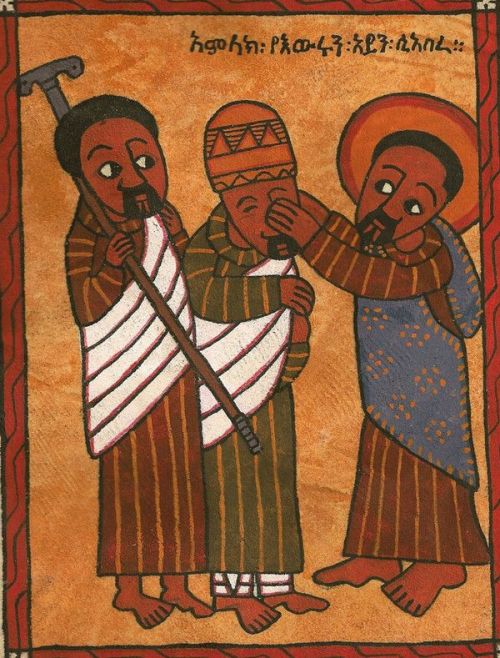
Ethiopian Orthodox Church depiction of Jesus healing the blind man

Because Jesus reaches out with the touch of mercy.

Jesus touched the man’s eyes (Matthew 20:29-34; Mark 10:46-54). He didn’t have to do that. The Lord of all most certainly could have healed without touching. In fact, it most likely may have been downright gross. A lot of people had eye diseases with runny pussy eyes in the ancient world.

Because the blind man didn’t listen to the crowd.

I really love that! Maybe it’s the rebel in me. I just believe it is such a beautiful thing whenever someone refuses to be shamed by another and embraces their need. That is exactly what the blind man did. He not only refused to give-in to peer pressure, but he also responded to them by shouting all the louder. May his tribe increase!

Because the blind man could actually see.

The man already had sight – not physical sight but spiritual eyes which could see better than anyone else in the crowd. One of the great ironies throughout the Gospels is that the sighted crowd seems to never see who Jesus really is, while blind folk see Christ clearly for who he is: the Son of David, the rightful king, the Savior of all. It matters not how much faith one possesses but in whom that faith is placed. A thimble-full of faith is enough to move mountains, while a water tower full of faith misplaced in someone else cannot even provide a single glass of refreshment.

Because the blind man followed Jesus.

Once healed by Jesus, there were plenty of persons who simply walked away and went about their lives. Yet, this man, who was given the gift of physical sight, started following Jesus and giving thanks to him. It feels a lot like my own testimony of experiencing the love of God in Christ and not ever wanting to leave it, so I’ve been following Jesus for over forty years, still having gratitude in my heart.

Because one lowly non-descript blind man made a difference.

I don’t think the man ever set out to change the world. Yet, he did. Here we are reading his testimony all these millennia later. At the time, please take note that one man becoming a disciple of Jesus and living a life of gratitude changed the entire crowd from being a group of shushing church ladies to a robust throng of worshipers. One individual makes a difference. Don’t let anyone tell you otherwise.

Lord Jesus Christ, Son of God, have mercy on me, a sinner.

Lord Jesus Christ, Son of David, heal me, a broken person.

Lord Jesus Christ, Son of Man, help me, a lost and lonely individual.

Lord have mercy, Christ have mercy, Lord have mercy on my love-starved soul. Amen.

Colossians 1:15-23 – Worship That Is Fit for a King

The Son is the image of the invisible God, the firstborn over all creation. For in him all things were created: things in heaven and on earth, visible and invisible, whether thrones or powers or rulers or authorities; all things have been created through him and for him. He is before all things, and in him all things hold together. And he is the head of the body, the church; he is the beginning and the firstborn from among the dead, so that in everything he might have the supremacy. For God was pleased to have all his fullness dwell in him, and through him to reconcile to himself all things, whether things on earth or things in heaven, by making peace through his blood, shed on the cross.

Once you were alienated from God and were enemies in your minds because of your evil behavior. But now he has reconciled you by Christ’s physical body through death to present you holy in his sight, without blemish and free from accusation— if you continue in your faith, established and firm, and do not move from the hope held out in the gospel. This is the gospel that you heard and that has been proclaimed to every creature under heaven, and of which I, Paul, have become a servant. (New International Version)

Jesus is King. Neither you, nor I, are. 

A simple statement; yet, not easily engrafted into daily life. 

The original sin of Adam and Even was rebellion – to break the bonds of loving authority God provided for them. We (especially us Americans) have this nasty anti-authoritarian strain which runs rather deep in us. 

As a child, when my middle daughter was grappling with the implications of faith in Christ, she once blurted out an honest cry that we can likely resonate with: “I just don’t want another person in my life telling me what to do!” 

Indeed, Jesus is King; we are not.

The New Testament lesson for today is rich with the pre-eminence and lordship of Jesus Christ: 

  • All things were created through Jesus and for him. 
  • Everything in all creation is held together by Jesus. 
  • Christ is the head of the church. 
  • In Jesus Christ, complete divinity exists and reigns. 
  • Jesus made peace through the cross because he had the authority and the qualifications to do so. 
  • Broken relationships and proper lines of authority are now restored and redeemed in Christ.

We can also likely relate to, at times, indulging an illusion of being in control and independently dictating the course of our lives. Yet, mercifully, Jesus is the great Sovereign, and this is a good thing – because in Christ we find reconciliation and purity of life. 

“The supreme thing is worship. The attitude of worship is the attitude of a subject bent before the King… The fundamental thought is that of prostration, of bowing down.”

G. Campbell Morgan

Because Christ is King, we really ought to submit to him. In fact, we need to pay some attention to how our bodies are to submit to his lordship.

When the body moves to animating physical actions of submission, this helps the heart to follow. Whole person worship involves engaging the mind, spirit, emotions, and, yes, the body. To neglect the body in worship is to truncate the ability to connect with God in Christ.

A typical metaphor for the Church is the “Body of Christ.” We can live into that phrase through an embodied spirituality of submission. Our individual bodies are temples of the Holy Spirit, important for expressing worship. (1 Corinthians 3:16)

God created us with literal physical bodies. And Jesus has a literal physical body. Bodies are important for whole person worship. This means the physical postures we take in worshiping King Jesus are significant. We need to pay attention to them.  

A healthy practice for Christians is to kneel in the presence of the Lord. I realize some Christian traditions do it as a part of their worship, and some do not. Some like it, some don’t. Yet, bowing, even prostrating oneself (if you are physically able!) can be a powerful symbol of the heart’s desire and disposition to submit to the lordship and authority of Jesus Christ. 

Crawling out of bed in the morning onto one’s knees and beginning the day aiming to live into the will of God, and ending the day in the same manner, are a practical means of remembering who Jesus is and who we are.

I believe all believers need to feel free in adopting a physical posture of worship which helps them connect with God in Christ. For some, that will be sitting in a comfortable position in contemplation. Others will want to stand, raise their hands, even dance in praise.

It also behooves us to let our bodies respond to whatever is happening with us spiritually. Exuberant praise needs the expression of hand clapping and toe tapping. Confession of sin needs a bit of bowing, kneeling, even prostrating. For prayer, hands open and palms facing up to receive blessing from God is a good bodily position of worship.

You get the idea. Just remember we need to strive for congruence in our worship, that is, what is happening with our outward bodily movements needs to match what is occurring inward with our spirits. And when the two are in sync, meaningful worship can happen – worship of submission fit for a king.

Sovereign God, in your mercy you have sent your Son, the Lord Jesus, who has brought reconciliation to a once broken relationship.  I bow before you in obedience, submission, and worship.  Let me live a cross-shaped life through enjoying the peace you have given me in Christ in both body and soul. Amen.

Hunger and Thirst for Justice and Righteousness

Welcome, friends! Jesus was and is deeply concerned for right relationships and just actions amongst humanity. Click the videos below, and let us consider his words….

Matthew 5:6 – Pastor Tim Ehrhardt
Words by Stuart Townsend. Sung by Kristyn Getty

O Lord, open my eyes that I may see the needs of others.
Open my ears that I may hear their cries.
Open my heart so that they need not be without comfort.
Let me not be afraid to defend the weak because of the anger of the strong,
Nor afraid to defend the poor because of the anger of the rich.
Show me where love and hope and faith are needed,
And use me to bring them to those places.
And so open my eyes and my ears
That I may this coming day be able to do some work of peace for you. Amen.

Matthew 5:6 – Blessed are Those Who Hunger and Thirst for Righteousness

Blessed are those who hunger and thirst for righteousness,
    for they will be filled. (New International Version)

Happy are people who are hungry and thirsty for righteousness because they will be fed until they are full. (Common English Bible)

Happy are those whose greatest desire is to do what God requires;
    God will satisfy them fully! (Good News Translation)

They are blessed who hunger and thirst after justice,
    for they will be satisfied. (New Century Version)

God blesses those who hunger and thirst for justice,
    for they will be satisfied. (New Living Translation)

The words “justice” and “righteousness” come from the same word (δικαιοσύνη). The English words are much like two sides to the same coin – one side primarily emphasizing an action, and the other side a relationship.

The word “justice” in Holy Scripture refers to much more than a punitive corrective action toward wrongdoing. That is only a secondary concern for justice. The primary idea is to provide necessities to people without prejudice or favoritism. This is why the Old Testament is filled with references to providing justice to groups of needy or oppressed people such as orphans, widows, foreigners, and the poor:

Do not deprive the foreigner or the fatherless of justice or take the cloak of the widow as a pledge. Remember that you were slaves in Egypt and the Lord your God redeemed you from there. That is why I command you to do this. (Deuteronomy 24:17-18, NIV)

Cursed is anyone who withholds justice from the foreigner, the fatherless or the widow. (Deuteronomy 27:19, NIV)

Good will come to those who are generous and lend freely, who conduct their affairs with justice. (Psalm 112:5, NIV)

I know that the Lord secures justice for the poor and upholds the cause of the needy. (Psalm 140:12, NIV)

Learn to do right; seek justice. Defend the oppressed. Take up the cause of the fatherless; plead the case of the widow. (Isaiah 1:17, NIV)

Woe to those who make unjust laws, to those who issue oppressive decrees, to deprive the poor of their rights and withhold justice from the oppressed of my people, making widows their prey and robbing the fatherless. (Isaiah 10:1-2, NIV)

God is greatly concerned for justice because the Lord is always just in all affairs.

The word “righteousness” primarily has to do with obtaining and maintaining right relationships with God and other people, with the result of doing right actions in the world. Holy Scripture is loaded with references to righteousness. In the Old Testament, justice and righteousness are often coupled together. That’s because justice is to be dispensed with personal relationship – and not detached in an impersonal way.

People do not merely need access to resources – they also require the gift of human connection in obtaining them.

The Lord loves righteousness and justice; the earth is full of his unfailing love. (Psalm 33:5, NIV)

The Lord works righteousness and justice for all the oppressed. (Psalm 103:6, NIV)

Let the one who boasts boast about this: that they have the understanding to know me, that I am the Lord, who exercises kindness, justice and righteousness on earth, for in these I delight,” declares the Lord. (Jeremiah 9:24, NIV)

I will betroth you to me forever; I will betroth you in righteousness and justice, in love and compassion. (Hosea 2:19, NIV)

God hungers and thirsts for righteousness, which is why believers share this same appetite. Being attentive to the entire spectrum of needs that people have – physical, mental, emotional, and spiritual – are what Jesus has in mind when characterizing true disciples.

God specializes in filling broken people and meeting their needs. The picture here is one of a starving person who needs food and drink, or he will die. The person who hungers does not merely view justice and righteousness as options, or something nice to have. Rather, they know that without God’s just action and right relationship, they will die!

People who strongly desire Jesus and his righteousness are easy to spot:

  • Those who are just and right crave and devour God’s Word, so they read and learn Holy Scripture.

Like newborn babies, crave pure spiritual milk, so that by it you may grow up in your salvation, now that you have tasted that the Lord is good. (1 Peter 2:2-3, NIV)

  • Those who are just and right are incessantly chattering about Jesus, so they pursue fellowship with believers and connections with unbelievers.

We are therefore Christ’s ambassadors, as though God were making his appeal through us. We implore you on Christ’s behalf: Be reconciled to God. God made him who had no sin to be sin for us, so that in him we might become the righteousness of God. (2 Corinthians 5:20-21, NIV)

  • Those who are just and right want to know Christ better, so they pray a lot.

The prayer of a righteous person is powerful and effective. (James 5:16b, NIV)

  • Those who are just and right desire right relations with others, so they make things right with others.

Godly sorrow brings repentance that leads to salvation and leaves no regret, but worldly sorrow brings death. See what this godly sorrow has produced in you: what earnestness, what eagerness to clear yourselves, what indignation, what alarm, what longing, what concern, what readiness to see justice done. (2 Corinthians 7:10-11, NIV)

Only those who know their poverty of spirit, personally grieve over sin, and are truly humble end up hungering and thirsting for righteousness. This is the recognition that without God, I will not make it. I can neither be justified nor righteous without Jesus.

Grant us, Lord God, a vision of your world as your love would have it: a world where the weak are protected, and none go hungry or poor; a world where the riches of creation are shared, and everyone can enjoy them; a world where different races and cultures live in harmony and mutual respect; a world where peace is built with justice, and justice is guided by love. Give us the inspiration and courage to build it, through Jesus Christ our Lord. Amen.

*Above painting by Hyatt Moore