Follow Me (Mark 1:14-20)

Come Follow Me, by Jorge Cocco Santángelo 

Now after John was arrested, Jesus came to Galilee proclaiming the good news of God and saying, “The time is fulfilled, and the kingdom of God has come near; repent, and believe in the good news.”

As Jesus passed along the Sea of Galilee, he saw Simon and his brother Andrew casting a net into the sea, for they were fishers. And Jesus said to them, “Follow me, and I will make you fishers of people.” And immediately they left their nets and followed him. As he went a little farther, he saw James son of Zebedee and his brother John, who were in their boat mending the nets. Immediately he called them, and they left their father Zebedee in the boat with the hired men and followed him. (New Revised Standard Version)

For all the talk of leadership, developing leaders, and being a leader, there is precious little conversation these days about becoming a follower. Perhaps we have such a dearth of leadership for this very reason, because one can only become a good leader if they experientially know what being a follower is.

The Call of Jesus

The call of Jesus is to pursue him, and he will develop us. Follow Jesus, and he’ll show you how to fish for people. All of Christ’s original disciples listened to Jesus, dropped everything they were doing, and immediately followed him.

I am wondering what would make you drop literally everything you are presently doing to pursue an entirely new life. I am curious what would cause you to follow Jesus without any conditions attached whatsoever. 

I am impressed that Peter and Andrew immediately responded to Jesus. They didn’t question Jesus as to whether this was a short term project or a long term assignment he was calling them to. They did not seek a contract with Jesus or ask how he would impact their stock portfolio. 

The first disciples simply dropped everything and left with Jesus.

I suspect they followed Jesus for the same reason I originally decided to follow him – because Jesus is such a compelling person, so gracious, interesting, and loving, that it was really no decision at all. Everything else pales in comparison with Jesus.

Read all four Gospels and the book of Acts and you will find that believers in Jesus follow Jesus; and those who do not follow Jesus are not believers. Followers follow, and those who do not follow are not Christ’s followers.

Jesus still calls people. He calls us to follow him and he will make us fishers of humanity. Maybe you are concerned about this and say, “I have no idea how to fish for people.” The good news is that Jesus said he would make us fishers of people. Jesus is not looking for people with skills he can use; instead, he calls, then develops people into fishers.

Christ always forms people with the ability to follow his call. Jesus will train us; we only need to answer the call to follow. 

When I was five years old my Dad took the training wheels off my bike and told me to ride it. I told him I couldn’t. He told me to get on the bike and he would run beside me. I got on the bike and started to ride with him holding it. When I began to panic, approaching a tree, I started talking to my Dad. But he didn’t answer… because he wasn’t beside me. He dropped out from shagging me a long way back.

We are not called to follow Jesus based on our skills, but on the lack of them so that Jesus will do in us a work of total allegiance and loyalty to the kingdom of God. 

Jesus will make sure to develop the skills we need in order to do what he has called us to do. We only need to hear and answer the call of Jesus to follow. The following is a parable about the church and being fishers of people: 

“Now it came to pass that a group existed who called themselves fishermen. Week after week those who called themselves fishermen met in meetings and talked about their call to fish, the abundance of fish, and how they might go about fishing. They discussed the importance of fishing and that fishing is the task of every fisherman.  They listened to special speakers talk about fishing and they promoted fishing and looked at all the latest equipment for fishing. They built large buildings called ‘Fishing Headquarters’ so that they could tell as many people as possible about fishing. They organized boards of people to send out fishermen to other places. They offered teaching and classes on how to fish and the best and latest fishing methods. With much training a good many persons got their fishing licenses and became upstanding members of Fishing Headquarters. There was just one thing that they did not do: They didn’t fish. When one person dared to suggest that those who do not catch fish are really not fishermen, the group became angry and kicked that crazy person out their group.”

The Message of Jesus

Jesus said the kingdom of God is near, so repent and believe the good news. For Jesus, the word “kingdom” means God’s intentions and will for this world to come true. Jesus was saying that he is creating a new society – which meant Caesar was not Lord and that people’s loyalty was not ultimately to the Roman Empire. 

The kingdom of heaven, God’s dream society, will eventually spread across the entire earth so that the whole world is God’s sacred space, devoted to love, shaped by justice, living in peace, and abounding with wisdom.  Jesus encouraged us to pray consistent with this idea saying, “May your kingdom come and your will be done on earth as it is in heaven.” (Matthew 6:10)

If we find ourselves not really working toward Christ’s idea of kingdom, then we need to “repent and believe the good news” that God is working toward restoring all things to their original beauty and luster. The word “repent” means a change of mind which leads to a change of behavior. And “believe” means to put all your eggs in God’s kingdom basket.

None of this is a suggestion, but is rather a straightforward call to follow Jesus in his kingdom building enterprise on this earth. It would, therefore, be a travesty to simply think about the message for a while and follow Jesus if we feel like it, or get around to it.

Jesus wants to make fishers within family systems, workplaces, neighborhoods, and all the places within a typical sphere of living: This requires the following:

  1. Go where the fish are. Fishing would be easy if we could put a basket by the water and have the fish jump into them! But that is not how it works. Rather, it takes intentional activities that connect people together.
  2. Cast the nets. Peter and Andrew did more than take their boat out to the middle of the lake. To catch fish, they threw their nets into the water. Here is what I believe this means for us: We do what is fair and just to our neighbors. We extend compassion to them and are steadfast in our love, even when others are unlovely. And we do not take ourselves too seriously.
  3. Obey Jesus and walk with him. After Christ’s resurrection, Jesus came to some of the disciples, who had fished unsuccessfully all night. He told them to throw their nets on the other side of the boat – which seemed like nonsense, but they did it anyway. It resulted in a great catch (John 21:1-14). During the three years of Christ’s earthly ministry, the disciples did everything with him – they walked, talked, and ate with Jesus. And when he ascended to heaven, they acted on the Great Commission given to them by Jesus to make other disciples.

May God cleanse our lips and our lives so that we might proclaim the good news of Christ’s kingdom with glad and sincere hearts to the glory of Father, Son, and Spirit.

Eternal God, the refuge and help of all your children, we praise you for all you have given us, for all you have done for us, for all that you are to us. In our weakness, you are strength, in our darkness, you are light, in our sorrow, you are comfort and peace. We cannot number your blessings; we cannot declare your love: For all your blessings we bless you. May we live as in your presence, and love the things that you love, and serve you in our daily lives, through Jesus Christ our Lord. Amen.


“Follow Me” (John 1:43-51)

The next day Jesus decided to go to Galilee. He found Philip and said to him, “Come, follow me.” Philip was from Bethsaida, Andrew and Peter’s hometown.

Philip went to look for Nathanael and told him, “We have found the very person Moses and the prophets wrote about! His name is Jesus, the son of Joseph from Nazareth.”

“Nazareth!” exclaimed Nathanael. “Can anything good come from Nazareth?”

“Come and see for yourself,” Philip replied.

As they approached, Jesus said, “Now here is a genuine son of Israel—a man of complete integrity.”

“How do you know about me?” Nathanael asked.

Jesus replied, “I could see you under the fig tree before Philip found you.”

Then Nathanael exclaimed, “Rabbi, you are the Son of God—the King of Israel!”

Jesus asked him, “Do you believe this just because I told you I had seen you under the fig tree? You will see greater things than this.” Then he said, “I tell you the truth, you will all see heaven open and the angels of God going up and down on the Son of Man, the one who is the stairway between heaven and earth.” (New Living Translation)

I describe myself as a follower of Jesus. I have been for decades. I found, and continue to find, in Jesus Christ a compelling person full of grace, truth, and love.

But my early life was not characterized with knowing Christ. I certainly learned about Jesus, that this ancient guy lived an altruistic life, got tortured and killed on a cross, and that Christians believe in his resurrection from death. However, back then it was more like some strange history lesson. The information made no difference to me.

That is, until I heard a voice – not an audible one that others could hear. Yet, it was just a real as any daily conversation with another person. I heard the call of Jesus. The Ancient of Days showed up.

I know with every epistemic fiber in my being that it wasn’t an undigested bit of beef, a blot of mustard, a crumb of cheese, a fragment of an underdone potato. I am sure beyond certainty that there was more of an empty grave than gravy about my experience of the risen Christ.

I experienced the call of Jesus to “follow me.” And that is really, at its simplest, the call which continually goes out to all humanity. It is a gracious and merciful call. It isn’t a summons to experience a cataclysmic event of total belief in one fell swoop. Rather, it’s a call to believe that is much more an unfolding awareness of the deep spirituality and connection with the divine within.

Important to that faith process is another call to “come and see.” Whereas there are some Christian traditions which focus solely on a singular one-time experience of saving faith in Christ, the Gospel of John displays a drama of faith with multiple layers which people move through.

There is no egalitarian zap in which God grants total and immediate understanding. Instead, faith is an ever-increasing process. It is appropriate and biblical to say that our salvation has happened, is happening, and will happen. We follow, we come and see, and we keep following, keep coming, keep seeing more and more.

Like a muscle, our faith grows, develops, stretches, and strengthens over time. To use another metaphor, we ascend a stairway to heaven, one step at a time, day after day, following Jesus and ascending to spiritual maturity.

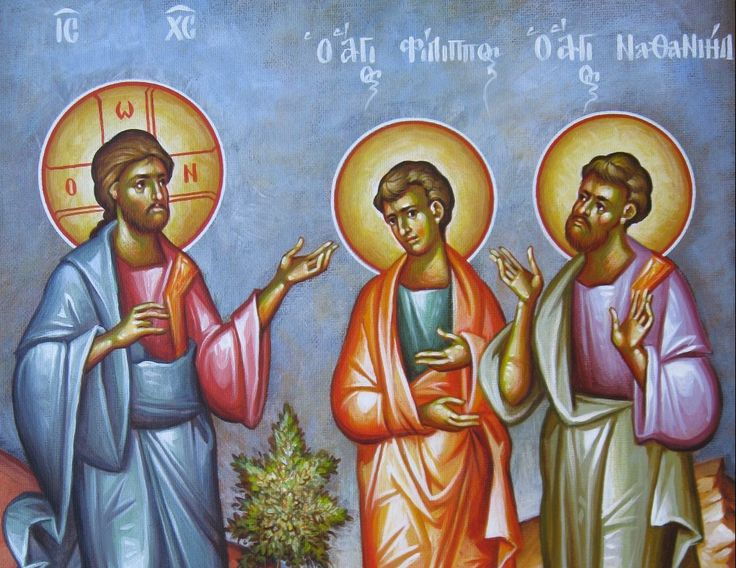
Orthodox icon of Christ calling Philip and Nathanael

Methinks this is likely part of what Jesus was getting at with Nathaniel in today’s Gospel lesson. Nathaniel would have quickly picked up on the reference Jesus was making, way back to the first book of Genesis. The Jewish patriarch, Jacob, had an experience of seeing the angels of God on some celestial stairway, ascending and descending. It was an encounter of God’s presence with Jacob, assuring him of divine intervention into the muck of humanity. (Genesis 28:10-17)

Jesus connected that ancient portrait to himself so that Nathaniel would understand, would believe, that God has again broken into this world with a special divine presence. To look at Jesus and follow him, is to see and follow God.

Christ Jesus is the ultimate example and embodiment of God with us. Throughout John’s Gospel, Jesus presents himself as:

  • Living water – connecting to Jacob’s well (John 4:5-14)
  • The Temple of God – the place where the Lord dwells in all divine fullness (John 2:18-22)
  • Bread from heaven – linking the giving of manna to the Israelites in the desert (Exodus 16:4-7; John 6:1-59)
  • The good shepherd – fulfilling divine Old Testament imperatives of caring for people (Ezekiel 34:11-16; John 10:1-30)

In all these ways, and more, Jesus intentionally connects himself as fulfilling God’s ancient promises to people.

In whichever way we need to hear the call to follow, Jesus accommodates to us. For some, Christ comes knocking on the front door. For others, he enters the side door, or slips into the backdoor of our lives.

And, if we will come and see, Jesus will also accommodate us by being the authority over us, the teacher to us, or the friend beside us. The Lord Jesus shall shepherd us and woo us to the flock for guidance and protection.

However it may be that Jesus comes to you, it most likely will be in ways you aren’t expecting. Surely, nothing good can come from Nazareth! Yet, it did. Can anything good come from Calcutta, India, or Juarez, Mexico, or Hoboken, New Jersey, or Milwaukee, Wisconsin, or even from a small rural area that doesn’t show up on a map? Yes, it can. Because with Jesus, God has entered this world, and, as it turns out, the Lord’s presence is everywhere.

Follow me. Come and see. Two of the simplest exhortations ever uttered. Yet, two of the most gracious phrases ever said, with profound implications for us beyond what we can fathom or imagine.

Guide us waking O Lord, and guard us sleeping; that awake we may watch with Christ and asleep we may rest in peace. May the shape of each day be formed by the pedantic following of my Lord; and may I come and see the wonders you have done, are doing, and will do. Almighty and merciful God – Father, Son and Holy Spirit – bless us and keep us. Amen.

Parable of the Ten Bridesmaids (Matthew 25:1-13)

The Parable of the Ten Virgins, by Lilibeth Kindle

“When the end comes, the kingdom of heaven will be like ten bridesmaids. They took their oil lamps and went to meet the groom. Five of them were foolish, and five were wise. The foolish bridesmaids took their lamps, but they didn’t take any extra oil. The wise bridesmaids, however, took along extra oil for their lamps. Since the groom was late, all the bridesmaids became drowsy and fell asleep.

“At midnight someone shouted, ‘The groom is here! Come to meet him!’ Then all the bridesmaids woke up and got their lamps ready.

“The foolish ones said to the wise ones, ‘Give us some of your oil. Our lamps are going out.’

“But the wise bridesmaids replied, ‘We can’t do that. There won’t be enough for both of us. Go! Find someone to sell you some oil.’

“While they were buying oil, the groom arrived. The bridesmaids who were ready went with him into the wedding hall, and the door was shut.

“Later the other bridesmaids arrived and said, ‘Sir, sir, open the door for us!’

“But he answered them, ‘I don’t even know who you are!’

“So stay awake because you don’t know the day or the hour. (God’s Word Translation)

Here’s the point of Christ’s parable, up front, so that we know what we are dealing with:

We prepare for things we really care about; we anticipate things that are important to us.

For example, people who really care about hunting make careful preparations for the season and anticipate opening day. Those who care about professional football look forward to game-day, plan for special food to eat, and set aside normal activities to watch them play.

And, of course, weddings are events that take lots of preparation because families care about the upcoming marriage. Since I have raised three girls, I can testify first-hand that wedding plans begin in third grade for many females.

The Wise and the Foolish Virgins, by Charles Haslewood Shannon, 1920

Here’s the point of Christ’s parable, stated in the negative: People show up to things unprepared mostly because they don’t value the event enough to be ready for it.

Casual hunters and fair-weather football fans go home when it gets too cold. That’s because they are not adequately prepared for the conditions.

Quickie weddings happen in Las Vegas where two people are not prepared to have a marriage for a lifetime. 

People drop out of impromptu events when there is no fun or gets too hard. However, if they really care about it, they prepare for it, have patience through it, and persevere in it when things get tough.

The true test of authentic commitment comes when things are not easy and it takes blood, sweat, and tears to see something through.

A Christian is one who not only professes Christ as Lord and Savior, but also backs the words up with a resolve to:

  • live into their baptism
  • avail themselves of communion
  • plan and prepare for both personal and public worship
  • make it their aim to love God, one another, and neighbor

There are few human events more freighted with emotion and preparation than weddings. Parents invest a lot of time, energy, resources, and love to have a meaningful wedding for their kids. There’s also the potential for disaster at a wedding.

A Greek Orthodox fresco of Jesus and the Parable of the Ten Virgins

Since I have done many weddings, I can tell you that a lot of things go sideways in the preparation process and even at the wedding itself. I have seen bridesmaids pass out, grooms forget the ring, and families fight like cats and dogs in the narthex just as the bride is ready to come down the aisle. All kinds of crazy stuff can happen with a wedding. 

At my own wedding, the bridesmaids were literally sown into their dresses by the seamstress just hours before the wedding; one of my groomsman did not show up because, I later found out, he was in jail; and, we were married on the hottest and most humid day of the year – 100 degrees – which did not go so well for a bunch of women trying to have their best ever hair day.

But you know what? We got married anyway. The wedding happened because it was important to us. I think it’s interesting that Jesus chose a parable about a wedding to tell us what the kingdom of God is really like. Weddings in Christ’s day were just as prone to mishap, maybe even more, than weddings today.

In ancient Israel, a couple would become engaged but not set a wedding date. The groom would take the time to busily prepare a home for himself and his bride to live. It might take days, or weeks, or months, even years. It is this imagery that Jesus picked up to communicate his point of being prepared for things we care about. 

No one knew when the groom would be finished with preparations. (Note: We are told in the Gospel of John that Jesus the bridegroom is busy preparing for a great wedding feast at the end of the age when he will come back and take us to be with him forever).

When the groom was ready, he left the home he had prepared and went to the bride’s house. Then, the two of them, along with their wedding party, would have a grand procession through the streets of the town, almost always after dark, and then back to the home of the groom. So, oil lamps were important to have ready, and on standby.

Here is the parable’s setting: The groom has left his house and begun his trek through town. He might come straightaway, and he might not, depending on what route he takes. The bridesmaids (virgins) have their oil lamps ready. Five of them have plenty of oil, and five of them do not.

The groom takes the circuitous route, so the virgins fell asleep waiting. At midnight the groom finally shows up at the bride’s house. Five virgins spring into action and are ready. The other five aren’t ready, at all. 

The five virgins without enough oil go out to find or buy some more, while the five virgins with plenty of oil join the celebration. The procession goes back to the groom’s house, posthaste, before the five virgins who were not part of the procession finally catch up to them at the house.

The five foolish bridesmaids knock on the door and expect to get in. But the door is shut and it isn’t going to be opened. The marriage will happen without them. Therefore, the bottom line of the story: The five foolish virgins were not ready because they did not care enough to be prepared.

Orthodox icon of Jesus and the Parable of the Ten Virgins

This, at face value, might seem harsh. Yet, in Christ’s time, not having the oil needed for the lamps would be like, in our day, having half the bridesmaids show up at the wedding at the last minute in jeans and t-shirts without having done their hair and expecting to stand up with the bride. No bride or groom and their family in our culture is going to roll with that kind of behavior. Why? Because it is deeply offensive.

As in all of Christ’s parables, the characters represent the people listening. The five wise and five foolish bridesmaids point to the mixed characters who were following Jesus. They consisted of both faithful authentic disciples of Jesus, as well as wedding crashers who were not there because they valued and respected Jesus.

Jesus told us to keep watch, because we do not know the day or the hour when he will return. So, today’s parable raises the big question: Are you prepared? 

We are to maintain constant vigilance, being always alert for Jesus to show up. It’s one thing to make a profession of Christ; and it is quite another thing to live each day doing God’s will and being prepared for Jesus to return.

Jesus wants more than fair-weather Christians. 

We cannot assume someone else will give us oil. No one can simply rely on another person to have everything they need to live the Christian life. Each one of us must listen and learn from God’s Word for ourselves, cultivate a life of prayer, and serve the church and the world in ways God has called us to – without relying on someone else to do the work that I should be doing. 

Every day is a fresh opportunity and privilege to serve Jesus. My personal practice is to rise each morning by 4:30am. I light a candle and spend some quiet unhindered time reading the lectionary passages for the day. I spend time in prayer. Throughout the day I pause to intentionally connect with God in prayer and some Scripture reading. 

I get up early in the morning regardless of how I feel. I engage in spiritual disciplines even when it does not strike my fancy. I go to work and do what it takes to get myself in a position to be a blessing to others.

Now, let’s come back to the message of Christ’s parable: We prepare for things we really care about, and we anticipate things that are important to us. The return of Jesus is a future reality. It’s up to each of us, whether it will be on our spiritual radar, or not.

Yet, I can tell you this: Jesus wants us to watch and pray, and to be prepared, because today the bridegroom may show up.

The Need to Defend a Ministry (2 Corinthians 10:1-11)

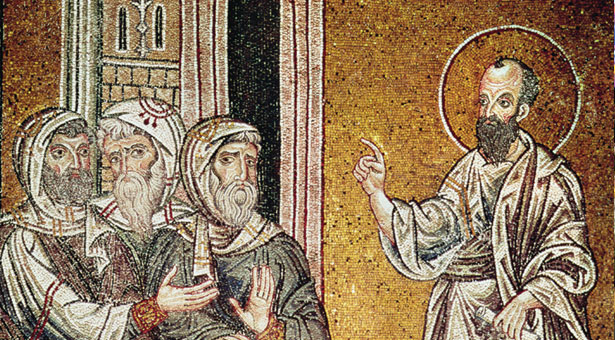
Mosaic of St. Paul Preaching, 12th century, Duomo, Monreale, Sicily, Italy

By the humility and gentleness of Christ, I appeal to you—I, Paul, who am “timid” when face to face with you, but “bold” toward you when away! I beg you that when I come I may not have to be as bold as I expect to be toward some people who think that we live by the standards of this world. 

For though we live in the world, we do not wage war as the world does. The weapons we fight with are not the weapons of the world. On the contrary, they have divine power to demolish strongholds. We demolish arguments and every pretension that sets itself up against the knowledge of God, and we take captive every thought to make it obedient to Christ. And we will be ready to punish every act of disobedience, once your obedience is complete.

You are judging by appearances. If anyone is confident that they belong to Christ, they should consider again that we belong to Christ just as much as they do. So even if I boast somewhat freely about the authority the Lord gave us for building you up rather than tearing you down, I will not be ashamed of it. I do not want to seem to be trying to frighten you with my letters. 

For some say, “His letters are weighty and forceful, but in person he is unimpressive and his speaking amounts to nothing.” Such people should realize that what we are in our letters when we are absent, we will be in our actions when we are present. (New International Version)

I don’t know about you, but I’m not a fan of feeling like I have to defend my ministry – my philosophy of how to go about things, my hermeneutics, my words, my actions, my clothes, my food – and pretty much everything about me. Believe it or not, I’ve been criticized for things like not having shiny enough shoes (and having too nice of shoes), the make and model of the car I drive (and don’t drive), being too serious (and not being serious enough).

So, for me, I detect in the Apostle Paul’s retort to the Corinthian Church, an exasperation. Reading between the lines, I can hear him saying something like, “I can’t believe I’m even talking about this stuff because you guys are about as spiritually aware as a bowling ball – and bowling balls haven’t even been invented yet. Heck, I don’t even know what a bowling ball is! That’s about how much you know what you’re talking about. Sheesh!”

Yet, despite Paul’s annoyance and displeasure with the Corinthians’ line of thinking, the Apostle still made up his mind to craft a response that was as humble and gentle as he could possible come up with.

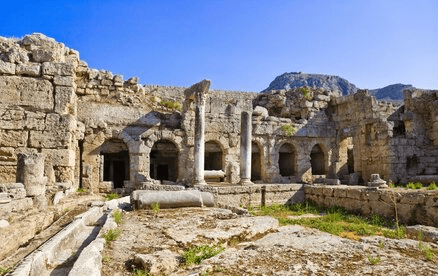
A modern archaeological site at Corinth, Greece

The Church’s first criticism toward Paul is that he is bold from a distance, but up close and personal, rather weak and unimpressive as an Apostle. I’m willing to be that every church pastor in the U.S. is more than able to know what this feels like in putting themselves in the Apostle’s shoes.

It’s an age old criticism that every preacher faces at various points, or at least with some sermons or writings. The people just don’t appreciate or like what they’re hearing or reading. It often comes out in the ubiquitous phrase, “I’m just not getting spiritually fed.” Wrapped up in that phrase is not only the criticism of oratorical skills, but also that they don’t like something about the preacher’s physical appearance, particular idiosyncrasies, or interaction with other people.

The second criticism of Paul by the Corinthians is that he acts too much according to human standards. In other words, the Apostle is just too worldly for them. If you happen to know anything about the ancient Corinthian Church, you’re either doing a major eye roll right now, or you’re just plain busting a gut in laughter.

There’s no more worldly church in the New Testament than the Corinthian Church. To have them bringing this point up to Paul is both laughable and downright sad. But again, every preacher nowadays knows the criticism all too well. For example, many pastors aren’t paid well with the convoluted reasoning that they shouldn’t be tempted toward worldliness – even though the parishioners themselves have no problem owning large homes, multiple cars, and high paying jobs.

The Corinthians were likely also concerned about Paul’s egoism – that he’s too much into worldly power and philosophies. Again, laughable stuff, considering the source. Yet again, these sorts of criticisms are rife within many churches. And the critics themselves tend to be ones who are enamored with wanting power and control for themselves, wanting to ensure that no one, including an upstart pastor, never treads upon their mastering of a very small world.

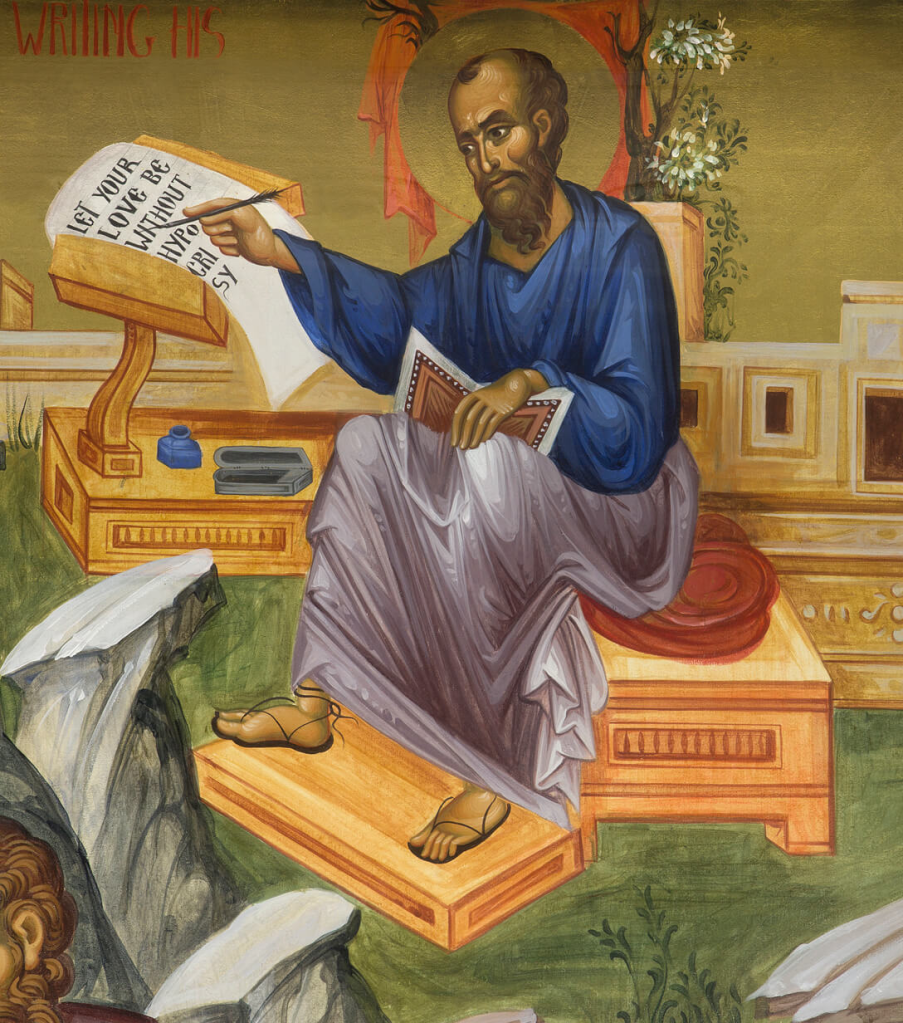
Orthodox icon of St. Paul writing to the churches

Paul responds to this by stating that he is, of course, a human being. However, he wields a different kind of power. Employing military metaphors, the Apostle describes the weapons that he uses as capable of destroying spiritual strongholds of arguments, and obstacles of pride against the knowledge of God – the very sorts of strongholds that were present among the Corinthians.

What’s more, Paul takes captive every thought and makes it obedient to Christ, and not to a self-serving agenda of worldly control and power. And he will use those weapons, if necessary, if the Corinthians keep up their petty criticisms and worldly behavior.

The bottom line of it all is that Christ made Paul an Apostle; and nobody in the Corinthian Church was made one. Paul’s authority was given, not taken, and he will use it to build up and not tear down. In other words, the Apostle Paul was committed to fulfilling his apostolic commission by establishing churches, building up those churches in the strength of faith, and protecting them from misguided and wrongheaded ways of operating.

All I have to say to this is that I am very glad that the Church belongs to Christ. Because that’s the only way we can still be talking about the Church still existing all these centuries later. God works, despite all the human foibles and nonsense.

Even though I talk like this (as does Paul!) there are still good Christian believers and good Christian churches in this world. Not every parishioner lacks self-awareness, is short-sighted, and has a plank in their eye. Nor are all pastors just in it for attention and some sort of worldly gain.

I’m still living and breathing, ministering and mentoring, after decades of Christian labor because of many good people who treated me well, spent good time with me, as well as those who received my teaching and my love, put it into practice, and have produced a harvest of righteousness beyond what I could imagine.

It would be good for all of us to experience supportive community, spiritual maturity, and wise ministry to others. If we can go through any process – no matter what it is – with the humility and meekness of Christ, then no matter what the end is, we have brought some peace and goodness into this old fallen world of ours.

And there is no shame in that!

Almighty and eternal God: Every good and perfect gift comes from you. Send down upon our pastors and parishioners alike a healthy spirit of grace and goodness, so that we all together may truly please you in all we say and do; and continually pour out your divine blessing upon us all. We ask this for the honor of your Son, our Advocate and Friend, Jesus Christ our Lord. Amen.