What Do You Value? (Matthew 6:1-6, 16-21)

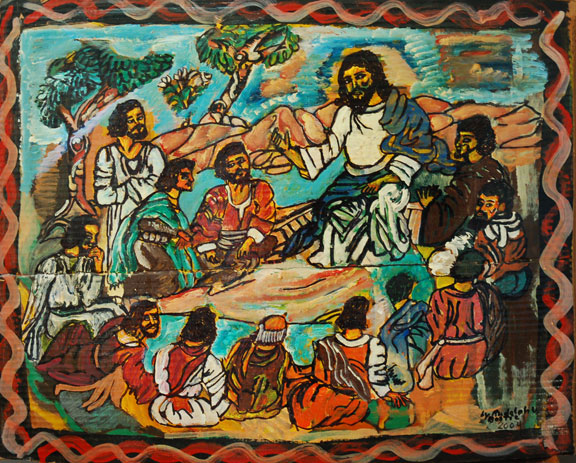
The Sermon on the Mount, by Beryl Lewis (1939-2021)

“Be careful not to practice your righteousness in front of others to be seen by them. If you do, you will have no reward from your Father in heaven.

“So when you give to the needy, do not announce it with trumpets, as the hypocrites do in the synagogues and on the streets, to be honored by others. Truly I tell you, they have received their reward in full. But when you give to the needy, do not let your left hand know what your right hand is doing, so that your giving may be in secret. Then your Father, who sees what is done in secret, will reward you.

“And when you pray, do not be like the hypocrites, for they love to pray standing in the synagogues and on the street corners to be seen by others. Truly I tell you, they have received their reward in full. But when you pray, go into your room, close the door and pray to your Father, who is unseen. Then your Father, who sees what is done in secret, will reward you….

“When you fast, do not look somber as the hypocrites do, for they disfigure their faces to show others they are fasting. Truly I tell you, they have received their reward in full. But when you fast, put oil on your head and wash your face, so that it will not be obvious to others that you are fasting, but only to your Father, who is unseen; and your Father, who sees what is done in secret, will reward you.

“Do not store up for yourselves treasures on earth, where moths and vermin destroy, and where thieves break in and steal. But store up for yourselves treasures in heaven, where moths and vermin do not destroy, and where thieves do not break in and steal. For where your treasure is, there your heart will be also. (New International Version)

Spiritual Disciplines

In Christ’s day, there were three spiritual disciplines that were especially important: giving, prayer, and fasting. For the Jewish faithful, these three practices were meant to work together in helping them to know God and serve others. 

Yet, over time, although the disciplines were maintained, they were observed for all the wrong reasons. Jesus was concerned to communicate that not only are people to do the right thing, but that they do the right things for the right reasons.

To do any less, is to be a hypocrite who maintains an outward form of religion, but is inwardly motivated by the praise and recognition of others. Such a person is, in reality, far from God. 

Ash Wednesday is the beginning of Lent on the Christian Calendar. This season is a time devoted to spiritual disciplines, especially fasting.

Fasting

Those who truly hunger and thirst for righteousness take the time eat spiritual food in order to pursue God and seek right relationships in this world. It’s not a matter if we fast, but when.

The Bible has a great deal to say about fasting:

  • Fasting is a sign of humility and brokenness before God in recognizing both personal and corporate guilt. (1 Samuel 7:2-6)
  • Fasting is a means of preparation for ministry. Jesus used fasting in the desert as preparation for his ministry, and to face down the devil (Matthew 4:1-2). And the apostles fasted when seeking God’s direction about a new ministry. (Acts 13:2-3)
  • Fasting is meant to connect with God and serve others; and not to simply go through the motions. (Isaiah 58:3-7)

Therefore, fasting is a time to get in touch with God, to know the divine will, and then to do it. 

God doesn’t operate on a point system. If we only go through the motions of a spiritual discipline, or do it so that others will notice that I am doing my duty, then we have come under the condemnation of Jesus and are proved as hypocrites.

True fasting in an outward practice reflecting an inner attitude of heart; it’s an expression of devotion in order to connect with God and do good works of service to others.

Framing the topic another way: Why don’t we fast? Because it’s culturally okay not to? Because nobody cares whether I do, or don’t?

The spiritual disciplines of giving, praying, fasting, and other Christian practices have changed my life because they are a vital means of connecting with God and engaging the world.

A farmer disciplines himself to plow, plant, and cultivate – not because he wants to impress others (“Y’all see my big ol’ tractor and my implements!?”) but so that he will receive the reward of reaping a harvest at the proper time. 

So, we also, can engage in spiritual disciplines, like fasting, in order to see a harvest of righteousness.

Earthly vs. Heavenly Treasure

Do not store up for yourselves treasures on earth. What are earthly treasures? It’s stuff, money, possessions, as well as control, power, position, and recognition from others.

You may rightly ask, “Is this really, in and of itself, wrong?” No, it’s not. The real question is not whether we possess earthly treasure (because we all do) but rather:

Do I use my earthly treasure to build heavenly treasure? Do I hoard earthly treasure for my own purposes apart from Christ’s kingdom values?

Jesus once illustrated the difference:

Someone in the crowd said to him, “Teacher, tell my brother to divide the inheritance with me.” 

Jesus replied, “Man, who appointed me a judge or an arbiter between you?” 

Then he said to them, “Watch out! Be on your guard against all kinds of greed; life does not consist in an abundance of possessions.” 

And he told them this parable: “The ground of a certain rich man yielded an abundant harvest. He thought to himself, ‘What shall I do? I have no place to store my crops.’ “Then he said, ‘This is what I’ll do. I will tear down my barns and build bigger ones, and there I will store my surplus grain. And I’ll say to myself, “You have plenty of grain laid up for many years. Take life easy; eat, drink and be merry.”’  “But God said to him, ‘You fool! This very night your life will be demanded from you. Then who will get what you have prepared for yourself?’ 

“This is how it will be with whoever stores up things for themselves but is not rich toward God.”(Luke 12:13-21, NIV)

Again, earthly possessions are tools to be used; and not for accumulating personal wealth, esteem, and success for the sake of security in money. Rather, everything the Christian has is for the advancement of God’s kingdom values. 

Why do this? Because earthly treasure is temporary, and heavenly treasure is permanent. 

Is what you are pursuing today really going to matter in 50 billion millennia?

Heavenly treasure is righteousness as defined by Jesus: right relationships with both God and other humans.  Humility, peace, grace, mercy, purity, forgiveness are all relational values. The only thing that we will take with us when we die is relationships.

If I am genuinely committed to God’s kingdom, my most cherished values will be established by God. 

Our real values consume our thoughts and our efforts; what is in our hearts directs our work. And our ultimate values derive from how we perceive our identity. 

For a great many Americans, the primary noun that characterizes and defines us is not American Christians, not American citizens, not American workers; we are known primarily as American Consumers. 

Jesus is not necessarily advocating that we take vows of poverty, or that we ought not to enjoy the good things we have; what he is asking of us is to make a decision where your loyalty is placed.

Spiritual disciplines such as fasting help us to maintain our most cherished values, to see them clearly, and to choose wisely based upon those values.

May it be so, to the glory of God. Amen.

The Transfiguration of Jesus (Mark 9:2-9)

The Transfiguration of Jesus, by Armando Alemdar Ara, 2004

After six days Jesus took Peter, James and John with him and led them up a high mountain, where they were all alone. There he was transfigured before them. His clothes became dazzling white, whiter than anyone in the world could bleach them. And there appeared before them Elijah and Moses, who were talking with Jesus.

Peter said to Jesus, “Rabbi, it is good for us to be here. Let us put up three shelters—one for you, one for Moses and one for Elijah.” (He did not know what to say, they were so frightened.)

Then a cloud appeared and covered them, and a voice came from the cloud: “This is my Son, whom I love. Listen to him!”

Suddenly, when they looked around, they no longer saw anyone with them except Jesus.

As they were coming down the mountain, Jesus gave them orders not to tell anyone what they had seen until the Son of Man had risen from the dead. (New International Version)

It may be that reading this account of Christ’s transfiguration (metamorphosis) seems a bit strange, even confusing. Perhaps you have no categories of thought to explain such an encounter.

In a Peanuts cartoon, Charlie Brown, Lucy, and Linus were lying on their backs looking at the sky. Lucy says, “If you use your imagination you can see lots of things in the cloud formations. What do you think you see, Linus?” 

Linus replied, “Well, those clouds up there look to me like the map of the British Honduras on the Caribbean… That cloud up there looks a little like the profile of Thomas Eakins, the famous painter and sculptor… And that group of clouds over there gives me the impression of the stoning of Stephen… I can see the Apostle Paul standing there to one side…” 

Lucy responds, “Uh huh… that’s very good… what do you see in the clouds, Charlie Brown?”

To which Charlie Brown replied, “Well, I was going to say a ducky and a horsy, but I changed my mind.”

Maybe your spiritual life seems more like Charlie Brown than Linus. Compared to the experiences of others, you have not had any defining moments of ecstasy; no shining Jesus in front of you; or no spectacular vision of Christ.

Perhaps your life seems rather mundane and ordinary in light of the many stories we have in the Gospels of Jesus doing the miraculous. 

Most of life is lived in the daily grind. In the monotony of life, we need some hope, an occasional mountain top experience that helps us glimpse into the future of what it will be like someday when the kingdom of God comes in its fullness.

Christ’s transfiguration came after a hard frank discussion Jesus had with the disciples about his impending death. Jesus was up front with them, saying that he must suffer, be rejected, and killed. But in three days he will rise again. The disciples did not want to hear that; Peter even rebuked Jesus for saying it. In response, Jesus said:

“If anyone would come after me, he must deny himself and take up his cross and follow me. For whoever wants to save his life will lose it, but whoever loses his life for me and for the gospel will save it.”

Jesus (Mark 8:34-35, NIV)

Jesus identified himself as the Suffering Servant, the One who must suffer and die. Yet, he is also the One to be glorified. For Jesus, there has to be suffering before glory. And it is the same for us.

The Christian life includes walking through the valley of the shadow of death. But it is also punctuated with mountain top experiences that give us hope. The nature of the Christian journey is up and down, with both the mountain and the valley as spiritual realities of great importance.

We may have a lot of questions about Christ’s transfiguration. Jesus had a metamorphosis smack in front of the disciples’ eyes. Why? What’s the significance of this? Was it just a demonstration to get their attention? Why are Moses and Elijah there? What’s really going on?

Transfiguration, by Sadao Watanabe, 1971

Jesus intentionally took Peter, James, and John up the mountain to have this experience. Up to that point, a lot of rumors were circulating about Jesus – that maybe he was Elijah come back, or some other prophet, perhaps even Moses himself. But Moses and Elijah showing up next to Jesus, meant that Jesus is not them. 

In the Old Testament, Moses was used by God to deliver the Israelites out of slavery in Egypt and to bring them to the Promised Land. Centuries later, Elijah was used by God to bring about a great repentance of the people from the false god Baal, and a mighty revival to the exclusive worship of the Lord.

As good as Moses and Elijah were, having them with Jesus on the mountain meant that it gets even better with Christ. Jesus is the Messiah, the True Deliverer, who saves people from their sins. What’s more, Jesus is the ultimate revivalist, bringing truth, grace, and the love of God to people, calling them from legalistic religion back to the true worship of God.

Deliverance and revival were integral to Christ’s earthly ministry. And Jesus expects his followers to do the same. In Christian ministry, there will be suffering, because we must take up our cross. There will also be glory, experiencing and seeing deliverance from sin that comes with revival. 

When I was in college, a group of us Christians met each week for encouragement and prayer. For a two year period, at least one person a week was added to our group, having had a dramatic conversion to Christ. That was an incredible time of being on the mountain with Jesus, seeing him manifested in all his glory through changing people’s lives.

Yet, inevitably, we descend to the valley. What goes up must come down. And how we handle the valley is crucial. On the mountain, things seemed effortless; but in the valley, it’s all different.

Coming off the mountain may lead to various temptations, like wishing you were back on the mountain – looking back to some Golden Age where everything seemed so great, and people were enthused and excited about God and the group you were in. Yet, there are times when the revival fires wane, and the glory departs. Then what?…

God’s Word to us today, given by God the Father, is: “This is my Son, whom I love. Listen to him!”

A 12th century Mosaic of Christ’s Transfiguration

Here is what Jesus has said to us, as recorded by the Evangelist Mark:

“The time has come. The kingdom of God is near. Repent and believe the good news!” (Mark 1:15)

“Come, follow me, and I will make you fishers of men.” (Mark 1:17)

“It is not the healthy who need a doctor, but the sick. I have not come to call the righteous, but sinners.” (Mark 2:17)

“Why are you so afraid? Do you still have no faith?” (Mark 4:40)

“Everything is possible for him who believes.” (Mark 9:23)

“If anyone wants to be first, he must be the very last, and the servant of all.” (Mark 9:35)

“I tell you the truth, anyone who will not receive the kingdom of God like a little child will never enter it.” (Mark 10:15)

“…the Son of Man will be betrayed to the chief priests and teachers of the law. They will condemn him to death and will hand him over to the Gentiles, who will mock him and spit on him, flog him and kill him….” (Mark 10:33-34)

“For even the Son of Man did not come to be served, but to serve, and to give his life as a ransom for many.” (Mark 10:45)

“I tell you, whatever you ask for in prayer, believe that you have received it, and it will be yours. And when you stand praying, if you hold anything against anyone, forgive him, so that your Father in heaven may forgive you your sins.” (Mark 11:24-25)

“My God, my God, why have you forsaken me?” (Mark 15:34)

“Go into all the world and preach the good news to all creation.” (Mark 16:15)

If you have had a mountain top experience with Jesus, let that encounter give you the drive and the hope to keep carrying the bucket through the valley, without living in the past.

If you have never been on the mountain, then today, listen to Jesus and follow what he says.

If you are vexed in your spirit, go to Jesus. Listen to him. Do what he says.

Know the word of the Lord, and bank on it. For our light and momentary sufferings will result in praise, honor, and glory when Jesus Christ is revealed. Amen.

Contending with Forces Beyond Our Control (Mark 5:1-20)

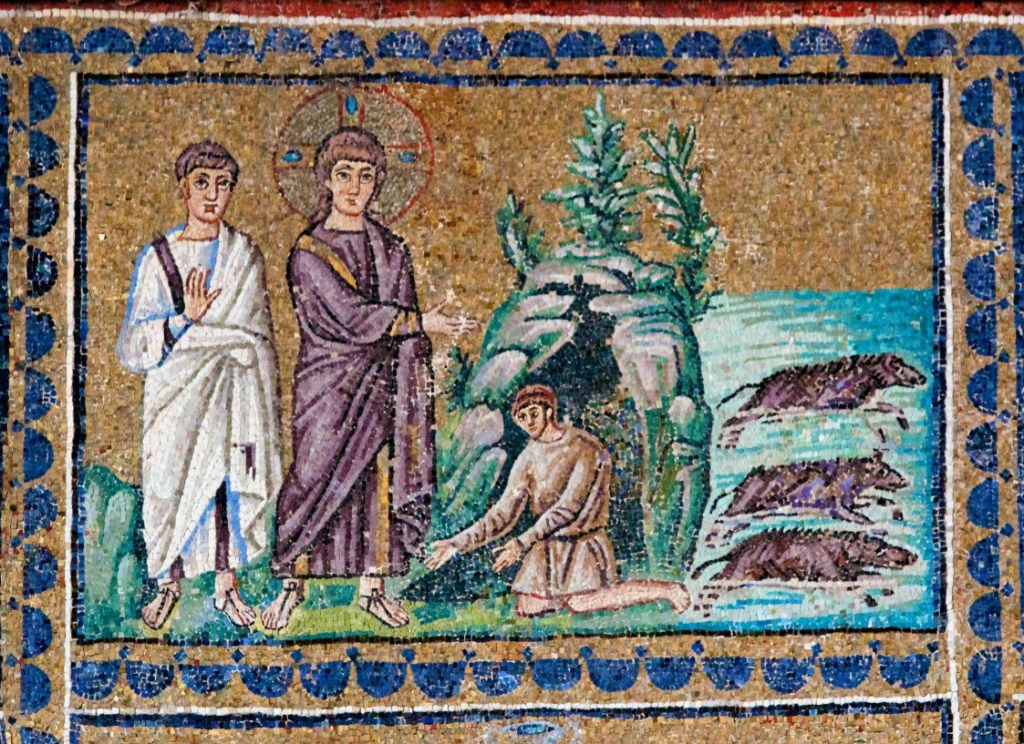
6th century mosaic of the exorcism of the Gerasene demoniac, Basilica di Sant’Apollinare Nuovo, Ravenna, Italy

They went across the lake to the region of the Gerasenes. When Jesus got out of the boat, a man with an impure spirit came from the tombs to meet him. This man lived in the tombs, and no one could bind him anymore, not even with a chain. For he had often been chained hand and foot, but he tore the chains apart and broke the irons on his feet. No one was strong enough to subdue him. Night and day among the tombs and in the hills he would cry out and cut himself with stones.

When he saw Jesus from a distance, he ran and fell on his knees in front of him. He shouted at the top of his voice, “What do you want with me, Jesus, Son of the Most High God? In God’s name don’t torture me!” For Jesus had said to him, “Come out of this man, you impure spirit!”

Then Jesus asked him, “What is your name?”

“My name is Legion,” he replied, “for we are many.” And he begged Jesus again and again not to send them out of the area.

A large herd of pigs was feeding on the nearby hillside. The demons begged Jesus, “Send us among the pigs; allow us to go into them.” He gave them permission, and the impure spirits came out and went into the pigs. The herd, about two thousand in number, rushed down the steep bank into the lake and were drowned.

Those tending the pigs ran off and reported this in the town and countryside, and the people went out to see what had happened. When they came to Jesus, they saw the man who had been possessed by the legion of demons, sitting there, dressed and in his right mind; and they were afraid. Those who had seen it told the people what had happened to the demon-possessed man—and told about the pigs as well. Then the people began to plead with Jesus to leave their region.

As Jesus was getting into the boat, the man who had been demon-possessed begged to go with him. Jesus did not let him, but said, “Go home to your own people and tell them how much the Lord has done for you, and how he has had mercy on you.” So the man went away and began to tell in the Decapolis how much Jesus had done for him. And all the people were amazed. (New International Version)

Jesus cures the Gerasene demoniac,from the Gospel Book of Otto III, Reichenau,
Germany, c.1000

The Evangelist Mark wants his readers and hearers to understand and know that Jesus is the Divine Warrior who fights against evil in the world. Many times in his earthly ministry, the Lord Jesus encountered some rather militant demons. In today’s Gospel lesson, an entire legion of them were tormenting a man who was unable to be with others and hung out in cemeteries all the time, practicing self-harm.

Much like Pharaoh’s army being drowned in the Red Sea by an act of God, so Jesus sent the legion of demons into a herd of pigs who rushed over an embankment and into the sea to drown.

The chaotic man comes to his right mind. The chaos evoked by the demonic realm is restored to order.

But, similar to an Old West movie in which the townsfolk are shortsighted to the sheriff’s heroic feat, the people in the region of the Gerasenes only see the loss of pigs, and not the loss of demons. So, the people pleaded with Jesus to leave the area.

Yet, at some point, everyone must deal with Jesus, simply because he is a force to be reckoned with. 

Eventually, we all face unseen forces that are beyond our control. It might not be today, and the sun may out, but the weather will change; everyday isn’t the same. Summer will give way to autumn, and then winter. The landscape will look very different. It’s not a question of “if” but “when.” We may console ourselves that we don’t have to deal with those forces today, but contend with them we shall.

Jesus will come. A person might not have to deal with him today, maybe not tomorrow. However, eventually, there will be a whopper of a gale force, and we will have to deal with it.

In today’s Gospel lesson, a man who was severely influenced by a strong demonic force approached Jesus. Inside of him was such a terrible inner storm that the demons shouted at Jesus.

Jesus, unfazed by the man’s inner violence and outer screams, uttered a command from a place of confidence. As fierce as the man was, Jesus had the authority to deal with the situation. As a result, the terrible force within the man subsided.

Yet, the bad weather was not over – it picked up momentum with the townsfolk. It seems they had been living their merry lives with no thought to Jesus. But he showed up. So, they had to contend with his authority right there in front of them. Unfortunately, they chose poorly. 

The Evangelist, Mark, wants us to see a connection in the story between the demons who begged Jesus, and the people of the town who begged Jesus. They did not humbly beg to follow him; they begged him to get away and leave them alone.

Jesus is an authoritative force to be reckoned with… and he is coming to your town.  Maybe not today, perhaps not tomorrow. But things will not always be the way they are right now. People will have to contend with unseen forces, and they will eventually face Jesus, one way or another.

Jesus Christ, Son of God, you are Lord over the wind, the waves, and the weather. You also command the unseen, and they obey. You are God with us. Oh, that all people would beg to follow you and not beg you to leave! I am grateful for your power and authority over all things. Amen.

Jesus the Mentor (Mark 3:13-19)

Jesus and the Disciples, by Rudolph Bostic

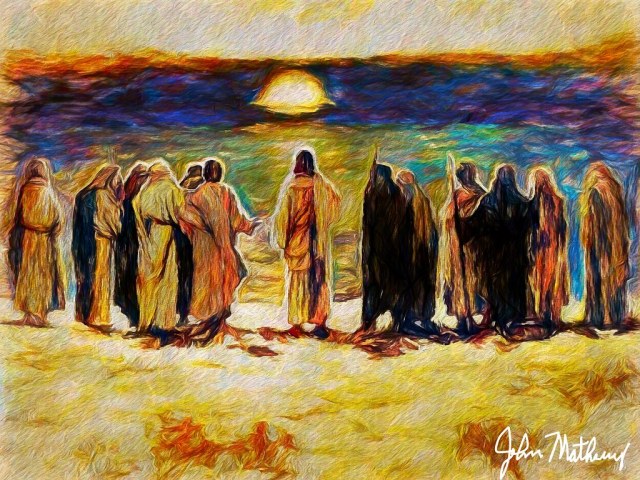
Jesus went up on a mountainside and called to him those he wanted, and they came to him. He appointed twelve that they might be with him and that he might send them out to preachand to have authority to drive out demons. These are the twelve he appointed: Simon (to whom he gave the name Peter), James son of Zebedee and his brother John (to them he gave the name Boanerges, which means “sons of thunder”), Andrew, Philip, Bartholomew, Matthew, Thomas, James son of Alphaeus, Thaddaeus, Simon the Zealotand Judas Iscariot, who betrayed him. (New International Version)

For me, every place in Holy Scripture is significant, even the seemingly mundane portions of it. Today’s verses might appear rather insignificant. However, there is some important meaning to recording who Christ called as his disciples and why he did it.

Jesus appointed twelve Jewish men to be his close disciples, his apostles. In choosing them, let’s not read into it something that isn’t there. This choosing, in no way, is meant to convey that church leadership boards are always supposed to have twelve men. It seems to me, that if such churches believe this, they ought to go all the way by insisting that they ought also to be Jewish Christians – no Gentiles on the election ballot at the annual meeting!

Excluding women, maintaining a particular number of people to a group, or considering only one ethnicity to leadership is nowhere to be interpreted in this text of Scripture. I can imagine Jesus sitting at the right hand of the Father raising a Spock-like eyebrow to such hermeneutical gymnastics and stating the lone word, “fascinating!”

A disciple is a follower. An apostle is one who is sent out with a specific purpose. Jesus called these particular people in order to send them out with a mission. In other words, Christ’s disciples are really missionaries. And these apostles, these missionaries, are appointed in order that they might be with Jesus, follow him everywhere, learn from him, and then have the received authority to go out and accomplish the mission given them to do.

An apostle can only properly carry out the instructions of the Teacher by first being a disciple who spends copious amounts of time in that Teacher’s presence. Indeed, if we are looking for some contemporary application in these more mundane texts of Scripture, let us find here an insight into our own Christian formation.

Jesus and the Disciples, by John Mathews

Christian ministry is rightly patterned after the Teacher we follow, Jesus our Lord. Christ himself demonstrated for us the way of mentoring or discipling, through his own words and actions. He called particular individuals, taught them, and equipped them for spiritual warfare in this world by granting them authority to do the work.

If we need a pattern, there it is. It’s a model of mentoring others in the ways of Christian mission and ministry. The idea is that we call, teach, equip, and authorize others in the words and ways of Jesus. I really don’t much care what you call it: Christian discipling, relational mentoring, small group teaching, spiritually forming, or any other word or phrase.

The important thing is to actually understand and do this very Christ-like work of developing mature followers of Jesus who can do the important work of spiritual warfare and ministry, then in turn, develop others. We are to pass on a body of faith and doctrine, of mission and ministry, to a group of people who will do the work. And they then do the same for others.

I rather like the word “mentoring” because for most people it evokes the idea of putting time and effort into some relationships for a specific purpose. And when we look at Christianity as a great mentoring project, perhaps we will see why church is becoming a byword in many parts of the Western world. This also ought to perhaps clue us into how we might move forward as Christians.

I am suggesting that, generally speaking, we have neglected this pattern of Jesus in calling, teaching, equipping, and authorizing. It is one large reason why there is such a decline in church attendance (and participation) in the West. And until we collectively take up this mantle of mentoring ministry, we shall continue to lessen, because we are irrelevant to people’s daily lives – both inside and outside the church.

As a first course of action, I invite you – no matter your age or stage in life – to make it a priority to simply “hang out” with individuals and groups of people. Maybe that sounds like an extrovertish sort of thing to do. However, this invitation is coming from me, an introvert. I didn’t say you have to be the life of the party, or engage in a lot of talking. But I am saying that mature followers of Jesus ought to strongly consider some intentional relationships with people other than family and a few friends.

Hang out around any given church, on any given Sunday, after any given worship service, and you are likely to see small groups of people talking with each other. Those groups typically center around friends according to age. What is often lacking are intentional interactions between the generations.  

Ethiopian Orthodox Church depiction of Christ and his disciples

The younger generations (particularly persons aged 18-29) often need and want to have relationships with more experienced (older!) believers in the faith. Younger adults, however, tend to lack the confidence to go after older adults in order to be mentored or influenced by them. I believe the onus is on the older generations to go after the younger.  

Maybe I’m just old, but it seems like younger generations have an incredible array of relationships, differing levels of friendship, and a complexity to their interactions that I didn’t have “back in my day.” What’s different, it seems, is that their relationships are more gray, and less black and white. And they appear to do a solid amount of hanging out.

Hanging out is typically sitting around with a group of people, eating and drinking, watching movies, studying (or doing bible study) or any other activity. Its doing just about anything, but doing it together with others. And this is the perfect environment for initially establishing how to begin living into the words and ways of Jesus to mentor others.

One of the things we older folks can do is to really understand the reality of younger generations’ relational interactions. For example, when I lived in a university town I used to often just “hang out” with college students, with no agenda other than just being with them. The local Perkins restaurant was at its busiest at midnight, filled with college students hanging out.

There are places in every town and city where young adults go, especially the bar scene. Bars aren’t just places to drink, but are locations of conviviality where persons have the chance to be around one another in a kind of secular church where fellowship happens, looking for a chance to relate meaningfully with others.

All people desire intimacy and want to know that someone else cares about them. This is a very real and felt need. How that need is going to be met can be either legitimate or illegitimate. And we can help with that.

One of the best things we can do for others is to communicate to them that we “have their back,” that we care, love, and genuinely like them.

No one can sniff out a disingenuous attitude quite like a young adult. So, our interactions have to be an authentic desire to be around them. Also, this does not mean we have to pretend to be younger than we are. Instead, one of the greatest needs a young person has is to be in a mentoring relationship with someone older and wiser who can help them navigate life and bring some sort of definition to relationships that they may lack.

The older generations could learn to “hang out” with younger generations and find individuals for whom they can build a solid one on one or group relationship with. If they can have such relationships now, it will serve them for a lifetime.

It seems to me that, as I look at the biblical text, being a mentor, and walking alongside another with love, grace, and wisdom, is built into Christianity by Jesus himself. So, let’s consider how we might best go about this important work.

May your love overflow more and more with knowledge and full insight to help you to determine what really matters, so that in the day of Christ you may be pure and blameless, having produced the harvest of righteousness that comes through Jesus Christ for the glory and praise of God. (Philippians 3:9-11, NRSV)