The Good Shepherd (John 10:11-18)

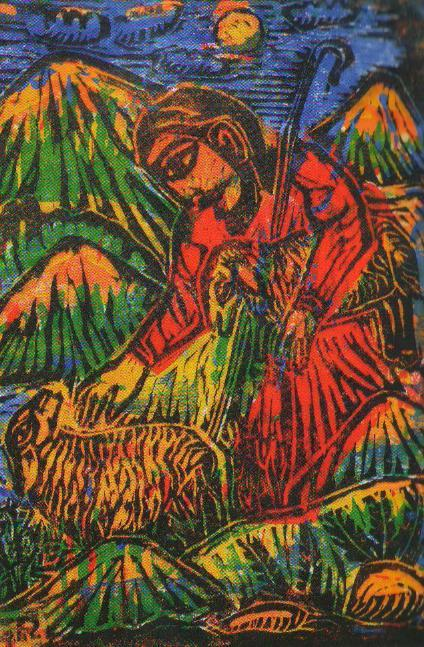
Jesus the Good Shepherd, by Solomon Raj (1921-2019)

“I am the good shepherd. The good shepherd lays down his life for the sheep. When the hired hand sees the wolf coming, he leaves the sheep and runs away. That’s because he isn’t the shepherd; the sheep aren’t really his. So the wolf attacks the sheep and scatters them. He’s only a hired hand and the sheep don’t matter to him.

“I am the good shepherd. I know my own sheep and they know me, just as the Father knows me and I know the Father. I give up my life for the sheep. I have other sheep that don’t belong to this sheep pen. I must lead them too. They will listen to my voice and there will be one flock, with one shepherd.

“This is why the Father loves me: I give up my life so that I can take it up again. No one takes it from me, but I give it up because I want to. I have the right to give it up, and I have the right to take it up again. I received this commandment from my Father.” (Common English Bible)

This is a beautiful passage of Scripture, as we look at it now, two-thousand years removed from its original context. Yet, at the time, Jesus spoke these words after a smack down conflict with the religious authorities, complete with plans to stone him.

In healing a man born blind, Jesus not only restored his physical sight, but he also gave him clear spiritual vision. In contrast, Christ’s opponents remained in their spiritual darkness, unable to see the light of life. And in their spiritual blindness, they couldn’t lead anybody anywhere without falling into a pit and making things worse.

Jesus is the good shepherd, the caring leader who is aware, and has the sheep’s best interests in mind, and at heart. The religious authorities proved to be bad shepherds who only wanted to fleece the sheep of their wool; such persons steal, harm, and kill. Jesus, however, offers abundant life.

The good shepherd provides altruistic care at a great cost. Whereas the hired hand runs away when the wolves come and threaten the flock, Jesus as the Good Shepherd puts his life on the line to protect the sheep. Three times we are told that Christ lays his life down for the benefit of others.

Bad shepherds have no such concern. And, unfortunately, such leaders have been around ever since the fall of humanity into sin. They cut and run when things get risky and dangerous.

This is what the Sovereign Lord says: “Woe to you shepherds of Israel who only take care of yourselves! Should not shepherds take care of the flock? You eat the curds, clothe yourselves with the wool and slaughter the choice animals, but you do not take care of the flock. You have not strengthened the weak or healed the sick or bound up the injured. You have not brought back the strays or searched for the lost. You have ruled them harshly and brutally. 

So they were scattered because there was no shepherd, and when they were scattered they became food for all the wild animals. My sheep wandered over all the mountains and on every high hill. They were scattered over the whole earth, and no one searched or looked for them.” (Ezekiel 34:2-6, NIV)

Jesus, in his incarnation, embodies the love and concern of God for the people of this world. Christ takes the initiative to do what needs to be done for the benefit of the at-risk sheep.
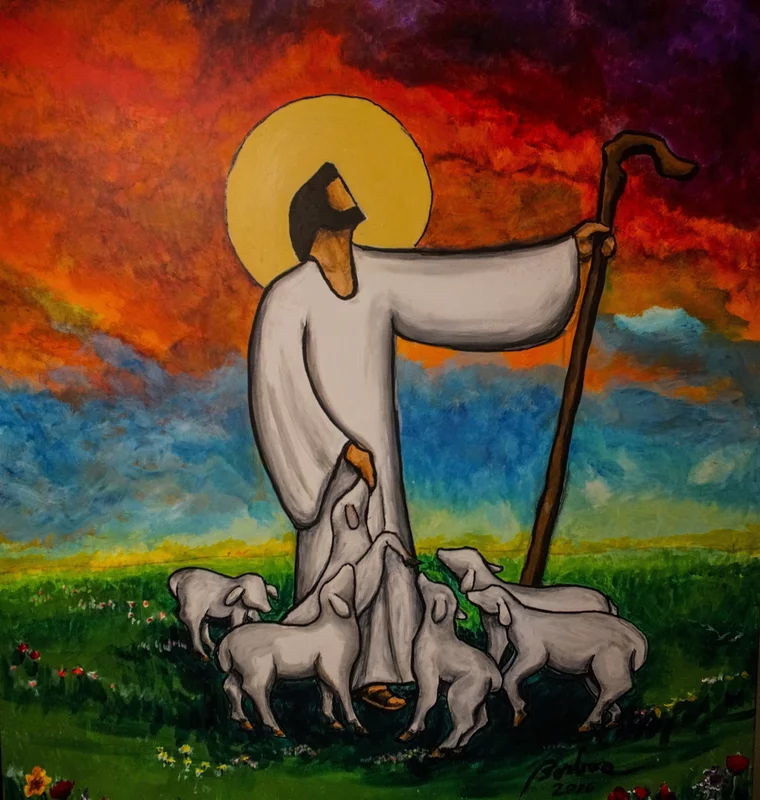
Jesus the Good Shepherd, by Francisco Borboa

For this is what the Sovereign Lord says: “I myself will search for my sheep and look after them. As a shepherd looks after his scattered flock when he is with them, so will I look after my sheep. I will rescue them from all the places where they were scattered on a day of clouds and darkness. I will bring them out from the nations and gather them from the countries, and I will bring them into their own land. I will pasture them on the mountains of Israel, in the ravines and in all the settlements in the land. I will tend them in a good pasture, and the mountain heights of Israel will be their grazing land.

There they will lie down in good grazing land, and there they will feed in a rich pasture on the mountains of Israel. I myself will tend my sheep and have them lie down, declares the Sovereign Lord. I will search for the lost and bring back the strays. I will bind up the injured and strengthen the weak, but the sleek and the strong I will destroy. I will shepherd the flock with justice.” (Ezekiel 34:11-16, NIV)

Since Jesus is the Good Shepherd, he has the unique ability and authority to decide who is in the sheep fold, and who is out. Nobody else gets to make those sorts of decisions. This way, ultimate issues of eternal life and abundant life are handled with perfect justice and righteousness.

It’s okay that this is all a mystery to us. We sheep need only to keep the Shepherd in our line of sight, and let him do his job of caring for us – without whining or complaining. After all, we could easily have a bad shepherd herding us around like a bunch of stupid cows, and treating us with indifference, even meanness.

The Holy Trinity of God – Father, Son, and Spirit – work as One. The Father loves the Son and the Spirit, and also loves those whom the Son and Spirit have touched. The Son loves the Father and the Spirit, and obeys all things from the Father, while listening to the Spirit. And the Spirit loves the Father and the Son, knowing them intimately and always operating in love for the benefit of the sheep’s deliverance from wolves.

In particular, the Son, Jesus, lays down his own life, but takes it up again. He does so because of love. The perfect unity and love of the blessed Holy Trinity spills out in Christ’s care for us.

The laying down and taking up of life on the part of the Good Shepherd is not only an expression of great love and faithfulness toward us sheep, but it is also a deep abiding love and commitment toward the Father from whom all blessings flow.

To put it another way, this motley flock of sheep are purposely drawn into the unity, harmony, and love between the Father and the Son. And when we glimpse and experience such overwhelming love, we choose to remain connected to this incredible loving dance.

Our world is much too characterized by selfish concerns and shortsighted actions. In the loving embrace of the Good Shepherd, we have an opportunity to experience peace and rest, grace and abundance, light and life. To know such love is to never turn back to old self-centered ways of living.

Shepherd of all, by laying down your life for the flock, you reveal your love for all. Lead us from the place of death to the place of abundant life, so that guided by your care for us, we may rightly offer our lives in love for you and our neighbors. Amen.

Challenging the Status Quo (Acts 4:1-4)

While Peter and John were speaking to the people, the priests, the captain of the temple guard, and the Sadducees confronted them. They were incensed that the apostles were teaching the people and announcing that the resurrection of the dead was happening because of Jesus. They seized Peter and John and put them in prison until the next day. (It was already evening.) Many who heard the word became believers, and their number grew to about five thousand. (Common English Bible)

I’ll be honest. I like upsetting the status quo. It drives me nuts when a system or group of people get so used to doing things a certain way that there is no room for anything different. Peter and John did exactly that – they went off the beaten path. According to the religious authorities, they were creating trouble, causing a stink, disturbing the peace, and making waves.

At the heart of the disturbance was the authorities’ deep concern of potential social disorder. After all, the Roman Empire with all its great strength was firmly ensconced in Judea. It was already hard enough for Jews to maintain their customs and religious practices. Now, these rabblerouser disciples of Jesus come along with their unorthodox teaching, and threaten the very social fabric of Jewish life. No! Get them out of here!

So, off to jail Peter and John went. That’s how the politics of fear typically works. Being afraid of change leads to removing the object of fear. Stuff the apostles in the gulag. Shut and lock the door. Maybe if they are out of sight they will be out of mind to the people.

But the rulers were too late. A lot of people heard the message of Christ’s resurrection. The number of believers in Jesus swelled into the thousands. Well, now, everyone’s really in a pickle! That is, except the church. Each time the Christians got squelched and silenced, more of them showed up. Oh, my, goodness. The ruling council saw they were multiplying like roaches!

It didn’t help the authorities that these religious bugs continued to interpret their own whippings and jailtime as a positive thing – enjoying the solidarity of suffering with their Lord. Ugh. What’s a decent Sadducee to do with that kind of thinking and behavior?

Apostles Peter and John heal the sick, by Pieter Aertsen (1508-1575)

Turns out nothing can stop resurrection. It cannot be chained, bound, or imprisoned. Once life gets into the hearts of people, there’s no getting it out. The message takes over and consumes the whole person. Then it spreads to another, like an infectious disease.

Before you know it, the entire social order is off kilter. What a bunch of weirdos. Following a dead guy who they say isn’t dead. Walked right out of the grave, they say. Sheesh. Pull yourselves together. So many unhinged delusional people believing in resurrection!

It’s easy for some Christians to be hard on non-Christians, just as it was easy for the ancient Jewish rulers to be hard on others leaving their fold. Sometimes we followers of Jesus forget whence we have come. We can get so upset and worked up in fear.

It could be that our underwear is too tight. More likely, we take the prideful stance of believing that our own status quo is best for everyone. So, there’s no listening, paying attention, or teachable spirits.

Peter, John, and the other apostles just went about proclaiming good news with joy. And the gospel spread. Jesus became known first to thousands, then tens of thousands, hundreds of thousands, and millions. Today, according to the Pew Research Center, there are over 2.5 billion Christians in the world. That’s a lot of people.

Christianity has had two thousand years to create their own status quo, some of it good, some of it not so much.

Yet, at the heart of it all, is the resurrection of Jesus Christ from death. It’s a message that still speaks to billions. And it’s a message Christians need to come back to, whenever they are fearful of others challenging their hegemony.

All the hopes and expectations of Christians everywhere are realized not in maintaining some Constantinian sort of Christendom, but in the resurrection of Jesus Christ the dead. The former does a lot of handwringing over social and cultural issues. The latter has a lot of joy, celebration, and renewal which works itself out in both personal and systemic redemption.

Because the good news of Easter can hardly be contained in a single day’s celebration, it’s message of new life in Christ is like a bright sun of inexhaustible grace to people everywhere – still warming the earth all these centuries later.

The Apostle Peter went on to pen a letter to struggling Christians facing hard circumstances in a world not yet dominated by Christianity, reminding them of the heart of Christian faith:

Praise be to the God and Father of our Lord Jesus Christ! In his great mercy he has given us new birth into a living hope through the resurrection of Jesus Christ from the dead, and into an inheritance that can never perish, spoil or fade. This inheritance is kept in heaven for you, who through faith are shielded by God’s power until the coming of the salvation that is ready to be revealed in the last time. 

In all this you greatly rejoice, though now for a little while you may have had to suffer grief in all kinds of trials. These have come so that the proven genuineness of your faith—of greater worth than gold, which perishes even though refined by fire—may result in praise, glory and honor when Jesus Christ is revealed. 

Though you have not seen him, you love him; and even though you do not see him now, you believe in him and are filled with an inexpressible and glorious joy, for you are receiving the result of your faith, the salvation of your souls. (1 Peter 1:3-9, NIV)

Don’t get stuck in the status quo to the point you cannot see anything outside yourself.

May we come back repeatedly to Christianity’s message so that our faith is strengthened, the church is edified, and the world is blessed. Amen.

To Believe, or Not (Mark 16:9-18)

The risen Jesus appears to his disciples, by Unknown Italian artist, 1476

[Note: The earliest manuscripts and some other ancient witnesses do not have verses 9–20.]

When Jesus rose early on the first day of the week, he appeared first to Mary Magdalene, out of whom he had driven seven demons. She went and told those who had been with him and who were mourning and weeping. When they heard that Jesus was alive and that she had seen him, they did not believe it.

Afterward Jesus appeared in a different form to two of them while they were walking in the country. These returned and reported it to the rest; but they did not believe them either.

Later Jesus appeared to the Eleven as they were eating; he rebuked them for their lack of faith and their stubborn refusal to believe those who had seen him after he had risen.

He said to them, “Go into all the world and preach the gospel to all creation. Whoever believes and is baptized will be saved, but whoever does not believe will be condemned. And these signs will accompany those who believe: In my name they will drive out demons; they will speak in new tongues; they will pick up snakes with their hands; and when they drink deadly poison, it will not hurt them at all; they will place their hands on sick people, and they will get well.” (New International Version)

The Great Commission, by He Qi

So, how do you view the Bible? Some view it as a direct communication from God to human authors, as if the Lord actually wrote it all, akin to how Moses received the Ten Commandments. Others see the Bible as a thoroughly human invention of literature about God. And then there are those who are somewhere in-between the two views.

Textual criticism is a branch of study that examines a literary work, and aims to establish the original text. This is important and needed, especially since we have all sorts of ancient pieces of literature. We rely upon learned scholars who are fluent in the original languages, and in the examination of texts, so that we can have reliable translations of those texts.

Therefore, textual criticism of the Bible means thinking critically about manuscripts and variations in the biblical texts found in those manuscripts, in order to identify the original reading of the Bible. Keep in mind that, prior to the invention of the printing press, copies of everything had to be hand written. Scribes were trained scholars who meticulously copied manuscripts; and human error was always a part of the process.

The New Testament was copied by thousands of people in thousands of places in dozens of languages. Though that reality can make textual criticism rather complicated, this diversity is also a blessing; it speaks to the high probability that we have a very close and reliable authentic original Bible – namely because so many people were involved in copying scriptural texts.

Today’s lectionary reading is an entire chunk at the end of Mark’s Gospel that is very difficult to ascertain whether it was original to his writing, or not. If you are of the ilk that the Bible is a God-authored book, you will likely want to resolve this tension. And if you’re not, you just might be rolling your eyes at this point, as if this is all silly stuff that doesn’t matter.

I’m suggesting it is neither as silly nor as serious as some want to make it. It just is. And sometimes we must accept what is, without always having to explain it in objective Enlightenment terms; or relegate it to the realm of the ethereal and mystical.

Instead, we can deal with the text we have in front of us without any wringing of the hands, or ignoring it altogether. And what we have, it seems to me, is this: a text of Scripture that is consistent with the rest of Mark’s Gospel in showing us the nature of both belief and unbelief.

An ancient papyrus fragment of Mark’s Gospel

To believe, or not to believe? That is the question.

Throughout the Gospel of Mark, we are confronted with the choice of believing or disbelieving the acts of Jesus in his earthly ministry. And that issue of faith comes to a head with Christ’s resurrection.

The women exhibited belief. They made the pilgrimage to Christ’s tomb and discovered it empty. It is upon the testimony of women – even though a woman’s testimony was not considered reliable in that day – that believers know Christ is risen from death.

The men, however, are nowhere to be found. One reason for unbelief by people who ought to know better is that they go looking for all the wrong sort of evidence. While on this earth, Jesus refused to be like any sort of worldly ruler; he sought to use his authority by being a servant; and he tapped into the power of humility and love.

If we go limiting our epistemology (the study of how we receive knowledge) then we will likely not discover the truth about much of anything. The male disciples refused to believe the testimony of the female Mary Magdalene. The risen Christ finally showed himself and rebuked the stubborn men.

To see Jesus will take something else, something more, than our standard use of three dimensions and five senses and critical thinking skills. As important and needed as they are, it isn’t enough to truly see the risen Lord. We need to bring in some other epistemic impulses: the conscience and the gut; the spirit and the heart; intuition and experience; and the testimony of witnesses whom we would rather dismiss, than listen to.

Jesus ascends to heaven, but not everyone sees it – for obvious reasons. There are some who may search for evidence their entire lives, never to find it, because they want confirmation by means of their own mentally contrived and culturally conditioned constructs.

The Gospel is neither ant-intellectual nor only understood by the scholarly and learned; the good news of Jesus Christ is both simple and complex, easy to understand and hard to comprehend, compelling and revolting. And there is one thing for sure: the person and work of Jesus will always challenge us, change us, and move us.

The story is still being written, not just with pens and keyboards, with textual criticism and documentary evidence, but with mercy and love upon the tablet of the heart.

Lord, I want to believe. Help me in my unbelief! May I see and hear the risen Savior, through the enablement of the Spirit. Amen.

Jesus Is In the Room (Luke 24:36b-48)

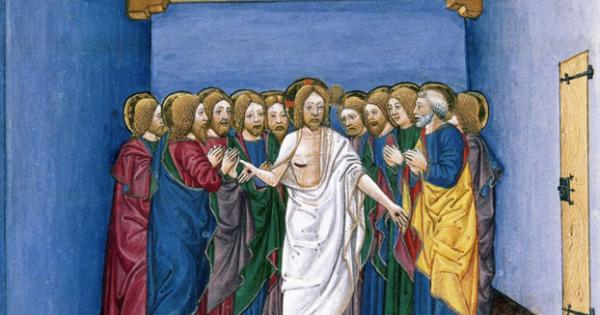
Jesus appears to the apostles, by Duccio di Buoninsegna (1255-1319)

Jesus himself stood among them and said to them, “Peace be with you.” They were startled and terrified and thought that they were seeing a ghost. He said to them, “Why are you frightened, and why do doubts arise in your hearts? Look at my hands and my feet; see that it is I myself. Touch me and see, for a ghost does not have flesh and bones as you see that I have.” 

And when he had said this, he showed them his hands and his feet. Yet for all their joy they were still disbelieving and wondering, and he said to them, “Have you anything here to eat?” They gave him a piece of broiled fish, and he took it and ate in their presence.

Then he said to them, “These are my words that I spoke to you while I was still with you—that everything written about me in the law of Moses, the prophets, and the psalms must be fulfilled.” 

Then he opened their minds to understand the scriptures, and he said to them, “Thus it is written, that the Messiah is to suffer and to rise from the dead on the third day and that repentance and forgiveness of sins is to be proclaimed in his name to all nations, beginning from Jerusalem. You are witnesses of these things. (New Revised Standard Version)

Hanging Out and Scratching Their Heads

Christ’s disciples were abuzz. Two dudes showed up and told eleven of the original disciples that they had seen and talked to Jesus himself! This was a lot to wrap both their heads and their hearts around. Could they dare to hope it is true?

Peter and John encountered an empty tomb. And now these guys from Emmaus are giving this wild testimony of a risen Savior. Into the weird mix of doubt, curiosity, grief, hope, wondering, and outright confusion, Jesus materialized out of the blue saying, “Peace be with you.”

Already feeling unsettled and uncertain, the disciples had anything but a peaceful response to the presence of their Lord. Startled, troubled, and frightened they were, as if somebody had just dropped a skunk into the room.

Why the fear? Why not be overjoyed or overcome with sheer delight at seeing Jesus?

The disciples were caught off guard, as if they had zero expectation of seeing Jesus. Believing him to be dead, they immediately went to thinking this was some ghost. After all, the door was locked. Nobody could have gotten into the room without the disciples knowing it. (John 20:19)

A fresco of Christ appearing to the disciples, in the Visoki Dečani Monastery, Deçan, Kosovo

Face to Face with Faith

As it turns out, faith and belief are not uniform static terms. There are layers to faith. Yes, the disciples really did believe, and their faith developed over time with Jesus. However, their belief had not yet come to full bloom. So, in this sense, they still possessed a lack of faith and were rebuked by Jesus for it. (Mark 16:14)

A full-orbed belief in the Lord Jesus Christ is more than words, more than making professions, and more than signing-off on a doctrinal statement of faith. Faith is shown for what it is through our actions. (James 1:19- 2:26)

Faith comes to fruition when the head, the heart, and the hands all align together and conspire to proclaim the gospel in thought, word, and deed. If they are misaligned or incongruent with each other, then that faith is inadequate. There is yet another level to the belief which needs to emerge.

Perhaps this is instructive for people today. While maintaining beliefs about the person and work of Jesus, and acknowledging Christ’s death and resurrection, some Christians live as though Jesus had never risen from the grave. If Jesus were to suddenly show up and say, “Peace be with you,” like a startled puppy, they’d likely have an accident on the floor.

It’s a Real Resurrected Body

As Jesus had done so many times before in his earthly ministry, he invited the disciples to experience him in a real, tangible, visceral way. This is no ghost. This is a Christ who has physical flesh and bones. You can eat with this Jesus, real food and drink. Look at his hands and feet. Touch and feel them if you must. But, by all means, believe!

Christ is risen. So, now what? This is what the earliest of disciples struggled to understand – how to live in the reality of resurrection, and how Jesus is present with his followers. Christ is with us as a real human and as the real God.

Although Jesus appeared to be a ghost because he could seemingly pass through things, he is not. Christ has a very real body with flesh and bones, although it is a glorified resurrected body which isn’t quite the same as our current earthly bodies. He feels hunger and eats food.

Today’s story follows the Emmaus Road experience in which two people encounter the resurrected Christ. They didn’t even notice that it was Jesus and that they were looking at a glorified body. In that story, Jesus went with them and had a meal around the table.

The Disciples Are Now Witnesses

The eyes of the disciples were opened so that they could truly see Jesus for who he really is. And it happened in their communal eating together – just as it did in the previous story with the friends from the Emmaus Road. Specifically, their new spiritual sight enabled them to be witnesses to the reality of Christ’s resurrection.

The disciples seeing Jesus empowered them to proclaim the good news that repentance for the forgiveness of sins is real; deliverance from our guilt and shame can really happen, when we confess it and turn from it. No more being locked-up in a room in fear, or in a metaphorical personal prison of anxiety.

We Are Now Empowered

The post-resurrection encounter of the disciples and Jesus would not be confined to a one room lock-in experience. The Spirit of God will come upon all sorts of people, all over the world. The sadness of crucifixion and death transforms into the joy and confidence of gospel proclamation. A true release from the shackles of fear and guilt result in a giddy blabbering about Jesus everywhere one goes.

It turns out that seeing and touching Christ’s wounds on his hands and feet doesn’t evoke bad nightmares, but elicits good dreams for the future of faith – that resurrection is a reality, is reachable, and is a path to experience the blessing of God.

Jesus is in the room, my friend. Let your fear be changed into joy.

Holy and righteous God, you raised Christ from the dead and glorified him at your right hand. Let the words of Holy Scripture, fulfilled in Jesus your Son, burn within our hearts and open our minds to recognize him in the breaking of bread. Amen.