The Parable of the Sower (Mark 4:1-20)

The Sower, by Mike Moyers

Again Jesus began to teach by the lake. The crowd that gathered around him was so large that he got into a boat and sat in it out on the lake, while all the people were along the shore at the water’s edge. He taught them many things by parables, and in his teaching said:

“Listen! A farmer went out to sow his seed. As he was scattering the seed, some fell along the path, and the birds came and ate it up. Some fell on rocky places, where it did not have much soil. It sprang up quickly because the soil was shallow. But when the sun came up, the plants were scorched, and they withered because they had no root. Other seed fell among thorns, which grew up and choked the plants, so that they did not bear grain. Still other seed fell on good soil. It came up, grew and produced a crop, some multiplying thirty, some sixty, some a hundred times.”

Then Jesus said, “Whoever has ears to hear, let them hear.”

When he was alone, the Twelve and the others around him asked him about the parables. He told them, “The secret of the kingdom of God has been given to you. But to those on the outside everything is said in parables so that,

“‘they may be ever seeing but never perceiving,
    and ever hearing but never understanding;
otherwise they might turn and be forgiven!’”

Then Jesus said to them, “Don’t you understand this parable? How then will you understand any parable? The farmer sows the word. Some people are like seeds along the path, where the word is sown. As soon as they hear it, Satan comes and takes away the word that was sown in them. Others, like seed sown on rocky places, hear the word and at once receive it with joy. But since they have no root, they last only a short time. When trouble or persecution comes because of the word, they quickly fall away. Still others, like seed sown among thorns, hear the word; but the worries of this life, the deceitfulness of wealth and the desires for other things come in and choke the word, making it unfruitful. Others, like seed sown on good soil, hear the word, accept it, and produce a crop—some thirty, some sixty, some a hundred times what was sown.” (New International Version)

The Sower, by Johne Richardson

All four of the New Testament Gospels have their own particular angle and focus upon the life of Jesus Christ. For Mark, he wrote to demonstrate and prove the established authority of Christ over everything.

God’s power is expressed in and through Christ. So, when Mark tells a story, he is concerned to communicate that God’s kingdom – God’s rule and reign on this earth – comes through Jesus as the Sovereign over this realm of the universe and our world.

By means of a parable – a farmer going out and scattering seeds – Jesus was making some points about the kingdom of God: it will be successful; it is thoroughly under divine control; and it’s inclusive.

God’s Reign Will Succeed

History is inexorably moving toward a climax. God’s sovereign rule has broken into human history. Christ’s authoritative rule is taking root, growing, and shall eventually envelope all the world.

It may not presently seem as if that’s going to happen. But appearances can be deceiving. Although much, if not most, of the good gospel seeds spread about this earth never produce a harvest of righteousness, there is enough good soil for those seeds to succeed.

Even though there is a lot of unproductive and ineffective soil in this world, good seeds in good soil will germinate and take root. They will grow, develop, mature, and ripen. An abundant yield of crops will more than satisfy the needs of the earth. And it will blow the imagination of even the wisest and best farmer.

One person, having realized the incredible fruit of the Spirit, makes a broad, deep, and expansive impact on dozens, hundreds, thousands, tens of thousands, and even millions of people. It certainly doesn’t happen overnight; but goodness, truth, beauty, and righteousness are making their way slowly – and will overtake and overwhelm all evil.

If you make disciples who make more disciples, that is multiplication. Jesus made disciples, and called his followers to do the same. He spent three years training twelve men; and then commissioned them to go out and reproduce the process with others. (Matthew 28:18-20)

Beginning in Jerusalem, the earliest disciples of Jesus began making more disciples, following Christ’s ascension, and that movement has never stopped. Jesus started a movement of a few seeds multiplying into many seeds, so that the Church would grow exponentially. Not even the gates of hell can stop the process from happening. (Acts 1:1-8; Matthew 16:17-19)

God’s Reign Is Ruled by God

That may seem like a ridiculously obvious statement, yet it still needs to be said. God is authoritatively in control, not only of God’s own kingdom, but of all things. This means that God’s rule and reign is the result of God’s action, not ours. The only thing we need to do is scatter the seed and be a simple farmer. Everything else is up to God.

Our ability to do anything is animated by God’s gracious work in our lives. The power to effect making disciples comes from the Lord. Since we are dependent upon God for our next breath, we are also completely under the authority and sustaining presence of God for everything in life.

Both the subject and object of every biblical story is God. In this unfolding drama of redemptive history that we are experiencing, God is the writer, producer, director, and lead actor; we only have some bit parts in the whole thing. It’s our job to respond – and not to try and take over the show.

God’s Reign Is Inclusive

When gospel seeds are established in good soil, eventually producing an abundant harvest, it will feed the entire world. It will include all kinds of people. The produce which is available is not limited to a particular group of people. God’s grace and goodness are shown to people without prejudice or favoritism.

The best things in life begin as small as a mustard seed. That’s because every good thing we have is a result of humility. And from that place – the hummus of the earth – God creates life, gives new life, and does the improbable and the impossible of transforming a tiny little seed into a tall expansive plant which blesses many.

Conclusion

As simple humble farmers of faith, we need to pay attention to what we have, so that we don’t become complacent. The forces of evil – the spiritual tornados and tsunamis – are still very much active on this earth. Those powers temporarily oppose the good power and authority of Christ.

The good word spread to us can be snatched and taken away by the ravens of Satan. Although other good words make some effective headway, all the weeds around them can choke the plants until they wither and die. All sorts of existential conditions surrounding the plants can cause a failure to thrive.

Whenever Christians face opposition – or when they observe young believers lost to those surrounding forces – they need not become discouraged. Why? Because this is all a part of the ministry to which every follower of Jesus is called. Our part is to keep sowing and planting. The rest is up to God.

Sovereign and almighty God:
Give me strength to live faithfully this day;
Let me not turn coward because of difficulties, or become irresponsible to my duties;
Let me not lose faith in other people;
Keep me sweet and sound of heart, in spite of ingratitude, treachery or meanness;
Preserve me from minding little stings or giving them;
Help me to keep my heart clean and to live so honestly and fearlessly that no outward failure can dishearten me or take away the joy of conscious integrity;
Open wide the eyes of my soul that I may see good in all things;
Grant me this day some new vision of your truth;
Inspire me with the spirit of joy and gladness, and make me the fertilizer to suffering souls; in the name of the strong Deliverer, our only Lord and Savior, Jesus Christ. Amen.

Misunderstanding Jesus (Mark 3:20-35)

By Jorge Cocco Santángelo

Then he went home, and the crowd came together again, so that they could not even eat. When his family heard it, they went out to restrain him, for people were saying, “He has gone out of his mind.” And the scribes who came down from Jerusalem said, “He has Beelzebul, and by the ruler of the demons he casts out demons.” 

And he called them to him and spoke to them in parables, “How can Satan cast out Satan? If a kingdom is divided against itself, that kingdom cannot stand. And if a house is divided against itself, that house will not be able to stand. And if Satan has risen up against himself and is divided, he cannot stand, but his end has come. But no one can enter a strong man’s house and plunder his property without first tying up the strong man; then indeed the house can be plundered.

“Truly I tell you, people will be forgiven for their sins and whatever blasphemies they utter, but whoever blasphemes against the Holy Spirit can never have forgiveness but is guilty of an eternal sin”—for they had said, “He has an unclean spirit.”

Then his mother and his brothers came, and standing outside they sent to him and called him. A crowd was sitting around him, and they said to him, “Your mother and your brothers are outside asking for you.” And he replied, “Who are my mother and my brothers?” And looking at those who sat around him, he said, “Here are my mother and my brothers! Whoever does the will of God is my brother and sister and mother.” (New Revised Standard Version)

Who exactly is Jesus? That’s a question which has been bantered around by people for the past two millennia. I suppose that is to be expected, since people contemporary to Christ misunderstood him, including his own family.

There were a couple of related charges against Jesus by the religious authorities of his day: he has a demon; and by the prince of demons he casts out demons. There was also a charge against Jesus from members of his family: he is out of his mind. All the accusations and misinterpretations were in response to the crowds Jesus was attracting.

Sometimes one’s own relatives will think one is crazy, just for doing God’s will. Yet, the good news is that the misunderstood and the misinterpreted folks can find a family within Christian community. Jesus stated that his family are not those who are related by blood, but those who share his purpose of doing the will of God.

Jesus teaching, by James Tissot (1836-1902)

When it came to the religious leaders accusations, they were essentially saying that Jesus was using dark magic and not God’s power. They thought of Jesus as having gained control of certain spirits to do his bidding, as if he were casting spells on people and making them do what he wanted.

Yet, it is illogical, as Christ pointed out, that Satan would cast out his own demons, thus undermining his own sinister work. It’s much more logical to discern Christ’s work as the power of God and the work of the Holy Spirit. To miss this completely, and accuse otherwise, is to commit an unpardonable sin.

The controversy and charges in this story are about who is truly in and who is really out. Because, in reality, the insiders are out and the outsiders are in. And it isn’t so clear cut as everyone seems to think.

Jesus was drawing in the crowd of people, while family members were becoming outsiders. Those on the inside are given insight and understanding about God’s kingdom, whereas those on the outside are scratching their heads, not knowing what Jesus is doing or talking about.

Since the family was mystified by their own relative, they misinterpreted Jesus as being off his rocker. And since the religious leaders were clueless to the parables and actions of Jesus, they misunderstood the source of his power as demonic.

To mistake the work and power of the Holy Spirit as satanic is to be guilty of an unforgivable sin, simply because the ones mistaking, misunderstanding, and misinterpreting never see a need for repentance and forgiveness. They believe they’re okay, and that Jesus is not.

You cannot be forgiven if you always think you’re right.

The bottom line for both the family and the religious leaders is that Jesus didn’t meet their expectations and act as they all think he should; so they make completely misguided conclusions about him.

But, in truth, all they’re actually doing is projecting their own stuff onto Jesus. The family is out of their mind for not recognizing who is actually in front of their face. And the religious authorities blasphemed God by saying hard things about the Lord of life, of whom they were observing.

If that’s how others are going to treat Jesus, then they’re going to be on the outside of God’s kingdom. It’s their own fault, because of their own chosen lack of awareness, and their refusal to take a good hard look at who Jesus is.

For myself, I want to investigate Jesus so closely that I’m like the crowd pressing in to see him and touch the hem of his garment – believing that my desperate desire can be fully met in him. And I want the continued assurance that I am claimed by Christ as his brother.

I am grateful that I no longer have to be an outsider looking in; but instead have become a keeper of kingdom truth because I am drawn into the mystery of God’s love in Jesus Christ through the enablement of the Holy Spirit. To which I say with flavor, “amen” and “amen.”

What Will You Do with Jesus? (John 5:1-18)

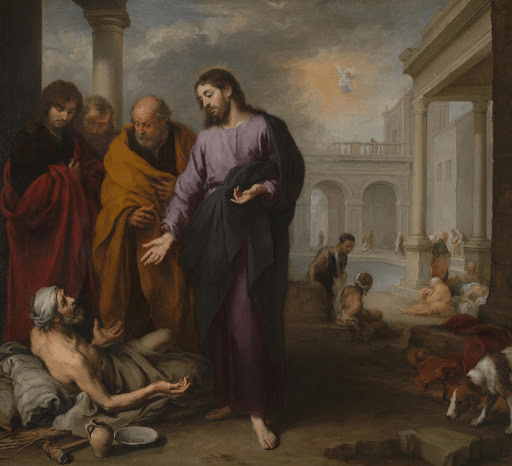
Healing the Paralytic, by Bartolomé Esteban Murillo, 1670

Sometime later, Jesus went up to Jerusalem for one of the Jewish festivals. Now there is in Jerusalem near the Sheep Gate a pool, which in Aramaic is called Bethesda and which is surrounded by five covered colonnades. Here a great number of disabled people used to lie—the blind, the lame, the paralyzed. One who was there had been an invalid for thirty-eight years. When Jesus saw him lying there and learned that he had been in this condition for a long time, he asked him, “Do you want to get well?”

“Sir,” the invalid replied, “I have no one to help me into the pool when the water is stirred. While I am trying to get in, someone else goes down ahead of me.”

Then Jesus said to him, “Get up! Pick up your mat and walk.” At once the man was cured; he picked up his mat and walked.

The day on which this took place was a Sabbath, and so the Jewish leaders said to the man who had been healed, “It is the Sabbath; the law forbids you to carry your mat.”

But he replied, “The man who made me well said to me, ‘Pick up your mat and walk.’ ”

So they asked him, “Who is this fellow who told you to pick it up and walk?”

The man who was healed had no idea who it was, for Jesus had slipped away into the crowd that was there.

Later Jesus found him at the temple and said to him, “See, you are well again. Stop sinning or something worse may happen to you.” The man went away and told the Jewish leaders that it was Jesus who had made him well.

So, because Jesus was doing these things on the Sabbath, the Jewish leaders began to persecute him. In his defense Jesus said to them, “My Father is always at his work to this very day, and I too am working.” For this reason they tried all the more to kill him; not only was he breaking the Sabbath, but he was even calling God his own Father, making himself equal with God. (New International Version)

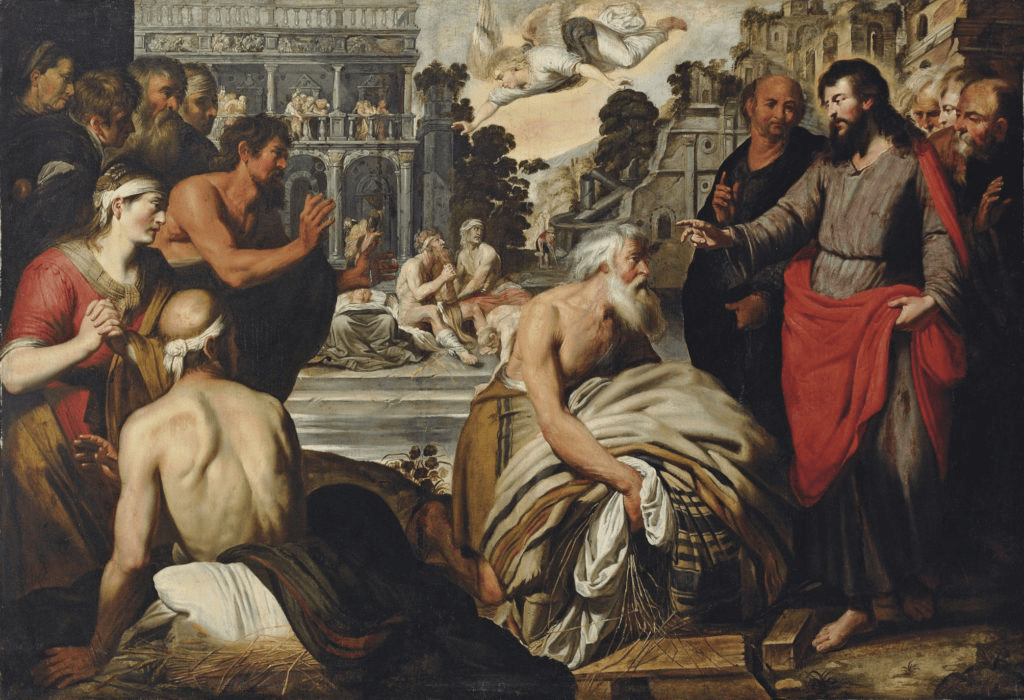
Christ at the Pool of Bethesda, by Artus Wolffort, c. 1625

During one of the yearly Jewish festivals, on a Sabbath day, a miracle happened. Miracles of healing are typically accompanied by celebration and joy. But not so much with this one.

It’s one of those things about living in a messed up world of broken systems, that an invalid can start walking and there are people who have frowns and furrowed brows about it.

Granted, the man who was healed by Jesus may seem a bit hard to like in some ways. We don’t really know what he was into, but when Christ bestows healing on you, then says to stop sinning, it’s probably a significant sin to warrant the Lord’s exhortation.

Regardless of any sort of sin, the man appears to be paraplegic. Especially in the ancient world, this meant all sorts of problems had to be navigated – such as needing others to literally carry you around (no wheelchair or handicapped accessible anything), long periods of social isolation, lack of bodily control over your bowels and bladder, and the continual needs for cleanliness.

This made the man hard to like by many people just because he likely had strong body odors and had to crawl to get around if no one would help. He would not have been pleasant to look at. But he would have to make sure you did because, in the absence of any charity, the guy’s only option was to beg.

I’m glad there are greater forces in the world than indifference and dislike. There is grace – which is an act of bestowing honor and/or forgiveness to another person. It is not dependent upon whether one deserves it. Grace chooses not to hold something over or against another. It is a deep concern for others that comes from within and not from without.

“I do not understand at all the mystery of grace – only that it meets us where we are but does not leave us where it found us.”

Anne Lamott

Another gracious act that Jesus did was to honor the man’s dignity by respecting him with a question. By asking a question, we don’t assume we know what’s best for another. Sincere questions acknowledge another’s basic humanity. “Do you want to get well?” Jesus asked.

In the life of being an invalid and having little control over much of anything, including one’s own body, being asked a question is to receive the gift of autonomy.

There are many times in my work as a hospital chaplain that I speak with patients who don’t have a lot of control in their lives. I go out of my way to ask questions such as, “May I come in?” “Is it alright with you if I pull up a chair and sit down?” “Would you be okay telling me about what is going on?” “May I pray with you?”

This is important, because there are too many other people in this world who would just barge into a room, act like they own the place, and talk at them, and not with them – hence reinforcing to the person that they’re nothing compared to others, that they don’t have any real say.

The man’s response to Jesus was to essentially say that he is alone. He has no one to help him. Even though the man is in a city, surrounded by hundreds and thousands of others, he is lonely.

Not anymore. Jesus saw him, even inquired about him and learned about the man. Jesus Christ, the Lord of all, cared about a non-descript invalid and was sincerely curious about him. In a world of everyone for himself, Jesus championed the lonely and the lost.

A simple command to obey was all. Christ told the man to pick up his mat and walk. That’s it. Just as words created the world, so a few words created a whole new life for the man. So, he got up, and he walked.

It’s interesting that the religious leaders never seemed to notice the man when he was lame, but now that he’s up and walking around, they pay attention to his apparent work on a Sabbath.

The invalid was validated by Jesus, but Jesus, the one validated by the Father, was invalidated by the religious leaders, who are the spiritual invalids.

It was against the (their) rules to carry something around. Apparently, it was okay for people to be lonely, not contribute to society in meaningful and dignifying ways, and to suffer; but it’s not okay to walk and carry a mat.

Even worse, is anyone who would heal on the Sabbath and tell the healed person to walk and carry a mat. It was so bad, apparently, that it warranted persecuting such a person. But that’s what happens when people are forced to serve rules, instead of the rules serving people.

On top of it all, Jesus was working; and he justified it by stating that his Father keeps working. This was dangerously close to blasphemy by likening himself to God. For the religious leaders, not only was Jesus unethical in breaking the law, but he was also theologically immoral; he claimed a special relation with God.

The more that laypeople get to know Jesus, the more compelling he becomes; they want to follow him. But the more that clergy discover Jesus, the more angry they become and want to do away with him.

Ultimately, it is Jesus we must contend with, and not the law and our interpretations of scripture. We need to decide what we are going to do with Jesus… what will you do?…

A Controversial Christ (Mark 2:23-3:6)

Wheatfield with Crows, by Vincent Van Gogh, 1890

One Sabbath day as Jesus was walking through some grainfields, his disciples began breaking off heads of grain to eat. But the Pharisees said to Jesus, “Look, why are they breaking the law by harvesting grain on the Sabbath?”

Jesus said to them, “Haven’t you ever read in the Scriptures what David did when he and his companions were hungry? He went into the house of God (during the days when Abiathar was high priest) and broke the law by eating the sacred loaves of bread that only the priests are allowed to eat. He also gave some to his companions.”

Then Jesus said to them, “The Sabbath was made to meet the needs of people, and not people to meet the requirements of the Sabbath. So the Son of Man is Lord, even over the Sabbath!”

Jesus went into the synagogue again and noticed a man with a deformed hand. Since it was the Sabbath, Jesus’ enemies watched him closely. If he healed the man’s hand, they planned to accuse him of working on the Sabbath.

Jesus said to the man with the deformed hand, “Come and stand in front of everyone.” Then he turned to his critics and asked, “Does the law permit good deeds on the Sabbath, or is it a day for doing evil? Is this a day to save life or to destroy it?” But they wouldn’t answer him.

He looked around at them angrily and was deeply saddened by their hard hearts. Then he said to the man, “Hold out your hand.” So the man held out his hand, and it was restored! At once the Pharisees went away and met with the supporters of Herod to plot how to kill Jesus. (New Living Translation)

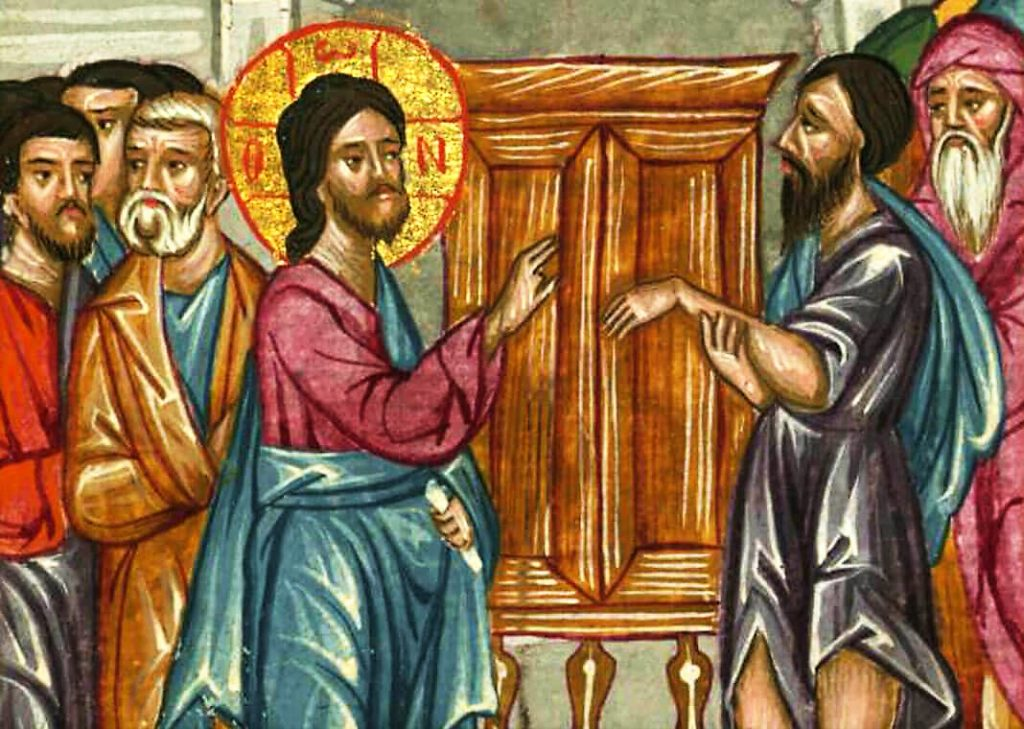
Jesus Heals the Man with the Withered Hand, by Ilyas Basim Khuri Bazzi Rahib, 1684

I am continually amazed whenever good people are surprised by being embroiled in the muck of human controversy. Since we live in a profoundly fallen world, good is often going to buck up against the bad. Besides, Jesus often found himself in a controversy of some kind; and we are not above our Lord.

There are two distinct yet similar controversies in today’s lesson; and they highlight why there were some folk who were all upset about the way Jesus went about things. Such people eventually came to the dark decision that Jesus needed to go away, permanently.

Much of the controversy between Jesus and the religious leaders came down to particular views of God’s law; and, of course, whose view was going to win out over the other. It ended up becoming what almost all controversies are about: Deciding who is really in power and calls the shots.

The Politics of Hunger

It was a Sabbath day. Jesus and his disciples were walking through the fields. And they were hungry. So the disciples took some grain, broke off the heads, and ate them. To any non-Jewish person, there’s no problem here. But the Pharisees were concerned.

First, they observed the disciples walking through grain fields. The Pharisees thought they should be staying put on the Sabbath. Second, and perhaps more significantly, the religious leaders saw Christ’s disciples gleaning – which was working on the Sabbath. To them, any respectable Jew prepared their food the day before. This is a lack of holiness, of not taking the Sabbath seriously. And this was completely unacceptable to the Pharisees.

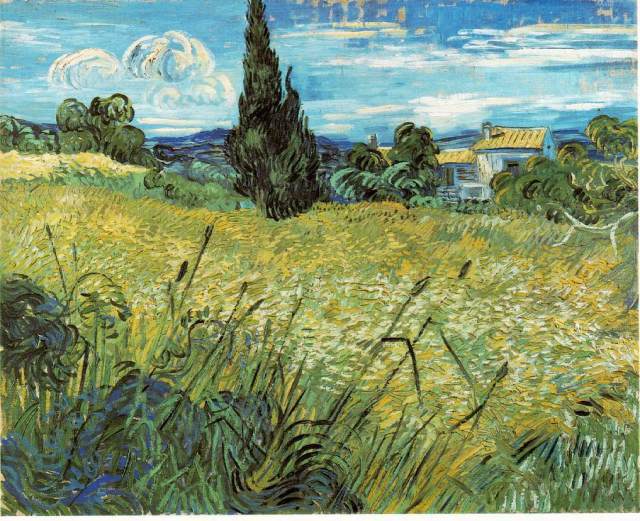
Wheat Field and Cypress by Vincent Van Gogh, 1890

Jesus, however, viewed walking through the fields differently. He did not consider the Sabbath as trivial; Jesus instead stood back and took a big picture perspective of it all. And that view included the ancient story of David, who took the consecrated bread in the tabernacle which was reserved only for Levite priests. (1 Samuel 21:1-6; Leviticus 24:8-9)

The reason David wanted the bread was because he was a fugitive, on the run from King Saul who was trying to take his life. Jesus insisted, on that day, the priest on duty did nothing wrong in giving the special bread to David. Yes, the strict letter of the law was broken; and, no, this was not wrong – because the priest was helping to save a life, and a very important one at that.

Jesus discerned there are times when particular laws come into conflict; so it’s necessary to maintain the spirit of a law in order to maintain a high value and meet a pressing human need. In a sense, Jesus gave a covenant code legal opinion on the subject.

It’s no surprise, to any reader of the New Testament Gospels, that Christ would behave this way; and that it would drive the religious leaders bananas. After all, they, the Pharisees, upheld law and rendered legal decisions – not this upstart wannabe. Jesus took an authoritative stance on what was happening, and the leaders did not at all like their own authority questioned.

This wasn’t some maverick interpretation by Jesus. He simply pointed out that the Sabbath is a gift, given to people to promote life and health – and not a burden that folks are to carry. Any decent Sabbath-keeper knew this.

It appears the leaders didn’t like being reminded of it from Jesus. What’s more, Jesus was much too close to likening himself to David. Yet another reason to despise this uppity teacher.

The Legality of Suffering

A second controversy brought the issue of who is in charge and who gets to arbitrate community values into a greater light. There is perhaps no other place for that conflict to happen than in the synagogue, the meeting place of worshipers. The juiciest things always seem to happen in a place of worship.

In the first story, the religious leaders were caught surprised over the behavior of Jesus and his disciples. They’re determined not to make that mistake again. From this point forward, it seems the Pharisees are continually waiting for a chance to put down Jesus as a lawbreaker and rabblerouser.

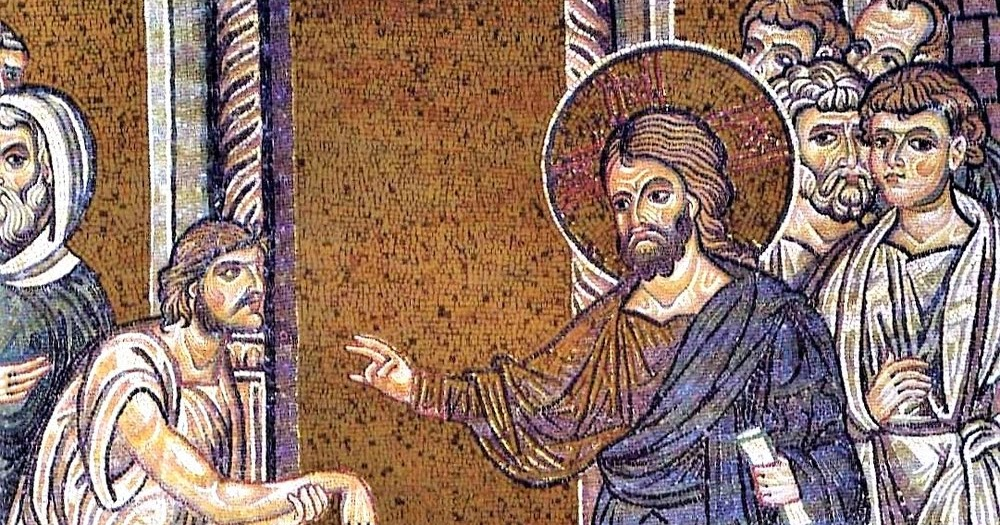
Byzantine mosaic of Christ healing the man with a withered hand, Cathedral of Monreale, Palermo, Sicily

For them, the issue wasn’t about the ability to heal, but whether it’s being done on the Sabbath. Much like the grainfield incident, healing is work, and working on the Sabbath is a direct violation of God’s immutable law. The religious leaders wanted to prove that Jesus has no regard for God’s will.

Law, for many Pharisees in Christ’s day, was meant to bring order so that chaos does not rule. Obedience to the law is a pre-condition for blessing. Without a clear demonstration of holy living, the community could be under a curse, much like their ancestors before them who were exiled for disregarding God’s law.

Yet again, Jesus cut through the anxious fear and authoritative posturing and went directly to the intended spirit of the law. The Sabbath, of all days in the week, ought to be a time for doing good, not harm; and to save life, not kill it. Jesus was not doing anything that could be considered work, anymore than his disciples were actually gleaning or harvesting grain.

There is no better day than the Sabbath for restoring a man’s withered and malformed hand, for giving him back his ability to make a living and contribute to the community. Much more was restored to the man than a physical ability; he now had the ability to better his life and his family, not to mention the local economy. It ought to be all good…

Unfortunately, the Pharisees didn’t see it that way, that the man gained his dignity back, his wholeness and his joy. They could only see a threat to their own hegemony.

The Beginning of the End

So, this marks the beginning of the end. The leaders are so upset and angry, they began plotting for Christ’s destruction. Unlikely political allies came together because of a common enemy. To view Jesus as a threat to society is, at the least, messed up. But that’s what happens when people cannot see beyond the end of their nose. They make bad choices.

Even though Jesus came to give life, others want to take his. Despite the fact that Jesus did not reject the law or demean the Sabbath, people with a short-sighted agenda and hard hearts could only see someone upsetting the status quo.

Today, these same things can quickly turn to hostility. The legal implications of one’s values and commitments can get nasty fast. Opinions can harden, resulting in oppression, persecution, and even death.

The most noble of motives can go sour; and the best of intentions, the highly educated, and the most gifted persons among us can become despotic in their leadership. Indeed, absolute power corrupts absolutely.

This is why the gracious and benevolent kingdom of God will win the day. Hard-hearted people become desperately out of touch with what is most important; they are calloused to the human need in front of their faces. I believe that the words and ways of Jesus can dispel those dark forces and impulses.

I’ll take a controversial Christ any day because that is the path to life abundant and everlasting.

Whenever unjust, oppressive, harmful, and fearful systems hold on, the ministry of Jesus exposes them for what they are, and will deliver us from evil.

Thanks be to God!