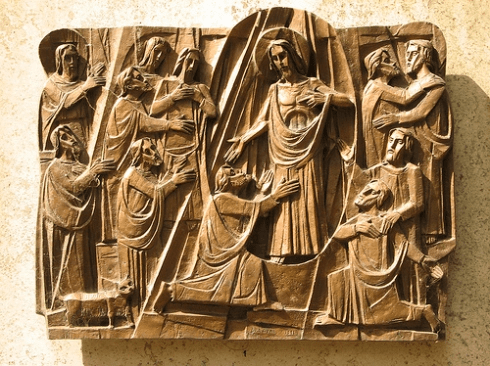
Watch Out For the Millstones (Mark 9:38-50)

John said to him, “Teacher, we saw someone casting out demons in your name, and we tried to stop him because he was not following us.” But Jesus said, “Do not stop him, for no one who does a deed of power in my name will be able soon afterward to speak evil of me. Whoever is not against us is for us. For truly I tell you, whoever gives you a cup of water to drink because you bear the name of Christ will by no means lose the reward.

“If any of you cause one of these little ones who believe in me to sin, it would be better for you if a great millstone were hung around your neck and you were thrown into the sea. If your hand causes you to sin, cut it off; it is better for you to enter life maimed than to have two hands and to go to hell, to the unquenchable fire. And if your foot causes you to sin, cut it off; it is better for you to enter life lame than to have two feet and to be thrown into hell.And if your eye causes you to sin, tear it out; it is better for you to enter the kingdom of God with one eye than to have two eyes and to be thrown into hell,where their worm never dies and the fire is never quenched.

“For everyone will be salted with fire. Salt is good, but if salt has lost its saltiness, how can you season it? Have salt in yourselves, and be at peace with one another.” (New Revised Standard Version)

Weird encounters and exorcisms, hard words and sayings, and enough metaphors to creep out the visual learners among us, were all regular staples of Christ’s earthly ministry.

For me, this makes sense. Christ coming into a world of great need, filled with all sorts of disturbances and disturbing people, will create spiritual headlines. The ministry of Jesus does not involve idyllic pictures of beautiful butterflies, and bunnies without bowel movements.

The world needs real saving, which is why Jesus showed up in an incarnational invasion that nobody saw coming.

Christian discipleship is not for the faint of heart. It demands an embrace of robust moral teaching, along with a cross to carry.

Following Jesus involves lots of servitude, and only a little bit of leadership. It requires radical humility to do anything.

Furthermore, Jesus was anything but a narrow-minded exclusivist. He encouraged his disciples to have broad and open-minded attitudes and approachs toward those who do good and provide help, outside of the disciple circle.

Whether following Jesus, or not, Christ commended, and did not condemn, those who squish evil like a grape, and offer cold water to others on a hot day. Why? Doesn’t this seem antithetical to the demands of discipleship within the disciple group?

Maybe. Maybe not. Frankly, it seems paradoxical (two things that seem contradictory but nevertheless are equally true). On one hand, only the disciples bear the name of Christ; but on the other hand, everyone who does justice and mercy has Christ’s name invisibly emblazoned on their heads.

Anybody who remotely conforms to the character of Christ, upholding basic morality and human kindness, receives a divine thumbs up from Jesus.

And conversely, anyone who acts the bully and trips up a little one who believes – whether they have a label of disciple or not – are in for a world of divine retribution.

It all hinges on how scandalous we can be; or rather, what sort of scandal we stir up with our lives.

The good kind of scandal is going against the grain of injustice and doing good when no one else much cares; and the unjust ones need a big obstacle of righteousness in their way.

The bad sort of scandal is putting a stumbling block between God and those trying to come to the Lord. It’s the wicked who need to be tripped up and set straight, and not the faithful who need to run an obstacle course just to get a peek at the good life as defined by God.

Just so you know, millstones were usually the heaviest objects in a village – weighing up to a ton (2,000 lbs.) or more. We can perhaps understand Jesus talking of perpetrators getting a millstone necklace; but it’s a real tragedy whenever someone puts one on for themself.

You’re harming yourself if the choice is to be irresponsible, hateful, unloving, or unjust. I’m not talking about the inevitable mistake, white lie, or unconscious bias. I’m talking about a deliberate choice to get in another’s way of happiness; tear someone down with verbal violence; or harm a person by any means you can do it.

All of us have a responsibility to protect and promote the common good of all persons, and the social good of the community.

Nobody is helped whenever a person comes down hard with judgmental criticism on a coworker who was just trying to do their best but failed. Everyone loses whenever a relative spreads gossip throughout the family system.

And no one is built up whenever a neighborhood association leader or condo board chair creates unnecessary roadblocks to community well-being, but then railroads a pet personal project through for their own advantage.

Feet end up walking in dangerous places. Hands reach where they shouldn’t. Eyes look with a sinful gaze. There are times when it is warranted to amputate a limb in order to save the whole body; to perform a surgery in an effort to save a life; and to remove an eye before it creates serious sickness.

But I am talking metaphorically and spiritually – which is no less real than the physical and tangible. Gangrene happens not only to the flesh and blood body; it also happens to the diseased soul.

When it happens, the only the way to deal with it is by getting rid of gangrenous part. Otherwise, death is around the corner, as well as the coroner. Both body and soul suffer. And it will do no good to feign healthiness and pretend as if everything is “just fine.”

Some salt, therefore, is good. It acts as a preservative against expiration; and promotes the good taste of obedience and fidelity to God.

All your grain offerings you shall season with salt; you shall not omit from your grain offerings the salt of the covenant with your God; with all your offerings you shall offer salt. (Leviticus 2:13, NIV)

Let’s consider hard whether we want to be lame Christians who offer nothing but a tepid discipleship and spirituality to the church and world; or whether we will spiritually support one another by building bridges to provide needed supply lines, instead of walls to keep out the people we don’t like.

You already know what Jesus wants, and what Christ advocated and agitated for. So, let’s avoid a future with millstones in it.

Almighty God of redemption and mercy: Help us to be at peace with one another: not clambering for positions; not being fearful of those who we do not know in the kingdom, but honoring, loving, and serving them. Enable us to increase peace among ourselves by being aware of sin and its effects, and choosing to deal with it. May we be seasoned with salt as we live for the cause of Christ in a world of conflict. Amen.

To Believe, or Not (Mark 16:9-18)

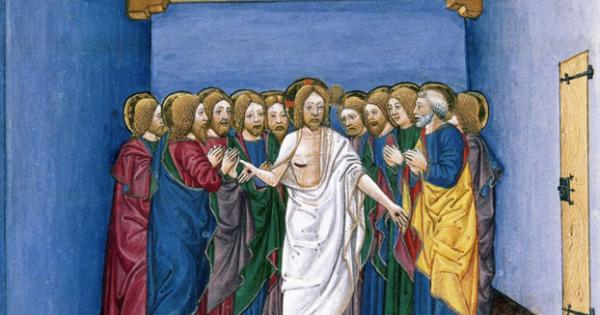
The risen Jesus appears to his disciples, by Unknown Italian artist, 1476

[Note: The earliest manuscripts and some other ancient witnesses do not have verses 9–20.]

When Jesus rose early on the first day of the week, he appeared first to Mary Magdalene, out of whom he had driven seven demons. She went and told those who had been with him and who were mourning and weeping. When they heard that Jesus was alive and that she had seen him, they did not believe it.

Afterward Jesus appeared in a different form to two of them while they were walking in the country. These returned and reported it to the rest; but they did not believe them either.

Later Jesus appeared to the Eleven as they were eating; he rebuked them for their lack of faith and their stubborn refusal to believe those who had seen him after he had risen.

He said to them, “Go into all the world and preach the gospel to all creation. Whoever believes and is baptized will be saved, but whoever does not believe will be condemned. And these signs will accompany those who believe: In my name they will drive out demons; they will speak in new tongues; they will pick up snakes with their hands; and when they drink deadly poison, it will not hurt them at all; they will place their hands on sick people, and they will get well.” (New International Version)

The Great Commission, by He Qi

So, how do you view the Bible? Some view it as a direct communication from God to human authors, as if the Lord actually wrote it all, akin to how Moses received the Ten Commandments. Others see the Bible as a thoroughly human invention of literature about God. And then there are those who are somewhere in-between the two views.

Textual criticism is a branch of study that examines a literary work, and aims to establish the original text. This is important and needed, especially since we have all sorts of ancient pieces of literature. We rely upon learned scholars who are fluent in the original languages, and in the examination of texts, so that we can have reliable translations of those texts.

Therefore, textual criticism of the Bible means thinking critically about manuscripts and variations in the biblical texts found in those manuscripts, in order to identify the original reading of the Bible. Keep in mind that, prior to the invention of the printing press, copies of everything had to be hand written. Scribes were trained scholars who meticulously copied manuscripts; and human error was always a part of the process.

The New Testament was copied by thousands of people in thousands of places in dozens of languages. Though that reality can make textual criticism rather complicated, this diversity is also a blessing; it speaks to the high probability that we have a very close and reliable authentic original Bible – namely because so many people were involved in copying scriptural texts.

Today’s lectionary reading is an entire chunk at the end of Mark’s Gospel that is very difficult to ascertain whether it was original to his writing, or not. If you are of the ilk that the Bible is a God-authored book, you will likely want to resolve this tension. And if you’re not, you just might be rolling your eyes at this point, as if this is all silly stuff that doesn’t matter.

I’m suggesting it is neither as silly nor as serious as some want to make it. It just is. And sometimes we must accept what is, without always having to explain it in objective Enlightenment terms; or relegate it to the realm of the ethereal and mystical.

Instead, we can deal with the text we have in front of us without any wringing of the hands, or ignoring it altogether. And what we have, it seems to me, is this: a text of Scripture that is consistent with the rest of Mark’s Gospel in showing us the nature of both belief and unbelief.

An ancient papyrus fragment of Mark’s Gospel

To believe, or not to believe? That is the question.

Throughout the Gospel of Mark, we are confronted with the choice of believing or disbelieving the acts of Jesus in his earthly ministry. And that issue of faith comes to a head with Christ’s resurrection.

The women exhibited belief. They made the pilgrimage to Christ’s tomb and discovered it empty. It is upon the testimony of women – even though a woman’s testimony was not considered reliable in that day – that believers know Christ is risen from death.

The men, however, are nowhere to be found. One reason for unbelief by people who ought to know better is that they go looking for all the wrong sort of evidence. While on this earth, Jesus refused to be like any sort of worldly ruler; he sought to use his authority by being a servant; and he tapped into the power of humility and love.

If we go limiting our epistemology (the study of how we receive knowledge) then we will likely not discover the truth about much of anything. The male disciples refused to believe the testimony of the female Mary Magdalene. The risen Christ finally showed himself and rebuked the stubborn men.

To see Jesus will take something else, something more, than our standard use of three dimensions and five senses and critical thinking skills. As important and needed as they are, it isn’t enough to truly see the risen Lord. We need to bring in some other epistemic impulses: the conscience and the gut; the spirit and the heart; intuition and experience; and the testimony of witnesses whom we would rather dismiss, than listen to.

Jesus ascends to heaven, but not everyone sees it – for obvious reasons. There are some who may search for evidence their entire lives, never to find it, because they want confirmation by means of their own mentally contrived and culturally conditioned constructs.

The Gospel is neither ant-intellectual nor only understood by the scholarly and learned; the good news of Jesus Christ is both simple and complex, easy to understand and hard to comprehend, compelling and revolting. And there is one thing for sure: the person and work of Jesus will always challenge us, change us, and move us.

The story is still being written, not just with pens and keyboards, with textual criticism and documentary evidence, but with mercy and love upon the tablet of the heart.

Lord, I want to believe. Help me in my unbelief! May I see and hear the risen Savior, through the enablement of the Spirit. Amen.

Jesus Is In the Room (Luke 24:36b-48)

Jesus appears to the apostles, by Duccio di Buoninsegna (1255-1319)

Jesus himself stood among them and said to them, “Peace be with you.” They were startled and terrified and thought that they were seeing a ghost. He said to them, “Why are you frightened, and why do doubts arise in your hearts? Look at my hands and my feet; see that it is I myself. Touch me and see, for a ghost does not have flesh and bones as you see that I have.” 

And when he had said this, he showed them his hands and his feet. Yet for all their joy they were still disbelieving and wondering, and he said to them, “Have you anything here to eat?” They gave him a piece of broiled fish, and he took it and ate in their presence.

Then he said to them, “These are my words that I spoke to you while I was still with you—that everything written about me in the law of Moses, the prophets, and the psalms must be fulfilled.” 

Then he opened their minds to understand the scriptures, and he said to them, “Thus it is written, that the Messiah is to suffer and to rise from the dead on the third day and that repentance and forgiveness of sins is to be proclaimed in his name to all nations, beginning from Jerusalem. You are witnesses of these things. (New Revised Standard Version)

Hanging Out and Scratching Their Heads

Christ’s disciples were abuzz. Two dudes showed up and told eleven of the original disciples that they had seen and talked to Jesus himself! This was a lot to wrap both their heads and their hearts around. Could they dare to hope it is true?

Peter and John encountered an empty tomb. And now these guys from Emmaus are giving this wild testimony of a risen Savior. Into the weird mix of doubt, curiosity, grief, hope, wondering, and outright confusion, Jesus materialized out of the blue saying, “Peace be with you.”

Already feeling unsettled and uncertain, the disciples had anything but a peaceful response to the presence of their Lord. Startled, troubled, and frightened they were, as if somebody had just dropped a skunk into the room.

Why the fear? Why not be overjoyed or overcome with sheer delight at seeing Jesus?

The disciples were caught off guard, as if they had zero expectation of seeing Jesus. Believing him to be dead, they immediately went to thinking this was some ghost. After all, the door was locked. Nobody could have gotten into the room without the disciples knowing it. (John 20:19)

A fresco of Christ appearing to the disciples, in the Visoki Dečani Monastery, Deçan, Kosovo

Face to Face with Faith

As it turns out, faith and belief are not uniform static terms. There are layers to faith. Yes, the disciples really did believe, and their faith developed over time with Jesus. However, their belief had not yet come to full bloom. So, in this sense, they still possessed a lack of faith and were rebuked by Jesus for it. (Mark 16:14)

A full-orbed belief in the Lord Jesus Christ is more than words, more than making professions, and more than signing-off on a doctrinal statement of faith. Faith is shown for what it is through our actions. (James 1:19- 2:26)

Faith comes to fruition when the head, the heart, and the hands all align together and conspire to proclaim the gospel in thought, word, and deed. If they are misaligned or incongruent with each other, then that faith is inadequate. There is yet another level to the belief which needs to emerge.

Perhaps this is instructive for people today. While maintaining beliefs about the person and work of Jesus, and acknowledging Christ’s death and resurrection, some Christians live as though Jesus had never risen from the grave. If Jesus were to suddenly show up and say, “Peace be with you,” like a startled puppy, they’d likely have an accident on the floor.

It’s a Real Resurrected Body

As Jesus had done so many times before in his earthly ministry, he invited the disciples to experience him in a real, tangible, visceral way. This is no ghost. This is a Christ who has physical flesh and bones. You can eat with this Jesus, real food and drink. Look at his hands and feet. Touch and feel them if you must. But, by all means, believe!

Christ is risen. So, now what? This is what the earliest of disciples struggled to understand – how to live in the reality of resurrection, and how Jesus is present with his followers. Christ is with us as a real human and as the real God.

Although Jesus appeared to be a ghost because he could seemingly pass through things, he is not. Christ has a very real body with flesh and bones, although it is a glorified resurrected body which isn’t quite the same as our current earthly bodies. He feels hunger and eats food.

Today’s story follows the Emmaus Road experience in which two people encounter the resurrected Christ. They didn’t even notice that it was Jesus and that they were looking at a glorified body. In that story, Jesus went with them and had a meal around the table.

The Disciples Are Now Witnesses

The eyes of the disciples were opened so that they could truly see Jesus for who he really is. And it happened in their communal eating together – just as it did in the previous story with the friends from the Emmaus Road. Specifically, their new spiritual sight enabled them to be witnesses to the reality of Christ’s resurrection.

The disciples seeing Jesus empowered them to proclaim the good news that repentance for the forgiveness of sins is real; deliverance from our guilt and shame can really happen, when we confess it and turn from it. No more being locked-up in a room in fear, or in a metaphorical personal prison of anxiety.

We Are Now Empowered

The post-resurrection encounter of the disciples and Jesus would not be confined to a one room lock-in experience. The Spirit of God will come upon all sorts of people, all over the world. The sadness of crucifixion and death transforms into the joy and confidence of gospel proclamation. A true release from the shackles of fear and guilt result in a giddy blabbering about Jesus everywhere one goes.

It turns out that seeing and touching Christ’s wounds on his hands and feet doesn’t evoke bad nightmares, but elicits good dreams for the future of faith – that resurrection is a reality, is reachable, and is a path to experience the blessing of God.

Jesus is in the room, my friend. Let your fear be changed into joy.

Holy and righteous God, you raised Christ from the dead and glorified him at your right hand. Let the words of Holy Scripture, fulfilled in Jesus your Son, burn within our hearts and open our minds to recognize him in the breaking of bread. Amen.

Jesus Shows Up (John 20:19-31)

The Doubt of St. Thomas, by He Qi

It was still the first day of the week. That evening, while the disciples were behind closed doors because they were afraid of the Jewish authorities, Jesus came and stood among them. He said, “Peace be with you.”After he said this, he showed them his hands and his side. When the disciples saw the Lord, they were filled with joy.Jesus said to them again, “Peace be with you. As the Father sent me, so I am sending you.”Then he breathed on them and said, “Receive the Holy Spirit.If you forgive anyone’s sins, they are forgiven; if you don’t forgive them, they aren’t forgiven.”

Thomas, the one called Didymus, one of the Twelve, wasn’t with the disciples when Jesus came.The other disciples told him, “We’ve seen the Lord!”

But he replied, “Unless I see the nail marks in his hands, put my finger in the wounds left by the nails, and put my hand into his side, I won’t believe.”

After eight days his disciples were again in a house and Thomas was with them. Even though the doors were locked, Jesus entered and stood among them. He said, “Peace be with you.” Then he said to Thomas, “Put your finger here. Look at my hands. Put your hand into my side. No more disbelief. Believe!”

Thomas responded to Jesus, “My Lord and my God!”

Jesus replied, “Do you believe because you see me? Happy are those who don’t see and yet believe.”

Then Jesus did many other miraculous signs in his disciples’ presence, signs that aren’t recorded in this scroll. But these things are written so that you will believe that Jesus is the Christ, God’s Son, and that believing, you will have life in his name. (Common English Bible)

Mosaic of Doubting Thomas, Cathedral of Monreale, Italy

When Jesus shows up, there is peace. Wherever Jesus goes, the Spirit of God is there. When Jesus appears, people believe.

The Meeting

After the crucifixion of Christ, the disciples were huddled together, mostly in fear of being found out and put out by the religious authorities. Out of nowhere, Jesus showed up, smack in the middle of the anxious group of men.

Christ in the center makes all the difference. From this central place, Jesus bestowed to the disciples his peace. The very first word the risen Christ spoke to his disciples was neither a command to stop being afraid, nor a rebuke for sitting around and doing nothing, or disappointment because they all ran away in the final hour of need at the crucifixion.  

Instead, the first word of Christ was a gift of peace. The presence and peace of Christ melted the disciples’ fear. Christ-centered peace is graciously given; and so, it only makes sense to gratefully receive it.

The Reality

Jesus showed up, then showed off his hands and his side. He was not fabricated out of the disciples’ imagination; he was not some ghostly apparition. Rather, Christ was standing in the middle of them, very real, very physical, and very alive.

Christ gave his disciples real truth: actual wounded hands and side, on a real body. Christ is risen and alive – not just spiritually, but physically. Since the resurrection of Jesus really happened, then nothing else matters; our joy is complete. We have what we need.

The Mission

As Jesus was sent by the Father, so Jesus sent his disciples; and he is still sending us, his disciples, out into the world. Just as Jesus came not to condemn the world but to save it, so we go out with words of grace and peace. The church exists for the life of the world – to bless it with the presence and peace of Christ.

“Whoever believes in me does not believe in me only, but in the one who sent me. The one who looks at me is seeing the one who sent me. I have come into the world as a light, so that no one who believes in me should stay in darkness.” (John 12:44-46, NIV)

Our spiritual DNA makes us little Christ’s walking around, doing the will of God, for the benefit of a world in darkness. We bear the name of Christ: Christians, proclaiming a message of life, delighting in God and creation; and not destroying the earth and its inhabitants.

The Gift

We are not alone. The Holy Spirit has been graciously given to us by Jesus. Although our mission is a big one, our resource for accomplishing it is even bigger. Jesus gives the Spirit in the same way he gives himself – as a sheer gift with no strings attached. Just as God breathed life into the very first people on earth, so Jesus breathes on the disciples and gives them new life and a new heart.

I will give you a new heart and put a new spirit in you; I will remove from you your heart of stone and give you a heart of flesh. And I will put my Spirit in you and move you to follow my decrees and be careful to keep my laws… and you will be my people, and I will be your God. (Ezekiel 36:26-28, NIV)

The Privilege

Christ has redeemed us, forgave us of our guilt and shame. Now, we pass on the forgiveness to others. The special mission of the Church is giving Jesus to others with grace and peace, so that they may believe he is truly the risen Lord; and so, receive Jesus, the Spirit, forgiveness, and purpose in life, with Christ at the center of all things.

For the one whom God has sent speaks the words of God, for God gives the Spirit without limit. The Father loves the Son and has placed everything in his hands. Whoever believes in the Son has eternal life, but whoever rejects the Son will not see life, for God’s wrath remains on them.” (John 3:34-36, NIV)

The Appearance

When Jesus appears, its good if we also show up to see him. It seems Thomas was late for church and missed the beginning of the service. He wasn’t with the other gathered disciples. Nobody knows where he was or what he was doing. But the important thing is that he did eventually show up, because showing up is the beginning of a changed life.

The Witness

After Jesus showed up, the disciples bore witness to what they saw and heard to Thomas. Yet Thomas, bless his doubting heart, wasn’t having it. He’s a realist. He wants proof, some actual physical evidence. Thomas was clearly a tactile learner because he needs some touch to believe any of this crazy talk of his disciple brothers.

The Risen Lord appears to St. Thomas and the apostles, Catacombs of St. Callixtus, Rome, Italy

Sometimes Thomas gets a bad rap, but he is really our Everyman. Doubt and skepticism are an important part of a full-orbed and honest faith. Jesus gave Thomas some space, time, and respect to begin wrapping his head and heart around this new reality of resurrection. I wonder if we all can do the same with others.

The Middle

A second time, Jesus showed up in the middle of the disciples. The Word became flesh and dwelt among us – and didn’t become a ghost and hang out in secret places. Once again, peace is given by Jesus to his followers. Both appearances happen on a Sunday (which is why Christians worship on Sunday); and both meetings are literally Christ-centered (which every Christian meeting is supposed to be). Every Sunday; and Christ in the middle. Keep those two together forever, and you cannot go wrong.

The Invitation

There’s no beating around the bush with Jesus. He immediately engaged Thomas and invited him to touch the wounds on his very real body. Christ knew Thomas’ hangup, and went right to it. Thomas wanted evidence; Jesus offered it. If we get anything out of this encounter, it’s that the risen Christ honors honest doubt.

The evidence is here. Now believe it, and stop disbelieving. We have documentary evidence of the Old and New Testaments; the Church’s witness in Creeds, Confessions, and contemporary narratives of changed lives; and the internal testimony of the Holy Spirit. Therefore, look into them carefully and draw a sound conclusion.

The Confession

“My Lord and my God!” That’s the confession and the conclusion Thomas drew from the evidence – not only that Jesus is real, alive, existed, a good teacher; or other people’s Lord and God – but that he is my Lord and my God.

Jesus cared enough for Thomas to specifically meet him personally at his point of need. The grace of God keeps coming and never runs out. Jesus is filled up to the full in both grace and truth.

The Believer

Thomas had the physical evidence. But it doesn’t take that to truly believe. God blesses those who’ve never seen nor touched, but still believe. Jesus was thinking of you and me, and not only the people in front of him at the time. The Lord Jesus blesses us with the gift of peace, grace, and faith.

Though you have not seen him, you love him; and even though you do not see him now, you believe in him and are filled with an inexpressible and glorious joy, for you are receiving the end result of your faith, the salvation of your souls. (1 Peter 1:8-9, NIV)

The Conclusion

All this is for our benefit, so that we, too, may believe that Jesus is the Christ, the Son of the living God. Since Jesus is alive, he continues to bless us with his presence, power, and peace. Jesus is with us:

  • through the Word of God, giving us his peace, showing up and meeting needs people.
  • at the Table in the sacrament of communion, bringing grace and forgiveness
  • in the person of the Holy Spirit, enabling and energizing us for mission and ministry to the world

It’s a life worth living, a Christ-centered life, full of God’s blessing. Amen.