1 Corinthians 9:1-16 – Showing Tolerance

Tolerance, statue by Spanish artist Jaume Plensa

Am I not free? Am I not an apostle? Have I not seen Jesus our Lord? Are you not the result of my work in the Lord? Even though I may not be an apostle to others, surely, I am to you! For you are the seal of my apostleship in the Lord.

This is my defense to those who sit in judgment on me. Don’t we have the right to food and drink? Don’t we have the right to take a believing wife along with us, as do the other apostles and the Lord’s brothers and Cephas? Or is it only I and Barnabas who lack the right to not work for a living?

Who serves as a soldier at his own expense? Who plants a vineyard and does not eat its grapes? Who tends a flock and does not drink the milk? Do I say this merely on human authority? Doesn’t the Law say the same thing? For it is written in the Law of Moses: “Do not muzzle an ox while it is treading out the grain.” Is it about oxen that God is concerned? Surely, he says this for us, doesn’t he? Yes, this was written for us, because whoever plows and threshes should be able to do so in the hope of sharing in the harvest. If we have sown spiritual seed among you, is it too much if we reap a material harvest from you? If others have this right of support from you, shouldn’t we have it even more?

But we did not use this right. On the contrary, we put up with anything rather than hinder the gospel of Christ.

Don’t you know that those who serve in the temple get their food from the temple, and that those who serve at the altar share in what is offered on the altar? In the same way, the Lord has commanded that those who preach the gospel should receive their living from the gospel.

But I have not used any of these rights. And I am not writing this in the hope that you will do such things for me, for I would rather die than allow anyone to deprive me of this boast. For when I preach the gospel, I cannot boast, since I am compelled to preach. Woe to me if I do not preach the gospel! (NIV)

A person who cannot tolerate small misfortunes can never accomplish great things.

Chinese Proverb

There is a reason for tolerance. You and I employ it in all kinds of ways and contexts so that we might achieve an important purpose.

Parents of newborn babies put up with a lot from the little one. As a father myself, who has raised three daughters with my wife, I can testify that over the course of many years I have been puked-on, peed-on, poked in the eye, and kicked in places I would rather not discuss. I have patiently helped with homework, taken time out to play with dolls, and stayed up late waiting for teenagers to come home. None of those things ever showed-up on my bucket list.  So, why did I do them?

Yes, you already know that was a rhetorical question with a decisive answer. It is because I love my girls. I would do anything for them. I was committed to doing whatever it took to raise virtuous, fun-loving, well-adjusted, God-seeking, responsible persons. I was willing to put up with a lot to see that happen.

The Apostle Paul was passionate and committed about reaching lost people and raising them in the Christian faith.  He was willing to put up with a lot to see that purpose come to fruition. Paul was determined not to put any obstacle in the way of gospel proclamation.

Paul was motivated by seeing the good news of Jesus Christ take root in people. He did all that he could to communicate the message. Paul had a committed personal conviction to not let his personal rights stand in the way of what was most important.

“Toleration is the greatest gift of the mind; it requires the same effort of the brain that it takes to balance oneself on a bicycle.”

helen keller

Mature faith in Christ patiently, lovingly, and deliberately helps others know Jesus Christ better. Mature people will put up with a lot to raise godly disciples. They refuse to let themselves or anything else stand in the way of a young Christian’s spiritual growth. They willingly set aside personal agendas and even rights and needs to see them grow up in faith. They protect and serve, teach, and nurture, all while enduring all kinds of unpleasant stuff.

Tolerance for tolerance sake means nothing. But tolerance purposely used to spiritually form others in Jesus Christ is part of being a devoted follower of God.

Patient God, you know all about enduring humanity’s failings, immaturity, weaknesses, and sins.  Yet, you put up with a lot to see us born again, grow in faith, and become productive Christians.  Enable me to persevere for the grand purpose of seeing others come to discover you, know Christ, and experience the power of the Holy Spirit.  Amen.

Mark 1:21-28 – The Authority of Jesus

Welcome, friends! Although there is an unseen world, the Lord has authority even over the dominion of darkness. We can experience spiritual healing and deliverance because of Jesus. Click the videos below and let us worship Christ, the sovereign over all creation.

Mark 1:21-28
A Mighty Fortress Is Our God – arranged and sung by Matt Boswell

Our Father in heaven,
    we pray that your name will always be kept holy.
We pray that your kingdom will come—
    that what you want will be done here on earth, the same as in heaven.
Give us the food we need for today.
Forgive our sins,
    just as we have forgiven those who did wrong to us.
Don’t let us be tempted,
    but save us from the Evil One. Amen.

The Authority of Jesus

They went to Capernaum, and when the Sabbath came, Jesus went into the synagogue and began to teach. The people were amazed at his teaching because he taught them as one who had authority, not as the teachers of the law. Just then a man in their synagogue who was possessed by an impure spirit cried out, “What do you want with us, Jesus of Nazareth? Have you come to destroy us? I know who you are—the Holy One of God!”

“Be quiet!” said Jesus sternly. “Come out of him!” The impure spirit shook the man violently and came out of him with a shriek.

The people were all so amazed that they asked each other, “What is this? A new teaching—and with authority! He even gives orders to impure spirits and they obey him.” News about him spread quickly over the whole region of Galilee. (NIV)

When I was in college, I drove a big car – an Oldsmobile Delta 88 with a 455 Rocket engine. Because I had the largest car around, I could fit a lot of people into my vehicle to drive to church on Sundays. Since I often gave rides to people I did not know very well, one Sunday I picked up two sisters who had never been to my church before.

Everything went like a typical Sunday morning, until toward the end of the pastor’s sermon one of the sisters began yelling and crying out in the service, maybe much like the account we have in our Gospel account for today. The pastor quickly brought an end to the worship service and the congregation hurriedly filed out of the building. I stayed behind because, well, I was her ride.

What happened next is an entire story for another day. I will just say that I saw some crazy stuff that did not seem readily explainable with our five human senses. And, I might add, there was a deliverance on that Sunday from whatever or whomever was influencing the young lady.

Ever since my experience on that Sunday, I continually wonder: What are our expectations when we come to a worship service?  Do we anticipate Jesus will be present via the Holy Spirit?  If so, do we believe he is there to confront demons and bring deliverance to people? Do folks even believe there is such beings as angels and demons anymore? How do we make sense of stories like this?

Perhaps there is so little deliverance from evil in our own experiences and in many faith communities because we simply have no expectation that such a thing will happen. Maybe the demons just sleep through gatherings knowing that their influence is not being threatened.

This brings me to the bread and butter of today’s message. I will give you three pre-suppositions (that is, things that we assume or take for granted) from which I work from when approaching Scripture and ministry. I will also make three observations of this story about Jesus, because ultimately the story is really all about him and not about demons. Finally, I offer three applications based on today’s Gospel lesson.

First Pre-supposition: Demons are real.  We know almost nothing about the man in the Gospel story other than he was “possessed by an evil spirit” which meant he was being influenced by a demon. I believe there is an unseen reality we cannot perceive with our physical eyes.

Second Pre-supposition:  Jesus has authority over demons.  Jesus took charge of the situation because he had the authority to do so. Throughout Mark’s Gospel, Jesus is portrayed as one who came to decisively deal with the powers of sin and death, especially as expressed through the demonic realm.

Third Pre-supposition:  Demons could be here.  I do not mean to scare anyone. I simply intend to point out that demons, or any type of evil manifestations, are not just out there somewhere in the world. Today’s story takes place in the sacred space of worship to God: the synagogue. Although it is a rather dramatic story, most demonic activity goes unaware because demons do not like to be recognized; they like the anonymity of the shadows and to operate in the dark where no one can detect them.  If we knew they were around, we would do something about it!  Just because we have dedicated spaces to the worship of God does not mean that it magically keeps evil out. God’s people must be savvy to evil demonic ways and take charge to use our authority in Christ with truth, justice, peace, faith, and the message of the gospel so that we might live wisely and shoo the devil away.

Based upon those three assumptions, the following are three observations about God and Jesus concerning the Christian life. These realities ought to evoke confidence in our lives without fear of the demonic realm…

First Observation: Jesus is directly interested in people.  Jesus came to seek and to save the lost. Christ came to directly confront evil and deliver humanity from sin, death, and hell.  Jesus showed interest, care, and love to people.  In the story, Jesus went to Capernaum to begin his ministry. Capernaum was a non-descript small village that was of no interest to anybody outside of it. Yet, Jesus sought to reach common ordinary people as well as the rich and famous because all are in need.  Furthermore, Jesus is concerned about every part of our lives, and not just the spiritual matters.

Second Observation: Jesus deals with pain and suffering.  One of the truest theological statements I could ever say to you is this: God loves you in the person of Jesus through the power and presence of the Holy Spirit.  Jesus suffered on our behalf. Christ is against everything that destroys. In fact, Jesus did not even destroy the demon, who was probably expecting that to happen. Instead, the Lord Jesus took the demon’s power away.  Jesus has taken the sting out of death.  Anything that robs life of its intended flourishing, Jesus is ready to do away with.  This can be a tricky point because God will use pain and suffering to teach us and form us into faithful people. Yet, that does not mean God is the author of pain or enjoys suffering. It just means that God’s grace will bend any circumstance, whether good or evil, to divine purposes for our benefit.

Third Observation: Jesus gives grace.  Every instance of healing, each miracle, and every event of deliverance from evil are all because Jesus loves us and cares about us, despite whether we deserve it or not.

Now let’s pull this together into some points of application…

First Application: We need the deliverance of Jesus, and not only psychological therapy.  I am a big believer in counseling and therapy for all kinds of emotional issues. It seems to me that far too many persons do not take advantage of the resources we have today in the psychological realm. What is more, I daily provide a range of counseling for individuals as both a church pastor and hospital chaplain. However, this in no way diminishes the need for spiritual deliverance or that therapy can somehow replace Jesus. If demons are real, and evil truly present, then no amount of counseling will deal decisively with Satan because only Jesus can do that.  I believe Jesus is not merely one option among a smorgasbord of people who could help us. Rather, Jesus is the Messiah who delivers us from evil, like no other can.

Second Application: Amazement is not faith.  The people in the Gospel story were amazed at Christ’s teaching and deliverance ministry. They had never seen or heard anything like it. Yet being impressed is not the same as naked trust. Spreading news of what Jesus did is not the same as putting Christ’s teaching into practice and personally experiencing divine power to deliver from sin.

Third Application: The Lord’s Table brings healing.  Christian communion is neither only a remembrance of what Jesus did on the cross, nor a magical act of bringing deliverance. Rather, the Table is a means of grace in which we partake of the elements in faith knowing Jesus is victorious over the demonic realm. What is more, the Spirit will join us to Christ and give us the confidence and hope to confront all that ails us. Liturgical rhythms of grace consistently and surely work their way into us and bring about the healing we need and want.

Conclusion

Jesus Christ has authority over everything, including the demonic realm. This makes him perfectly suited and situated to provide spiritual deliverance from evil – which is precisely how Christ encouraged us to pray. So, let us pray the prayer our Lord taught us:

Our Father which art in heaven, hallowed be thy name.

Thy kingdom come, thy will be done in earth, as it is in heaven.

Give us this day our daily bread.

And forgive us our debts, as we forgive our debtors.

And lead us not into temptation but deliver us from evil: For thine is the kingdom, and the power, and the glory, forever. Amen.

Matthew 8:28-9:1 – A Force to Be Reckoned With

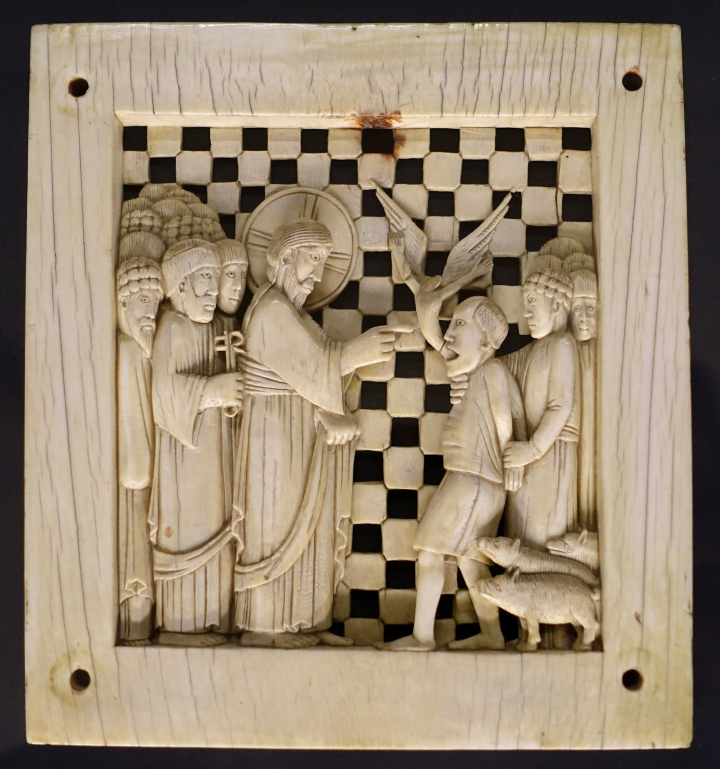
Christ healing the demoniac, ivory engraving, c.968 C.E.

When Jesus arrived at the other side in the region of the Gadarenes, two demon-possessed men coming from the tombs met him. They were so violent that no one could pass that way. “What do you want with us, Son of God?” they shouted. “Have you come here to torture us before the appointed time?”

Some distance from them a large herd of pigs was feeding. The demons begged Jesus, “If you drive us out, send us into the herd of pigs.”

He said to them, “Go!” So, they came out and went into the pigs, and the whole herd rushed down the steep bank into the lake and died in the water. Those tending the pigs ran off, went into the town, and reported all this, including what had happened to the demon-possessed men. Then the whole town went out to meet Jesus. And when they saw him, they pleaded with him to leave their region.

Jesus stepped into a boat, crossed over and came to his own town. (NIV)

At some point, everyone must deal with Jesus, simply because he is a force to be reckoned with. 

Eventually, we know that a storm will come. It may be sunny today, and the forecast might predict more sun or partly sunny for a while. Yet we know the weather will change. In the American Midwest state of Wisconsin where I live, we have not had as much snow this winter as we typically do. Oh, but all of us Wisconsinites know it is coming. It is not a question of “if” but “when.” It will not be here today or tomorrow, but it will come.

Jesus will come.  A person might not have to contend with him today, maybe not tomorrow. However, eventually, there will be a whopper of a storm and we will have to deal with it. In today’s Gospel lesson, two men described as being severely influenced by demons approached Jesus. Inside of them was such a terrible inner storm that they shouted at Jesus.

“Healing comes when our story is raw, bone-deep, and full of hunger for what only Jesus can offer.”

dan allender

Jesus, unfazed by the men’s inner violence and outer screams, uttered a command from a place of confidence. As fierce as the men were (the demons were so many that they were exorcised into a herd of pigs), Jesus had the authority to deal with the situation. As a result, the storm within the men subsided.

Yet, the storm was not over – it picked up momentum with the townsfolk. It seems they had been living their merry lives with no thought to Jesus. But he showed up. So, they had to contend with the authority right there in front of them. Unfortunately, they chose poorly. 

The Evangelist, Matthew, intends for us to see a connection in the story between the demons who begged Jesus, and the people of the town who begged Jesus. They did not humbly beg to follow him; they begged him to get away and leave them alone.

Jesus is an authoritative force to be reckoned with… and he is coming to your town.  Maybe not today, perhaps not tomorrow.  But things will not always be the way they are right now.  People will have to face Jesus.

Jesus Christ, Son of God, you are Lord over the wind, the waves, and the weather. You also command the unseen, and they obey. You are God with us. Oh, that all people would beg to follow you and not beg you to leave!  I am grateful for your power and authority over all things.  Amen.