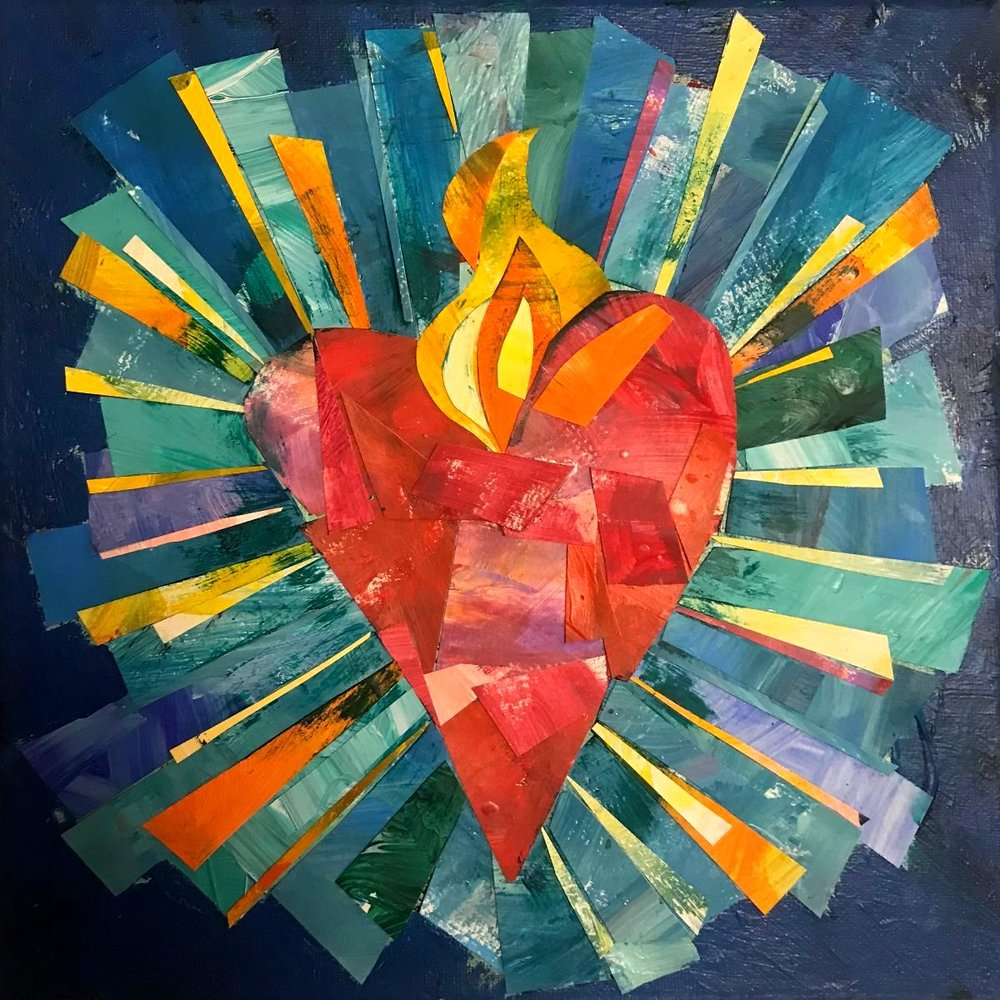
I Concede (Job 42:1-6, 10-17)

By Bible Art

Then Job answered the Lord:

“I know that you can do all things
    and that no purpose of yours can be thwarted.
‘Who is this that hides counsel without knowledge?’
Therefore I have uttered what I did not understand,
    things too wonderful for me that I did not know.
‘Hear, and I will speak;
    I will question you, and you declare to me.’
I had heard of you by the hearing of the ear,
    but now my eye sees you;
therefore I despise myself
    and repent in dust and ashes.”

…And the Lord restored the fortunes of Job when he had prayed for his friends, and the Lord gave Job twice as much as he had before. 

Then all his brothers and sisters came to him, and all who had known him before, and they ate bread with him in his house; they showed him sympathy and comforted him for all the evil that the Lord had brought upon him; and each of them gave him a piece of money and a gold ring. 

The Lord blessed the latter days of Job more than his beginning, and he had fourteen thousand sheep, six thousand camels, a thousand yoke of oxen, and a thousand donkeys. He also had seven sons and three daughters. He named the first Jemimah, the second Keziah, and the third Keren-happuch. In all the land there were no women so beautiful as Job’s daughters, and their father gave them an inheritance along with their brothers. 

After this Job lived one hundred and forty years and saw his children and his children’s children, four generations. And Job died, old and full of days. (New Revised Standard Version)
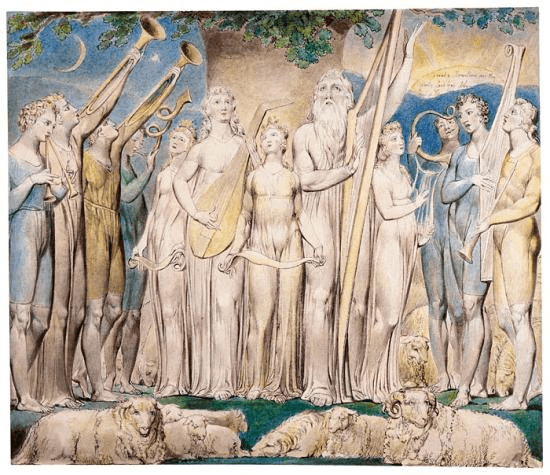
Job is restored, by William Blake (1757-1827)

Job was in awful suffering. He contended with God about it. Job’s friends contended with Job. In the end, God never gave a humanly suitable answer to the problem of suffering. Namely, because we cannot understand the answer, even if it is provided.

Indeed, the gap between God and humanity is quite pronounced. God is the Creator. We are creatures. Yet, God did vindicate Job.

That’s right God affirmed Job – and not Job’s companions. Even though Job did what many a believer in God today believes is wrong, perhaps even sacrilegious or sinful.

Job argued, confronted, grappled with, and even opposed God for the terrible troubles he faced in losing his family, his wealth, and his health. He fully engaged God.

Job’s friends, however, did no such thing. Instead, they argued, confronted, grappled with, and even opposed their friend Job. They fully avoided God.

In the end, Job conceded that he himself knows nothing. Yet, there is still the hint of complaint within him. This is good. Job did not stop engaging God. He remained faithful and devoted.

Let us never believe that faithfulness and devotion to God involves putting up a false front and nice polite piety. Prayer, in truth, is a hard wrestling with God, a struggling and working through all the difficulties of this unfair life.

God is not the least offended by our full, real, and raw engagement of him. But God is offended by avoiding such engagement altogether.

All of us, in reality, speak mostly in ignorance. We talk about things we don’t really understand. The only thing we can be 100% truthful about, however, is ourselves – about how we are really doing, feeling, experiencing, believing, struggling with, etc.

I myself am the true expert on me – and you, the expert on you. And this truth I can bring to God anytime, anywhere. The Book of Job affirms to me that this is the sort of devotion and sacrifice which the Lord is pleased with.

Job gained some knowledge and understanding through personally encountering God. The Lord God almighty, Creator of heaven and earth, actually spoke to Job in a direct revelation of the Divine presence.

This is an affirmation of Job’s integrity. But the godless, disintegrated, and fragmented person cannot see God or expect a personal audience with God.

Through all that Job had been through, he held to his integrity, and held onto God, both at the same time. In the end, he still did not understand why he had to go through such horrible suffering.

English translations of the Hebrew text don’t do it justice. There is always something lost in translation of any language to another. And it seems what is lost here is that Job was perhaps still protesting at the end. Yet, it comes across in English as Job despising and abhorring himself, as if he had done something very wrong.

“I despise myself,” misses the mark. Without getting into some deep grammatical Hebrew waters, I wonder if the phrase might better be rendered, “I protest.” What is meant to be conveyed is that Job still acknowledges what he originally held onto. Namely, that he has done nothing wrong, did not deserve what he went through, yet has never rejected God, nor lost faith in God.

Job did not need to repent of some secret sin, as his friends supposed. Job repenting does not mean because of sin; Job’s repentance was a change of position from mourner and complainer, to accepting the situation as it is, without answers.

So, this brings us back to the beginning of the book. God is God. There are celestial forces and operations in play we know nothing about. Humans are not God. Humans are never going to get most of what is happening in this world. And humans will inevitably experience hard and bad things – and not know why.

No answers given. No change of situation (yet). But Job changed. He changed his mind about how to live with what he was experiencing. He relinquished his complaint, and decided to keep living, even though he did not get answers.

Honestly, this response of Job is more consistent with my own experience of awful suffering, and more faithful to the text of Scripture. Much like Jacob wrestling with the angel, Job had to finally concede and relent, and continue on his life journey, come what may.

Following Job’s intercession for his friends, God restored Job to wealth and family. A significant piece of this restoration was Job’s wider community of friends and family who gathered around him, giving Job the consolation and comfort that the three “friends” in the book did not provide.

The community cared for Job, not through nice theological phrases, but with genuine fellowship. They shared together around the table, the community giving both a meal and contributing monetary gifts for Job’s needs.

The Book of Job ends, perhaps with as many, or more, questions than when it started. Answers, however, are not the point.

Rather, Job’s incredible and awful experience of suffering and redemption becomes an invitation for you and me to have a more expansive view of what a relationship with the living God truly looks like.

May God bless you with discomfort
At easy answers, half-truths, and superficial relationships,
So that you may live deep within your heart.

May God bless you with anger
At injustice, oppression and exploitation of people,
So that you may work for justice, freedom and peace.

May God bless you with tears
To shed for those who suffer pain, rejection, hunger, and war,
So that you may reach out your hand to comfort them
And turn their pain into joy.

And may God bless you with enough foolishness
To believe that you can make a difference in the world,
So that you can do what others claim cannot be done
To bring justice and kindness to all our children and the poor. Amen.

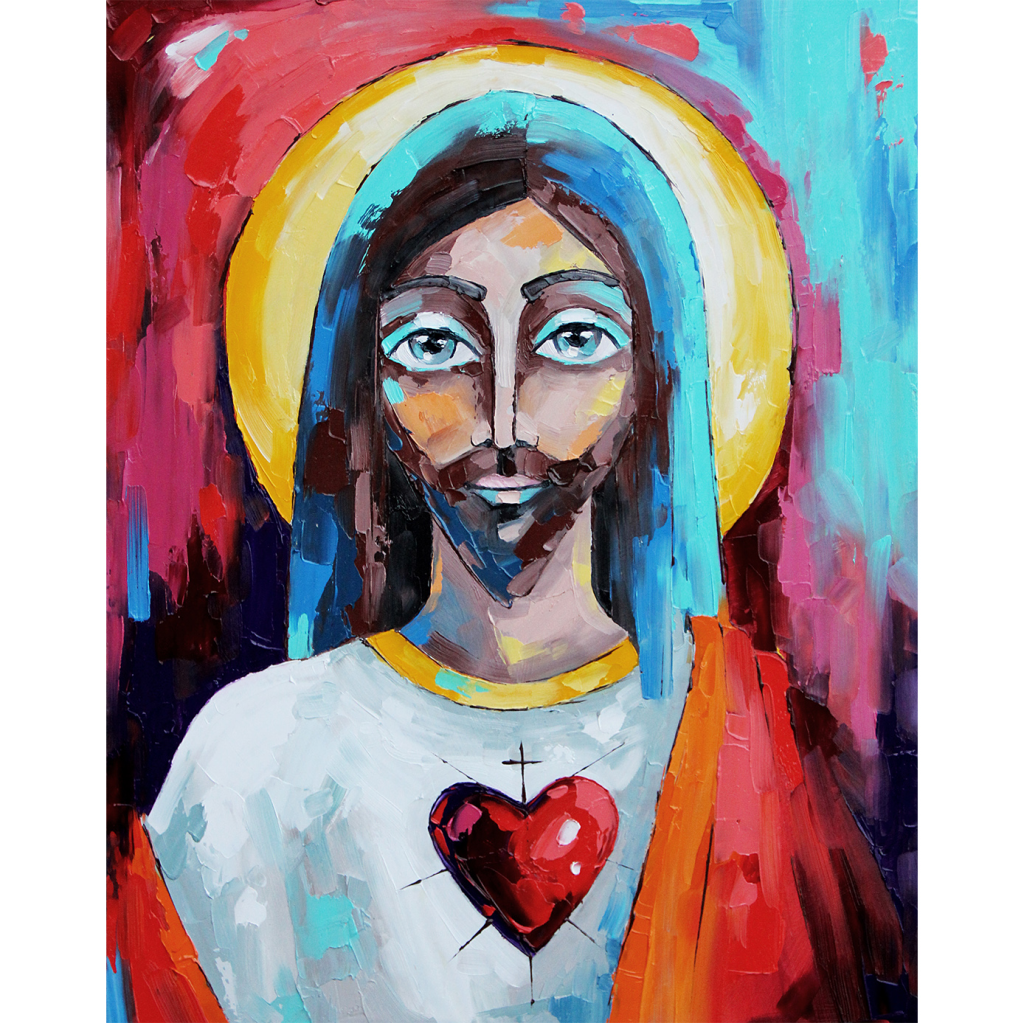
From the Heart (Mark 7:9-23)

Art by Anna Startseva

Then he said, “You skillfully sidestep God’s law in order to hold on to your own tradition. For instance, Moses gave you this law from God: ‘Honor your father and mother,’ and ‘Anyone who speaks disrespectfully of father or mother must be put to death.’ But you say it is all right for people to say to their parents, ‘Sorry, I can’t help you. For I have vowed to give to God what I would have given to you.’ In this way, you let them disregard their needy parents. And so you cancel the word of God in order to hand down your own tradition. And this is only one example among many others.”

Then Jesus called to the crowd to come and hear. “All of you listen,” he said, “and try to understand. It’s not what goes into your body that defiles you; you are defiled by what comes from your heart.”

Then Jesus went into a house to get away from the crowd, and his disciples asked him what he meant by the parable he had just used. “Don’t you understand either?” he asked. “Can’t you see that the food you put into your body cannot defile you? Food doesn’t go into your heart, but only passes through the stomach and then goes into the sewer.” (By saying this, he declared that every kind of food is acceptable in God’s eyes.)

And then he added, “It is what comes from inside that defiles you. For from within, out of a person’s heart, come evil thoughts, sexual immorality, theft, murder, adultery, greed, wickedness, deceit, lustful desires, envy, slander, pride, and foolishness. All these vile things come from within; they are what defile you.” (New Living Translation)

There is nothing inherently wrong with tradition. Ideally, traditions are helpful ways of remembering and maintaining the values that are important to us.

Yet, what can happen over time is that the tradition itself can become equal to the value we hold to; and eventually, the tradition can become more important than the value it is supposed to remind us of.

In the worst case scenario, the tradition is kept, and the value is forgotten and lost. Whenever that happens, traditions easily become weaponized to protect our interests while harming others. And that is a phenomenon Jesus wanted nothing to do with.

So, Christ affirmed and upheld the essential purpose of the Torah (scriptural law) as the foundation of morality to live justly and righteously in the world. Keeping Torah, therefore, is a matter of inner motives, and intents of the heart, rather than external compliance to ritualized traditions.

Unfortunately, the outward form had supplanted the inward disposition of the heart. Purity then became a matter of observable rituals, and defilement a matter of failing to do the ritual properly. And the original values behind the rituals were lost – which caused souls to become lost, and other people victimized by religious traditions.

Whether one is ritually clean or unclean is not ultimately determined by material objects; it is, instead, determined by the state of the heart.

Art by Andy Perez

In other words, no outward ritual can ever really make a person clean or unclean, pure or impure, spotless or polluted. Inner transformation is what scrubs a person clean and makes them pure.

Ritual traditions, and even scriptural law itself, is unable to effect a transformative change.

Torah can require purity, cleanness, and moral uprightness; but it cannot affect a metamorphosis. We need something other than traditions, rituals, and laws to bring true and sustainable transformation of life.

I say that it is time to hear and observe Jesus. Millions of people throughout history, and up to the present time, have found in Christ (and not in Christian rituals, traditions, church codes, nor in a political Christendom) the answer and the key to what life is really all about.

Again, there is not a problem with our human traditions per se, but with traditions replacing Torah and the word of God.

Jesus gave an example of just such a contradiction between religious tradition and divine law: According to tradition, if a person makes a vow concerning their property and/or possessions as a gift to God at the temple, then those assets cannot be used to support that person’s parents in their old age.

Christ pointed out that this clearly contradicts the command to honor your father and mother. Ironically, the very tradition that was supposed to purify became the means to contamination – because the tradition forbids the person from obeying the command of God.

In a word picture that everyone could understand, Jesus explained that impurity and defilement have to do with what passes through the heart, not the bowels.

People obey or disobey the Ten Commandments due to the state of their heart, and not whether they keep every detail of traditional washing of the hands and body.

People lack virtue not because they fail to do human traditions; but because of what is in their hearts.

This is why Jesus, in his Sermon on the Mount, gets to the heart of why people break commands. For example:

  • The outward act of murder is a result of the inward anger of nurturing bitterness in the heart. (Matthew 5:21-22)
  • The physical act of adultery is the culmination of dozens of mental adulteries which originated in the heart. (Matthew 5:27-28)

Everything that harms and hurts is sourced in the heart, and not in failing to keep a tradition.

Furthermore, the Gospel writer Mark, added the very interesting parenthetical comment that in speaking this way, Jesus meant to declare that all foods are clean; there is nothing eaten that can make us impure.

That may not seem remarkable to most people, but to Jews this statement is cataclysmic and revolutionary. Levitical law details the separating of clean and unclean food, for the purpose of distinguishing the Israelites from all the other surrounding nations. (Leviticus 11:43-44; 20:24-26)

Holding to food laws, and traditional hand washings when it comes to eating, are a way of preserving religious identity and national identity. Jesus had no intention of doing away with Jewish identity, but he very much intended to do away with maintaining practices that keep strict separation from other people.

In other words, Christ was opening the way for ministry to Gentiles. He wanted to bring connection where there was deep division. He wanted the world to know God.

This gets at the “heart” of true religion. Distinctiveness as God’s people does not necessarily nor ultimately come by observing particular traditions; it comes primarily through purity of heart.

And the means of bringing purity of any kind, comes through love. Love always makes a way and finds connections. Love is the sine qua non mark of God.

Traditions infused with love, point people to God, and let them know that they belong.

But traditions for tradition’s sake, repel people, and communicate to them that they don’t belong, and should go away and not pollute the pure ones.

This approach of Jesus toward the religious leaders raises for me several probing questions:

  1. What is the true state of your heart?
  2. Are you aware of your own heart’s dark shadows?
  3. In what sort of direction is your heart inclined to speak and act?
  4. Does encouragement or criticism typically arise from your heart?
  5. Is love the compass of your heart, or does bitterness give you direction?
  6. Will you acknowledge your need of a savior? Will you ask for help?

Blessed God and Father of our Lord Jesus Christ: Make us quick to listen, and slow to speak, so that the Word implanted in our hearts may take root to nourish all of our living. And may the the Word within us overflow into speech and action which blesses the world. Amen.

Raised Into a Spiritual Body (1 Corinthians 15:35-49)

But someone will ask, “How are the dead raised? With what kind of body will they come?” How foolish! What you sow does not come to life unless it dies. When you sow, you do not plant the body that will be, but just a seed, perhaps of wheat or of something else. But God gives it a body as he has determined, and to each kind of seed he gives its own body. 

Not all flesh is the same: People have one kind of flesh, animals have another, birds another and fish another. There are also heavenly bodies and there are earthly bodies; but the splendor of the heavenly bodies is one kind, and the splendor of the earthly bodies is another. The sun has one kind of splendor, the moon another and the stars another; and star differs from star in splendor.

So will it be with the resurrection of the dead. The body that is sown is perishable, it is raised imperishable; it is sown in dishonor, it is raised in glory; it is sown in weakness, it is raised in power; it is sown a natural body, it is raised a spiritual body.

If there is a natural body, there is also a spiritual body. So it is written: “The first man Adam became a living being”; the last Adam, a life-giving spirit. The spiritual did not come first, but the natural, and after that the spiritual. The first man was of the dust of the earth; the second man is of heaven. As was the earthly man, so are those who are of the earth; and as is the heavenly man, so also are those who are of heaven. And just as we have borne the image of the earthly man, so shall we bear the image of the heavenly man. (New International Version)

We have so far experienced, in this Christian Year:

  • Advent and the anticipation of Christ’s birth; a celebration of that birth in the Christmas season
  • Epiphany with it’s light shining on the salvation we enjoy for all kinds of people
  • Lent, as we moved slowly and silently toward the cross and practiced spiritual disciplines
  • Holy Week, by walking with Jesus in Jerusalem, to the Garden of Gethsemane, up the hill to where he was crucified

But that is not the end of the story. Christ is risen! On Easter Sunday we celebrated Christ’s resurrection from death. Now, we are in the season of Eastertide, an extended time of celebration in which we revel in new life. Life is possible and real because the resurrection of Jesus from death is real.

The resurrection is crucial and central to the entire Christian life. That’s why the Apostle Paul concluded his letter to the Corinthians with a long defense of its truth.

Today’s lesson zeros in on a particular point in Paul’s argument for the importance and place of resurrection in Christianity. He insisted that the resurrection – the spiritual body – is unique; it’s not like any other sort of body. And this is the body that believers will have in the future. Just as Christ was resurrected, we too, shall experience a resurrection.

We shall be transformed from being like Adam, the original person with a physical body, to being like the risen Christ, the first with a spiritual body.

Sometimes the Apostle Paul’s arguments can seem thick and hard to get through. So, allow me to put his line of thinking in a context which I deal with every day. In my work as a hospital chaplain, I visit patients on the cardiac units. The following is the sort of conversation I sometimes have:

Patient: “Ever since I had my heart operation, I don’t feel close to God. I’ve always had a good relationship with the Lord. But I don’t sense it. It’s as if God is distant. Did I do something wrong? Maybe God is punishing me.”

Chaplain: “Sounds like you really love God.”

Patient: “Yeah, I do. I don’t get it, why I’m like this now.”

Chaplain: “Think about this with me for a minute. Your body was just traumatized. Somebody opened up your chest and messed with your literal physical heart. And that doesn’t only affect your body. It messed with your spiritual heart, too. The two hearts are different, in some ways. But there’s a close relationship between the physical heart and the spiritual heart. Trauma is trauma. It impacts your whole person, not just part of you.”

Patient: “So, am I always going to feel this way?”

Chaplain: “It’s going to take a long time to physically heal from what your body has been through. It won’t take near as long for your spiritual heart to heal – but it will heal. You’ll be close to God again. But it probably isn’t going to happen today. What’s more, it’s possible that when you heal, you’ll actually feel even closer to God than before; after having been through this, it will be like you have a new lease on life.”

Paul’s understanding of the resurrection is not far off from these sort of interactions I have with hospital patients. We live the Christian life in the tent of this body, not knowing anything different. But we will eventually die. And when that happens, we never go back to the way things were when we were living on this earth.

We don’t just get resuscitated; we eventually get resurrected. We don’t become disembodied people after death, and at the end of the age when Christ returns. No, instead, we get a body – it’s our body, but it’s different, it’s changed, because it is a spiritual body. And it’s likely to be like nothing you’ve ever experienced before.

Life on this old fallen planet of ours is sometimes characterized by adversity, trouble, hardship, and even sometimes traumatic situations. But it will not always be this way. The resurrection of Jesus Christ from death changes everything.

Death will give way to life. There will be a spiritual body. We shall be healed in the complete sense of the word – physically, mentally, emotionally, and spiritually – without any more death, disease, and destruction. Suffering will lead to glory.

This is a Christian perspective on resurrection. Since Christ is risen from death, and now has a spiritual body, so too, will his followers be raised to life with just such a body – so that we can be with the Lord forever, as it was intended when God originally created people in God’s image.

Resurrection means hope. We have the confident expectation that promises of an eternal spiritual body is coming. Just as a tiny seed is transformed into a plant, so we will be changed. For those who have had to struggle with the constant debilitations of the body, this is truly good news. And it’s no April Fools.

Lord Jesus, You suffered death but conquered it. You laid in the tomb, but on the third day, You rose again. You are the resurrection, our hope and our life. O glorious and victorious Redeemer, help us not to be afraid of death, for we must pass through it to see you face to face. And on the last day we will rise again because You said so. Amen.

Resurrection of the Lord (John 20:1-18)

Mosaic of Mary Magdalene in the garden with Jesus, Resurrection Chapel, Washington National Cathedral, Washington D.C.

Early on the first day of the week, while it was still dark, Mary Magdalene came to the tomb and saw that the stone had been removed from the tomb. So she ran and went to Simon Peter and the other disciple, the one whom Jesus loved, and said to them, “They have taken the Lord out of the tomb, and we do not know where they have laid him.” 

Then Peter and the other disciple set out and went toward the tomb. The two were running together, but the other disciple outran Peter and reached the tomb first. He bent down to look in and saw the linen wrappings lying there, but he did not go in. 

Then Simon Peter came, following him, and went into the tomb. He saw the linen wrappings lying there, and the cloth that had been on Jesus’s head, not lying with the linen wrappings but rolled up in a place by itself. 

Then the other disciple, who reached the tomb first, also went in, and he saw and believed, for as yet they did not understand the scripture, that he must rise from the dead. Then the disciples returned to their homes.

But Mary stood weeping outside the tomb. As she wept, she bent over to look into the tomb, and she saw two angels in white sitting where the body of Jesus had been lying, one at the head and the other at the feet. They said to her, “Woman, why are you weeping?” She said to them, “They have taken away my Lord, and I do not know where they have laid him.” 

When she had said this, she turned around and saw Jesus standing there, but she did not know that it was Jesus. Jesus said to her, “Woman, why are you weeping? Whom are you looking for?” Supposing him to be the gardener, she said to him, “Sir, if you have carried him away, tell me where you have laid him, and I will take him away.” 

Jesus said to her, “Mary!” She turned and said to him in Hebrew, “Rabboni!” (which means Teacher). Jesus said to her, “Do not touch me, because I have not yet ascended to the Father. But go to my brothers and say to them, ‘I am ascending to my Father and your Father, to my God and your God.’” 

Mary Magdalene went and announced to the disciples, “I have seen the Lord,” and she told them that he had said these things to her. (New Revised Standard Version)

Do Not Hold On To Me, by He Qi

Although Peter and John have a role in this story about Christ’s resurrection, the main character is Mary Magdalene. This is significant and symbolic for several reasons:

  1. It was Mary who experienced one of the most profound and deep changes of life due to the ministry of Jesus. Mary had been an immoral woman and spiritually enslaved to the machinations of seven demons. Jesus thoroughly delivered her from her personal hell.
  2. Mary was forever thankful to Jesus for changing her life, and so, she followed Christ and supported him in any way she could. 
  3. Mary was at the foot of the cross when Jesus died. While other disciples were keeping their distance out of fear, Mary was bold in standing with the other women for all to see that they were completely devoted to Jesus. Mary never turned her back on Jesus. 
  4. It was Mary who was there on the Sunday morning of Christ’s resurrection. Whereas the other followers were nowhere to be found, Mary came to the grave, still with a heart given to Jesus and grieving over his death. 

Because Mary had been given a new chance at life, she was deeply thankful and everything she had belonged to Jesus. Mary Magdalene was forgiven much, and, so she loved much. Here she is, after her Lord’s crucifixion, death, and burial, at the grave of Jesus. 

Mary came to the tomb on Easter Sunday still living in a Good Friday world – grieving, sad, and discouraged.  She soon discovered, however, that Christ is risen!

In the midst of your days of disappointment, loss, or sadness, how have you been surprised by joy and the presence of the risen Christ?  How has your grief been turned to gratitude?  Have you seen the risen Lord?  

Let Mary Magdalene’s experience be of encouragement to you. Mary was given new life and was transformed by the Lord. Yet, on Easter Sunday she did not immediately get what the heck was going on. Jesus rising from death was not anywhere on her radar. 

The empty tomb and the angels did not immediately lead her to faith – not until she saw Jesus, and even then, she did not recognize him. Only when Jesus called her name did Mary recognize him and respond, believing it was her Lord. 

And Jesus is still calling out names. He is calling your name. Jesus had said to his disciples that the sheep listen to the shepherd’s voice; he calls his own sheep by name and leads them out (John 10:3-4). One little word can change our lives forever: our name.

Easter opens a whole new world for us, as it did for Mary – a future of announcing good news and proclaiming resurrection.

There is a simple reason why the grave clothes were left in the tomb just lying there – they were not needed anymore! We no longer need the grave clothes of discouragement, defeat, and despair. We no longer need to weep and wonder because Christ is risen! Jesus Christ has called us by name, and we hear his voice.

The twentieth century theologian, Karl Barth, said that what brings people to worship God – not just on Easter, but any day – is an unspoken question clinging to our minds and hearts: Is it true? Is it true that God lives? Is it true that Jesus is alive? Could it be true that I can live a new life in Christ? Is it true that I can rebuild my life?  Is it all true? 

Mary Magdalene approached the tomb and found that it was true: Christ Jesus is risen from death!

Today, all over the world, followers of Jesus are testifying that this day and it’s deep implications for life is real: Christ is risen, and there is new life in Jesus. Believers across the globe are worshiping the risen Lord because they declare along with us, “I have seen the Lord!”

God has always been in the business of changing lives. British author A. N. Wilson, used to be known for his scathing attacks on Christianity and proclaimed the death of God. Yet he celebrated Easter in 2009 at a church with a group of other church members, proclaiming that the story of Jesus is the only one that makes sense out of life and its challenges. Wilson said:

“My own return to faith has surprised none more than myself…. My belief has come about in large measure because of the lives and examples of people I have known—not the famous, not saints, but friends and relations who have lived, and faced death, in light of the resurrection story, and in the quiet acceptance that they have a future after they die.”

The moment Jesus calls a person’s name, the power of the resurrection is enabled—the same power that raised Jesus from the dead. 

Come now, see what you consider as immovable slabs of stone in your life—bitterness, insecurity, fear, self-doubt or cynicism. Those immense rocks can be rolled away. To know Jesus is to know the power of the resurrection. 

We don’t need to merely hear testimonies of changed lives like Mary Magdalene’s; we can experience new life ourselves.

There is one word, one name, which has forever changed the world: “Jesus.”  And Jesus wants to change the world by uttering one simple word, one name, your name, so that you can exclaim with great joy, “I have seen the Lord!”

Loving Lord Jesus, you are our freedom. When I was lost in a dark hole of guilt and shame, you liberated me. You lifted me from sin, death, and hell.

Almighty God, hear today our prayers for the salvation of the world. Grant mercy to everyone who has turned away from you. Open their hearts and minds with your gracious light. Gather your children from the east and the west, from the north and the south. 

O God, bring people everywhere out of the darkness of disease and death, and into your marvelous light. Hear our prayers and answer us. May the benevolent way of Jesus be the hope of the world; among all nations may your salvation come.

Gracious Lord, our neighbors, relatives, friends, and co-workers, along with the sick, the poor, the prisoner, the widow, and all creation are in your hands. Therefore, fill us all with your love and your mighty resurrection power! And, grant us peace through Jesus Christ, our risen Lord. Amen.