Perspective Changes Everything

perspective is everything

Today is one of my bad back days.  It’s days like today that remind me: perspective is everything.  You see, thirteen years-ago this coming May me and my family were in a car accident.  I was traveling on a highway in Iowa where we were living at the time, and a small car on a gravel road blew right through the stop sign without even slowing down.  There was nothing I could do.  I plowed into the rear quarter panel of the oncoming car, and it literally spun like a top off the highway and came to a stop.  Both the driver and his girlfriend passenger were not injured.

Two of my daughters were in the very back seat of our mini-van (which I had just bought only a month before), with my wife and dog as front seat passengers.  The car was totaled.  My girls were not harmed.  But my wife tore her shoulder’s rotator cuff protecting the dog and had to have an agonizing surgery to repair it.  My lower back was injured, but not in a way which surgery could repair.  To this day I live with chronic pain.  Some days it’s not bad, maybe a one or two on the pain scale.  But on my bad days I can barely walk across the room, and I need cane to get around.  Today is one of those days.

20180226_154906_resized

I have played the scene of the accident in my mind hundreds of times.  I have thought time and again about what I could have done to prevent the accident.  But there was no way to avoid it.  I thought about the fact that if we just would have left a minute earlier or a minute later from my parents’ house from where we were visiting, all would be fine.  Yet, I know that kind of thinking is a fool’s errand.  I have pondered every possible scenario in my head and have gotten nowhere.

It also took me awhile to forgive the young man who was driving the other car.  He changed my life, and not in a good way.  Although his insurance took care of everything and he was very repentant about the whole thing, I was understandably mad for a long time.  I did, over time, come to the point of forgiving him.

Through the years I have learned to live with my limitations.  I have now accepted the pain as part of my life.  But, on occasion, I sometimes I can’t help but think of how my life would be today if I hadn’t been in that stupid accident.

About three years ago I was praying alone in the church for which I was a pastor.  And God brought the accident to my mind.  I said to God, “Lord, we’ve been through this accident hundreds of times together.  I don’t want to think about it anymore.  Why are you bringing this up now?”

I’m not sure I really wanted an answer, but God brought it up because he knew I was finally ready to get his perspective on the accident.  Out of the hundreds of times I went over that accident in my mind, the one perspective I never took was that of the young man – the other driver.  God invited me to take a different view, from the other driver.  So, I did.  I know that intersection like the back of my hand, so it wasn’t a hard exercise.

I put myself in the driver’s seat of his car.  I’m driving down the gravel road not paying attention to the fact that a stop sign is coming up.  I blow through the sign onto the highway and right in front of a minivan who slams on the brakes just enough to crush the rear quarter panel.  I spin out like a top and come to rest only a few feet from a huge Iowa grain elevator.

For the first time in my life I finally understood.  God had a divine appointment for me that day.  You see, if I had not come along just when I did, that young man and his girlfriend would have blown through the stop sign and struck that grain elevator.  It would have killed them both instantly.

perspective changes everything

Suddenly, my perspective changed 180 degrees.  Previously, I had always thought about myself and my family.  I always considered my hardship and my change of life.  But now I saw that God sent his servant to save two lives that day.  Had I not struck his car, causing him to spin and come to a rest unharmed, two people would have died.

Now, every time my back acts up, like today, and it effects how my life is lived, I’m reminded that it is a very small price to pay for the lives of two human beings.  Perspective is everything.

The biblical meaning of “repentance” is literally to have a change of mind – to see a different perspective.

The Bible invites us to view our lives with new lenses.  Our hurts and our pains, our sorrows and our sufferings, our changes and our limitations, are all part of something much bigger that God is doing in the world.  We are not always privy to his plans and purposes.  But his Word challenges us to take a perspective of the world, of humanity, and of ourselves that is counter to how we often think only about ourselves.

The thread of God’s moral perspective, his view of human ethics, runs through the entirety of the Bible.  The psalmist reminds us that this Word is good, sweet, and more precious than gold (Psalm 19).  The Apostle Paul reminds us that this Word is our wisdom to live by (1 Corinthians 1:18-25).  And Jesus, as the Word made flesh among us, lived that loving and gracious Word with perfect moral and ethical goodness.  The temple, as the place where God’s Word was read and observed, was not to be adulterated with the view of making a profit – which was why Jesus drove out the money-changers (John 2:13-22).  Later, after Jesus died and rose from death, his disciples gained a new perspective.  They remembered their master’s words and affirmed them as being the Word of God.  They believed.  Their repentance and faith changed the world.

20180226_155620

God is inviting us to take up his Word and see our lives, the lives of others, and every event and situation through that lens.  We are to see Jesus, not only as a great teacher, a moral and good person, and a loving healer – but also as Lord and Savior.  In a very small way I suffered so that someone else could live.  But Jesus suffered sin, death, and hell in our place so that you and I could live – so that we might have the eternal life of enjoyment with God forever.

Allow the Word of God to shape your lives and form your thinking today and every day.  You might not always know what God is doing, but you can be assured that everything he does is just, right, and good.

May you know Christ better in this season as you reflect upon our Lord’s great sacrifice on our behalf.  May you know the love of God the Father, the grace of the Lord Jesus, and the encouragement of the Holy Spirit.  Amen.

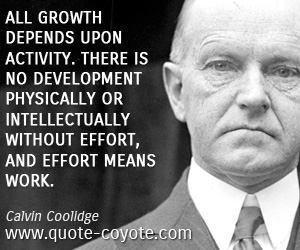
Nothing Happens If You Don’t Do Something

Calvin-Coolidge-work-quotes

Politicians know it.  You’ve got to work the base and reach out to get elected and make a difference crafting policy.  Farmers know it maybe better than anybody.  Either work the soil, or people will go hungry.  Heck, even Scooby-Doo knows it.  The gang must work to find the clues so that they can solve the mystery and hear the bad guy lament his capture: “I’d have gotten away with it, too, if it hadn’t been for you kids and that meddling mutt!”

We instinctively know that it takes work to get anything done.  That isn’t so much the issue.  The problem is getting going by transcending our fears, facing-down our inner demons, and having some faith that what I’m doing is going to bear some lasting fruit.

Sometimes we don’t act because we subscribe to the Beaver Cleaver philosophy of life (I’m really dating myself with these TV references): “Gee, Wally, I just thought the bully would go away if I did nothing.”  Leaning into life and dealing with it sometimes seems too overwhelming, so we avoid activity.

I’m talking to myself here as much or more than you:  Nothing happens if I don’t do something.

Ah, the perfectionist in me chimes in now: “But it needs to be done right.”  Yes, it does.  But that doesn’t mean to obsess over it by researching the proposed action to death before you get around to do anything at all.  Isaac Newton was an English scientist, mathematician, astronomer, physicist, and something of a dedicated theologian.  The guy was the poster boy for research.  But even Newton knew the absolute importance of activity.  His first law of motion is this:

An object at rest will tend to stay at rest, unless acted upon by an external force.

Newton’s axiom is also referred to as the law of inertia because it takes force or inertia to get something moving that isn’t moving.

Unless you and I do something different than what we are already doing, nothing is going to be different.  That is a law as strong as gravity (which brings Newton into the equation yet again).  If I want to experience a certain reality, then I need to do some activity to make things different.

If you don’t like the results of what you’re getting, you’ll need to do an activity that you haven’t done before.  If sending out mailings isn’t getting the politician elected, then she’d better do something different.  If the farmer isn’t getting any kernels on his ears of corn, he’d better rethink what he did and do something different.  If Scooby-Doo isn’t finding any clues, the gang better get in the Mystery Machine so he can sniff somewhere else.  Something has got to change!

Scooby Doo

If you don’t like the state of your soul; if you don’t like how your relationships are going (including with God); or, if you don’t like where you are in life, you’re going to need to do something different than what you’re currently doing.

People who enjoy good healthy relationships with God and others, good healthy careers, a good healthy body, mind, and spirit, work their ever-living tails off doing the things that make for those good realities.

It’s cliché, but if the get-rich-quick scheme seems too good to be true because it involves no change of activity, it probably is.  If the diet plan includes no exercise and no life-style changes, it’s a scam.  And, to think that you can have a wonderful relationship with God without the effort of carving-out time and connecting with the Holy Trinity each day with tried and true spiritual disciplines is total bunk.

If you looked down at the bottom of this post to get to the bottom line (so you didn’t have to do the activity of reading the entire thing), I’ll give it to you straight:

If there is something you don’t like about your life, it is your responsibility to get active and put the work and effort into changing your attitude, your narrative, and your activity. 

Nobody can do your work for you.  It’s up to you.

Like I said, I’m giving myself a pep talk as much, probably more, than I’m talking to you.  I need the constant reminder that I’ve got to put the work in every day to do what is most important to me:  Cultivating my relationship with Jesus Christ; spending time with my wife talking and working with her; doing the jobs I need to do to make money; pastoring, mentoring, and blessing others by teaching them the words and ways of Christ.

So, consider these words from the Lord Jesus and put them into practice today so that they frame your life:

“Ask, and you will receive.  Search, and you will find.  Knock, and the door will be opened to you.  For everyone who asks, receives.  Whoever seeks, finds.  And to everyone who knocks, the door is opened” (Matthew 7:7-8).

Who Ought to Change?


            Murray Bowen was one of the most influential psychiatrists of the 20thcentury.  His family systems theory, also known as Bowen theory, has largely replaced a great deal of Freudian psychology in the West.  The basic concept of Bowen’s therapeutic approach is that the family (as well as any group of persons) is an emotional unit.  As a unit, a change in any one of the members results in the others members compensating for the emotional functioning that has been altered.  Like touching one part of the spider web, the entire thing shakes.  The contribution, importance, and focus of Bowen’s theory was that rather than trying to change the other person, one can change him/herself without becoming part of the problem.  The theory states that if any family member can change his or her emotional functioning within the system, the whole family will improve its corporate functioning in response to that change.  In other words, we must learn to function in a healthy way within the family system.  Personal transformation becomes the best approach to handling family crises and problems.
 
            Bowen was not thinking of churches when working with his clients, but applying family systems theory to the church is not a stretch.  It almost sounds like Dr. Bowen was fresh off a congregational meeting when he said:  “The human is a narcissistic creature who lives in the present and who is more interested in his own square inch of real estate, and more devoted to fighting for his rights than in the multigenerational meaning of life itself.  As the human throng becomes more violent and unruly, there will be those who survive it all….  I think the differentiation of self (remaining connected to others, yet separate from their problems) may well be one concept that lives into the future.”
 
            In a crisis or presenting problem in society or the church, just as in a family, mounting anxiety moves intensely around unhealthy ways of relating.  Polarized factions take the spotlight and think only of their emotionally based interpretations of the facts.  They fail to see the big picture or look at the welfare of the common good.  All they can see is their angle on the unpleasant situation or person.  Thinking becomes reductionist, and hearts harden.  Everyone ends up looking like a stooge.


            Whatever you think of Bowen’s theory, it is not hard to discern that anxiety plays a major role in many individuals, families, and even churches.  When worry and anxiety take over a person or group of people, things become emotionally charged.  Hence, the church is an emotional unit.  Typically, the response to anything we don’t like is to try and change the other person who is rocking the boat or upsetting the status quo web of relationships.  But maybe the Apostle Paul was onto all this emotional stuff well before the 20th century:  “Do not be anxious about anything, but in everything, by prayer an petition, with thanksgiving, present your requests to God.  And the peace of God, which transcends all understanding, will guard your hearts and your minds in Christ Jesus” (Philippians 4:6-7).
 
            Learning to manage our own anxiety and deal with the incessant worry within ourselves is imperative to coping with relational problems in the church.  It is the peace of God, and not the peace of others that makes the difference.  We are people that are all for change – that is, we want others to change so that we do not have to.  But the Christian is to conform to Jesus, and not the other way around.  Because the Lord is near to us, we have a consistent and continual presence to anchor ourselves, no matter whether the circumstances are to my liking, or not.  So, prayer becomes the means of casting anxiety away so that peace can take its place.  Sounds easy – it is anything but.
 
            It is human to want everything and everyone to change when there are problems, adversity, or challenge.  But the change most needed is quite personal, and it is only ourselves that we can change.  Therefore, our focus must be on finding ways to remain connected to God and others without resorting to passive-aggressive tactics, cutting-off relationships altogether, or bullying others into changing with our violent or manipulative words.
 
            When faced with unwanted change and/or difficult circumstances, rather than looking for an alteration from others, try asking yourself one of these questions: 
 
·         What is a small step that I can take to improve my situation?
·         If I were guaranteed not to make the situation worse, what would I be doing differently?
·         Is there a person in my life whose voice and input I haven’t heard in a long time?  What small question could I ask them to help me in my situation?
·         What is one good thing about this situation I find myself in?
·         What is one positive trait I possess that can serve me well in this situation?


Are there other questions you could ask that would be helpful?  A journey that seems like a thousand miles must begin with one step.  What will that step be?

Put Yourself Out There


“I can’t offer the Lord my God a sacrifice that I got for nothing.” (2 Samuel 24:24).
 
            This seems to be one of those “lost” verses of the Bible.  No one really wants to sacrifice.  Anybody who has been around church for any length of time knows that the church is all for change – that is, everyone else should change to conform to the way we are already doing things.  People are not looking to change themselves – to offer God a sacrifice that is costly.  In fact, we want pastors and church leaders who will offer change with a minimal sacrifice on our part.  We want assurances and certainties that there will be changes made that will not disturb us, but will affect others.  After all, it’s the world that’s going to hell, not us.  They are the ones who need to change, not us, right!?
 
            Um, wrong.  Jesus did not die on the cross so that we could avoid the cost of discipleship.  The Holy Spirit was not given to us in order to fulfill all our ideas of how church and life should operate.  No, we are called to a radical life of following Jesus in a sacrificial life.  Taking up our crosses and following Jesus daily does not mean that we are suffering through media bias, or have to put up with mediocre preaching and/or pastoral care.  It means that there are demands on our lives as Christians to live sacrificially, giving our very lives for the sake of Jesus. 
 
            Let’s face it.  Living the Christian life and committing ourselves to a life of following Christ is dangerous business.  Following God got Daniel in the lions’ den; Isaac on the altar; and, Paul at the end of a whole lot of stones being thrown.  But we have no record of Daniel, Abraham, or Paul whining about how hard it all was; or, how much they would have to give up to actually change and live for God.  In fact, we get just the opposite:  “Christ has shown me that what I once thought was valuable is worthless.  Nothing is as wonderful as knowing Christ Jesus my Lord.  I have given up everything and count it all as garbage” (Philippians 3:7-8).
 
            Let’s be honest with ourselves:  We don’t put ourselves out there and live for God with complete abandon because we are afraid, risk-averse, and just do not consider it worth committing to some church thing that may or may not pan-out for me.  What we need to hear, and what we want to hear, are often two very different things.  When parishioners simply look to pastors and leaders for easy answers and simple solutions to the complex challenges of our world, the church ends up with dysfunction.  If our concept of leadership is expecting a pastor, elder, or ministry leader to solve problems with no ramifications for ourselves, then it ought to be no surprise when churches do nothing but routine management instead of boldly reaching others with the gospel of Jesus Christ.
 
            I’m not delusional.  I get it that congregations rarely hire pastors to disturb their lives.  Members expect that pastors will use their authority to provide them with right answers, and not to confront them with the need for growth, change, and completely wrapping their entire lives around the person and work of Jesus.  But the work of ministry demands disturbing people – just doing so at a rate they can absorb.  Even then, after all has been done with discernment and love, it could still all implode like a house of cards.  After all, Jesus was perfect and he ended up being killed by people who could not absorb the life he was calling them to live.


            So, you and I have a decision to make.  Will we be the kind of leaders that shrink from the rigors of ministry, fearing what people will think of us?  Or, will we be leaders who embrace the good news of Jesus and seek to orient all of church ministry around Father, Son, and Spirit?  Put yourself out there.  For we all really play to an audience of One.