
Malachi 3:16-4:6 – Turning Hearts

Then those revering the Lord,
    each and every one, spoke among themselves.
        The Lord paid attention and listened to them.
Then a scroll of remembrance was written before the Lord
        about those revering the Lord,
            the ones meditating on his name.
On the day that I am preparing,
says the Lord of heavenly forces,
        they will be my special possession.
        I will spare them just as parents spare a child who serves them.
You will again distinguish between the righteous and the wicked,
        between those serving God and those not serving him.

Look, the day is coming,
        burning like an oven.
All the arrogant ones and all those doing evil will become straw.
    The coming day will burn them,
says the Lord of heavenly forces,
        leaving them neither root nor branch.
But the sun of righteousness will rise on those revering my name;
        healing will be in its wings
            so that you will go forth and jump about like calves in the stall.
You will crush the wicked;
        they will be like dust beneath the soles of your feet
            on the day that I am preparing,
says the Lord of heavenly forces.
Remember the Instruction from Moses, my servant,
        to whom I gave Instruction and rules for all Israel at Horeb.
Look, I am sending Elijah the prophet to you,
        before the great and terrifying day of the Lord arrives.
Turn the hearts of the parents to the children
    and the hearts of the children to their parents.
            Otherwise, I will come and strike the land with a curse. (CEB)

According to the U.S. Census Bureau, twenty-five million children in America — one out of every three — live in biological father-absent homes. The National Fatherhood Initiative reports that nine in ten American parents agree this is a “crisis.”  Consequently, there is a “father factor” in many social issues today. Children with involved fathers do better across every measure of child well-being than their peers in father-absent homes.

From a biblical perspective, the relationship between fathers and children is hugely important not only for the well-being of family and society, but for God’s people.  Fathers in ancient Israel were the primary instructors of God’s covenant to their children.  This responsibility was critical to ensuring success in Israel and obeying their God. 

The fact of the matter in the prophet Malachi’s day was this: The fathers blew it.  The last verse of the Old Testament ends on a note of coming judgment. However, that is not the end of the story because the prophet Elijah will come to turn the hearts of the fathers to their children and vice versa.

John the Baptist, Jesus said, was the Elijah to come:

From the days of John the Baptist until now, the kingdom of heaven has been subjected to violence, and violent people have been raiding it. For all the Prophets and the Law prophesied until John. And if you are willing to accept it, he is the Elijah who was to come. Whoever has ears, let them hear. (Matthew 11:12-15, NIV)

In the Christian tradition, Jesus is the fulfillment of God’s covenant promises to the people. Therefore, fathers who follow Jesus have a sacred responsibility to gently guide their kids to Christ. It is important for Christian dads to take up the mantle of teaching children the ways of God especially as expressed by Jesus.  

God is on a mission of restoration, and a good place to begin is with restoring relationships between fathers and children. In fact, it behooves all fathers to step back and slow down enough to consider what the nature of their family relationships are really like – taking action to instruct kids in both word and deed.
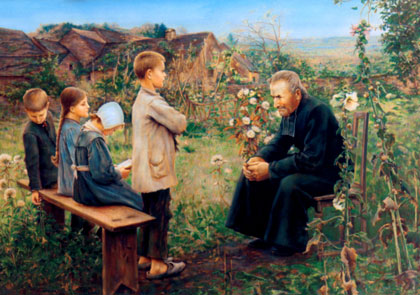
The word catechism derives from the Greek language and means “instruction.” Ever since the start of the Protestant Reformation, learning about God has often taken the form of catechetical teaching. Catechisms vary in length with a pedagogical question and answer format. Typically included are explanations on the Apostle’s Creed, the Ten Commandments, and the Lord’s Prayer.

Question and answer 104 of the Reformed Confession, the Heidelberg Catechism, says this:

Q. What is God’s will for you in the fifth commandment?

A. That I honor, love, and be loyal to my father and mother and all those in authority over me; that I submit myself with proper obedience to all their good teaching and discipline; and also that I be patient with their failings – for through them God chooses to rule us.

Here is a simple observation: Children cannot obey what they have not been taught. Underpinning all submission and obedience of both divine and human authority is the basic assumption that parents will instruct their children in the way of sound theology, biblical ethics, and religious piety.

What is more, we are all spiritual fathers and mothers to a host of children in our sphere of influence. This is a foundational way of relating to one another, and so, deliberate intention and effort needs to be placed here. Otherwise, there is religious decline with neither social nor familial cohesion.

So, let us love one another through careful training, effective teaching, and gracious tutoring so that righteousness will shine like a cloudless dawn and rise to warm the world with the love of God.

Gracious God, thank you for the gift of children.  Teach me your ways of grace so that I might pass them on to children in the merciful name of Jesus Christ through the power of the Holy Spirit.  Amen.

Learning and Teaching God’s Word

Christians often refer to the Bible as God’s Word.  By that reference we mean that God has graciously revealed himself to us through this Book, the Holy Scriptures.  The ancient Hebrews referred to the first five books of the Old Testament as the Law of the Lord or the Torah.  The Jewish people understood God as a great, high and holy Being who graciously accommodated or communicated to us on our level by giving the Law.  Just as a parent coos and babbles and speaks in a very different way to a baby in a crib, so God speaks to us in a manner that we can understand his care and concern and love for us.  Just as an infant can in no way understand an adult conversation taking place, so God is a being well above our comprehension and we have no ability to understand anything he says unless he graciously and lovingly bends down to speak to us on our level.
 
            God’s Law, his Torah, was the curriculum for Israel’s religious instruction.  The law of the Lord is meant to be a behavior pattern, to be embodied in the lives of God’s people through both teachers and parents who learn God’s Word and, in turn, pass it along to children and others outside the faith so as to provide our guide for how to live in God’s world.  God’s law is an extension of God’s grace, and we are to gratefully accept the grace of God expressed in God’s Word.  We are to ingest it, eat it, reflect on it, dwell with it in order to know God and be the people God wants us to be.
 
            There are several other Hebrew words that come from this root word of law, Torah, in the Hebrew language.  A teacher is a “moreh.”  A parent is a “horeh.”  Parents and teachers are to be living guides in the way of God’s Word.  The Hebrew word for teaching is “yarah.”  In other words, the moreh’s and the horeh’s are to yarah the Torah.  Parents and teachers are to point and lead others into the ways of the Lord.  The fifth book of the Law, Deuteronomy, makes it clear how parents, mentors, teachers, and influencers are to pass on God’s Word:
 
Hear, O Israel:  The Lord our God, the LORD is one.  Love the LORD your God with all your heart and with all your soul and with all your strength.  These commandments that I give you today are to be upon your hearts.  Impress them on your children.  Talk about them when you sit at home and when you walk along the road, when you lie down and when you get up.  Tie them as symbols on your hands and bind them on your foreheads.  Write them on the doorframes of your houses and on your gates (Deuteronomy 6:4-9, NIV).


            In other words, God’s Law or God’s Word is to be as familiar to us as our back door and it is to be in front of us all the time.  Let me put this Deuteronomy passage in a modern spin to help us understand a bit better what our privilege is when it comes to God’s Word:
 
Attention, Church!  God, our God! God the one and only!  Love God, your God, with your whole heart: love him with all that is in you; love him with all you’ve got!  Write these commandments that I’ve given you today on your hearts. Get them inside of you and then get them inside your children.  In order to do this, talk about God’s Word at home when you are eating supper together and when you are working or playing with each other.  Start your day with God’s Word when you get up, and end your day with God’s Word when you go to bed at night.  Put God’s Word on your refrigerator and your car’s dashboard; have it on your smartphones and let it be available to you anywhere and anytime.  Use every opportunity you have to incessantly chatter about God’s Holy Word.
 
            Someone may say, “That’s pretty radical – I don’t need to do all that!”  Then I would say you are missing out on living a blessed life because people are blessed when they walk according to God’s Word and keep God’s Law in front of them and seek God through his Word with all their heart. 
 
            Eleanor Turnbull, a veteran missionary to Haiti, collected and translated some simple but powerful prayers of the Christians who live in the Haitian mountains. Here are four prayers that they pray every day.  Take note of their high view of God, and their longing to know God’s Word:  “Our Great Physician, Your word is like alcohol.  When poured on an infected wound, it burns and stings, but only then can it kill germs.  If it doesn’t burn, it doesn’t do any good.”  “Father, we are all hungry baby birds this morning.  Our heart-mouths are gaping wide, waiting for you to fill us.”  “Father, a cold wind seems to have chilled us.  Wrap us in the blanket of your Word and warm us up.”  “Lord, we find your Word like cabbage.  As we pull down the leaves, we get closer to the heart.  And as we get closer to the heart, it is sweeter.”


            Let’s not be so busy, pre-occupied, or worried that we push God’s Word to the margins of our lives as only a Sunday activity.  Let’s take the time to carefully look at it and let God speak to us through it. Let’s be intentional about connecting with the God who has so graciously given us his guide for grateful living.  Let’s lay solid plans to catechize people into the basics of faith and holy living in the church.  May your efforts both honor God and build up Christ’s church.