Show Some Basic Human Kindness and Love (Ruth 3:8-18)

Art by Chanelle Nibbelink

At midnight the man was startled and turned over, and there, lying at his feet, was a woman! He said, “Who are you?” And she answered, “I am Ruth, your servant; spread your cloak over your servant, for you are next-of-kin.”

He said, “May you be blessed by the Lord, my daughter; this last instance of your loyalty is better than the first; you have not gone after young men, whether poor or rich. And now, my daughter, do not be afraid, I will do for you all that you ask, for all the assembly of my people know that you are a worthy woman. But now, though it is true that I am a near kinsman, there is another kinsman more closely related than I. Remain this night, and in the morning, if he will act as next-of-kin for you, good; let him do it. But if he is not willing to act as next-of-kin for you, then, as the Lord lives, I will act as next-of-kin for you. Lie down until the morning.”

So she lay at his feet until morning but got up before one person could recognize another, for he said, “It must not be known that the woman came to the threshing floor.” Then he said, “Bring the cloak you are wearing and hold it out.” So she held it, and he measured out six measures of barley and put it on her back; then he went into the town. 

She came to her mother-in-law, who said, “How did things go with you, my daughter?” Then she told her all that the man had done for her, saying, “He gave me these six measures of barley, for he said, ‘Do not go back to your mother-in-law empty-handed.’” She replied, “Wait, my daughter, until you learn how the matter turns out, for the man will not rest but will settle the matter today.” (New Revised Standard Version)

Boaz was an unmarried wealthy landowner. He was pious and conscientious. Ruth was a widow, a foreigner from Moab. Naomi was Ruth’s mother-in-law, and also a widow. Naomi and Ruth only had each other.

As one in poverty did in those times, Ruth walked behind the harvesters in the fields during the barley harvest, gleaning whatever was left behind. She was gleaning in the field of Boaz. He noticed.

Boaz was kind enough to make sure that Ruth was able to glean for two people. It turns out that Boaz was an in-law to Naomi, through her late husband Elimelech. Naomi sought to play matchmaker, so that Ruth would be well cared for. So, she instructed Ruth in what to do….

A woodcut of Ruth and Boaz on the threshing floor, by Unknown Artist

Harvest time in Judah was also a time of celebration and feasting. Late one night, on the barley wheat threshing floor, Boaz lay down to sleep after a day of bringing in the grain, and an evening of eating and drinking.

Doing exactly as her mother-in-law Naomi instructed, Ruth went to threshing floor, and then quietly laid down at the feet of Boaz. At midnight, Boaz was startled and woke up. There, at his feet, was a woman!

“Who are you? What do you want?” asked Boaz. And Ruth made herself known with the humble response, “I am Ruth, your maidservant.”

Ruth continued to follow Naomi’s guidance, and asked that Boaz spread his cloak over her, because he is the next of kin, the relative who could be responsible for engaging a levirate marriage with her (that is, a legal marriage involving in-law’s).

Although sleepy, and maybe even a bit tipsy, Boaz knew immediately that Ruth was asking him to marry her. Pious man that he was, Boaz would likely have realized the imagery of his situation, as likened to the prophet Ezekiel’s description concerning God’s love toward Jerusalem:

I spread the edge of my cloak over you and covered your nakedness: I pledged myself to you and entered into a covenant with you, says the Lord God, and you became mine. (Ezekiel 16:8, NRSV)

In following Naomi’s advice, Ruth put herself in a very vulnerable situation. Yet, Naomi’s observation of Boaz was spot on. Ruth’s faith in, and love for, her mother-in-law was well-placed.

The man Boaz responded favorably to the asking and overture of Ruth. He praised Ruth for her steadfast love and faithfulness; and her willingness to be with him, instead of a younger man.

Arising organically and sincerely from within Boaz was a prayer for God’s blessing upon Ruth. Not only would Boaz act to marry Ruth, but he also assured her that she belongs to God and God’s people.

The cloak of Boaz being spread over Ruth not only symbolized their upcoming levirate marriage, but it also communicated her marriage to God. Ruth was coming into God’s covenant as one of the people, as well as entering the marriage covenant.

I like that Boaz did not regard the actions and words of Ruth as something impertinent, immoral, or inappropriate. He fully recognized that she was operating consistent with the law of God in honoring a family obligation. And Boaz reciprocated by being honored to have been asked, and honored to comply with Ruth’s wishes.

It seems to me that this is love, as it is intended to be with us. We respect one another’s character, and seek to do whatever we can to meet this person’s need. When I love, I want to go out of my way to act on behalf of this person I admire and adore.

Boaz was not under a legal obligation to marry Ruth. He could have done nothing. But love compelled him – a love for Ruth which was grounded in an abiding love for God.

It wasn’t that Boaz should have, or could have, done something to help meet the needs of Ruth and Naomi. Boaz wanted to do something. He wanted to help Ruth. Boaz wanted to show kindness and steadfast love to Ruth. He wanted to fulfill her asking.

Naomi came up with a plan, because she trusted in the mercy, kindness, and generosity of Boaz. And also because she loved her daughter-in-law Ruth, and wanted her to be loved and cared for.

To show his goodwill and intention to fulfill Ruth’s request, he gave her a significant gift of barley. That is, he loaded her up with groceries to take home. This was a sign that Boaz would indeed make sure that the needs of Ruth and Naomi would be met this day, and into the future.

I am struck with how simple this story really is, at it’s core. It’s just three people, who each care. Caring is something that all of us can do, no matter who we are, where we are, or what situation we find ourselves in.

We really can show basic human kindness to another. We can be merciful, just, and generous. We can ask for what we want and need. We can help one another.

Perhaps, then, the real question for each of us is not whether we can speak and act with love, grace, and kindness; the real question is: Will I speak and act with love and mercy?

If we want to live in a world where there is justice, mercy, and love, then we must demonstrate those very things in our own lives, today and every day.

Live the way that you yourself want to be treated. And if you want mercy, generosity, and love from others, then ask for it.

God of steadfast love, help us each day in the midst of things we don’t understand, To those of us who are afraid, give courage To those who are exhausted, give strength To those in despair, give hope.

Comfort us in our struggles, O Loving God, and meet every need. Grant us safety, security and stability, and help us learn the lessons you are giving us, so that we may all work together to make this world a better place. Amen.

Live with Integrity (Psalm 26)

Vindicate me, O Lord,
    for I have walked in my integrity,
    and I have trusted in the Lord without wavering.
Prove me, O Lord, and try me;
    test my heart and mind.
For your steadfast love is before my eyes,
    and I walk in faithfulness to you.

I do not sit with the worthless,
    nor do I consort with hypocrites;
I hate the company of evildoers
    and will not sit with the wicked.

I wash my hands in innocence
    and go around your altar, O Lord,
singing aloud a song of thanksgiving
    and telling all your wondrous deeds.

O Lord, I love the house in which you dwell
    and the place where your glory abides.
Do not sweep me away with sinners
    nor my life with the bloodthirsty,
those in whose hands are evil devices
    and whose right hands are full of bribes.

But as for me, I walk in my integrity;
    redeem me and be gracious to me.
My foot stands on level ground;
    in the great congregation I will bless the Lord. (New Revised Standard Version)

Those with integrity long for, and pray for, justice and righteousness. They despise evil and desire the community of faith to be full of love.

Today’s psalm, as well as all of the psalms, are solid prayers which are meant to be prayed by any individual person, at any time, in any era. Those desiring the right, the just, and the good, will especially gravitate toward the psalter and prayer.

The faithful seek to live a morally upright life of integrity, peace, and wholeness. Yet, the psalm is also for those who find themselves unfaithful. They can pray and ask God to search their hearts and bring them to innocence. So, no matter who you are, this psalm is for anyone who wants to connect with the Lord

We have the ability to come before God because God encourages it, and makes it possible for us to approach. The Lord isn’t looking for perfection; God wants some honesty and vulnerability, and for us to realize how utterly dependent creatures we are.

The steadfast love of God is everywhere, and the psalmist recognized this. No matter the situation or circumstance, no matter the place or time, God’s love is present. The reason why we can wrap our faith and commitment around God is that God is consistently and constantly loving in everything.

And whenever we discern and know that this world spins on the axis of love, then we have no desire whatsoever to hang out with those who practice wickedness; we want nothing to do with worthless conversations and actions.

When one has been touched by divine love, not only is there a desire to avoid all evil, but there is also a longing to remain in that love, and to have love be the dominant operative force in all things on this earth.

Once we receive love, we want to give love. And having given love, we desire for the entire world to know this love, which is the true ballast and support of the world.

Without love, there is nothing. With love, all things are possible.

The one who loves does not consort with liars or hypocrites, because such persons indulge deception and selfishness, not openness and respect for others. The lover of God and of righteousness is not found in the company of evildoers.

The lovers amongst us are much too busy providing justice and goodness. The haters amongst us just sit around and curmudgeon on about everything that is messed up in this world, and make fun of all the do-gooders who are so enamored with love.

Which group of people would you rather be around? The lovers or the curmudgeons? Would you like to be in the group who acts like they have everything together? Or would you instead like to be in the group who knows how much they are dependent on the force of love, and of the originator of love, the one who is Love incarnate?

I, personally, would rather be in the community of the redeemed, who know they have been rescued by grace and could fall into wickedness if not for God’s sustaining grace. I have no desire to be in community with people who talk one way and live another.

I would like to be in the place characterized by integrity and love, the sort of place described by the Apostle Paul in his letter to the Romans:

Therefore, I urge you, brothers and sisters, in view of God’s mercy, to offer your bodies as a living sacrifice, holy and pleasing to God—this is your true and proper worship. Do not conform to the pattern of this world, but be transformed by the renewing of your mind. Then you will be able to test and approve what God’s will is—his good, pleasing and perfect will.

For by the grace given me I say to every one of you: Do not think of yourself more highly than you ought, but rather think of yourself with sober judgment, in accordance with the faith God has distributed to each of you….

Love must be sincere. Hate what is evil; cling to what is good. Be devoted to one another in love. Honor one another above yourselves. Never be lacking in zeal, but keep your spiritual fervor, serving the Lord. Be joyful in hope, patient in affliction, faithful in prayer. Share with the Lord’s people who are in need. Practice hospitality.

Bless those who persecute you; bless and do not curse. Rejoice with those who rejoice; mourn with those who mourn. Live in harmony with one another. Do not be proud, but be willing to associate with people of low position. Do not be conceited.

Do not repay anyone evil for evil. Be careful to do what is right in the eyes of everyone. If it is possible, as far as it depends on you, live at peace with everyone. (Romans 12:1-3, 9-18, NIV)

The only thing better than blessing the Lord, is blessing the Lord with an entire congregation of redeemed people who possess integrity, righteousness, and sincere love.

The psalmist, along with the Apostle Paul, lets us know that each of us is responsible for our moral and spiritual integrity. We bear the responsibility to give and receive love. Prayer then becomes much easier and desirable whenever we can pray with a longing for God and God’s righteousness. We really can follow God’s ways and serve the common good of all people with some solid integrity.

Our Father in heaven,
Hallowed be Your name.
Your kingdom come.
Your will be done
On earth as it is in heaven.
Give us this day our daily bread.
And forgive us our debts,
As we forgive our debtors.
And do not lead us into temptation,
But deliver us from the evil one.
For Yours is the kingdom and the power and the glory forever. Amen. (Matthew 6:9-13, NKJV)

Abundant Life (1 Kings 8:1-21)

Solomon dedicates the Temple at Jerusalem, by James Tissot (1836-1902)

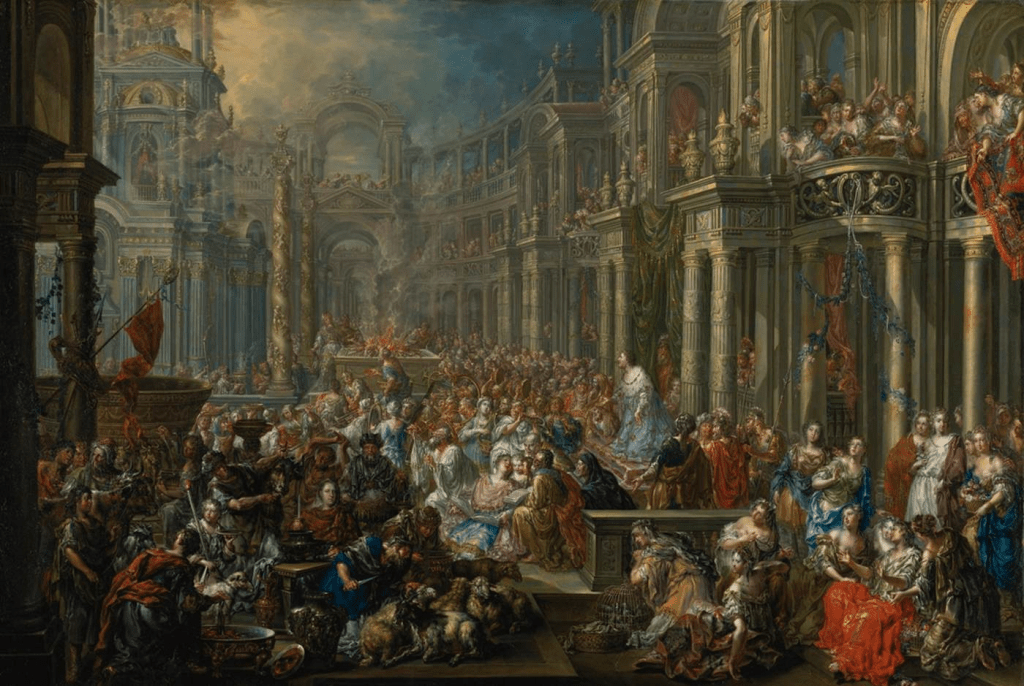
Solomon then summoned to Jerusalem the elders of Israel and all the heads of the tribes—the leaders of the ancestral families of the Israelites. They were to bring the Ark of the Lord’s Covenant to the Temple from its location in the City of David, also known as Zion. So all the men of Israel assembled before King Solomon at the annual Festival of Shelters, which is held in early autumn in the month of Ethanim.

When all the elders of Israel arrived, the priests picked up the Ark. The priests and Levites brought up the Ark of the Lord along with the special tent and all the sacred items that had been in it. There, before the Ark, King Solomon and the entire community of Israel sacrificed so many sheep, goats, and cattle that no one could keep count!

Then the priests carried the Ark of the Lord’s Covenant into the inner sanctuary of the Temple—the Most Holy Place—and placed it beneath the wings of the cherubim. The cherubim spread their wings over the Ark, forming a canopy over the Ark and its carrying poles. These poles were so long that their ends could be seen from the Holy Place, which is in front of the Most Holy Place, but not from the outside. They are still there to this day. Nothing was in the Ark except the two stone tablets that Moses had placed in it at Mount Sinai, where the Lord made a covenant with the people of Israel when they left the land of Egypt.

When the priests came out of the Holy Place, a thick cloud filled the Temple of the Lord. The priests could not continue their service because of the cloud, for the glorious presence of the Lord filled the Temple of the Lord.

Then Solomon prayed, “O Lord, you have said that you would live in a thick cloud of darkness. Now I have built a glorious Temple for you, a place where you can live forever!”

Then the king turned around to the entire community of Israel standing before him and gave this blessing: “Praise the Lord, the God of Israel, who has kept the promise he made to my father, David. For he told my father, ‘From the day I brought my people Israel out of Egypt, I have never chosen a city among any of the tribes of Israel as the place where a Temple should be built to honor my name. But I have chosen David to be king over my people Israel.’”

Then Solomon said, “My father, David, wanted to build this Temple to honor the name of the Lord, the God of Israel. But the Lord told him, ‘You wanted to build the Temple to honor my name. Your intention is good, but you are not the one to do it. One of your own sons will build the Temple to honor me.’

“And now the Lord has fulfilled the promise he made, for I have become king in my father’s place, and now I sit on the throne of Israel, just as the Lord promised. I have built this Temple to honor the name of the Lord, the God of Israel. And I have prepared a place there for the Ark, which contains the covenant that the Lord made with our ancestors when he brought them out of Egypt.” (New Living Translation)

Dedication of Solomon’s Temple in Jerusalem, by Johann Georg Platzer (1704-1761)

I admit, at many times, that I am prone to melancholy. I tend to be quick at accepting blame, and rather slow at owning my good work. Another way of putting this is that it is easier to give than to receive.

Those who have endured a lot of hard circumstances, and persevered through many adversities, can sometimes be reticent to accept the good, the abundant, and the beautiful, whenever it comes to us in this life.

Waiting for the other shoe to drop, far too many people hold back themselves from receiving and enjoying the really good things in life. They worry that the goodness will disappear, or be taken away; and so, they withhold gratitude and blessing, whenever they are in the presence of great abundance.

Just so you know, in case there are those of you who need to hear it spelled out plainly: That’s messed up.

People are meant to be abundantly generous, as well as wildly receptive. It’s likely why there are so many spiritually unhealthy persons in the world.

Bless their hearts, they give a lot, without receiving much, and then their spiritual diarrhea makes it so they can’t give anymore. And they oftentimes give to those who are in such a habit of receiving (and not giving) that the receiver’s spiritual constipation becomes a terrible problem.

Let’s avoid both extremes by letting ourselves both give and receive with equal abandon. No one can be spiritually growing, healthy, and mature without the dynamic of giving and receiving.

Solomon knew how to do both. King Solomon was the king of abundance. He accepted and received big; and he gave and blessed big. Nobody before him or after him received and gave more.

The Temple, in all of its glory and grandeur, with the Ark of the Covenant encrusted with gold as the central object in the building, was all for a God who doesn’t live in houses, a God who is invisible.

In Solomon’s dedication of the Temple, he made it clear that the God of Israel is not, and cannot, be restricted to, or located within, a single place. Thus, the Lord is limitless, and not subject to any human manipulation.

God is free to give with great abandon. And God is also free to take away. Blessed be the name of the Lord God. If we continually try and anticipate or predict what God will do, we will likely be a nervous ball of anxiety all of the time, wondering when the unexpected and/or unwanted will visit us.

It is much better to receive the good things the Lord gives us, and enjoy them while we have them.

“I came that they may have life and have it abundantly.”

Jesus (John 10:10)

Nothing is permanent, with the exception of relationships and love. So, if we can connect the temporal material things of this life in service to the immaterial realities of this universe, then we are in a position to experience peace, joy, and satisfaction.

If and when the material disappears, or is taken away, then it shall neither defeat us, nor destroy us. For our relational connections with God and others exist, and are free flowing, with the energy of gracious receiving and giving as the conduit of abundant life.

Melancholy is important and has its place for us in this present life; yet, so do things like celebration, dedication, joy, exuberance, emotional commitment, and open love. Indeed, to have these in abundance is a reflection of the God of abundance, in whose name we are bold to pray:

God of abundance, you have fed us with the bread of life and cup of salvation; you have united us with Christ and one another; and you have made us one with all your people in heaven and on earth. Now send us forth in the power of your Spirit, that we may proclaim your redeeming love to the world and continue forever in the risen life of Christ our Savior. Amen.

Everything Belongs to God (Psalm 24)

By Stushie Art

The earth is the Lord’s and all that is in it,
    the world, and those who live in it,
for he has founded it on the seas
    and established it on the rivers.

Who shall ascend the hill of the Lord?
    And who shall stand in his holy place?
Those who have clean hands and pure hearts,
    who do not lift up their souls to what is false
    and do not swear deceitfully.
They will receive blessing from the Lord
    and vindication from the God of their salvation.
Such is the company of those who seek him,
    who seek the face of the God of Jacob.

Lift up your heads, O gate
    and be lifted up, O ancient doors,
    that the King of glory may come in!
Who is the King of glory?
    The Lord, strong and mighty,
    the Lord, mighty in battle.
Lift up your heads, O gates!
    and be lifted up, O ancient doors,
    that the King of glory may come in!
Who is this King of glory?
    The Lord of hosts,
    he is the King of glory. (New Revised Standard Version)

The world belongs to God; and so do we. People have a simple, yet profound, task in this life: To confess the Lord’s great and sovereign ownership of everything, including themselves; and to therefore live a good and holy life because of that theological understanding.

“There is not a square inch in the whole domain of our human existence over which Christ, who is Sovereign over all, does not cry, Mine!”

Abraham Kuyper

Abraham Kuyper (1837-1920) was born in the Netherlands. He was a church minister, university professor, and politician – having established a Christian university, as well as served in the Dutch parliament and as Prime Minister of the Netherlands.

Kuyper labored throughout his life to flesh-out the theological implications of a sovereign God. He consistently insisted that all we do as humans is to be integrated and brought under the lordship of Jesus Christ.

He firmly believed that all things belong to God in Christ; thus, all the fragments of our lives are to be oriented and integrated around our Creator’s great claim upon us as creatures. Whether a pastor, teacher, or politician – every vocation, each activity, and all thoughts and intents rightly belong to God.

By Stushie Art

This means that religion and spirituality cannot be kept within superimposed limits. There is no separation of any one domain of human thought from the rest, no isolation of any one domain of human life from another or from Christ.

The spiritual life is not limited to merely the ethereal. It is both celestial and terrestrial – heavenly and earthly – concerned for the immaterial and the material. God cares about it all, because it all belongs to God.

God owns the world. So, the implications of this for us is huge. It means we don’t really own anything. We are simply stewarding all that God has given us – including our very lives.

The chaos of this world, from a biblical perspective, comes from creatures attempting to assert their own sovereignty and to control things. Since we were not created to be little gods roaming about doing our own thing, the inevitable result is a topsy-turvy messed-up world.

God’s divine claim and ownership of the world means that absolute authority does not rest with nations, states, or leaders. Everything we see, as well as what we don’t see, belongs to the Lord.

A significant task of believers is to confess and bear witness to God’s rightful and benevolent rule in this world. In fact, Christians everywhere pray toward this end every week:

“Your kingdom come, your will be done, on earth, as it is in heaven.” (Matthew 6:10)

The circle of life, within Holy Scripture, is the Creator God bestowing life and relationship to created humans, who then respond by practicing just and righteous living – thereby receiving renewal from the Lord and life anew. Theoretically, this movement can go unbroken. It can be a regular celebration in consistent rhythms of worship and adoration of God.

When we are able to get into the intended divine groove of faith, life, and worship, we will discover our meaning and purpose in the world.

By rightly ordering our lives, centering and grounding them in the gracious and loving relationship of Creator and creature, then we find true blessing – because it enjoys an intuited stamp of approval by the God who makes life possible.

In the Christian tradition, Jesus is the Victor, the King of Glory. All the promises and hopes of people are found and focused, in Christ. We enter through Jesus, the door of life, into deliverance from death and everything which separates us from God, others, and self.

Jesus comes to bring blessing, justice, righteousness, mercy, purity, and peace. For this is how the world was meant to operate from the beginning. We are to open the ancient door of faith, especially when the Lord comes knocking:

Listen! I am standing and knocking at your door. If you hear my voice and open the door, I will come in and we will eat together. Everyone who wins the victory will sit with me on my throne, just as I won the victory and sat with my Father on his throne. If you have ears, listen to what the Spirit says to the churches. (Revelation 3:20-22, CEV)

Old Abraham Kuyper is long dead, and yet he got it right, if we are able to hear him:

“Whatever people may do, to whatever they may apply their hands – in agriculture, in commerce, and in industry, or in mind, in the world of art, and science – they are, in whatsoever it may be, constantly standing before the face of God. They are employed in the service of God. They have strictly to obey God. And above all, they must aim at the glory of God.”

Blessed Lord, Creator of heaven and earth, though I am quite capable of fretting, complaining, and lamenting about how out of control things seem, the truth is that nothing is outside your grip. I may not always see your hand, discern your heart, or like your ways, but you are God and there is no other. 

So, continue to renew my thinking, gentle my heart, and deepen my worship. I humbly and gladly affirm that you are God, and I am not, through Jesus Christ, my Lord, who with you and the Holy Spirit reign sovereign as one God, now and forever. Amen.