Romans 8:1-8 – The Privilege of Life in the Spirit

Therefore, there is now no condemnation for those who are in Christ Jesus, because through Christ Jesus the law of the Spirit who gives life has set you free from the law of sin and death. For what the law was powerless to do because it was weakened by the flesh, God did by sending his own Son in the likeness of sinful flesh to be a sin offering. And so, he condemned sin in the flesh, in order that the righteous requirement of the law might be fully met in us, who do not live according to the flesh but according to the Spirit.

Those who live according to the flesh have their minds set on what the flesh desires; but those who live in accordance with the Spirit have their minds set on what the Spirit desires. The mind governed by the flesh is death, but the mind governed by the Spirit is life and peace. The mind governed by the flesh is hostile to God; it does not submit to God’s law, nor can it do so. Those who are in the realm of the flesh cannot please God. (New International Version)

It is a great privilege to be a Christian and possess God’s own Spirit in our lives. There are four privileges of the Christian to take note of so that believers can truly live in the Spirit and not in the flesh (sinful nature).

First Privilege: There is now no condemnation.   

No condemnation means “without judgment.” God pronounced a verdict, and the decision is final. We are united to Christ by means of God’s Spirit. Since God does not condemn us, there is no need whatsoever to condemn ourselves or other people.

Since we do not sit under judgment, believe the sin issue has been taken care of once for all through the life and death of Christ. If you do not feel forgiven, then put yourself in a position to believe. Allow the Holy Spirit of God to take the redemption of Christ and apply it to your life in a real and practical way.

It would be silly to go into the bathroom, turn on the shower, then just stand in the middle of the bathroom without getting under the showerhead. Because you did not put yourself in a position to become clean! You may passionately believe a shower, soap, and shampoo will make you clean. Yet, if you do not actually avail yourself of the privilege of taking the shower but just stand there and look at it, you will not become clean. 

We must put ourselves in a position to experience the privilege of God’s grace, our wonderful state of cleanliness, and the lack of condemnation through reading the Word of God on a regular basis; praying in the Spirit on all occasions; and practicing the silence and solitude necessary to receive the cleansing work of the Holy Spirit.

An illustration of marriage might help us understand both our reality and our responsibility. Two people are declared “married” in a formal wedding ceremony. The couple then works out their shared union together over a lifetime. The Minister does not pronounce condemnation at the ceremony but declares a blessing.

From that point forward the two persons must work on their marriage. They must believe their relationship is important enough to warrant putting themselves in a position to grow together by intentionally doing things like creating date nights and conversations on the couch; learning, appreciating, and participating in the other’s interests and life. 

God is not opposed to effort – but to the notion that we save ourselves. Just as we do not marry ourselves and pronounce ourselves a married couple, so we do not save ourselves. Having a marriage license in hand does not mean there is no effort to be done in the relationship. A marriage is both a legal reality, and a kind of mystical union between the spouses.

Second Privilege: Freedom from sin and death.

In Holy Scripture, sin is not only personal struggle but an ever-present reality in the world. Unfortunately, the power and presence of sin is everywhere within people, institutions, and systems. Because sin is everywhere, death is everywhere. Biblically, death refers not only to the body, yet also to the spirit. Death is a relational term. It’s to be separated from God, apart from a relationship. Conversely, life is connection, to be in union with God. 

God sent the Son. God’s Son became incarnate, a sin-offering, an atoning sacrifice for our sins. God condemned sin in sinful humanity. God met the righteous requirements of the law. God effects holiness in us by means of the Spirit. 

Rather than saving us from sin then simply telling us to live a holy upright life, God the Father and Son sent God the Holy Spirit to indwell us so that we can live like Jesus. Therefore, we must put ourselves in a position to experience this saving work through dwelling in the Scriptures and letting the Spirit and the Word effect practical change in our lives. 

I often quote Scripture from memory. I don’t really set out to memorize Scripture so much as I set out to dwell in it to the degree that it ends-up becoming a part of me. The goal is to become awash by the Spirit and the Word so that in every decision, in everything said, and in each action, we are moved by the Holy Spirit.

Third Privilege: We possess the mind of Christ.

The rub of the problem all Christians face, living in a sinful world, has to do with our mindset. What occupies our minds is what determines whether we will have life and peace, or not. 

If the object of our thoughts is continually away from Christ and the Spirit, we will have loose thinking.  If we put ourselves in a position to indulge the sinful nature, it will affect our mindset. Our mental choices can lead to life or death.

For example, alcoholics know they have two choices: the way of life or the way of death. The first step of the twelve steps is to admit powerlessness over alcohol and that my life has become unmanageable. The second step is to believe a Power greater than myself can restore me to sanity. The third step is to turn life and will to that Power. 

We are powerless over sin, which will, if left unchecked, lead to death. Yet, in the Spirit, we have the possibility of life. Sin, like alcohol, is a daily possibility, even after giving my life and will to God. However, there is also the possibility of life. And that hope of life is what we possess when we have the mind of Christ and the Spirit. We hope through the power of the Spirit to overcome death, embracing choices which lead to life.

The Spirit is not some vitamin supplement to the Christian life, or a protein shake that helps us become healthy.  The Spirit is life and peace, a person, not simply a force. The Spirit brings us the practical benefits of new life in Christ. So, what we put into our minds is vitally important. It’s not about willpower but about putting oneself in a position to receive spiritual power to mold, make, and change us.

Relying solely on willpower is setting yourself up for a crash. Evidence-based studies repeatedly demonstrate that we as people tend to overestimate how much self-control we will have against temptation when we are not in the “heat of the moment.” We too easily believe we can handle more temptation than we can.

Those who are most confident about their self-control are the most likely to succumb to temptation. The key avoiding situations where vices thrive and, most importantly, for individuals to maintain a humble view of their willpower.

Fourth Privilege: The Holy Spirit indwells us.

The Spirit is the distinguishing mark of the Christian life. The Spirit opposes the sinful nature and expects us to do the same. We need not live the Christian life on our own power because of the Holy Spirit. 

There is an internal struggle within us that desires to do right but has a compulsion to do otherwise. It’s the indwelling Spirit that gives us victory. Christ’s life, as much as his death, achieved salvation from sin for us. The very same Spirit that helped Jesus in life and raised him from death belongs to us!

When I was a kid, I remember my grandmother canning grape preserves. I sat on a stool in the kitchen and watched her, looking forward to yummy grape goodness on my next piece of toast. I once asked Grandma, “Why are you always melting that wax over the fruit?” I didn’t understand how wax could make my toast taste any better. She answered, “The wax seals the jar tightly so the fruit can’t be contaminated. If I didn’t seal it, the fruit would eventually rot.” 

You and I are God’s preserves. God not only chooses, redeems, and calls us; the Lord also has a plan for preserving us – to give us the indwelling Spirit so that we can live free from sin and do the will of God.

So, may Christians everywhere appreciate the privileges of no condemnation, freedom from sin, possessing the mind of Christ, and the power of the indwelling Spirit. May you avail yourselves of the Spirit and experience life and peace so that you will love God, love one another, and love the world through the power of the Holy Spirit.

Almighty God, fill us with the knowledge of your will through all spiritual wisdom and understanding. Help us to live worthy of the Lord Jesus and to please him in every way; bearing fruit in every good work, growing in the knowledge of God; being strengthened with all power according to your glorious might so that we may have great endurance and patience, joyfully giving thanks to you. For you, Lord, have rescued us from the dominion of darkness and have brought us into the kingdom of the Son you love, in whom we have redemption, the forgiveness of sins. Amen.

Psalm 115 – The Living God Is Both Far and Near

Not to us, O Lord, not to us, but to your name give glory,
    for the sake of your steadfast love and your faithfulness.
Why should the nations say,
    “Where is their God?”

Our God is in the heavens;
    he does whatever he pleases.
Their idols are silver and gold,
    the work of human hands.
They have mouths, but do not speak;
    eyes, but do not see.
They have ears, but do not hear;
    noses, but do not smell.
They have hands, but do not feel;
    feet, but do not walk;
    they make no sound in their throats.
Those who make them are like them;
    so are all who trust in them.

O Israel, trust in the Lord!
    He is their help and their shield.
O house of Aaron, trust in the Lord!
    He is their help and their shield.
You who fear the Lord, trust in the Lord!
    He is their help and their shield.

The Lord has been mindful of us; he will bless us;
    he will bless the house of Israel;
    he will bless the house of Aaron;
he will bless those who fear the Lord,
    both small and great.

May the Lord give you increase,
    both you and your children.
May you be blessed by the Lord,
    who made heaven and earth.

The heavens are the Lord’s heavens,
    but the earth he has given to human beings.
The dead do not praise the Lord,
    nor do any that go down into silence.
But we will bless the Lord
    from this time on and forevermore.
Praise the Lord!
(New Revised Standard Version)

Theology 101 Syllabus:

  • The earth belongs to God, not us.
  • Humanity stewards the earth, not depletes it.
  • Glory belongs to God, not us.
  • Humanity gives glory, not seeks glory.
  • God is mindful of us with blessing, not cursing.
  • Humanity is mindful of God with praise, not idolatry.
  • God is eternal, not finite, alive, and not dead.
  • Humanity is finite, not infinite. Dead people don’t steward the earth and give glory and praise to God. Mortal humans have a privilege and responsibility on this earth while they are still alive.

Any questions?

When it comes to knowing God, we learn as much or more about Divine attributes and actions in the psalms as anywhere else in Holy Scripture. This is one reason why the Lectionary has a psalm for every day – and why the same psalm is repeated three days in a row. It is the consistent, repeated, and continual reading and recitation of the psalms which provides us with the robust theology we need for practical daily living.

God speaks. Idols do not. We have the privilege of God’s Word. There are no words from idols. People become like the objects of their worship. Worshiping a mute inanimate object leads to being silent on the great problems and issues of our day. Idol worship has nothing substantive to offer. It’s worthless.

Conversely, the worship of God (a deity who has words for the immense needs of the world) brings a sense and application of humility, justice, and mercy to the very real and present situations surrounding us.

“The believer trusts in the name of the Lord to show steadfast love – to put love where love is not.”

Mit Tdrahrhe

Evil will not be perpetrated with impunity. That is, the person of violent speech and/or actions will not be able to victimize continually and without consequence. Their wicked words and deeds are held accountable by a God who cares about such things. An idol is unable to hear the cries of victims. And an idol is neither able to proclaim justice nor words of assurance. Idolatry has no ability to stop the ravaging of the earth and its people.

The Lord is both far and near – far enough and high enough to see the big picture and act accordingly – yet near enough to bring true comfort and solace. I was once speaking with a friend about this, discussing the simultaneous transcendence and immanence of God. He listened and then said, “So, it sounds like God is a loving hard-ass!” Well, yes. Not quite the way I would frame it, but he certainly picked up on the spirit of what I was saying.

It is important to hold together and maintain both God’s intimacy and distance. Because they each work together to provide the worshiper with what is needed. The Lord both infinitely observes from afar as well as gets his hands dirty working on behalf of finite humanity. This is the view of God the psalms give us. A God who cares in the total sense of the word – caring with comforting words and confident action.

A vision of God in the psalms inevitably leads to prayer, trust, praise, and worship. The Lord might be invisible, yet the evidence of this immense deity is everywhere in the blessings we have, both big and small. Deep within our personhood is firm epistemic proof that we belong to God.

May the Lord who created heaven and earth give you divine blessing.

May all people everywhere praise the Lord now and forevermore! Amen.

Psalm 118:1-2, 19-29 – Gratitude Changes Us

O give thanks to the Lord, for he is good;
    his steadfast love endures forever!

Let Israel say,
    “His steadfast love endures forever….”

Open to me the gates of righteousness,
    that I may enter through them
    and give thanks to the Lord.

This is the gate of the Lord;
    the righteous shall enter through it.

I thank you that you have answered me
    and have become my salvation.
The stone that the builders rejected
    has become the chief cornerstone.
This is the Lord’s doing;
    it is marvelous in our eyes.
This is the day that the Lord has made;
    let us rejoice and be glad in it.
Save us, we beseech you, O Lord!
    O Lord, we beseech you, give us success!

Blessed is the one who comes in the name of the Lord.
    We bless you from the house of the Lord.
The Lord is God,
    and he has given us light.
Bind the festal procession with branches,
    up to the horns of the altar.

You are my God, and I will give thanks to you;
    you are my God, I will extol you.

O give thanks to the Lord, for he is good,
    for his steadfast love endures forever. (NRSV)

Show me a spiritual sourpuss, and I’ll show you a person who lives without daily gratitude toward God and others. But show me a gracious person who liberally gives thanks, and I will show you a person profoundly in touch with God’s steadfast love.

The psalmist chose to give thanks for God’s goodness and faithful love. I wonder how much different each day would be if we began it with the psalmist’s great call to worship: “This is the day the Lord has made; let us rejoice and be glad in it.” 

There is a misguided notion that only certain people have the attitude of gratitude – that some folks are just naturally ornery, and some are just born happy. But the truth is that gratitude and giving thanks is a practice which needs to be carefully cultivated. As it grows and develops, gratitude bears the fruit of joy. 

Thankfulness is a daily decision of faith to have the kind of attitude which pleases God and blesses others.

We now know so much more about the human brain. Research has discovered that the brain is made up of an estimated 100 billion neurons making a total of 100 trillion neural connections. That’s a lot of neural power! Most of those neural pathways are good and healthy. For example, I didn’t have to think about how to tie my shoes this morning because I have a well-developed neural pathway that automatically makes the connection to do it.

However, some of those neural pathways are not good, even unhealthy. There might be connections in our heads which lead to substance abuse when under stress, or to violently lash out when afraid or hurt, or things like plain old procrastination. If you have ever had the experience of telling yourself that you’re not going to respond a particular way, then end up doing it anyway, it is likely you have a well-worn neural pathway which connects certain events to a set of focused actions.

What this all means is that willpower won’t do the trick in changing behavior. That’s because our brains don’t work that way. The good news is that all those neural connections and pathways, like ruts in a gravel road, can fade away and new ones can be developed. Scientists call this “neural plasticity.”

There are practices which can help unhealthy neural connections go away and create new healthy pathways.

One of those practices is gratitude. Giving thanks changes our brain chemistry! Yet, it doesn’t happen overnight. But if we identify three persons or possessions which we are grateful for and say them out loud at least three times a day over the next three months, then we have developed a new neural pathway in our brain.

So, in the future, when we face a stressful event – whereas in the past we might deal with it in an unhealthy way – now our brains reflexively go to a different place and see the situation in a different way than before. And we choose different actions and behaviors.

Readers of this blog know that I continually encourage reading the psalms out loud as prayers to God. If we make this a practice, it will not only change our brains – it will create new spiritual pathways in our souls which fortify us for those times in life when things are tough and hard.

Spiritual practices have a purpose. And when we use those disciplines, we end up developing connections with the Lord which support us and sustain us for a lifetime – not to mention that we become a delight for others to be around instead of being a tedious fart.

Loving God, this is the day you have made; I rejoice in it and am glad that your steadfast love covers all things. Help me to connect every good thing with your gracious hand upon me so that I will not look and act like I was baptized in pickle juice.  To the glory of Jesus Christ, I pray.  Amen.

Psalm 85:1-2, 8-13 – Giving the Good

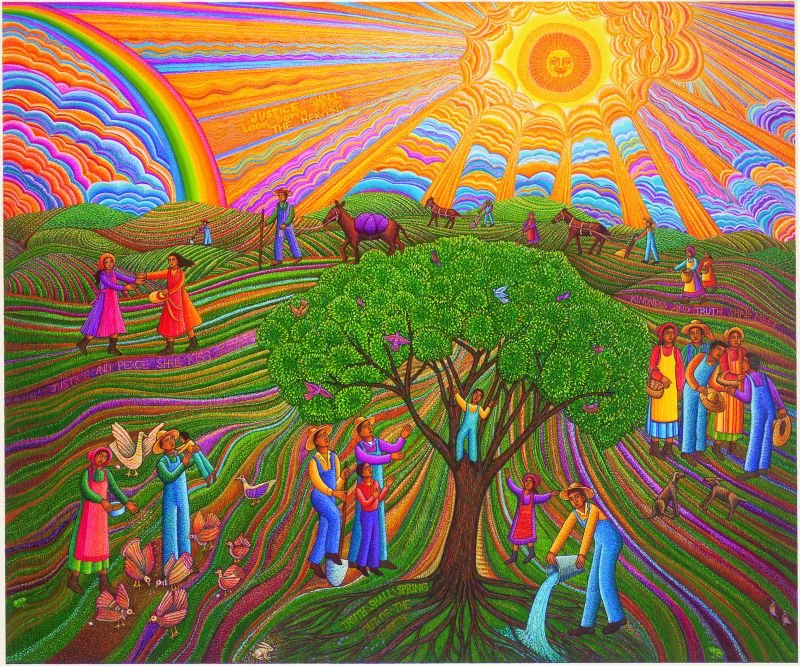
Psalm 85 by American artist John August Swanson

Lord, you were favorable to your land;
    you restored the fortunes of Jacob.
You forgave the iniquity of your people;
    you pardoned all their sin….

Let me hear what God the Lord will speak,
    for he will speak peace to his people,
    to his faithful, to those who turn to him in their hearts.
Surely his salvation is at hand for those who fear him,
    that his glory may dwell in our land.

Steadfast love and faithfulness will meet;
    righteousness and peace will kiss each other.
Faithfulness will spring up from the ground,
    and righteousness will look down from the sky.
The Lord will give what is good,
    and our land will yield its increase.
Righteousness will go before him,
    and will make a path for his steps. (NRSV)

Steadfast love, faithfulness, righteousness, and peace are terms which all spiritual folks need to be familiar with as well as experience. Steadfast love and faithfulness have its ground in God’s chesed, the divine covenant loyalty and kindness which always holds on, even despite people’s fickle commitment. Righteousness and peace are primarily relational terms which communicate a harmonious way of being with others and all creation.

This psalm says God will give exactly what the people have prayed for. It is a blessing given by the Lord to those who long for wholeness, integrity, and unhindered connection with God and God’s creation. And it is in the metaphors surrounding the words which give us such a beautiful picture of the blessing realized.

This is neither a general nor generic blessing from God Almighty. It is personal. In the grand immensity of the universe, the Creator God bends and condescends not only to all humanity but also to the individual. God’s steadfast love and faithfulness will meet to bless you and me. The Lord will come alongside and conform a divine blessing to our life. God’s grace will stick to us like glue in the form of right relationships and unity.

All of God’s attributes and character shall work in a seamless whole to bring divine acceptance and assistance to our lives. The good news here is that our struggles to be right and live right amidst terrible conditions of pandemics and people’s petulance have a vindication of divine sanction and enablement.

So, take a big breath and exhale, allowing the worries and anxieties of adverse situations to be expelled from our weary spirits. The Lord will give what is good. Today’s psalm is a wonderful reminder that salvation is not limited to a coming life; it is also deliverance in this present world we inhabit, basking in the Lord’s love and shalom and enjoying the good gifts God wants to give us right now.

Gracious God speak peace to your people. Through your Son, the Lord Jesus, we turn to you in our hearts, knowing your steadfast love and faithfulness, your righteousness and peace goes before us, with us, and behind us. In Christ, our salvation is at hand. May we reflect your goodness, as we respond to you with heart, soul, mind, and strength. This we pray in the name of the One who is your peace, your salvation—Jesus Christ. Amen.