Matthew 5:5 – Blessed Are the Meek

Blessed are the meek,
    for they will inherit the earth. (NIV)

To give us a flavor of Christ’s counter-cultural Beatitudes, when was the last time, or has anyone ever, described themselves to you as meek?

Whenever I have interviewed people for positions, both paid and voluntary, and asked them to tell me their strengths, I have never had anyone say to me, “I’m a meek person.”

Why would I want to be meek?

Far too often, we equate meek with weak. If someone is meek, we may wrongly reason they must be a washrag, or overly introverted, and maybe not taking proper initiative in life. Of all the character qualities we might aspire to, I doubt that meekness is on anyone’s top ten list of desired qualities.

Yet, of the few words in the Gospels which Jesus uses to describe himself, one of those words is meek. And even then, many English translations steer clear of the word. For example, the New International Version of the Bible says in translating the words of Jesus, “Come to me all you who are weary and burdened, and I will give you rest. Take my yoke upon you and learn from me, for I am gentle and humble in heart, and you will find rest for your souls. For my yoke is easy and my burden is light.” (Only the King James Version translates the word as “meek,” instead of “gentle.”)

What does it mean to be meek?

Meek and gentle are the same words. The original Greek word is πραεῖς (pronounced “prah-ace”). “Meek” is the word used in other ancient Greek literature for breaking a horse. It is to be changed from being a wild stallion who wants to go his own way, to a broken horse who is gentle before the Master and allows others on his back without bucking.

Consider, for example, the scene around Christ’s crucifixion. Jesus was naked, exposed, and vulnerable to the idle curiosity of the crowd and the vulgar frivolity of the soldiers who were having a party around his suffering. “If you are the king of the Jews,” they taunted, “save yourself.”

And yet the extraordinary thing is there was no spirit of revenge with our Lord. Jesus did not curse his tormentors. Instead, he prayed, “Father forgive them, for they don’t know what they’re doing.” (Luke 23:24)

It is important to notice the meekness that Jesus is speaking about in this Beatitude is not being a pushover. Meekness is not to be confused with being nice and easy-going. Meek and lowly as he was, Jesus could also take a whip to greedy money-changers in the Temple. We must not confuse meekness with weakness.

What characterizes a meek person?

Whereas poverty of spirit is more a humility before God, meekness is a humility toward other people. It is to be flat on our backs with only one way to look: up to God; and because we are in that position, there is no opportunity to look down on others. 

Meekness is a foundational Beatitude. Jesus considers it a necessary part of righteousness. I believe the word “meek” needs a renaissance. Even if we use the word “gentle” this will be a great advancement in how people interact with one another. So, what characterizes a meek person?

  • The meek have a desire to put other’s interests ahead of their own, because they know it is not all about them. They practice healthy rhythms of giving and receiving with others, without prejudice or favoritism.
  • The meek are more concerned with edifying and building up their brothers and sisters than justifying themselves. They don’t care who gets the credit. And they receive criticism well.
  • The meek are truly egalitarian and do all things with equity and inclusion. They make no distinctions between rich and poor, beautiful and ugly, intelligent and cognitive deficits, black and white, gay and straight, Democrat and Republican, or insider and outsider. In the meek person’s mind, every person is created in the image of God and therefore deserves respect, attention, and justice.

It is the meek who will inherit the earth – not aggressive people who believe in survival of the fittest, stepping on people to get where they want to go, or badgering others in order to get their way. 

Someone might protest, “But if I live this way, I’ll be pushed around.”  Meekness is not living without boundaries but is power under control. Maybe you will get stepped on – but you will inherit the earth.

How do I live as a meek person?

The three Beatitudes of being poor in spirit, mourning over sin, and meekness toward others are foundational to all that Jesus says and does. They are central to being Christ’s follower. Without them, there is only a contrived legalistic righteousness of our own without any real need of God. That is the way of pride, which is the straight and broad road to hell. 

Perhaps repentance is in order. It could be that too many people have made much more of themselves than what they truly are. Maybe we have adopted a soft attitude toward shame and shaming others, believing that some people need a bit of guilt from us to change their obnoxious ways. Perhaps we have paid scant attention to those who are in physical or spiritual poverty. And just maybe we have ignored and gossiped about others simply because we believe we are better than them.

A genuine follower of Christ lives a repentant lifestyle. The Apostle James said, “Confess your sins to one another, and pray for one another so that you may be healed” (James 5:16).  The way of Christ is the way of community. We are not to live ingenuine lives, hiding behind a mask of outward conformity. Now is the time for authenticity, living life as God intended it to be lived, as a disciple of Jesus in the way of spiritual poverty, mourning, and meekness – the narrow path that leads to salvation.

Non-retaliation happens when we realize our poverty of spirit and practice grief and lament. When we are flat on our backs before God, there is no place to look but up. And it means there is no ability to look down on others. It is to be broken and moldable before God. 

If you and I were part of the original crowd that listened to Jesus, there is hope. I have no ability to practice retaliation, even if I wanted to, because I have no earthly power. But that’s okay because, in this spirit of meekness, I take personal responsibility for my attitudes and my actions. I am neither worse nor better than any other person. I do not need to retaliate, even when egregiously wronged, because I can fully entrust myself to God alone who judges the living and the dead. 

Conclusion

It turns out that brokenness is the path to genuine righteousness. Jesus promised that the meek will inherit the earth. Christ didn’t just make that up. He was quoting Holy Scripture:

Do not fret because of those who are evil
    or be envious of those who do wrong;
for like the grass they will soon wither,
    like green plants they will soon die away.

Trust in the Lord and do good;
    dwell in the land and enjoy safe pasture.
Take delight in the Lord,
    and he will give you the desires of your heart.

Commit your way to the Lord;
    trust in him and he will do this:
He will make your righteous reward shine like the dawn,
    your vindication like the noonday sun.

Be still before the Lord
    and wait patiently for him;
do not fret when people succeed in their ways,
    when they carry out their wicked schemes.

Refrain from anger and turn from wrath;
    do not fret—it leads only to evil.
For those who are evil will be destroyed,
    but those who hope in the Lord will inherit the land.

A little while, and the wicked will be no more;
    though you look for them, they will not be found.
But the meek will inherit the land
    and enjoy peace and prosperity. (Psalm 37:1-11, NIV)

Jesus was saying that only the truly meek will learn contentment, joy, and satisfaction. Their ego is not so inflated that they insist they deserve more. Indeed, because as God’s people they are learning from him, the meek understand they are co-heirs with Christ in an inheritance of God’s kingdom.

May your meekness and gentleness be known to all.

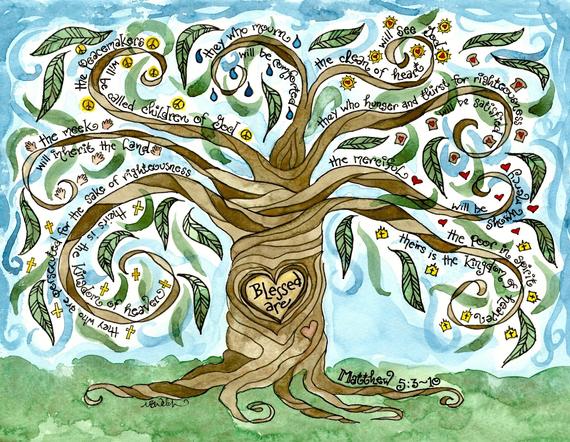
*Above painting by Hyatt Moore

The Beatitudes of Jesus: An Introduction

Now when Jesus saw the crowds, he went up on a mountainside and sat down. His disciples came to him, and he began to teach them. He said:

“Blessed are the poor in spirit,
    for theirs is the kingdom of heaven.
Blessed are those who mourn,
    for they will be comforted.
Blessed are the meek,
    for they will inherit the earth.
Blessed are those who hunger and thirst for righteousness,
    for they will be filled.
Blessed are the merciful,
    for they will be shown mercy.
Blessed are the pure in heart,
    for they will see God.
Blessed are the peacemakers,
    for they will be called children of God.
Blessed are those who are persecuted because of righteousness,
    for theirs is the kingdom of heaven.

“Blessed are you when people insult you, persecute you and falsely say all kinds of evil against you because of me. Rejoice and be glad, because great is your reward in heaven, for in the same way they persecuted the prophets who were before you. (Matthew 5:1-12, NIV)

The human brain is hard-wired, in such a way, that it works its best when healthy rhythms of giving and receiving occur. God created us to thrive and flourish when we pay attention to particular ways of being with one another as people.

Jesus used the term “blessed” not in a financial sense, as if having lots of money is what it means to experience blessing. The word “blessed” means to have God’s stamp of approval, his favor, with the emotional and spiritual response of joy or happiness. 

Real and lasting joy comes from a right relationship with God, defined according to what Jesus says – different from the false righteousness of the religious establishment which is based on outward appearance rather than inner attitudes. We need to know how to relate to our God, instead of simply conforming to an outward form of Christianity that everybody is doing.

Our entire selves are blessed when we engage in consistent rhythms of practicing humility before the Lord; sitting with grief; putting ourselves in another’s shoes; seeking right relationships with both God and others; pursuing mercy, purity, and peace-making in all our affairs; and allowing persecution to form us in ways the good times cannot.

Jesus preached the Beatitudes to clarify what it means to be approved by God. He wanted to gain true disciples who follow God for the right reasons. The crowd was following Jesus physically, but not necessarily spiritually. They all followed for different reasons: for healing, curiosity, or a genuine desire to be a disciple. So, Jesus sat them down to communicate what a true follower and disciple is.

Imagine we are part of the crowd originally hearing Christ’s Sermon on the Mount (Matthew 5-7).  The world in which the people lived, and the religious system which they took for granted, was highly restrictive. 

In order to approach God, enter the kingdom, and be a good citizen, one had to be Jewish, male, a faithful Law-keeper, physically whole, healthy, and able; and, if not wealthy, able to make a good living. 

Yes, this reality meant that Gentiles, women, those who struggled to keep the Law, the diseased and disabled, and the poor had no shot whatsoever in the kingdom of God. To be blessed and have God’s stamp of approval on your life meant you were a healthy and wealthy Jewish man who practiced a legalistic form of righteousness. 

Not a single one of us here would have any shot at the kingdom of God. Yet, we have heard something about this guy, Jesus. There seems to be something very compelling about him. We go seek him out, sit down on a mountainside and hear him say the most refreshing and scandalous words we have ever heard…

God approves of the spiritually bankrupt who realize they’ve got no leverage to make any deals. They shall be given the riches of God’s grace.

God approves of those who grieve over personal sin and lament the presence of sin in the world. They are the ones who will experience God’s forgiveness and comfort.

God approves of the powerless and those who use their authority to champion others. They will inherit God’s power and take up authority to command dark forces and put them in their place.

God approves of those who have a voracious appetite for right relationships and doing everything for the right reasons. Their growling spiritual stomachs will be stuffed with God’s righteousness.

God approves of those who liberally extend grace to others, being always considerate of everyone’s needs, showing neither prejudice nor favoritism. They shall receive God’s grace at the end of the age when Christ comes to judge the living and the dead.

God approves of the spiritually clean who have bathed in the waters of divine mercy. They will see Jesus face to face.

God approves of those who facilitate and negotiate peace. Because that is precisely what God’s children do.

God approves of those who are persecuted for living by these counter-cultural Beatitudes. They have an inheritance that will never perish, spoil, or fade.

Grant us, Lord God, a vision of our world as your love would make it: a world where the weak are protected, and none go hungry or poor; a world where the benefits of abundant life are shared, and everyone can enjoy them; a world where different races and cultures live in tolerance and mutual respect; a world where peace is built with justice, and justice is guided by love. And give us the inspiration and courage to build it, through Jesus Christ our Lord. Amen.

Luke 11:14-28 – Replace the Bad with the Good

Jesus was driving out a demon that was mute. When the demon left, the man who had been mute spoke, and the crowd was amazed. But some of them said, “By Beelzebub, the prince of demons, he is driving out demons.” Others tested him by asking for a sign from heaven.

Jesus knew their thoughts and said to them: “Any kingdom divided against itself will be ruined, and a house divided against itself will fall. If Satan is divided against himself, how can his kingdom stand? I say this because you claim that I drive out demons by Beelzebub. Now if I drive out demons by Beelzebub, by whom do your followers drive them out? So then, they will be your judges. But if I drive out demons by the finger of God, then the kingdom of God has come upon you.

“When a strong man, fully armed, guards his own house, his possessions are safe. But when someone stronger attacks and overpowers him, he takes away the armor in which the man trusted and divides up his plunder.

“Whoever is not with me is against me, and whoever does not gather with me scatters.

“When an impure spirit comes out of a person, it goes through arid places seeking rest and does not find it. Then it says, ‘I will return to the house I left.’ When it arrives, it finds the house swept clean and put in order. Then it goes and takes seven other spirits more wicked than itself, and they go in and live there. And the final condition of that person is worse than the first.”

As Jesus was saying these things, a woman in the crowd called out, “Blessed is the mother who gave you birth and nursed you.”

He replied, “Blessed rather are those who hear the word of God and obey it.” (New International Version)

You have likely heard the old adage that nature abhors a vacuum. That is, when a loss or change leaves a hole in something, that hole will quickly get filled with something else.

To stop doing one thing is only half of a necessary process. To start doing another thing is crucial.

In our Gospel lesson for today, Jesus tells a story about a demon-possessed man. He was delivered of his oppression. However, a problem arose because the man had no replacement for the demon. He simply did nothing after the demonic expulsion.

It didn’t take long for a group of demons, seemingly seeking such a situation as this man, and took full advantage of his vulnerability. In the end, the man was worse off than before – all because of the vacuum created without the hole being filled.

We are meant to hear God’s Word and obey. Both are necessary to the process of deliverance, growth, and spiritual development.

Whenever the process is only half-baked, we have double-minded people, divided in their loyalties between God and money/power or something else.

Getting rid of judgmental spirits is important but it’s only half the process. The other half is to intentionally make space for genuine inquiry, listening, and dialogue. Without the focus on helping one another through mutual discussion, a group of folks will inevitably degenerate into discouragement, even despair, as the demons of judgmentalism come back in full force.

Kicking hate to the curb only truly works if it is replaced with a spirit of love, concern, and compassion for one’s fellow human. An environment in which people feel free to share of themselves and their feelings is the result of deliberately seeking to do so. Simply policing hate in others eventually causes the demons of hate to establish themselves even deeper than before.

Attempting to eliminate a culture of secrecy and shame can only really come through courageous acts and words of creating a climate of openness which carefully and compassionately enables individuals to boldly name their shame and destroy the blood-sucking vampire feeding on them in the demonic shadows of night once-and-for-all.

A zombie apocalypse won’t happen, that is, unless the only thing we’re concerned about is getting rid of zombies. If our end game isn’t the thriving and flourishing of real live people, our planet will be overtaken with the living dead.

“We look forward to the time when the Power of Love will replace the Love of Power. Then will our world know the blessings of peace.”

William Gladstone

We live in a divided world, polarized chiefly around things we are against, rather than crafting a vision together of what we are for. It does little good to kick people out of power either through force or elections, only to have no collective and compelling cause to rally around and place our efforts.

I’m all in for the cause of living Christ’s Great Commission through making disciples, embodying the Great Commandment of loving God and neighbor, and taking up the Great Challenge to act justly, love mercy, and walk humbly. It is these activities which motivate me to put away hate, hubris, and half-baked ideas so that a healthy process of spiritual formation can happen.

If our lives are already filled with a good spirit, there will be no room for any bad spirit to enter. And if we’ve picked up one, let’s make sure to not only expel it but occupy the space with the grace and goodness which comes from knowing a good and gracious God.

Be intentional about replacing the bad with the good. If a hole is created, fill it with mercy.

O God, the source of all health: Fill my heart with faith in your love, that with calm expectancy I may make room for your power to possess me, and gracefully accept your healing; through Jesus Christ our Lord. Amen.

**Above engraving of Jesus healing a demon possessed man, by an Italian artist, 1591.

Numbers 6:22-27 – A Blessing

The Lord spoke to Moses: Tell Aaron and his sons: You will bless the Israelites as follows. Say to them:

The Lord bless you and protect you.
The Lord make his face shine on you and be gracious to you.
The Lord lift his face to you and grant you peace.

They will place my name on the Israelites, and I will bless them. (Common English Bible)

Life operates by blessing, not cursing.

The world cannot stand up under the curse. The new earth will endure forever with a blessing.

People wither without a blessing. They die when cursed. Not necessarily in body. Most definitely in spirit.

Something must be said about the word “blessing.” It gets used and misused a lot, especially by Christians.

As with most words in the Old Testament, “blessing” is a relational word. It means to have God’s stamp of approval on your life. It’s meant to convey that the Lord’s presence is with us. To be blessed by God is a multi-dimensional experience – receiving promises, enjoying peace, having right relationships with both God and other people, and knowing divine comfort and security.

A blessing isn’t simply having money and/or family and a good job. One could have none of those and still be blessed by God. And being blessed is not getting everything you want. Some people continually get what they want and are cursed, not blessed.

Blessing is tied not to human activity but divine initiative. We can’t finagle a blessing out of God. Plenty of folks try to do that, and, like Jacob, they might get away with it in their family – but it will not work with God. The grace of blessing is freely bestowed by a benevolent and merciful Lord.

Everything comes down to God. The Lord is not stingy but generous – not subject to the whimsy of human cajoling but deeply influenced by the unending unity, harmony, and love within the divine godhead.

In other words, divine blessing is a gift – not something earned or cleverly received through trickery or manipulation.

Blessing one another is also a gift. In fact, God clearly communicated to Moses and Aaron how they were to bless the people with powerful words.

I believe we all intuitively know that words and language have the power of life and of death, of blessing and cursing. And withholding words of blessing and keeping silent is to withhold goodness and love from another. Speaking words of blessing and backing up those words with an active commitment, is vital to humanity’s spiritual and emotional health.

Fathers and mothers everywhere across the world stand in a unique and special position as those who have the power of bestowing a blessing on their children – a blessing of being with them, approving of them, affirming their gifts and abilities, envisioning for them a special future of how God can use them. Those words of blessing have the power to help children navigate the world with assurance and confidence. Armed with blessing, they can filter-out the choices in front of them and walk in the way of God.

Notice in the New Testament Gospels how the God the Father blessed the Son:

And when Jesus had been baptized, just as he came up from the water, suddenly the heavens were opened to him and he saw the Spirit of God descending like a dove and alighting on him. And a voice from heaven said, “This is my Son, the Beloved, with whom I am well pleased.” (Matthew 3:16-17, NRSV)

God provided a constant presence and an active commitment through the Spirit; God spoke words of approval and affirmation; God the Father had a special future for Jesus the Son, which helped Jesus to repel the words of Satan. Since Jesus needed and received a blessing from his Father, how much more do we? 

Jesus passed the blessing to his disciples with a promise of presence and commitment:

Jesus came near and spoke to them, “I’ve received all authority in heaven and on earth. Therefore, go and make disciples of all nations, baptizing them in the name of the Father and of the Son and of the Holy Spirit, teaching them to obey everything that I’ve commanded you. Look, I myself will be with you every day until the end of this present age.” (Matthew 28:18-20, CEB)

Jesus informed the disciples his presence would be with them; communicated an active commitment to give them authority to do the job of disciple-making; pictured for them a special future of reaching the nations; affirmed and approved them. “The Great Commission” is really a statement of God’s blessing.

One reality needs to be recognized and affirmed with all confidence: You and I already possess God’s blessing; there is no need to try and earn it. The words of blessing state what is, in fact, already true.

We have the privilege and the ability to reverse the world’s curse and turn it into blessing. Those blessed with money can be a blessing by giving it away. Those blessed by growing up in a loving family can provide love to others who are unloved and need a special blessing. Those blessed with wisdom can mentor and instruct those who need wisdom. Those blessed with the mercy of God can be merciful to others. Those blessed with a wonderful relationship with God can pray people into the kingdom of God.

Parents, it is never too late to bless your children, even if they are adults. Children, it is never too late to bless your parents and your siblings, even if they are prickly and hard. To not bless is to curse. Bless through words that build up, and do not tear down. Use those words to picture a special future of what God can do. Follow through with those words by demonstrating an active commitment to embodying blessing.

I leave you with a blessing:

May God answer you when you are in distress; may the name of Jesus protect you. 

May the Lord send help when you need it and give you support when you cry out to him. 

May the God of heaven remember your good deeds done in faith and accept you just as you are. 

May the Lord give you the desire of your heart and make all your plans succeed.

When the Almighty goes out of the way to answer your prayers, then I will be the first to shout with joy!

I know the Lord is God. There is a special future for you beyond what you can even ask or think. And I will be there on the sidelines, encouraging you all the way.

Some people trust in the political process, others trust in the strength of the economy; but we trust in the name of the Lord our God. 

May God answer when you call.

May God bless you with an everlasting love. 

May you know Christ, and him crucified, risen, and coming again. 

May God’s presence and power be with you now and forever.  Amen.

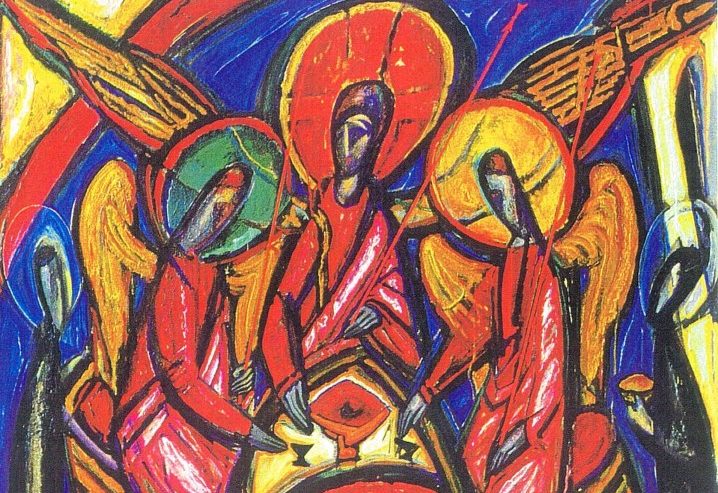
*Above painting of the Trinity by Alek Rapaport, 1994