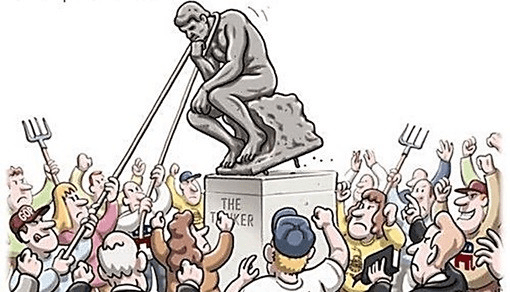
Anti-Intellectualism

Everyone with good sense
    wants to learn. (Proverbs 18:15, CEV)

Anti-intellectualism:

  1. opposition to or hostility toward intellectuals and the modern academic, artistic, social, religious, and other theories associated with them
  2. the belief or doctrine that intellect and reason are less important than actions and emotions in solving practical problems and understanding reality

Holy Scripture encourages knowledge, understanding, and wisdom. In order to be a truly wise and understanding person, there must be a combination of knowledge and experience. When these two elements come together, and are practiced over a long period of time, then spiritual maturity is realized.

In every church I’ve ever served across the decades there have been individuals and groups of people in my congregations who are anti-intellectual. They were not big fans of seminaries. They often mistrusted highly educated persons with multiple degrees. And they had a hard time submitting to any authority structure that smacked to them of being elitist.

Unfortunately, the majority of those persons, in my experience, refused to learn in any other way other than their own personal experience. I don’t think I need to tell you the many pitfalls such a stance creates: constant misinterpretation of situations; prejudice toward others whom they don’t understand; and chronic disobedience to every authority in their life.

It likely wouldn’t surprise you to know that these sorts of parishioners rarely, if ever, read their Bibles, or even seek to learn other than hearing Sunday sermons. They reek of spiritual immaturity and pride, being puffed-up with themselves that they aren’t like the elites in power.

Now imagine what a group of people like this would be like if they were in the highest levels of government… But we need not imagine; the reality is in front of us every day.

To understand the current political climate in the United States, it seems to me we need to see that the present governmental administration, at its heart, is an anti-intellectual movement.

Now please know that I am not saying that everyone in the administration is stupid. What I am saying is that many if not most Republicans have a deep seated problem with educational elites – hence the sustained attention on American universities, especially Harvard.

They believe themselves to be practical, no nonsense people who can get things done without umpteen committees and eggheaded reports. The problem, however, is that in their belief of experiential superiority, they’ve refused to listen. They end up making snap judgments of situations and other people. In other words, they can quickly make a disaster of things whenever they’re in charge.

Furthermore, what the anti-intellectuals end up doing most is grasping for as much worldly power as they can gain.

For Protestant Evangelicals, their desire for power stems from their perceived loss of a golden age of Christendom. Back then they were in power – prayer in schools, no abortion, the Ten Commandments in every court house, riding your bike in the neighborhood with safety, etc.

Yet, because there is such a paucity of listening and seeking to understand, the anti-intellectuals fail to understand that their own golden age was a bronze age of Jim Crow laws, failed reservation promises, and the need to operate in the shadows for all sorts of other persons.

Holy Scripture’s Book of Proverbs – which is a combination of accumulated knowledge and lived experience – has something to say about those who refuse to listen and learn from others:

With wisdom you will learn
what is right
    and honest and fair.
    with knowledge. (Proverbs 2:9-10, CEV)

Fools think they know
    what is best,
but a sensible person
    listens to advice. (Proverbs 12:15-16, CEV)


Stupidity leads to foolishness;
    be smart and learn. (Proverbs 14:18, CEV)

Fools have no desire to learn,
instead they would rather
    give their own opinion. (Proverbs 18:2, CEV)

Pride leads to destruction;
    humility leads to honor.
It’s stupid and embarrassing
to give an answer
    before you listen. (Proverbs 18:12-14, CEV)

An ignorant fool learns
    by seeing others punished;
a sensible person learns
    by being instructed. (Proverbs 21:11, CEV)

If we apply our hearts to wisdom, we will learn:

  • the pursuit of power at all costs creates stupidity
  • the disdain and/or ignorance of others has adverse consequences for all
  • there has always been an anti-intellectual strain throughout the history of the world (including U.S. history)
  • the act of placing blame on others (such as the so-called “elites”) will come back to bite us

It does no good to reason with an anti-intellectual, namely because they will not avail themselves of logic nor learning.

Instead, it is wise to treat an anti-intellectual like we ourselves would want to be treated: to have another listen to us and be curious about why we hold to what we hold, without judgment; and to have another respect our ability to choose for ourselves.

Can you imagine a world where we would all commit ourselves to listening and learning, acquiring knowledge, understanding, and wisdom? We would likely live in a very different world than the one we are in today.

May the course of this world be peaceably governed by divine providence. And may the church everywhere joyfully serve God in confidence and serenity. Amen.

Holding Both Victory and Defeat (2 Samuel 19:1-18)

David mourns the death of Absalom, by Gustave Doré (1832-1883)

Joab was told, “The king is weeping and mourning for Absalom.” And for the whole army the victory that day was turned into mourning, because on that day the troops heard it said, “The king is grieving for his son.” The men stole into the city that day as men steal in who are ashamed when they flee from battle. The king covered his face and cried aloud, “O my son Absalom! O Absalom, my son, my son!”

Then Joab went into the house to the king and said, “Today you have humiliated all your men, who have just saved your life and the lives of your sons and daughters and the lives of your wives and concubines. You love those who hate you and hate those who love you. You have made it clear today that the commanders and their men mean nothing to you. I see that you would be pleased if Absalom were alive today and all of us were dead. Now go out and encourage your men. I swear by the Lord that if you don’t go out, not a man will be left with you by nightfall. This will be worse for you than all the calamities that have come on you from your youth till now.”

So the king got up and took his seat in the gateway. When the men were told, “The king is sitting in the gateway,” they all came before him.

Meanwhile, the Israelites had fled to their homes.

Throughout the tribes of Israel, all the people were arguing among themselves, saying, “The king delivered us from the hand of our enemies; he is the one who rescued us from the hand of the Philistines. But now he has fled the country to escape from Absalom; and Absalom, whom we anointed to rule over us, has died in battle. So why do you say nothing about bringing the king back?”

King David sent this message to Zadok and Abiathar, the priests: “Ask the elders of Judah, ‘Why should you be the last to bring the king back to his palace, since what is being said throughout Israel has reached the king at his quarters? You are my relatives, my own flesh and blood. So why should you be the last to bring back the king?’ And say to Amasa, ‘Are you not my own flesh and blood? May God deal with me, be it ever so severely, if you are not the commander of my army for life in place of Joab.’”

He won over the hearts of the men of Judah so that they were all of one mind. They sent word to the king, “Return, you and all your men.” Then the king returned and went as far as the Jordan.

Now the men of Judah had come to Gilgal to go out and meet the king and bring him across the Jordan. Shimei son of Gera, the Benjamite from Bahurim, hurried down with the men of Judah to meet King David. With him were a thousand Benjamites, along with Ziba, the steward of Saul’s household, and his fifteen sons and twenty servants. They rushed to the Jordan, where the king was. They crossed at the ford to take the king’s household over and to do whatever he wished. (New International Version)

King David learns of Absalom’s death, by Unknown artist, c.1590

King David’s son, Absalom had become a bitter and angry man, especially toward his father. He took his time to build a conspiracy against David, in order to replace him as king. Absalom succeeded in taking Jerusalem.

However, King David escaped with those loyal to him. Although Absalom had the upper hand and could have followed through with overtaking David, a monkey wrench in counsel led to David gaining a fighting chance. It all eventually led to the death of Absalom in battle.

And this is where King David showed yet again the sort of incongruence that, it seems, only a parent can do. His loyal men won the battle, yet Absalom was slain because of Joab, the commander. David’s grief over his son’s loss was palpable; he wept and lamented, despite the great victory that had been achieved against the odds.

Indeed, David experienced the dilemma of being both a father and a king – and it ripped his heart.

Throughout the narratives of David, Joab is presented as a no-nonsense business-like guy. He didn’t have much tolerance for the touchy-feely stuff, and let the king know it. Joab often had a right assessment of things, but conversely, he often spoke and acted in a wrong manner.

Joab essentially picked up a strange parental role of scolding David into facing his present circumstance. The troops needed assurance; and it could only come from the king, whom they were fighting for in the first place.

So, David acquiesced to Joab, and took his public seat, receiving the army as victors. Yet, King David had enough of Joab’s unfeeling shenanigans, and summarily replaced him as commander of the military.

With Absalom dead, and David acting more like a king again, it isn’t long before Israel and Judah receive him back as their king, and take him to Jerusalem to once again rule over the land. David had to discover, yet again, in a new situation what it means to hold both victory and defeat, joy and sorrow, together.

It’s typical for us as biblical readers to ask, “What’s the point of the story?” We tend to like our bottom lines and neat summaries of things. After all, we’re busy people with things to do and people to see. Just give it to me straight, and I’ll go on my merry way.

But Scripture reading doesn’t work like that. It’s not fast food. Scriptural narratives require us to slowly chew on them, to sit with them for a while, and to take the time for reflection, prayer, and listening.

In doing this, we will likely discover that we could read the same story at different times and at various seasons of our lives, and come away with a different “bottom line” in each fresh reading of the text.

This is why I am a committed Bible reader (and thinker!). In some cases, I’ve read the same story hundreds of times. Nearly always, I walk away from the encounter seeing something new or discovering an insight of the text (or myself!) that I had never seen before.

So, these daily Bible reflections are my thoughts of Scripture that I had at a particular time and place. Having said that, I wonder what stirs within you as you read and encounter the story of King David after the death of his son Absalom…

Feel free to share your thoughts.

O Lord, we call upon You in times of both sorrow and joy. Give us the strength and the will to bear our heavy burdens, as well as to wisely carry our manageable ones. In all things, help us feel the warmth and love of Your divine compassion. Amen.

Be Helpful, Not Harmful (Psalm 119:113-128)

I hate two-faced people,
but I love your teachings.
You are my hiding place and my shield.
My hope is based on your word.
Get away from me, you evildoers,
so that I can obey the commandments of my God.
Help me God, as you promised, so that I may live.
Do not turn my hope into disappointment.
Hold me, and I will be safe,
and I will always respect your laws.
You reject all who wander away from your laws,
because their lies mislead them.
You get rid of all wicked people on earth as if they were rubbish.
That is why I love your written instructions.
My body shudders in fear of you,
and I am afraid of your regulations.

I have done what is fair and right.
Do not leave me at the mercy of those who oppress me.
Guarantee my well-being.
Do not let arrogant people oppress me.
My eyes are strained from looking for you to save me
and from looking for the fulfillment of your righteous promise.
Treat me with kindness,
and teach me your laws.
I am your servant.
Help me understand
so that I may come to know your written instructions.
It is time for you to act, O Lord.
Even though people have abolished your teachings,
I love your commandments more than gold, more than pure gold.
I follow the straight paths of your guiding principles.
I hate every pathway that leads to lying. (God’s Word Translation)

I don’t know about you, but disingenuous people drive me nuts. This is the type of person who is nice as pie to your face, but then walks away and talks smack about you to another. They seem to always have an agenda in order to get ahead, gain power, and be in the know, so that they can have leverage against you.

There are other people who try to avoid doing wrong and always try to do right. There are yet others who either bulldoze or sleepwalk through life, doing what they will, with impunity, unaware of how they’re damaging people’s lives. And then there are those who try to steer clear of what they consider the biggie sins, while having no problem indulging in so-called little sins. 

Selfishness, self-centeredness, and unawareness of the self’s impact on this world will create all sorts of problems for others. Indeed, sin is messy business. 

No matter the form or the attempt at dealing with one’s selfish proclivities, the bottom line is that we all engage in such behavior because it benefits us, that is, we like doing it. We might not always like the consequences and the fallout of self-centered living, but it sure feels good while it lasts.

Humanity needs a complete reorientation of the heart. Rather than hating every way that doesn’t benefit me, we must learn to hate every way which is contrary to God’s good commands.

The psalmist proclaims and affirms that all God’s precepts are right. It’s important to hate every false path which deviates from the true self and the common good of all persons. 

If we indulge in self-centered ways because we like them, the road to thinking of others and their needs is learning to hate my false self and false belief systems – to loathe them so much that it’s like a nasty stench in our nostrils. 

Hating sin comes from the acquired taste of loving God’s commandments. When we come around to cherish and desire God’s Word, then selfish sinful desires gradually become so odious to us that we want nothing to do with them.

The reason the psalmist could proclaim such an extended love song to the commands of God, is that he tried them, ate them, and imbibed them. And how good they were! It caused him to forsake every selfish way in trying to achieve human enjoyment. 

I encourage people to have a solid plan for reading (or listening to) Scripture every day – because it really has the power to reorient us from being selfish jerks who harm others to becoming unselfish thinkers who help others.

Scripture changes our taste buds. Sustained, consistent, daily eating of the psalms will teach us to want God and God’s ways – while forsaking the dark path of insolence and oppression in order to satiate our own selfish wants.

The psalmist committed himself to avoiding worthless selfish situations, as well as steering clear of harmful people with the propensity to doing wrong. They are fickle, double-minded, two-faced people, divided in their loyalties.

On one side of their mouth, they talk a good line about faith; and then talk out the other side of their mouth, spewing a bunch of worthless gobbledygook which, at the least, adds no value to anything, and, at worst, wrecks good plans and harms others.

If there are people in authority over us who don’t give a wit about our most cherished values, we will likely find ourselves tasked with doing things which rub against our understanding of Holy Scripture. In this state of moral distress, we are pushed, pulled, and tested in our single-minded devotion by the double-minded selfish person to do what we are uncomfortable with.

In the stress and crucible of trouble, we need the courage to speak up, despite the fear of repercussions. And that strength is only possible if we have a resilient spirit with the capacity to sustain our personal integrity in the face of distress. That is, we need God and God’s Holy Word.

Scripture and fellow believers provide support; we need to care for one another as a community of redeemed persons who seek to live into the words of ways of almighty God.

It can be tricky business, wisely trying to discern between what we to accept and what to pushback against. Yet, with God, God’s Word, and God’s people, we possess all the resources required in living the spiritual life and navigating the selfish world we inhabit.

Almighty God, I pray that you will deal with me according to your steadfast love and teach me your statutes. I am your servant; give me understanding so that I might know and live by your commands and forsake the evil of the world. Amen.

How Can Young People Keep Their Lives Pure? (Psalm 119:9-16)

How can young people keep their lives pure?
    By obeying your commands.
With all my heart I try to serve you;
    keep me from disobeying your commandments.
I keep your law in my heart,
    so that I will not sin against you.
I praise you, O Lord;
    teach me your ways.
I will repeat aloud
    all the laws you have given.
I delight in following your commands
    more than in having great wealth.
I study your instructions;
    I examine your teachings.
I take pleasure in your laws;
    your commands I will not forget. (Good News Translation)

Every historical age, and every generation of people has its own struggles. Of course, the challenges vary widely depending on who you ask – young adults of different races, income levels, and geographic locations often have different concerns or prioritize the same concerns differently.

Young people today have particular challenges concerning money, school, violence, sex, climate change, social media, and many other issues. And they face them in different ways than I had to deal with them (back when I was considered young).

Yet, no matter the struggle, nor the concern, the ability to remain set apart for godly purposes is perhaps the main challenge for a spiritual young person. How can a young person keep their life pure?

The psalmist asked the question, and gave a straightforward answer: By obeying God’s commands.

Knowing the answer, however, is only part of attaining and maintaining purity of life. One must put in the hard work necessary to achieve it and hold onto it. And the psalmist helps out with that, as well.

An engagement with the following spiritual practices is how the young person can live into obedience to God and be pure. It’s necessary to frame them as “I will” statements, so that we continually understand that these spiritual practices are vital, and not optional, to a successful life of purity.

I Will Put Energy Into Prayer

It’s one thing to throw up a few prayers in the heat of the moment. But it’s an altogether different thing to devote oneself to prayer and intentionally put the time and energy into praying.

Devote yourselves to prayer, being watchful and thankful. (Colossians 4:2, NIV)

Let there be no excuses in developing a robust prayer life – with the content of those prayers including petitions to avoid falling into disobedience.

I Will Hold God’s Word In My Heart

This is the primary means of keeping sin at bay and maintaining purity and holiness. The Scriptures are meant to be read, ingested, meditated upon, ruminated on, contemplated, and lived. Bibles are not intended to adorn coffee tables; they are designed for their contents to be known.

We can only hold what we have. To keep God’s Word in the heart, it must be taken into that heart.

I have hidden your word in my heart, that I might not sin against you. (Psalm 119:11, NLT)

I Will Praise God

Praise to God arises organically whenever we truly take in the words of God. That’s because God’s Word is life. Praising the Lord is a consistent theme throughout Holy Scripture, as people experience the grace and goodness of God.

I will praise you, Lord!
    You always do right.
I will sing about you,
    the Lord Most High. (Psalm 7:17, CEV)

I’ve thrown myself headlong into your arms—
    I’m celebrating your rescue.
I’m singing at the top of my lungs,
    I’m so full of answered prayers. (Psalm 13:5-6, MSG)

I Will Repeat Aloud God’s Word

It’s a good thing to read the Bible and know the commands of God. It’s an even better thing to read, out loud, and read it more than once.

“…Ezra the priest brought the Law before the assembly, which was made up of men and women and all who were able to understand. He read it aloud from daybreak till noon… in the presence of the men, women and others who could understand. And all the people listened attentively to the Book of the Law.” (Nehemiah 8:2-3, NIV)

Ezra Reads the Law to the People, by Bernadette Lopez

This, in fact, is how we actually get God’s Word impressed on our minds and into our hearts. It’s important for Scripture to move from our short term memory into our long term memory. Then, we can draw from it, especially in those times when we need immediate wisdom or comfort or help.

Just as praise is organic, so God’s Word can spontaneously come out of us – that is, if we have prepared ourselves by filling up the soul to the full of Scripture. Then, helpful words and theology begin to overflow out of us, and benefits everyone.

I Will Delight in Obedience

Submission doesn’t come naturally to most people; it requires intentional development. We need a plan for getting the commands of God inside us. Then they can be familiar to us. And we can follow those commands with all the grace and ability the Lord grants us.

This is more than woodenly following some rules. Keeping to the letter of the Law only engages the mind. The heart needs to be involved, as well. We must also keep the spirit of the Law. And that can happen by learning to delight in obeying God.

Trust in the Lord and do good;
    dwell in the land and enjoy safe pasture.
Take delight in the Lord,
    and he will give you the desires of your heart…

The Lord makes firm the steps
    of the one who delights in him;
though he may stumble, he will not fall,
    for the Lord upholds him with his hand. (Psalm 37:3-4, 23-24, NIV)

I Will Study God’s Word

Learning to delight in God’s commands logically leads toward wanting to examine those commands more closely, to take a good hard look at the biblical teachings available to us.

We don’t necessarily need to become Bible scholars in order to study. We just need the desire and a way to take a closer examination at Scripture. A good way to begin is engaging in a practice known as Lectio Divina.

Lectio Divina is an ancient Latin term which means “spiritual reading.” It is to read Holy Scripture not just to know its contents, but to experience its power to restore, heal, transform, and draw close to God. 

This is a simple way to prayerfully read the Bible, meditate on its message, and listen for what God may be saying for us to do. The goal is to become more Christ-like.

Lectio Divina is based upon reading a selected text of Scripture three times. Each reading is followed by a period of silence after which we respond to God with what we are hearing as we listen.

First Reading

During the first reading, read the text aloud twice. Read slowly and carefully. The purpose of the first reading is to hear the text and listen for a word, phrase or idea that captures your attention. Focus your attention on it, repeating it within your mind several times.

Second Reading

During the second reading, read the text again. This time, focus your attention on how the selected word, phrase or idea speaks to your life. What does it mean for you today? How is Christ, the Word, speaking to you about your life through this word, phrase or idea? After reading, observe a period of silence, then express a brief prayer to God.

Third Reading

Read the text again. This time, focus on what God is calling you to do or to become. Experiencing God’s presence changes us. It calls us to something. During this final reading, focus on what God is calling you to do or to be. Again, observe a period of silence, then pray to God about what you believe you are being called to do or to be.

I Will Take Pleasure in God’s Word

It is probably a foregone conclusion, that when we commit our energy to prayer, hold the Word near and dear to our heart, praise God, speak aloud the words of God, delight in and study divine instruction, we will find ourselves enjoying every moment of it – and living a pure and holy life.

We will discover that God takes pleasure in us. This enjoyment of God over us is so compelling and gracious, that it’s almost as if we cannot help but reciprocate with praise, adoration, and devotion to holiness of life.

There is no arm-twisting in this realm of enjoyment. No need to gin-up motivation, nor to try and get obedience and purity out of others.

The sooner we all learn that the world truly spins on an axis of mercy, the quicker folks will realize a better way to live than endless rules and pronouncements.

For the Lord is always true to the basic divine character of pure steadfast love through what is right, just, and good. Amen.