Hebrews 10:32-39 – Believe, Be Patient, and Remember

Remember those earlier days after you had received the light, when you endured in a great conflict full of suffering. Sometimes you were publicly exposed to insult and persecution; at other times you stood side by side with those who were so treated. You suffered along with those in prison and joyfully accepted the confiscation of your property, because you knew that you yourselves had better and lasting possessions. So do not throw away your confidence; it will be richly rewarded.

You need to persevere so that when you have done the will of God, you will receive what he has promised. For,

“In just a little while,
    he who is coming will come
    and will not delay.”

And,

“But my righteous one will live by faith.
    And I take no pleasure
    in the one who shrinks back.”

But we do not belong to those who shrink back and are destroyed, but to those who have faith and are saved. (New International Version)

Sometimes we get stuck in our troubles. We might get lost in adversity and cannot see either how we got here or a way out. This is hopelessness. Without a confident expectation of better days ahead, while in the throes of difficulty, a failure of faith can too easily happen.

To realize better days, it’s important to remember the earlier days. I’m not talking about living in the past and wishing it were the 1950s again with Beaver Cleaver across the street. This is not about believing that the past was the good old days, and the present is no good. Rather, I’m referring to remembering the ways we endured and persevered with joy in past experiences.

The original Christian recipients of the message of Hebrews needed to recall the various ways they stood firm and tall in their faith, despite the adversity. They were insulted and persecuted, showing solidarity to others in similar situations. They were attentive to prisoners and sought to meet their needs. And they actually responded to the confiscation of their property with joy because they knew there was more than this present life.

God blesses those who patiently endure testing and temptation. Afterward they will receive the crown of life that God has promised to those who love him.

James 1:12, NLT

The believers needed to reconnect with their purpose, with their why. The reason they had such incredible attitudes while enduring hard things is because they were pursuing heavenly treasure. Their earthly possessions were merely temporary things, not of eternal value. It is people who have eternal value, and the believers willingly focused efforts in helping others.

However, the Christians eventually, over time, lost their focus and could only see the pain and the difficulty. They became disconnected with their purpose. And so, they were in danger of losing their faith and becoming utterly hopeless.

Remember what God has done for you. Affirm what is right, just, and true. Embrace faith and patience. That’s what the prophet Habakkuk did. And his resilience helped to bring proper perspective to present troubles.

“Nothing that is worth doing can be achieved in a lifetime; therefore, we must be saved by hope.”

Reinhold Niebuhr

Habakkuk was distressed over the corruption of his fellow Israelites. So, he complained to God about it. God responded by informing Habakkuk that judgment was coming to Israel through the Babylonians. This was neither what Habakkuk expected nor wanted. The prophet grumbled even more because the Babylonians were more corrupt than the Israelites. “The Babylonians need judgment, too!” believed Habakkuk. 

Habakkuk struggled to come to terms with what God was doing, and not doing. Finally, he concluded the matter by reconnecting with his faith: 

Even though the fig trees have no blossoms,
    and there are no grapes on the vines;
even though the olive crop fails,
    and the fields lie empty and barren;
even though the flocks die in the fields,
    and the cattle barns are empty,
yet I will rejoice in the Lord!
    I will be joyful in the God of my salvation!
The Sovereign Lord is my strength!
    He makes me as surefooted as a deer,
    able to tread upon the heights. (Habakkuk 3:17-19, NLT)

One of the most significant faith experiences we can ever have, is to come to the point of complete trust in God so that our happiness is not dependent upon good circumstances. The truth is that the Christian’s joy and spiritual security is independent of what is going on around us. Even though situations might be difficult and even evil, believers can still rejoice because we do not need everything to go our way in order to experience happiness.

Faith, patience, and joy are neither cheap, nor easy. It requires daily affirmations of faith and patience. It requires remembering. There is a reward ahead if we persevere to the end.

We can remain patient, express faith, kindle hope, and remember necessary things whenever we stop doing unimportant things which do not add value to our ultimate goals; be mindful of those things which are most important to us; and move through life at a pace of hope, not anxiety.

God, give us grace to accept with serenity
the things that cannot be changed,
Courage to change the things
which should be changed,
and the Wisdom to distinguish
the one from the other.

Living one day at a time,
Enjoying one moment at a time,
Accepting hardship as a pathway to peace,
Taking, as Jesus did,
This sinful world as it is,
Not as I would have it,
Trusting that You will make all things right,
If I surrender to Your will,
So that I may be reasonably happy in this life,
And supremely happy with You forever in the next.

Amen.

James 2:17-26 – Faith Works

Isn’t it obvious that God-talk without God-acts is outrageous nonsense?

I can already hear one of you agreeing by saying, “Sounds good. You take care of the faith department; I’ll handle the works department.”

Not so fast. You can no more show me your works apart from your faith than I can show you my faith apart from my works. Faith and works, works and faith, fit together hand in glove.

Do I hear you professing to believe in the one and only God, but then observe you complacently sitting back as if you had done something wonderful? That’s just great. Demons do that, but what good does it do them? Use your heads! Do you suppose for a minute that you can cut faith and works in two and not end up with a corpse on your hands?

Wasn’t our ancestor Abraham “made right with God by works” when he placed his son Isaac on the sacrificial altar? Isn’t it obvious that faith and works are yoked partners, that faith expresses itself in works? That the works are “works of faith”? The full meaning of “believe” in the Scripture sentence, “Abraham believed God and was set right with God,” includes his action. It’s that weave of believing and acting that got Abraham named “God’s friend.” Is it not evident that a person is made right with God not by a barren faith but by faith fruitful in works?

The same with Rahab, the Jericho harlot. Wasn’t her action in hiding God’s spies and helping them escape—that seamless unity of believing and doing—what counted with God? The very moment you separate body and spirit, you end up with a corpse. Separate faith and works and you get the same thing: a corpse. (The Message)

True faith is shown as the genuine article by how it acts and responds in real life situations. 

Christians are saved for a purpose. Christian faith is much more than mere intellectual knowledge of Jesus Christ. We are to take our knowledge of Christ’s redemptive events and put it into daily practice.

There were folks in today’s New Testament lesson who were justifying a lack of action with statements such as, “I’m not wired that way,” “That’s not my gift,” “We pay our pastor to do the ministry,” “This church is not meeting my needs,” “Let the next generation deal with change.”

Anyone in the habit of complaining without doing anything to be part of the solution needs to get an active faith. Every believer in Jesus Christ is called to ministry. All Christians are gifted by God for service. And God expects us to use those gifts to build up the Body of Christ. The church suffers when we do not all participate with the abilities God has provided.

Faith apart from action is impossible. It’s like saying I can bench press 400lbs. just because I read about it in a muscle magazine; or, that I can produce corn just because I saw a farmer in a field. 

There are no atheistic demons. The glimpses of Satan we get in the Bible lead me to think he likely has the entire Bible memorized and knows it quite well. Knowledge, however, by itself, is useless.

The Great Blondin, walking a tightrope across Niagara Falls, 1859

In the nineteenth century, a famous tightrope walker from France, Charles Blondin, once strung a cable across Niagara Falls from the American side all the way to the Canadian side. Thousands of people watched him do his theatrics across the falls.  He walked back and forth, people applauding wildly. Then to further wow the crowds, he put a blindfold on and went back and forth. He also rode a bicycle back and forth, and then pushed a wheelbarrow back and forth.

As the story goes, while pushing the wheelbarrow back and forth, he called out to the crowd on one end, inquiring whether or not they thought he could successfully push the wheelbarrow across with a human being riding in the wheelbarrow. The crowd went berserk: “Sure you can. You’re remarkable. We believe in your abilities. You are the greatest.” On and on they went, to which Blondin responded, “Then someone volunteer. You come right up here, single file, form a line, and get in the wheelbarrow to prove your trust in my ability.” A deafening silence overtook the crowd. There were no takers.

Intellectual belief is one thing. It is quite another thing to place complete trust in Jesus Christ. Knowledge without an active commitment is about as helpful as a backseat driver.

Faith is a big word in Scripture and life. It encompasses the totality of how we come to Jesus Christ and how we live for him. So, when talking about faith, it is important to distinguish between saving faith and sanctifying faith. 

If we are fuzzy on our understanding and application of these two spiritual realities of salvation and sanctification, we will sleepwalk through life as zombies living in two different worlds of the living and the dead.

“Salvation” is a term used a lot in the church. In Christianity, it means to be delivered from sin, death, and hell.  Through the death and resurrection of Jesus, a person is “saved” by knowing about the work of Christ on the cross and trusting this has taken care of the sin issue once for all. 

Through repentance and faith in Jesus, there is salvation. A person cannot earn it, accomplish it, or buy it. Salvation is a gift that comes by faith in the person and work of Jesus. It is a one-time event of trust.

“Sanctification,” on the other hand, begins when we become believers in Jesus. The word means “to become holy,” or, “to be set apart for God.” Sanctification is not a singular event; it is a lifelong process. Whereas saving faith is a gift given to us without effort, sanctification requires much effort. We work, struggle, and expend lots of energy to live the Christian life. 

“Grace is not opposed to effort; it is opposed to earning. Earning is an attitude. Effort is an action. Grace, you know, does not just have to do with forgiveness of sins alone.”

Dallas Willard

When a student receives a college scholarship, it is a one-time event, granted to the student. She now possesses it and is able to attend school without trying to earn the money to pay for it. Yet, the scholarship was given for a reason – so that the student can now focus entirely on their studies and/or sport. The work is just beginning.  More blood, sweat, and tears will take place living into that scholarship than the student could ever imagine. It won’t be easy. It will consume the student’s waking hours for the next four years.

When the Apostle James talks about faith, he is primarily referring to sanctifying faith, to believers who already professed saving faith in Jesus. They were granted a full-ride scholarship in the kingdom of God. Now the work begins. And, just as a student will surely become discouraged at points throughout their education, wondering if they ought to drop out, so the Christian will face tremendous adversity and challenge in living the Christian life.  There is a lot of spiritual training and studies to do so that faith will be strengthened for a lifetime of service.

Abraham was saved from an empty way of life and given a gift of grace to move to a better country. Abraham did nothing to earn this favor. God just chose him, period. Abraham sojourned as a pilgrim throughout the land God gave him, which mirrored his spiritual sojourning and learning to be a follower of God.

Abraham’s faith was demonstrated by what he did. The way genuine faith develops and grows is in the fiery trial of adversity and hardship.

Christianity is not a matter of continual upward triumph; it is a downright hard work of faith development as we learn to be followers of Christ. Spiritual maturity happens through sanctifying faith by means of difficult life circumstances.

Rahab, a completely different person than Abraham, was a prostitute who lived in the red light district of Jericho. Abraham is a recognized giant of faith. Rahab is an almost overlooked example of faith. All of us likely fall somewhere in between these two people – graced and called by God to live into our sanctifying faith through continual spiritual exercise.

Rahab’s faith and actions worked together. She honestly believed the city of Jericho would experience God’s judgment, and, so, she housed the visiting Israelite spies.

Maybe we need to expand our understanding of faith to include people we might typically exclude. 

No one is outside the realm of faith. So, let’s not be quick to judge those with dubious lives and backgrounds, as well as the poor and needy. If we do not know their stories, or why and how they ended up in this station in life, we may make unwarranted assumptions, and turn our backs on the needy.

We must not sanitize Rahab as someone other than who she was – and because of her faith she ended up being an ancestor of Jesus himself.

Needy people are not dumb, clueless, helpless, or ignorant; they are resourceful and resilient. They need Jesus, too. Yes, people make choices, often bad ones. Yet, nobody says to themselves, “When I grow up I want to be a prostitute or maybe a porn star and live in a red light district with a pimp who abuses me and gets high on heroin.” 

People too often back into behaviors due to a lack of positive relational connections and just trying to survive whatever crisis is going on in their lives.  The church can be a social connection for them to become grounded in something other than their past experience.

God grants faith scholarships to the rich and the poor, from every race, ethnicity, and background imaginable across the entire earth.

From the standpoint of faith, Abraham and Rahab are on the same level. Neither of them did anything to receive God’s grace. And God does not grit his teeth to show favor – the Lord genuinely loves us – and sincerely loves and likes all kinds of people.

Saving faith means life is just beginning. True salvation produces good works. Both Abraham and Rahab, along with all God’s people throughout the ages, exhibit sanctifying faith by persevering through hardship and allowing God to grow their faith.

Therefore, submit to hardship. Find solace in God and Scripture. Pray and worship like you mean it. Lean into community. Keep your eyes of faith open to what the Lord is doing around you.

Faith works. So, embrace it. Enjoy it. Live into it and with it always.

Psalm 130 – Believe, Hope, and Love

I cry out to you from the depths, Lord—

my Lord, listen to my voice!
    Let your ears pay close attention to my request for mercy!
If you kept track of sins, Lord—
    my Lord, who would stand a chance?
But forgiveness is with you—
    that’s why you are honored.

I hope, Lord.
My whole being hopes,
    and I wait for God’s promise.
My whole being waits for my Lord—
    more than the night watch waits for morning;
    yes, more than the night watch waits for morning!

Israel, wait for the Lord!
    Because faithful love is with the Lord;
    because great redemption is with our God!
He is the one who will redeem Israel
    from all its sin.
(Common English Bible)

Throughout church history, the book of Psalms has been used and understood as the Church’s prayer book.  Indeed, the psalms are much more than a collection of beautiful poems, words of assurance, and songs of praise – they are designed and meant to have regular and ongoing use as prayers. And I’m not just talking about the psalms being somebody else’s prayers; they are my prayers and your prayers. 

There are times when words fail us – where we find ourselves between a rock and a hard place and want to pray. Our stress and/or anxiety is so high, we can neither think straight, nor form anything coherent with our mouths. It’s in such times that the psalms present themselves to us as the path forward. 

What’s more, psalms are meant to be spoken out loud and more than once. And I’m not talking about saying them with a quiet mumble or a flat monotone.  No! These precious prayers of Holy Scripture are meant to be declared with full voice and a large amount of flavor!  They are to repeatedly roll off our lips with all the emotional and spiritual gusto which resides within us!  Tears and yelling are both appropriate and encouraged. 

For we do not possess a mere heady faith of thoughts and ideas; we also possess a faith that is robustly heartfelt, and dwells down deep in the gut where our bowels of compassion have their abode. 

Even with a cursory reading of today’s psalm, we can easily observe there’s more going on here than beliefs of faith, hope, and love. 

The psalmist is expressive, clinging to faith with a patient longing for God to make good on divine promises. It is chocked full of emotion, a prayer coming from the depths of the gut. The whole being is involved, and rightly so, because our faith affects the entirety of a person and everyone in the community of the redeemed.

If this psalm resonates with you in any way, let your proclamation of it be with the expanse of feeling inside you. After all, as people created in the image of God, we share God’s own deep sense of love – and love is genuinely love when it is outwardly expressed with a sacred combination of words, actions, and feelings.

Waiting, watching, hoping. We as humans do a lot of that. While we anticipate God’s response, we keep up the praying. We keep reminding God to be God. We encourage others to watch and wait and hope, all the while encouraging ourselves, as well.

Whenever we are stressed, more often than not, we thrash about, like a desperate swimmer in the middle of a lake, just trying to keep his head above water. Yet, the psalm tells us to do the counterintuitive: Don’t do something. Just stay there and relax. Why, in heaven’s name, should I do nothing?

Because the Lord will act.

And that action of God will redeem, renew, refresh, and revitalize. It will be new, like the morning dawn. A fresh day, that will not be like any other day before it.

God does his best saving work in the worst and most impossible of circumstances. We need not fear the overwhelming depths of difficulty and trouble. We can trust the Lord.

Perhaps the most awful of deep holes are emotional – deep depression and/or anxiety – a lostness inside oneself because of mental disorder. In such a dark oblivion, and terrible morass, one tries to survive into another hour, not just another day. Like a watchman waiting for the night to dissipate and dawn to break, there is a longing for God.

Deliverance and rescue seem slim. Hopelessness begins to calcify the spirit. Only love can release the hardening situation; the steadfast love of God is a gentle hammer, picking away at the grief.

This is a love which never gives up.

Today’s psalm begins as a desperate cry for help. It ends with an awareness of the need to trust, hope, and wait….

Blessed Jesus, in the comfort of your love, I lay before you the memories that haunt me, the anxieties that perplex me, the despair that frightens me, and my frustration at my inability to think clearly. Help me to discover your forgiveness in my memories and know your peace in my distress. Touch me, O Lord, and fill me with your light and your hope. Amen.

*Above painting of Psalm 130 by Virginia Wieringa

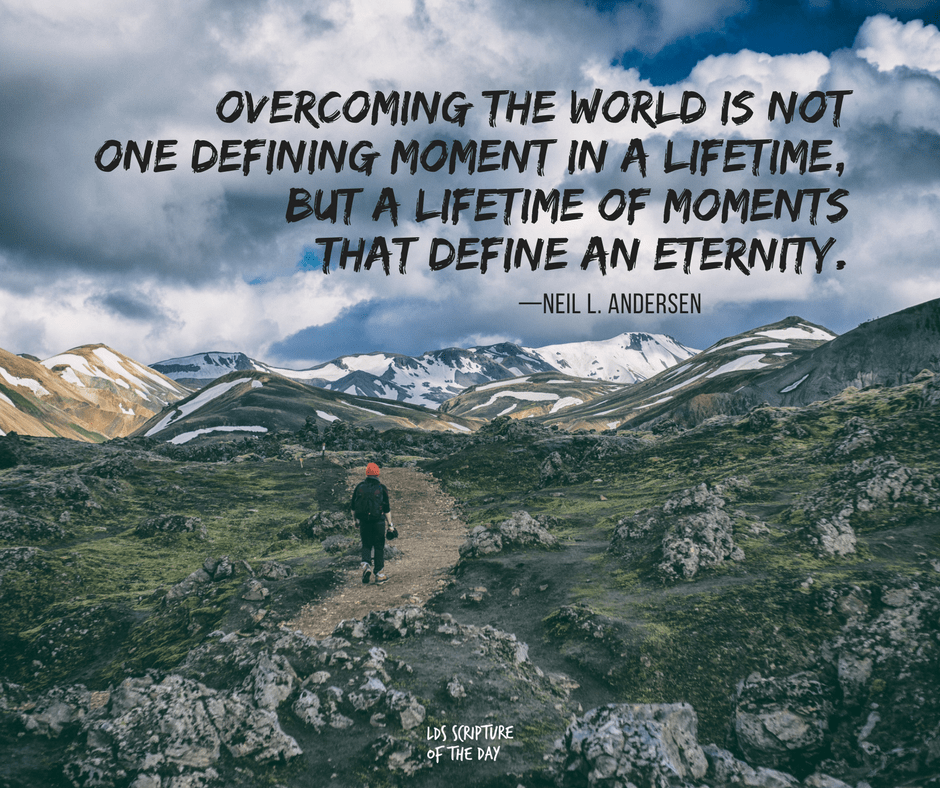
Overcoming the World

Everyone who believes that Jesus is the Christ is born of God, and everyone who loves the father loves his child as well. This is how we know that we love the children of God: by loving God and obeying his commands. In fact, this is love for God: to keep his commands. And his commands are not burdensome, for everyone born of God overcomes the world. This is the victory that has overcome the world, even our faith. Who is it that overcomes the world? Only the one who believes that Jesus is the Son of God. This is the one who came by water and blood—Jesus Christ. He did not come by water only, but by water and blood. And it is the Spirit who testifies because the Spirit is the truth. (1 John 5:1-6, NIV)

Faith, love, and obedience are tightly woven together to such an extent that to pull one of them out is to unravel the whole bunch. These three characteristics of the true Christian are vital and necessary to living the Christian life. They all must be present for the church to overcome the world.

The main verbs throughout the verses are the word “is.” And the verb tense is key. The verb clearly describes a past action of God which we as people need to receive. In other words, the grammar dictates that God has given us new birth.  We do not give ourselves spiritual birth any more than we can tell our mothers that it was us who gave birth to ourselves.

God saves us from sin and grants us forgiveness. This action is from God. We are recipients of God’s good grace toward us. There are three participles connected to this main verb:

  1. Believe
  2. Love
  3. Obey

A participle is a word which is connected to the verb’s action. So then, our actions are a result of God’s action toward us. To put it simply, a person born from God will believe, love, and obey. Just as a newborn baby first breathes, then learns to eat, sleeps, grows-up, learns to walk, and over time develops into an adult just like their mother and father, so the Christian who is born again from God exhibits faith, learns to love, and grows up developing the skills of obeying Jesus and following him, learning to walk in his ways, becoming just like him.

In the same way a child must learn and grow to have the necessary skills for facing the world in all its bigness, trials, and temptations, so the Christian must develop the abilities necessary to overcome the world. Those skills are faith, love, and obedience. Without them, we will be unable to deal with the world. But with them, we experience victory over the world.

The word, “overcome,” is a cognate word (related to) of “victory.”  That is, to overcome is to have firsthand exposure to the victory the Lord Jesus has achieved on the cross. Through being spiritually born again by God, we are set on a course requiring faith, love, and obedience to overcome the world. As we learn to apply these three spiritual characteristics to our lives, we experience practical victory over the world.

The term “world” are the patterns, systems, and operations of the world in direct contrast to how God operates. For example:

  • The world engages in revenge and payback when wronged, whereas the Christian learns to believe God as the Judge, loves the person who has offended them through prayer for their enemy, and obeys God through good works that seeks the welfare of the other. 
  • The world uses other people as either objects of their pleasure or to get ahead in life, whereas the Christian believes God will take care of their needs, will seek to love the other person instead of use them, and would rather obey God than be selfish. 
  • The world thinks nothing of lying, cheating, and stealing, if they can get away with it, whereas the Christian believes Jesus is the way, the truth, and the life, loves being a person of integrity, and obeys God even when it hurts.

This in no way means we avoid or belittle the world. In facing and overcoming the world, we need principled civility. Using faith, love, and obedience, we respect another’s viewpoint through growing in faith, expanding our hearts in love, and learning obedience through interaction with others for whom we disagree.

Where do we feel “the pull” in life from? Do we feel it from the world, or from God’s Word? We must learn how to deal with the worldly elements of our society in which we feel a pull and a tug to go along with it and want to give in to it. This requires a community of Christians engaging the world through faith, love, and obedience to overcome that pull.

Our call as Christians is not to just survive the world. If anyone could have had that kind of mentality, it was Helen Keller. Deaf, mute, and blind, she could have settled into just getting by and waiting for heaven. Yet, she accepted her situation, coped with it, and even transcended her limitations.  She did more than survive – she thrived. Helen Keller once said:

“The marvelous richness of human experience would lose something of rewarding joy if there were not limitations to overcome. The mountaintop would not be half so wonderful if there were no dark valleys to traverse.”

Helen Keller

We need faith in God, not ourselves. The Scripture says:

Trust in the Lord with all your heart,
    and do not rely on your own insight.
In all your ways acknowledge him,
    and he will make straight your paths. (Proverbs 3:5-6, NRSV)

We need to love God and others, and not the world. The Scripture says:

Don’t love the world’s ways. Don’t love the world’s goods. Love of the world squeezes out love for the Father. Practically everything that goes on in the world—wanting your own way, wanting everything for yourself, wanting to appear important—has nothing to do with the Father. It just isolates you from him. The world and all its wanting, wanting, wanting is on the way out—but whoever does what God wants is set for eternity. (1 John 2:15-17, MSG)

We need to obey the call of God, not the call of the world. Hear what Scripture says: 

The commandment that God has given us is: “Love God and love each other!” (1 John 4:21, CEV)

When faith, love, and obedience are working together as they were intended to, we will overcome the world and all its crud. We will keep ourselves from being polluted and stained by it.

Overcoming the world is a high calling from God. Faith means putting aside fear and taking the kind of risk God wants you to take. Love means putting aside hate and serving others, even when it hurts. Obedience means putting aside selfishness and choosing to do what is best for another person’s welfare. Being characterized by these three Christian virtues will have the effect of overcoming the world. It is not a burdensome or heavy way to live. It’s the way of Jesus.

Blessed Father, Son, and Holy Spirit, the God whom we serve: Sometimes our hearts and minds are flooded with fears. Sometimes we are paralyzed and overwhelmed and feel unable to go on. Yet today we hold onto the victory you have accomplished through the blood of Jesus Christ. You have told us not to fear, for you have overcome the world. So, we cling to you, believing your Word and your promises. In moments of crippling fear, we choose to hold your hand and believe; to love as we have been loved; and, to obey even in the most fearful places because we know that you have risen again.

Loving Lord Jesus, we surrender to you all that we are and hope to be. Holy Spirit, we invite you and all your ministry within us. Holy God of all, we offer you our heart, mind, body, soul, spirit, hopes, plans and dreams. We surrender to you our past, present and future problems, habits, character defects, attitudes, livelihood, resources, finances, medical coverage, occupation and all relationships. We give you our health, physical appearance, disabilities, family, marriage, children, grandchildren, and friendships.

We ask for your Lordship over every aspect of our lives. We surrender to you all our hurt, pain, worry, doubt, fear and anxiety, and ask you to wash us clean. We release everything into your compassionate care. Speak to us clearly, Lord. Open our ears to hear your voice. Open our hearts to commune with you more deeply. Open the doors that need to be opened and close the doors that need to be closed. Set our feet upon the straight and narrow road that leads to everlasting life. Amen.