Jesus Shows Up (John 20:19-31)

The Doubt of St. Thomas, by He Qi

It was still the first day of the week. That evening, while the disciples were behind closed doors because they were afraid of the Jewish authorities, Jesus came and stood among them. He said, “Peace be with you.”After he said this, he showed them his hands and his side. When the disciples saw the Lord, they were filled with joy.Jesus said to them again, “Peace be with you. As the Father sent me, so I am sending you.”Then he breathed on them and said, “Receive the Holy Spirit.If you forgive anyone’s sins, they are forgiven; if you don’t forgive them, they aren’t forgiven.”

Thomas, the one called Didymus, one of the Twelve, wasn’t with the disciples when Jesus came.The other disciples told him, “We’ve seen the Lord!”

But he replied, “Unless I see the nail marks in his hands, put my finger in the wounds left by the nails, and put my hand into his side, I won’t believe.”

After eight days his disciples were again in a house and Thomas was with them. Even though the doors were locked, Jesus entered and stood among them. He said, “Peace be with you.” Then he said to Thomas, “Put your finger here. Look at my hands. Put your hand into my side. No more disbelief. Believe!”

Thomas responded to Jesus, “My Lord and my God!”

Jesus replied, “Do you believe because you see me? Happy are those who don’t see and yet believe.”

Then Jesus did many other miraculous signs in his disciples’ presence, signs that aren’t recorded in this scroll. But these things are written so that you will believe that Jesus is the Christ, God’s Son, and that believing, you will have life in his name. (Common English Bible)

Mosaic of Doubting Thomas, Cathedral of Monreale, Italy

When Jesus shows up, there is peace. Wherever Jesus goes, the Spirit of God is there. When Jesus appears, people believe.

The Meeting

After the crucifixion of Christ, the disciples were huddled together, mostly in fear of being found out and put out by the religious authorities. Out of nowhere, Jesus showed up, smack in the middle of the anxious group of men.

Christ in the center makes all the difference. From this central place, Jesus bestowed to the disciples his peace. The very first word the risen Christ spoke to his disciples was neither a command to stop being afraid, nor a rebuke for sitting around and doing nothing, or disappointment because they all ran away in the final hour of need at the crucifixion.  

Instead, the first word of Christ was a gift of peace. The presence and peace of Christ melted the disciples’ fear. Christ-centered peace is graciously given; and so, it only makes sense to gratefully receive it.

The Reality

Jesus showed up, then showed off his hands and his side. He was not fabricated out of the disciples’ imagination; he was not some ghostly apparition. Rather, Christ was standing in the middle of them, very real, very physical, and very alive.

Christ gave his disciples real truth: actual wounded hands and side, on a real body. Christ is risen and alive – not just spiritually, but physically. Since the resurrection of Jesus really happened, then nothing else matters; our joy is complete. We have what we need.

The Mission

As Jesus was sent by the Father, so Jesus sent his disciples; and he is still sending us, his disciples, out into the world. Just as Jesus came not to condemn the world but to save it, so we go out with words of grace and peace. The church exists for the life of the world – to bless it with the presence and peace of Christ.

“Whoever believes in me does not believe in me only, but in the one who sent me. The one who looks at me is seeing the one who sent me. I have come into the world as a light, so that no one who believes in me should stay in darkness.” (John 12:44-46, NIV)

Our spiritual DNA makes us little Christ’s walking around, doing the will of God, for the benefit of a world in darkness. We bear the name of Christ: Christians, proclaiming a message of life, delighting in God and creation; and not destroying the earth and its inhabitants.

The Gift

We are not alone. The Holy Spirit has been graciously given to us by Jesus. Although our mission is a big one, our resource for accomplishing it is even bigger. Jesus gives the Spirit in the same way he gives himself – as a sheer gift with no strings attached. Just as God breathed life into the very first people on earth, so Jesus breathes on the disciples and gives them new life and a new heart.

I will give you a new heart and put a new spirit in you; I will remove from you your heart of stone and give you a heart of flesh. And I will put my Spirit in you and move you to follow my decrees and be careful to keep my laws… and you will be my people, and I will be your God. (Ezekiel 36:26-28, NIV)

The Privilege

Christ has redeemed us, forgave us of our guilt and shame. Now, we pass on the forgiveness to others. The special mission of the Church is giving Jesus to others with grace and peace, so that they may believe he is truly the risen Lord; and so, receive Jesus, the Spirit, forgiveness, and purpose in life, with Christ at the center of all things.

For the one whom God has sent speaks the words of God, for God gives the Spirit without limit. The Father loves the Son and has placed everything in his hands. Whoever believes in the Son has eternal life, but whoever rejects the Son will not see life, for God’s wrath remains on them.” (John 3:34-36, NIV)

The Appearance

When Jesus appears, its good if we also show up to see him. It seems Thomas was late for church and missed the beginning of the service. He wasn’t with the other gathered disciples. Nobody knows where he was or what he was doing. But the important thing is that he did eventually show up, because showing up is the beginning of a changed life.

The Witness

After Jesus showed up, the disciples bore witness to what they saw and heard to Thomas. Yet Thomas, bless his doubting heart, wasn’t having it. He’s a realist. He wants proof, some actual physical evidence. Thomas was clearly a tactile learner because he needs some touch to believe any of this crazy talk of his disciple brothers.
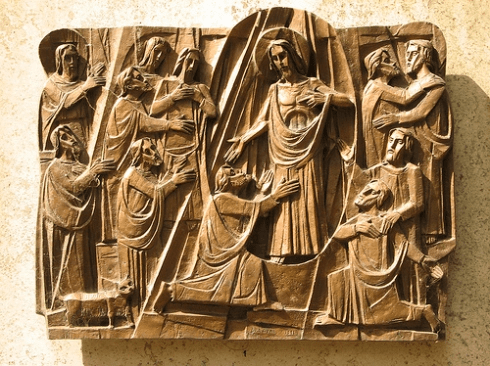
The Risen Lord appears to St. Thomas and the apostles, Catacombs of St. Callixtus, Rome, Italy

Sometimes Thomas gets a bad rap, but he is really our Everyman. Doubt and skepticism are an important part of a full-orbed and honest faith. Jesus gave Thomas some space, time, and respect to begin wrapping his head and heart around this new reality of resurrection. I wonder if we all can do the same with others.

The Middle

A second time, Jesus showed up in the middle of the disciples. The Word became flesh and dwelt among us – and didn’t become a ghost and hang out in secret places. Once again, peace is given by Jesus to his followers. Both appearances happen on a Sunday (which is why Christians worship on Sunday); and both meetings are literally Christ-centered (which every Christian meeting is supposed to be). Every Sunday; and Christ in the middle. Keep those two together forever, and you cannot go wrong.

The Invitation

There’s no beating around the bush with Jesus. He immediately engaged Thomas and invited him to touch the wounds on his very real body. Christ knew Thomas’ hangup, and went right to it. Thomas wanted evidence; Jesus offered it. If we get anything out of this encounter, it’s that the risen Christ honors honest doubt.

The evidence is here. Now believe it, and stop disbelieving. We have documentary evidence of the Old and New Testaments; the Church’s witness in Creeds, Confessions, and contemporary narratives of changed lives; and the internal testimony of the Holy Spirit. Therefore, look into them carefully and draw a sound conclusion.

The Confession

“My Lord and my God!” That’s the confession and the conclusion Thomas drew from the evidence – not only that Jesus is real, alive, existed, a good teacher; or other people’s Lord and God – but that he is my Lord and my God.

Jesus cared enough for Thomas to specifically meet him personally at his point of need. The grace of God keeps coming and never runs out. Jesus is filled up to the full in both grace and truth.

The Believer

Thomas had the physical evidence. But it doesn’t take that to truly believe. God blesses those who’ve never seen nor touched, but still believe. Jesus was thinking of you and me, and not only the people in front of him at the time. The Lord Jesus blesses us with the gift of peace, grace, and faith.

Though you have not seen him, you love him; and even though you do not see him now, you believe in him and are filled with an inexpressible and glorious joy, for you are receiving the end result of your faith, the salvation of your souls. (1 Peter 1:8-9, NIV)

The Conclusion

All this is for our benefit, so that we, too, may believe that Jesus is the Christ, the Son of the living God. Since Jesus is alive, he continues to bless us with his presence, power, and peace. Jesus is with us:

  • through the Word of God, giving us his peace, showing up and meeting needs people.
  • at the Table in the sacrament of communion, bringing grace and forgiveness
  • in the person of the Holy Spirit, enabling and energizing us for mission and ministry to the world

It’s a life worth living, a Christ-centered life, full of God’s blessing. Amen.

Dealing with Disrespect and Disbelief (John 12:34-50)

Christ and the Pharisees, by Anthony van Dyck (1599–1641)

The crowd spoke up, “We have heard from the Law that the Messiah will remain forever, so how can you say, ‘The Son of Man must be lifted up’? Who is this ‘Son of Man’?”

Then Jesus told them, “You are going to have the light just a little while longer. Walk while you have the light, before darkness overtakes you. Whoever walks in the dark does not know where they are going. Believe in the light while you have the light, so that you may become children of light.” When he had finished speaking, Jesus left and hid himself from them.

Even after Jesus had performed so many signs in their presence, they still would not believe in him. This was to fulfill the word of Isaiah the prophet:

“Lord, who has believed our message
    and to whom has the arm of the Lord been revealed?”

For this reason they could not believe, because, as Isaiah says elsewhere:

“He has blinded their eyes
    and hardened their hearts,
so they can neither see with their eyes,
    nor understand with their hearts,
    nor turn—and I would heal them.”

Isaiah said this because he saw Jesus’ glory and spoke about him.

Yet at the same time many even among the leaders believed in him. But because of the Pharisees they would not openly acknowledge their faith for fear they would be put out of the synagogue; for they loved human praise more than praise from God.

Then Jesus cried out, “Whoever believes in me does not believe in me only, but in the one who sent me. The one who looks at me is seeing the one who sent me. I have come into the world as a light, so that no one who believes in me should stay in darkness.

“If anyone hears my words but does not keep them, I do not judge that person. For I did not come to judge the world, but to save the world. There is a judge for the one who rejects me and does not accept my words; the very words I have spoken will condemn them at the last day. For I did not speak on my own, but the Father who sent me commanded me to say all that I have spoken. I know that his command leads to eternal life. So whatever I say is just what the Father has told me to say.” (New International Version)

It seems that nowadays, the more one rises in popularity and garners national attention, the more some folks want to disrespect them.

Out of the many examples of this phenomenon, consider the case of a young woman from my home state of Iowa. Sportswriter Mike DeCourcy recently mused on why the University of Iowa’s Caitlin Clark has discovered that not all the greats of women’s college basketball welcome her success.

Several women – who ought to know better – have cynically reacted to Clark’s legitimate college greatness with a sort of “Why her, why not us?” attitude. They’ve indulged in misinformation and cheap shots that clearly say more about them than Caitlin Clark.

This is especially curious, since Clark has elevated women’s basketball to a level of attention that her now detractors and others have envied for decades. DeCourcy writes, “None of this [delegitimizing Clark] is a good look for NCAA women’s basketball, and neither does it appear to be the most prudent way to continue growing the sport.”

The same type of thing could be said about Jesus and the movement he was sparking during his ministry on this earth. Many of the religious leaders refused to acknowledge his greatness, nor believe in the words he was saying. Instead, they sought to knock down Jesus and the good work he was doing.

It seems the religious leaders wanted the praise and attention Jesus was getting. Even many who believed in what was happening, kept their mouths shut and let the misinformation spread, because they, too, loved the praise of others instead of praise from God.

Playing with the game of darkness, nobody wins. People end up only being a mere shadow of the person they could be. Trying to disrespect others in order to shine the light on yourself is a convoluted and misguided way of handling anyone or any situation.

Carl Jung (1875-1961) described this hidden shadow self as an unconscious aspect of the human personality. In other words, the shadow results from the conscious self being unaware or unconscious concerning areas of its own personality. Without the light of conscious awareness, the shadow self runs amok within the psyche of a person and far too often calls the shots in speaking and behavior.

“Everyone carries a shadow,” Jung wrote, “and the less it is embodied in the individual’s conscious life, the blacker and denser it is.” (Psychology and Religion, 1938)

According to Jung, the shadow side of a person is prone to psychological projection, in which a perceived personal inferiority is recognized as a perceived moral deficiency in someone else. If those projections remain hidden, they eventually come out sideways by harming others because there is a dark illusion, even delusion, that others are stealing what is rightfully mine.

Hence, the sinless Jesus is denigrated, disrespected, and disbelieved. And it is what led to him being tortured and killed by those who thought they are doing a good thing.

It’s easy to be hard on the religious rulers in the New Testament, but this is the Christian season of Lent, and so, we must shine the light of Scripture upon ourselves. This is the time to deliberately gain awareness of our own shadow selves.

Perhaps the burning question for all believers at this time of year is: Do I seek the presence of God more than the presence of anything or anyone else?  

Maybe you live in fear at work and are more concerned about the presence of people around you than the presence of God, so you keep quiet when you ought to speak up or turn a blind eye to the shadows of an organization. Or worse, you talk bad about someone good, just because they’re getting the attention you feel you deserve.

In these remaining days of Lent, as we journey with Jesus to Jerusalem, let’s let the light of his gracious ministry dispel the dark shadows of our hearts and make us aware of who we are, and what we need to change.

If we can learn to appreciate the God-given and hard-earned talents of a young woman playing basketball, then perhaps we can then also learn to glory in One who is greater than any sports celebrity, and celebrate the great work done on this earth for us and for our salvation.

Good and gracious God, we are far too often influenced by what others think of us. We sometimes pretend to be either richer or smarter or nicer than we really are. So, prevent us from trying to divert attention from others to ourselves. Don’t let us gloat over praise received from others, nor be discouraged by criticism from another. Show us, instead, how to be humble of heart, like the Lord Jesus, in whose name we pray. Amen.

Whoever Believes (John 3:14-21)

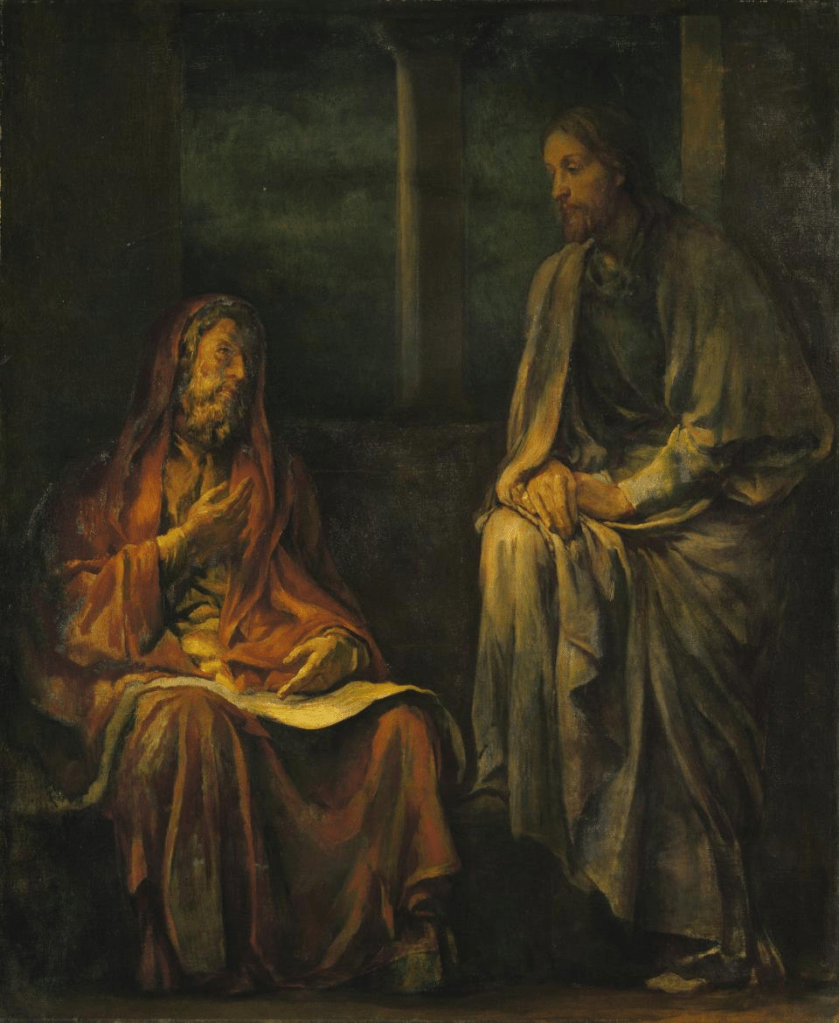
Interview Between Jesus and Nicodemus, by James Tissot (1836-1902)

Just as Moses lifted up the snake in the wilderness, so the Son of Man must be lifted up,that everyone who believes may have eternal life in him.”

For God so loved the world that he gave his one and only Son, that whoever believes in him shall not perish but have eternal life. For God did not send his Son into the world to condemn the world, but to save the world through him. Whoever believes in him is not condemned, but whoever does not believe stands condemned already because they have not believed in the name of God’s one and only Son. 

This is the verdict: Light has come into the world, but people loved darkness instead of light because their deeds were evil. Everyone who does evil hates the light, and will not come into the light for fear that their deeds will be exposed. But whoever lives by the truth comes into the light, so that it may be seen plainly that what they have done has been done in the sight of God. (New International Version)

For many, the truth about God’s purposes in Christ is confusing, even troubling. It was for Nicodemus. And even though there many today who simplify the exchange between Jesus and Nicodemus with a single Bible verse of John 3:16, taking a good look at the Gospel of John puts most of us with Nicodemus.

Nicodemus, a learned Jewish scholar, a Pharisee, found Christ’s words both confusing and troubling because it required him to let go of everything he understood – to let go and become like a newborn baby, receiving and discovering the world on new and different terms. In other words, Nicodemus had to unlearn some things before he could learn truth.

There are some things that are hard to grasp, not because they are so intellectually challenging, but because those things ask a lot of us, demanding our very lives. And so, we don’t so much want to understand; it would require a radical change.

But why would anyone not want to understand the good news that God so loved the world that gave the Son so that we may believe and have eternal life? Because we would then have to contend with the ways Jesus describes himself.

Jesus likened himself to the serpent that Moses lifted up in the desert (John 3:14; Numbers 21:4-9). In that story of Moses in the Old Testament book of Numbers, God sent poisonous snakes into the Israelite camp as punishment for the people’s incessant complaining against God.

Then, when the people repented, God told Moses to make a bronze snake, put it on a pole, and lift it up, so that anyone bitten by one of the poisonous snakes could see it and live. Jesus likened himself to the story. In the same way the bronze snake was lifted on a pole, Jesus explained that so must the Son of Man be lifted up, or exalted high above the people.

Visit of Nicodemus to Christ, by John La Farge, 1880

In the typical language of the Apostle John, using double meanings to a single concept, he meant to communicate that Jesus would be physically lifted onto the cross, above the people; and also that Jesus would be lifted up by God as the exalted One above all creation. (John 8:28; 12:32)

Just as the ancient Israelites were facing death because of their sin, and deliverance because of God’s action through Moses, so people everywhere in every age face the consequences of their sinful complaining; yet through the action of God through Christ’s crucifixion, resurrection and ascension, they can look up to the exalted and glorified Lord and receive deliverance from sin, death, and hell.

There is more to looking up at the lifted One than a mere incline of the head and eyes. In modern terms, we would refer to the sheer action of looking as an intellectual assent to faith. The Apostle John, however, means to have us believe, not simply acknowledge.

Jesus did not tell Nicodemus to simply acknowledge him as Savior, to accept him into the heart, and so, be saved. No, this was an encounter that left an intelligent man and an accomplished scholar scratching his head in bewilderment as he went back out into the darkness.

Today’s Gospel lesson is a story about how any one of us might reject the light offered to us because of the way it exposes what is dark within us. Therefore, to believe requires ultimate trust in another. It isn’t to acknowledge that Jesus was real and had an actual ministry on earth; it’s more than believing something happened in history in the ancient world of the first century.

To believe is to let our own lives be transformed by the Jesus we encounter in this story. And here is what that means:

  1. Realizing and becoming aware of the ways we are complicit in and benefit from having our loyalties elsewhere, other than Jesus. To believe demands us answering the question: Whom shall you serve?
  2. Placing our ultimate trust, allegiance, and loyalty in Jesus Christ. To believe begs the question: To whom will you commit all that you have, and all that you are?
  3. Forsaking all other competing loyalties and “gods,” including both secular and religious deities. To believe means a single-minded devotion, which asks of us all: To whom and to what will you forsake in order to embrace Jesus?
  4. Confronting inconvenient truths of our own personal values which clash with Christ’s ideals of righteousness. To believe presses us to answer the question: To whom and for what are you truly living for?
  5. Willing to die to self and to anything that would hinder knowing Jesus and him crucified, risen, ascended, and coming again. To believe forces us to ask ourselves: Am I willing to die for Jesus?

While there is nothing in this world worth killing for, there are things worth dying for. The lifting up of Jesus lets us know that the true life God has promised us is not the life that we can secure for ourselves through self-interest, caution, and theological debate.

Most merciful God,
we confess that we have sinned against you
in thought, word, and deed,
by what we have done,
and by what we have left undone.
We have not loved you with our whole heart;
we have not loved our neighbors as ourselves.
We are truly sorry and we humbly repent.
For the sake of your Son Jesus Christ,
have mercy on us and forgive us;
that we may delight in your will,
and walk in your ways,
to the glory of your Name. Amen.

A Desert Spirituality (Mark 1:9-15)

In those days Jesus came from Nazareth of Galilee and was baptized by John in the Jordan. And just as he was coming up out of the water, he saw the heavens torn apart and the Spirit descending like a dove upon him. And a voice came from the heavens, “You are my Son, the Beloved; with you I am well pleased.”

And the Spirit immediately drove him out into the wilderness. He was in the wilderness forty days, tested by Satan, and he was with the wild beasts, and the angels waited on him.

Now after John was arrested, Jesus came to Galilee proclaiming the good news of God and saying, “The time is fulfilled, and the kingdom of God has come near; repent, and believe in the good news.” (New Revised Standard Version)

40 Days of Desert

We are in the season of Lent in the Christian Year. Beginning with Ash Wednesday, Christians take a forty-day journey, leading to Holy Week and Easter. Jesus spent forty days in the desert being tempted by Satan. So, the Church remembers this event with the season of Lent.

This is the season in which many Christians give focus to the temptations we face on a regular basis. We intentionally practice spiritual disciplines, such as fasting, and give up something for six weeks, so that we might become aware of our attachments to other things and how much we rely on them, instead of trusting God.

It was important for Jesus to be in the desert; and it’s necessary for us, as well. Jesus retraced the steps of the ancient Israelites, who wandered in the desert for forty years before entering the Promised Land. The people needed to re-connect with God, after having failed in their faith. Trust had to be strengthened and developed before they could be ready to receive God’s promises.

Jesus accomplished what others did not: He faced down the devil and overcame temptation in the desert. 

The forty days were a necessary preparation for the upcoming three years of ministry that would culminate in Christ’s death, burial, and resurrection. Before any of that could happen, Jesus had to experience the desert.

We, like Jesus, need a desert spirituality. The desert forms us into followers of Jesus by learning to overcome temptation, so that we will not be shaped into followers of Satan. God desires to strengthen our faith, and facing down the temptations of Satan are crucial to our spiritual development.

For Christians, the desert becomes the gymnasium where we are broken down through the stress of temptation, so that we might become spiritually stronger in our faith. Without this kind of spiritual training, we become vulnerable to Satan’s accusations, and easy prey to his temptations.

Christ’s Desert

After the baptism of Jesus, the Spirit flung him into the desert. There was real danger in the desert, wild animals and all. Yet, put in that situation and having come through it, Jesus was able to deal with the crafty pursuits of Satan to distract him from his mission. 

Throughout the Gospel of Mark, after tossing demons out of people, Jesus commanded the unclean spirits not to tell anyone who he was. Part of what was going on, is that Satan wanted to tempt Jesus to gain fame and power through popularity and accolades. But that was not the way of Jesus. He was not going to bring in the kingdom of God through the avenues of careful marketing and brand recognition.

Another practice of Jesus throughout his ministry was to seek places for solitude and prayer. The needs Jesus daily faced were large and vast and never ended. Yet, he resisted working without any rest or guidance in prayer. 

A temptation could have been to please people and never get away to pray. Yet, through solitude and prayer, Jesus connected with his Father; he moved from place to place proclaiming the good news of God’s rule and reign. Jesus did not succumb to the temptation to settle in one place and build a petty kingdom of his own, apart from the Father.

As Jesus walked the countryside telling people of repentance and faith, he often spoke in parables that were designed to foster thought and reflection. Jesus was not duped by the temptation to always be black and white about everything, merely giving the bottom line of his teaching to people. 

Christ did not teach in order to get immediate results, or to let people know which side he was on concerning the issues of the day. Instead, Jesus was about the business of building something permanent that would far outlast his short three years of ministry.

Because of the desert, and through his Father’s affirmation, Jesus lived a unique three years on this earth that has never been equaled before or since.

Our Desert

Years ago, I went on a leadership retreat in the Canadian wilderness. We were so far out in the sticks that we needed special first aid training before leaving, because if someone got severely injured it would be hours before he could receive any medical attention. There was no cell phone service, no towns, no anything except mile after square mile of wilderness. 

We were continually vigilant to not attract bears. The wilderness can be a dangerous place. One day, we were each dropped off on our own personal islands for an entire day, alone. Being face to face with yourself can be hard to deal with, which is what a desert experience does – it exposes the idols of our hearts and the ways in which we are tempted.

A person does not need to be in the Canadian wilderness or in the actual desert to experience the effects of desert life. The Holy Spirit has a way of throwing us into the desert through a change of circumstance, so that we will exercise our spiritual muscles and get in spiritual shape. 

The top three temptations that people face on a daily basis are: 

  1. Worry and anxiety
  2. Procrastination and putting things off
  3. Gossip and other sins of the tongue 

So, how do we face down those temptations and retrace our steps back to the path of God? Here are some lessons I have learned in my own desert experiences:

  1. Know your weaknesses. Know yourself, and the temptations directed at you. The three I just mentioned all come from a tendency toward perfectionism. We worry about the future, of not saying or doing something perfectly. So, we procrastinate for fear of screwing up and not being perfect. And we gossip to others about their faults and weaknesses because it maintains the illusion that our perfectionism is intact, at least as compared to others. Perfectionism is slavery. For freedom Christ has set us free. Stand firm, therefore, and do not submit again to a yoke of slavery. (Galatians 5:1, NRSV)
  2. Understand the importance of timing. When are you at your weakest, and vulnerable to temptation? What triggers you to sin? Whenever kids act up, we first wonder if they are tired or hungry or have some other need. It’s the same with us. Carrying sleep debt, skipping meals, or eating junk food because we are in a hurry, will set us up for temptation. Elijah faced down four-hundred prophets of Baal, then fell apart when one woman, Jezebel, went after him. He needed food and rest. Discipline yourselves; keep alert. Like a roaring lion your adversary the devil prowls around, looking for someone to devour. (1 Peter 5:8, NRSV)
  3. Look to God and others. Don’t rely solely on your own willpower; or believe that you can resist temptation all by yourself, all the time. Even Jesus looked both to his Father and his disciples. Then Jesus went with them to a place called Gethsemane, and he said to his disciples, “Sit here while I go over there and pray.” He took with him Peter and the two sons of Zebedee and began to be grieved and agitated. Then he said to them, “My soul is deeply grieved, even to death; remain here, and stay awake with me.” And going a little farther, he threw himself on the ground and prayed, “My Father, if it is possible, let this cup pass from me, yet not what I want but what you want.” Then he came to the disciples and found them sleeping, and he said to Peter, “So, could you not stay awake with me one hour? Stay awake and pray that you may not come into the time of trial; the spirit indeed is willing, but the flesh is weak.” (Matthew 26:36-41, NRSV)
  4. Have a plan. Flying by the seat of your pants will not always work. The clever see danger and hide, but the simple go on and suffer for it. (Proverbs 22:3, NRSV) One of the ways I personally resist temptation is by having a daily plan of worshiping God, praying, and reading Scripture at set times throughout the day. For me, it’s significant to have more than a few minutes of “quiet time” in the morning.
  5. Overcome evil with good. Do not be overcome by evil, but overcome evil with good. (Romans 12:21, NRSV) Applying this to the top three temptations people face, that means worriers will love their enemy and pray for those who persecute. For the procrastinator, it means to take intentional steps of faith and risk, being real and vulnerable with others through accountable relationships. For the gossip, they will seek to speak words of encouragement that build others up.
  6. Know that you are never alone. Angels attended Jesus. Even the Son of God was not on his own.  Whatever you are facing is likely not unique to you. Others face it, too. Our brothers and sisters throughout the world are undergoing the same kind of problems when they seek to walk with Christ.

Let the desert shape and strengthen your faith. If the Holy Spirit has thrown you into a dry place, then instead of bucking the situation and complaining about it, learn all you can about resisting temptation so that you can come out the other end a stronger, more faithful follower of Jesus Christ. 

May it be so, to the glory of God.