Whoever Believes (John 3:14-21)

Interview Between Jesus and Nicodemus, by James Tissot (1836-1902)

Just as Moses lifted up the snake in the wilderness, so the Son of Man must be lifted up,that everyone who believes may have eternal life in him.”

For God so loved the world that he gave his one and only Son, that whoever believes in him shall not perish but have eternal life. For God did not send his Son into the world to condemn the world, but to save the world through him. Whoever believes in him is not condemned, but whoever does not believe stands condemned already because they have not believed in the name of God’s one and only Son. 

This is the verdict: Light has come into the world, but people loved darkness instead of light because their deeds were evil. Everyone who does evil hates the light, and will not come into the light for fear that their deeds will be exposed. But whoever lives by the truth comes into the light, so that it may be seen plainly that what they have done has been done in the sight of God. (New International Version)

For many, the truth about God’s purposes in Christ is confusing, even troubling. It was for Nicodemus. And even though there many today who simplify the exchange between Jesus and Nicodemus with a single Bible verse of John 3:16, taking a good look at the Gospel of John puts most of us with Nicodemus.

Nicodemus, a learned Jewish scholar, a Pharisee, found Christ’s words both confusing and troubling because it required him to let go of everything he understood – to let go and become like a newborn baby, receiving and discovering the world on new and different terms. In other words, Nicodemus had to unlearn some things before he could learn truth.

There are some things that are hard to grasp, not because they are so intellectually challenging, but because those things ask a lot of us, demanding our very lives. And so, we don’t so much want to understand; it would require a radical change.

But why would anyone not want to understand the good news that God so loved the world that gave the Son so that we may believe and have eternal life? Because we would then have to contend with the ways Jesus describes himself.

Jesus likened himself to the serpent that Moses lifted up in the desert (John 3:14; Numbers 21:4-9). In that story of Moses in the Old Testament book of Numbers, God sent poisonous snakes into the Israelite camp as punishment for the people’s incessant complaining against God.

Then, when the people repented, God told Moses to make a bronze snake, put it on a pole, and lift it up, so that anyone bitten by one of the poisonous snakes could see it and live. Jesus likened himself to the story. In the same way the bronze snake was lifted on a pole, Jesus explained that so must the Son of Man be lifted up, or exalted high above the people.
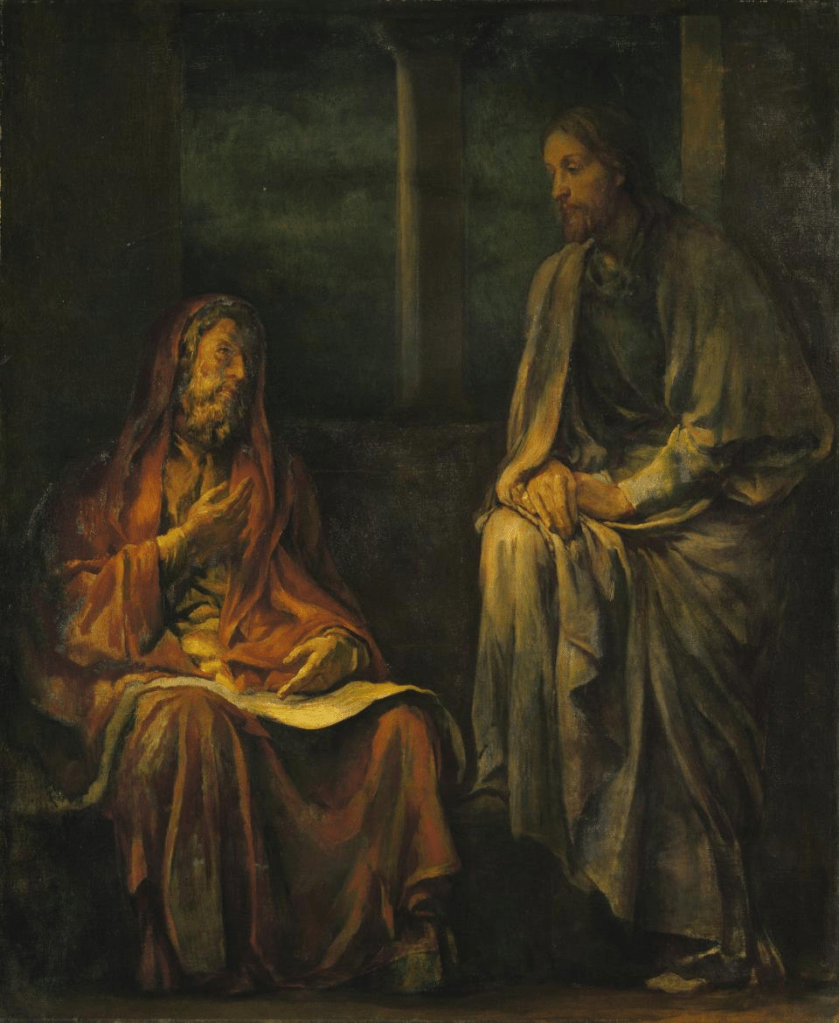
Visit of Nicodemus to Christ, by John La Farge, 1880

In the typical language of the Apostle John, using double meanings to a single concept, he meant to communicate that Jesus would be physically lifted onto the cross, above the people; and also that Jesus would be lifted up by God as the exalted One above all creation. (John 8:28; 12:32)

Just as the ancient Israelites were facing death because of their sin, and deliverance because of God’s action through Moses, so people everywhere in every age face the consequences of their sinful complaining; yet through the action of God through Christ’s crucifixion, resurrection and ascension, they can look up to the exalted and glorified Lord and receive deliverance from sin, death, and hell.

There is more to looking up at the lifted One than a mere incline of the head and eyes. In modern terms, we would refer to the sheer action of looking as an intellectual assent to faith. The Apostle John, however, means to have us believe, not simply acknowledge.

Jesus did not tell Nicodemus to simply acknowledge him as Savior, to accept him into the heart, and so, be saved. No, this was an encounter that left an intelligent man and an accomplished scholar scratching his head in bewilderment as he went back out into the darkness.

Today’s Gospel lesson is a story about how any one of us might reject the light offered to us because of the way it exposes what is dark within us. Therefore, to believe requires ultimate trust in another. It isn’t to acknowledge that Jesus was real and had an actual ministry on earth; it’s more than believing something happened in history in the ancient world of the first century.

To believe is to let our own lives be transformed by the Jesus we encounter in this story. And here is what that means:

  1. Realizing and becoming aware of the ways we are complicit in and benefit from having our loyalties elsewhere, other than Jesus. To believe demands us answering the question: Whom shall you serve?
  2. Placing our ultimate trust, allegiance, and loyalty in Jesus Christ. To believe begs the question: To whom will you commit all that you have, and all that you are?
  3. Forsaking all other competing loyalties and “gods,” including both secular and religious deities. To believe means a single-minded devotion, which asks of us all: To whom and to what will you forsake in order to embrace Jesus?
  4. Confronting inconvenient truths of our own personal values which clash with Christ’s ideals of righteousness. To believe presses us to answer the question: To whom and for what are you truly living for?
  5. Willing to die to self and to anything that would hinder knowing Jesus and him crucified, risen, ascended, and coming again. To believe forces us to ask ourselves: Am I willing to die for Jesus?

While there is nothing in this world worth killing for, there are things worth dying for. The lifting up of Jesus lets us know that the true life God has promised us is not the life that we can secure for ourselves through self-interest, caution, and theological debate.

Most merciful God,
we confess that we have sinned against you
in thought, word, and deed,
by what we have done,
and by what we have left undone.
We have not loved you with our whole heart;
we have not loved our neighbors as ourselves.
We are truly sorry and we humbly repent.
For the sake of your Son Jesus Christ,
have mercy on us and forgive us;
that we may delight in your will,
and walk in your ways,
to the glory of your Name. Amen.

True Faith (Hebrews 11:1-3, 13-19)

Now faith is confidence in what we hope for and assurance about what we do not see. This is what the ancients were commended for.

By faith we understand that the universe was formed at God’s command, so that what is seen was not made out of what was visible….

All these people were still living by faith when they died. They did not receive the things promised; they only saw them and welcomed them from a distance, admitting that they were foreigners and strangers on earth. People who say such things show that they are looking for a country of their own. If they had been thinking of the country they had left, they would have had opportunity to return. Instead, they were longing for a better country—a heavenly one. Therefore God is not ashamed to be called their God, for he has prepared a city for them.

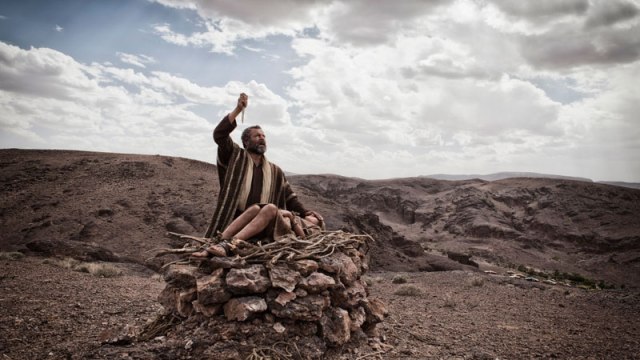
By faith Abraham, when God tested him, offered Isaac as a sacrifice. He who had embraced the promises was about to sacrifice his one and only son, even though God had said to him, “It is through Isaac that your offspring will be reckoned.” Abraham reasoned that God could even raise the dead, and so in a manner of speaking he did receive Isaac back from death. (New International Version)

Faith is important. It’s part of us. We are all people of faith – maybe not sharing the same faith – but it is faith, none-the-less.

Belief transcends time. Faith is rooted in the past, experienced in the present, and future-oriented. In Christianity, faith is historically moored to the redemptive events of Christ’s incarnation, life, death, resurrection, and ascension.

This historic faith has continuing ramifications into the present time. And it is a faith which believes Christ is coming again to judge the living and the dead.

People of faith allow their belief in what is coming to shape how they live now in daily life.

The biblical character of Abraham is synonymous with faith. And for good reason. God had told Abraham he would have a son with his wife Sarah. This would not be unusual except for the fact the couple were well advanced in age, and Sarah was incapable of having children.

Yet, despite the overwhelming odds, Abraham believed God. Years later and with a mix of patience and impatience from the would-be parents, the promise from God was realized. Abraham and Sarah had a son, Isaac.

But true faith never comes without anguish…

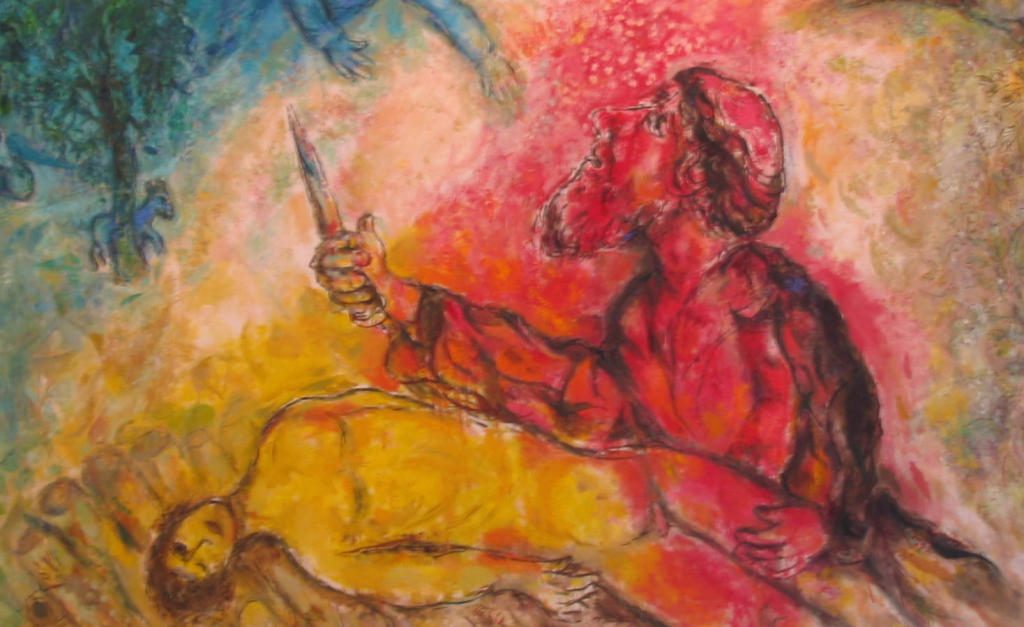
Isaac was known as the child of the promise. So that’s why this command of God was so perplexing: Take your son, this child of the promise, and go to the mountain and sacrifice him there. (Genesis 22:2)

Huh? What the #&%!  But it only seems strange and super-weird to us. There was no reaction from Abraham, no questioning, no talk back. He simply went about the business of saddling up the donkey, chopping some wood for the sacrifice, and took his only son with him on the journey to the mountain. (Genesis 22:3-5)

The Sacrifice of Isaac, by Marc Chagall, 1966

We might wonder what was going through Abraham’s mind through all of this. While you and I might try and figure out if we really heard God or not, Abraham had a history of talking with God. He knew God’s voice as well as he knew his own.

Abraham was well down the road of relationship with the God he served. We gain the insight from the author of Hebrews into Abraham’s thought process, a line of thinking consistent with a person who has a regular habit of talking with God.

The promise was given to Abraham that it would be Isaac who receives the family blessing. So, when Abraham’s faith underwent a maximum test, he was willing to sacrifice Isaac. He reasoned and believed that God could raise people to life. Abraham simply thought he would get Isaac back from death.

Abraham did not try and figure out God’s mind. He didn’t get into a debate with God about the contradiction of ethics he was being asked to do. He just obeyed. Abraham knew that it didn’t matter if Isaac were killed because God would raise him from death.

This, of course, is not what happened. It was all a test of faith. Abraham knew beyond a shadow of a doubt that God is the Lord who provides. (Genesis 22:9-14)

You and I, along with all the faithful believers who have gone before us, rarely know why we are facing the unwanted and unasked for circumstances we are enduring. We don’t always know what in the world God is thinking.

Yet, like Abraham, if we have a spiritual history of walking with God and hearing the Lord’s voice, we don’t hesitate to respond. We are convinced God will provide. Obedience for the follower of Christ is not a burden but a privilege, even when we are being tested beyond our seeming emotional ability to do it.

True biblical faith is neither an existential leap into darkness, nor a simple recognition of certain facts. Rather, Christian faith is a reliance upon and commitment to the promises of God that results in taking a risk. 

Sovereign Lord, your ways are sometimes strange and confusing. Yet, I know that everything you do is always right, just, and good. It is to your gracious and merciful character that I know you will provide. My allegiance is to you, in the Name of Jesus Christ, through the power of the Holy Spirit. Amen.

Believing Hearts vs. Poisoned Minds (Acts 14:1-7)

A Roman bridge between Iconium and Pisidian Antioch

The same thing occurred in Iconium, where Paul and Barnabas went into the Jewish synagogue and spoke in such a way that a great number of both Jews and Greeks became believers. But the unbelieving Jews stirred up the gentiles and poisoned their minds against the brothers. So they remained for a long time speaking boldly for the Lord, who testified to the word of his grace by granting signs and wonders to be done through them. 

But the residents of the city were divided: some sided with the Jews, and some with the apostles. And when an attempt was made by both gentiles and Jews, with their rulers, to mistreat them and to stone them, the apostles learned of it and fled to Lystra and Derbe, cities of Lycaonia, and to the surrounding region, and there they continued proclaiming the good news. (New Revised Standard Version)

The typical approach of the Apostles Paul and Barnabas was to enter a city and find the local Jewish synagogue. But their missionary efforts went well beyond attempting to reach fellow Jews; they also had the mind and heart to include non-Jewish persons, Gentiles, in the fledgling Church.

As a result of this apostolic ministry, a number of both Jews and Gentiles believed the message of God’s grace and became followers of Jesus. Thus, two ancient enemies came together to form one new society. Old animosities and prejudices came down. Jew and Gentile began worshiping together and embracing the words and ways of Jesus.

Yet, at the same time, there were also many Jews who refused to believe. Just as the new believers united together in faith, so the unbelievers banded together for a different purpose: to stir up the Gentiles by infecting their minds against this new union of people, centered around a common confession of Christ.

The unbelievers started a slander campaign against Paul and Barnabas, sowing mistrust and suspicion amongst the people in the street. But the sinful propaganda didn’t deter the apostles from spending considerable time in the city of Iconium and speaking confidently about the good news of Jesus.

What’s more, the message was confirmed by a demonstration of spiritual power. Paul and Barnabas were enabled by God to do many miraculous wonders in the city. This helped the gospel and the authority of the apostles to be established with the people.

The dynamic of belief and unbelief, cut right down the middle of the city. The people became divided and polarized. Some sided with the Apostles Paul and Barnabas, persuaded by their arguments and convinced by their actions; and others sided with the unbelieving Jews, having listened to their slanderous accusations and looking at the apostles as a threat to their existing society.

The climate in the city of Iconium became ripe for violence. Relations between believers and unbelievers deteriorated into planning harm against the new Christians. Even the city officials were becoming sympathizers with the planners to rid the city of the apostles once and for all. In other words, for Paul and Barnabas to remain in the city meant that they would likely get stoned and left for dead.

So, the apostles got out of Dodge and went to the cities of Lystra and Derbe. At least they could keep proclaiming the good news of grace to other people and avoid getting killed.

This story gets at a practical reality for many people of faith: How do people maintain their religious convictions and commitments in an environment that views them as harmful to society?

To be sure, not every person of faith faces this. But others around the world face it every day. And then there are perhaps the majority of the faithful, who sometimes find themselves in places and positions in which slander is rife and verbal violence abounds. What is a person of faith to do?

Not every situation is the same, so each circumstance will take some wisdom in handling it. Nevertheless, the following are some aspects to consider in dealing with the unbelief of others and the harmful effects it can bring:

  1. Persevere in your spiritual confidence. Paul and Barnabas did not cower in fear, but kept up their missionary efforts. The words of gossip and attitudes of hostility around them didn’t slow them down one bit. In fact, in other situations, the apostles who actually experienced harm, chose to view it as a privilege to suffer in the same sort of way Jesus did.
  2. Know when to walk away. Boldness doesn’t necessarily mean that one throws caution to the wind and simply keeps going, no matter the consequences. Paul and Barnabas knew when to leave the city and go somewhere else. They realized the shelf life of their ministry in Iconium was at an end. Neither one of them bemoaned the situation, but instead, looked ahead to the opportunity of gospel proclamation in other cities.
  3. Trust God in all things. Whenever we are slandered, or others actually make plans of harm against us, our initial desire may be to get them before they get us; or to fight back using the same tools of violence that were done against us. Paul and Barnabas did no such thing. Believers have spiritual tools of use that unbelievers don’t possess. So, use them. Pray for those who mistreat you. And let God handle the judgment end of things.

If Christians keep focusing on the words and ways of Jesus, they will consistently practice humility, not pride; confession of faith, not calling out in anger; meekness, not aggressiveness; righteousness, not wrongdoing; mercy, not judgment; purity, not dirty politics; and peacemaking, not war-mongering.

May it be so, to the glory of God. Amen.

The Lamb of God (John 1:29-34)

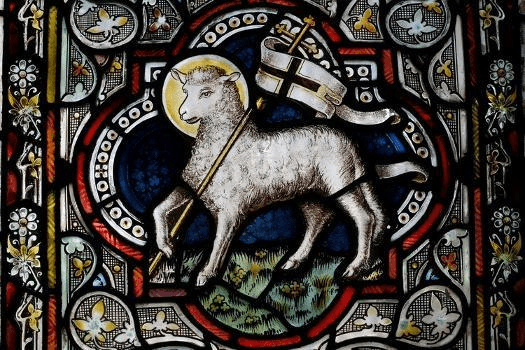
Stained glass of the Agnus Dei (Lamb of God), Chamonix, France

The next day John saw Jesus coming toward him and said, “Look, the Lamb of God, who takes away the sin of the world! This is the one I meant when I said, ‘A man who comes after me has surpassed me because he was before me.’ I myself did not know him, but the reason I came baptizing with water was that he might be revealed to Israel.”

Then John gave this testimony: “I saw the Spirit come down from heaven as a dove and remain on him. And I myself did not know him, but the one who sent me to baptize with water told me, ‘The man on whom you see the Spirit come down and remain is the one who will baptize with the Holy Spirit.’ I have seen and I testify that this is God’s Chosen One.” (New International Version)

The Gospel of John is all about finding and seeing Jesus – and then believing. Jesus is seen from various angles, namely because, as the embodiment of God, he requires a multi-perspectival look. In today’s lesson, we see John the Baptist exhorting everyone to take a look at Jesus as the Lamb of God.

Throughout the Apostle John’s Gospel, we see the gradual unfolding of belief amongst people, including the faith of John the Baptist. The Baptist’s initial understanding was that he was in the presence of someone of much greater worth than himself. Only by means of God’s Spirit is John able to gain increased insight concerning Jesus.

It’s important to point out that faith is never a static sort of thing. Rather, faith is always moving in a direction; it’s dynamic. Faith is more than a gift that’s put in a box and given and received. There is continual discovery to faith. It’s as if we’ve been given the gift of a Russian doll, and there are ever-increasing gifts within the gift. There are multiple levels of belief to explore and discover.

Spiritual insight is an initial gift of faith. There is, however, more. With insight there follows the ability to distinguish between material and immaterial realities. This is one reason why the Gospel of John can be difficult to understand – because within one verse, statement, or story, there are double, even triple, meanings to it.

John often invites us to see the spiritual reality that is there underneath the physical. It will take eyes of faith to see, because sheer physical sight will not see the entire reality. And at the end of faith is Jesus, to confess and believe that he is indeed the very Son of God.

The Holy Spirit in today’s lesson actually serves as the divine witness to John the Baptist’s burgeoning development of faith in Christ; John sees Jesus not only as coming from God, but as God.

The confirming voice of the Spirit at the baptism of Jesus lets everyone know that this Lamb of God, Jesus, the Son of God, will take away the sin of the world in his eventual Passover death.

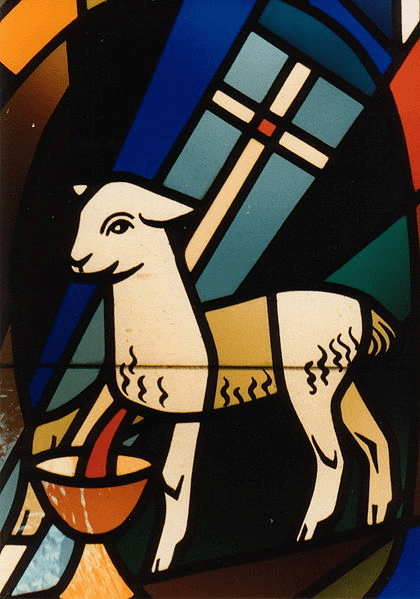
Stained glass of the Agnus Dei, El Cajon, California

To take away sin means to remove it and purify the person from it. John’s increased understanding discerns that his words and his baptism with water don’t bring this removal and purification; but they do point to Jesus. Christ as the one who is able to immerse people in the cleansing bath of grace.

Jesus Christ is qualified and able to call, gather, and cleanse not only Israel, but also the world and all the scattered children of God. Thus, John the Baptist’s ministry is to reveal Jesus to Israel; it’s directed to the entire world and to the taking away of the world’s great sin, once and for all.

The reference to Jesus as the “Lamb of God” is a familiar one to Christians. Lambs are common throughout the Bible. A lamb, however, that takes away sin is somewhat novel (although a scapegoat symbolically takes aways Israel’s sin into the desert, Leviticus 16:8-10). Passover lambs, lambs offered twice daily and in several offerings and acts of worship, were a part of many guilt and purification rituals in the Old Testament. (Leviticus 9:1-13; 14:1-13)

It seems to me that the Apostle John understood Jesus as the Lamb which removes sin by being the representative and once for all sacrifice to end all sacrifices. There is no longer any need to keep offering these various lambs day after day, festival after festival, year after year; Jesus is the efficacious one who ends it all and finally purifies and atones with potent deliverance from sin.

Day after day every priest stands and performs his religious duties; again and again he offers the same sacrifices, which can never take away sins. But when this priest [Jesus] had offered for all time one sacrifice for sins, he sat down at the right hand of God, and since that time he waits for his enemies to be made his footstool. For by one sacrifice he has made perfect forever those who are being made holy. (Hebrews 10:11-14, NIV)

And what is more, it’s this same Lamb of God who will again show up – even though slain, and yet lives – to gather together all the nations of the earth, lead them as the singular Good Shepherd, vanquish all the enemies who oppose goodness, and establish divine light in a sort of eternally lit menorah that blesses the world. (Revelation 5:6-12; 6:1; 7:17; 14:1: 1714; 21:22-23)

The baptism with water of Jesus by John the Baptist, therefore, confirmed and anticipated the baptizing (purifying) work of the Holy Spirit that only Jesus would accomplish. For John baptized with water, but Jesus baptizes with both water and Spirit – demonstrating his singular ability as Savior and Lord.

In this Christian season of Epiphany, Jesus – the Lamb of God who takes away sin and purifies with the Spirit – is Christianity’s eternal light and life.

The bright star still compels people to come and see, as well as leads the little Christs called “Christians” to take their light and let it shine wherever they go. It is a light of mercy and mystery, grace and goodness, wonder and wisdom. It is, I believe wholeheartedly, the light the world needs in order to bring an end to division and connect one another in peace and goodwill.

May it be so, to the glory of God. Amen.