Hebrews 11:4-7 – Let the Future Shape Your Present

By faith Abel brought God a better offering than Cain did. By faith he was commended as righteous when God spoke well of his offerings. And by faith Abel still speaks, even though he is dead.

By faith Enoch was taken from this life, so that he did not experience death: “He could not be found, because God had taken him away.” For before he was taken, he was commended as one who pleased God. And without faith it is impossible to please God because anyone who comes to him must believe that he exists and that he rewards those who earnestly seek him.

By faith Noah, when warned about things not yet seen, in holy fear built an ark to save his family. By his faith he condemned the world and became heir of the righteousness that is in keeping with faith. (New International Version)

Faith is important. It’s part of us. We are all people of faith – maybe not sharing the same faith – but it is faith, none-the-less.

Belief transcends time. Faith is rooted in the past, experienced in the present, and future-oriented. In Christianity, faith is historically moored to the redemptive events of Christ’s incarnation, life, death, resurrection, and ascension. This historic faith has continuing ramifications into the present time. And it is a faith which believes Christ is coming again to judge the living and the dead.

All of this means our salvation encompasses past, present, and future. So, it is appropriate and accurate to say the Christian has been saved, is being saved, and will be saved. Deliverance from sin, death, and hell was achieved on the cross. We are presently in the process of being delivered from our sinful nature and the effects of a fallen world. And we will be completely delivered at the end of the age when there will be no more disease, death, or grief-stricken crying.

The New Testament brings out all these dimensions of time. Whereas the Apostle Paul tended to continually look back to the past of God’s action in history, the author of Hebrews consistently looks ahead and brings out the future orientation of our faith.

And that is what the great Hall of Faith in chapter eleven of Hebrews is about – giving repeated examples of individuals who transcended their present hard circumstances through realizing what will be eventually coming. All of them acted particular ways in the present time because of what they believed would happen in the future. In other words, people of faith allow their belief in what is coming to shape how they live now in daily life.

Abel took the absolute best of his flock and made it an offering, with the intent of giving God an appropriate gift. Whereas his brother Cain cobbled together some of the leftovers from his vegetable harvest and gave them a nonchalant toss to God. Then, he got upset when God looked with disfavor on it.

Abel’s actions demonstrated the attitude of his heart. His belief and his practice worked together. And the gift he gave to God cost him his life, as Cain was inflamed with anger and killed his brother. Only by looking ahead and seeing that God’s reward is better than anything this world can offer, can we endure hardship.

Enoch focused on pleasing God through his three-hundred year life, knowing he would then enjoy an eternity with the Lord who provides good rewards. Enoch displayed his faith through obedience to God. He believed God existed and that God is good.

Noah, despite the jeering of his neighbors, took one-hundred years of his life to build a big ark, believing without a doubt that God’s judgment was coming. The daily grind of constructing an ark for such a long time was made possible because Noah was looking ahead. His present actions were shaped by his forward thinking faith.

In each individual’s life, their daily actions were a result of their unshakable belief in what was to come.

Faith enables us to persevere patiently through any kind of adversity. Knowing we have a better reward ahead; realizing our present trouble will not last forever; and believing Christ will eventually make all things right in this world which has so much wrong – forms the foundation of our faith in such a way as to buoy us so that we do not drown in a sea of injustice, microaggressions, unhealthy power dynamics, as well as plain old meanness and insensitivity from others.

So, when we face those times which tempt us to get lost or stuck in an ever-enclosing existential angst, take a pause, back up the truck, and see a more expansive big picture view of yourself, your situation, and others. You’ll be glad you did.

Christ be with me, Christ within me,

Christ behind me, Christ before me,

Christ beside me, Christ to win me,

Christ to comfort and restore me.

Christ beneath me, Christ above me,

Christ in quiet, Christ in danger,

Christ in hearts of all that love me,

Christ in mouth of friend and stranger.

Amen.

-Prayer of St. Patrick

Luke 8:4-15 – Christ’s Parable of the Soils

While a large crowd was gathering and people were coming to Jesus from town after town, he told this parable: “A farmer went out to sow his seed. As he was scattering the seed, some fell along the path; it was trampled on, and the birds ate it up. Some fell on rocky ground, and when it came up, the plants withered because they had no moisture. Other seed fell among thorns, which grew up with it and choked the plants. Still other seed fell on good soil. It came up and yielded a crop, a hundred times more than was sown.”

When he said this, he called out, “Whoever has ears to hear, let them hear.”

His disciples asked him what this parable meant. He said, “The knowledge of the secrets of the kingdom of God has been given to you, but to others I speak in parables, so that,

“‘though seeing, they may not see;
    though hearing, they may not understand.’

“This is the meaning of the parable: The seed is the word of God. Those along the path are the ones who hear, and then the devil comes and takes away the word from their hearts, so that they may not believe and be saved. Those on the rocky ground are the ones who receive the word with joy when they hear it, but they have no root. They believe for a while, but in the time of testing they fall away. The seed that fell among thorns stands for those who hear, but as they go on their way they are choked by life’s worries, riches and pleasures, and they do not mature. But the seed on good soil stands for those with a noble and good heart, who hear the word, retain it, and by persevering produce a crop. (New International Version)

The Parable

“Whoever has ears, let them hear,” said Jesus. Truly hearing Christ’s words and listening with focused attention is paramount to the Christian life. Our ears are the soil of our lives. Ears attentive and devoted to listening to Jesus are good soil; ears distracted, inattentive, and stopped up with ear wax are bad soil. Receptive listening to the Word of God brings a fruitful harvest of righteousness, peace, and joy in the Holy Spirit. Genuinely believing what we hear from Jesus is crucial. God’s Word falls on four different soils….

  1. The seed on the path. A path is for walking, which is why the seed never takes root. Here there is no listening. When we act without listening, our actions will be misguided. 
  2. The seed on rocky soil.  Here there is no deep listening. A lack of attentive hearing results in a shallow person who perhaps relies more on Christian clichés or on their personality or abilities instead of the sown Word.
  3. The seed on the thorny soil. Here there is significant listening. However, there is too much listening to a cacophony of voices and not enough singular listening to the sown Word. Listening to the wrong voices will cause an unfruitful life. So, we must be careful to whom we are listening.
  4. The seed on good soil. A devoted listening to the Word without distraction leads to a productive, fruitful believer.

“There is a difference between listening and waiting for your turn to speak.”

Simon Sinek

The Nature of Parables

A parable is a genre of biblical literature. Parables are as much about concealing truth as they are conveying truth. A person must give focused attention to the story to learn from it, much like a good novel conveys truth about the human condition without being preachy or outright saying the truth. Or it’s much akin to a good movie relying on character development and the power of story for its message, instead of being a straightforward documentary.

Jesus neither strong-arms people nor puts them in a full nelson to force them into God’s will. We will miss out on God’s working, if we are looking for a big dramatic hoo-ha of an event. That’s because it comes as an awareness within people and works its way out. For those not intent on changing, they will find Christ’s words confusing. They might “hear” Jesus, yet fail to really listen, since they have their own ideas about how God ought to operate.

Yet, grace is still present. The very fact that Jesus addressed the crowd of people demonstrates he cared enough to communicate. He could have said, “Hey, you guys, get lost, I’m just going to interact with people who really listen to me.” Instead of coming at the crowd and bursting through the front door, Jesus mercifully came to them through the side door so that they would be able to receive the message. 

Puking the good news of Jesus all over people without really listening is a bad idea. Neither is being worried about saying something offensive, so nothing is said at all. A better approach is asking permission to tell your story of what Jesus means to you, or what you are learning from God’s Word.

The Parable Interpreted

The focus is the experience of the seed in a variety of soils. Outside powers acting on the Word – devouring birds, rocks, the burning sun, choking thorn-bushes – demonstrate the Word is central and needs to be received well:

  1. The path is the inability to hear God’s Word because of hard-heartedness. The devil snatches it before any real understanding can take place.
  2. The rocky soil is hearing just enough to respond with joy. But the person drops out when hard circumstances occur. “I didn’t sign up for this!” is their cry. They needed to count the cost of discipleship before responding to the message. This is merely a professing Christian, nothing more.  Rather than listening and internalizing the Word, there is only positive affirmation without any action or practice. So, tomorrow the message is gone and forgotten. When difficulty comes, there are no supporting words to draw from, so the person fades away, unable to navigate life successfully.
  3. The thorny soil also hears and responds to the message. This person is also a professing Christian, nothing more. The issue here is that they also listen to voices of worry and wealth. In a sort of spiritual attention-deficit-disorder, there is no ability to filter all the voices calling out, and so, no growth.
  4. Listening with the intention of understanding and putting into practice the message heard is what brings about fruit. Receiving the Word through careful listening brings about spiritual growth. God brings the growth when we focus on the Word. And when a whole group does this, then it creates a greenhouse effect in which people cannot help but grow in the Lord.

Conclusion to the Parable

The simple reception of God’s Word leads to fruitfulness. The first soil did not receive the Word, though it listened. The second received it with joy but under pressure let it go. The third received it with only one hand because the other hand was busy. Only the fourth soil received the Word with both hands.

Blessed is the one who does not walk in step with the wicked or stand in the way that sinners take or sit in the company of mockers, but whose delight is in the law of the Lord, and who meditates on his law, day and night. That person is like a tree planted by streams of water, which yields its fruit in season and whose leaf does not wither—whatever they do prospers. (Psalm 1:1-3, NIV)

The old adage that we were created with two ears and one mouth, so that we will listen twice as much talk, is a truism. It’s hard to receive any words of encouragement, help, or reproof if you’re tongue is flapping in the wind.

Careful listening, attention to memory, and patient application are the pathways to realizing an abundant spiritual harvest of righteousness and peace.

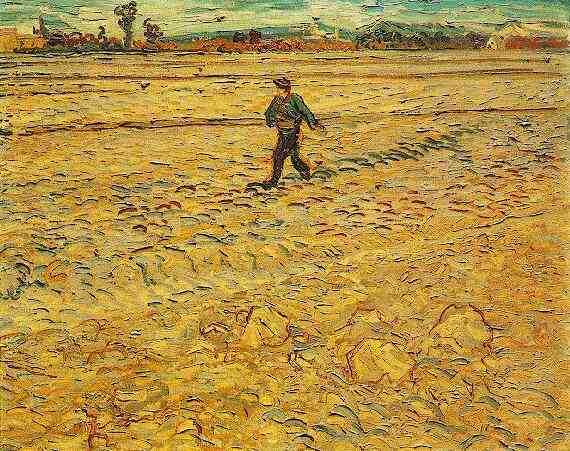
*Above paintings, The Sower by Vincent Van Gogh, 1881 & 1888

1 Timothy 6:11-12 – How to Fight the Good Fight

But you, Timothy, are a man of God; so, run from all these evil things [the love of money]. Pursue righteousness and a godly life, along with faith, love, perseverance, and gentleness. Fight the good fight for the true faith. Hold tightly to the eternal life to which God has called you, which you have declared so well before many witnesses. (New Living Translation)

Today’s New Testament lesson is a pertinent message for contemporary Christians. These verses come as the conclusion to the Apostle Paul’s letter to a young pastor in Ephesus, Timothy. The epistle is filled with encouragements, exhortations, and warnings of how to go about conducting ministry. 

Paul left Timothy with some pointed instruction to pursue righteousness, godliness, faith, love, steadfastness, and gentleness. These are the qualities which ought to inform every practice in the church and the Christian life. 

The Apostle gave Timothy a sacred trust, to hold tightly and guard the message of faith in Christ given to him. This good news of forgiveness and grace leading to eternal life through Jesus must be continually upheld. Because there will always be other individuals and groups distorting and diluting this wondrous salvation.

Two Exhortations

These two exhortations – pursuit of a godly life and grabbing hold of Christian good news – needs to be always held together. To only pursue virtuous practices apart from grasping the message will cause slow erosion and compromise the faith entrusted to us. To only embrace the gospel without trying our best to live a virtuous life will lead to ornery and combative attitudes, as well as behavior which undermines the very gospel we seek to uphold.

So, then, competing in the arena of spiritual warfare is useless without knowing why we are in that arena to begin with. We are striving for the hearts, minds, and souls of people who need the life-giving message of God’s grace in Jesus Christ. We are to carefully apply the poultice of grace to the incredible need of the world’s people, using all the virtues of righteousness and godliness at our disposal. 

Badgering, bullying, and bludgeoning people with the truth are unbiblical because it ignores the virtuous practices integral to our faith. On the other hand, loving others without careful proclamation of the gospel misses a central thrust of Paul’s letter to Timothy.

Ensure you are putting your energy into the right things. Uphold the faith delivered to us through sacred Scripture. Use love and gentleness in everything said and done. Seek after righteousness and godliness. Clutch eternal life and hold it tightly. With both hands, uphold the sanctity of the Christian message through the sacredness of holy living. We are to pursue the following:

Righteousness and Godliness

Being right with God comes through the justifying work of Jesus. This right standing then is to work out itself in practical daily living. We are to strive toward having right relationships with others.

Once you’re convinced that Christ is right and righteous, you’ll recognize that all who practice righteousness are God’s true children. (1 John 2:29, MSG)

Desire first and foremost God’s kingdom and God’s righteousness. (Matthew 6:33, CEB)

Like righteousness, godliness is given to us so that we are viewed as godly. Yet, living a godly life is a skill which requires much training. Since God is One and Love, so we are to work at unity and loving others with the divine power given to us.

By his divine power, God has given us everything we need for living a godly life. We have received all of this by coming to know him, the one who called us to himself by means of his marvelous glory and excellence. (2 Peter 1:3, NLT)

Train yourself in godliness, for, while physical training is of some value, godliness is valuable in every way, holding promise for both the present life and the life to come. (1 Timothy 4:7-8, NRSV)

Faith and Love

Faith is also a gift of God. Once given, we are to hold onto it, lean into it, and rely on it throughout our lives. We pursue our faith through being above board on all things and listening to our inward conscience, even and especially when outward circumstances are troublesome.

Love is the actionable means of meeting another’s needs. Armed with a robust faith in God, we are to confidently love the world, knowing the Lord has our back.

Cling to your faith in Christ and keep your conscience clear. For some people have deliberately violated their consciences; as a result, their faith has been shipwrecked. (1 Timothy 1:19, NLT)

What you heard from me, keep as the pattern of sound teaching, with faith and love in Christ Jesus. Guard the good deposit that was entrusted to you—guard it with the help of the Holy Spirit who lives in us. (2 Timothy 1:13-14, NIV)

Perseverance and Gentleness

We contend for the faith delivered to us by having the long view of Christianity and the Christian life. A daily walk of faith is rarely glamourous. The growth of our spirits and the construction of our souls is tedious and patient work. It requires a great deal of endurance.

Do not throw away your confidence; it will be richly rewarded.

You need to persevere so that when you have done the will of God, you will receive what he has promised. For,

“In just a little while,
    he who is coming will come
    and will not delay.”

And “But my righteous one will live by faith. (Hebrews 10:35-38, NIV)

The practical working of perseverance in one’s life is marked by gentleness. When we take the long view, we can be gentle, not rushing or hurrying people to be godly beyond their own personal growth capacity.

Let your gentleness show in your treatment of all people. The Lord is near. (Philippians 4:5, CEB)

Holding tight to the gospel message is a very practical affair. It isn’t an abstract doctrinal or dogmatic defense but a righteous, godly, believing, loving, enduring, and gentle application of truth in daily life.

King Jesus, Lord of all, help me to keep your commandments in ways consistent with the gospel of grace so that your church is encouraged, and your world is blessed with both the message and the medium. Amen.

Hebrews 3:1-6 – Jesus Is Better

Photo by Skitterphoto on Pexels.com

Therefore, brothers and sisters who are partners in the heavenly calling, think about Jesus, the apostle and high priest of our confession. Jesus was faithful to the one who appointed him just like Moses was faithful in God’s house. But he deserves greater glory than Moses in the same way that the builder of the house deserves more honor than the house itself. Every house is built by someone, but God is the builder of everything. Moses was faithful in all God’s house as a servant to affirm the things that would be spoken later. But Jesus was faithful over God’s house as a Son. We are his house if we hold on to the confidence and the pride that our hope gives us. (CEB)

It’s hard to be patient. Perseverance can be difficult. If the Christian life were a piece of cake or bowl of cherries, then there would be no need for the strengthening of faith and the development of spiritual perseverance. But the Christian life is not those things. Every good thing in life typically requires a great deal of blood, sweat, and tears.

So, when it comes to Christianity, the believer’s faith muscles need vigorous work to grow, strengthen, and support the believer for a lifetime of service. If the muscles of faith go unused, they atrophy. Faith requires exercise. Christian belief must be tried in the fire with the struggle of adversity to grow and mature.

The reason the author of Hebrews wrote his letter to Jewish Christians is because they were losing their grip and faltering in their faith. The hard circumstances of those Christians were leading them to entertain the notion of returning to old ways of life, apart from Christ. 

It can be tempting to think of the past as “the good old days.” But if you think about it for any length of time, you know better. Because of struggles in the present, our minds can easily turn to filter out all the crud from the past to make it look like things were better back then.

“Better” is what the book of Hebrews is all about.

The writer consistently and persistently insists that Jesus is better than anything from the Hebrew Christians’ past. Moses was one of the most respected and revered figures of Old Testament history. The letter to the Hebrews acknowledges proper regard for Moses but goes further to point-out and remind the people that whereas Moses was faithful within God’s house, it is Jesus who is Master over the house. Jesus is better than Moses.

What’s more, believers and followers of Jesus are the house. Jesus Christ is Lord – not Moses, or anybody else.  Jesus cares for and protects his house. It might be tempting to believe that a previous house we occupied in another city or town was better. But the reality is that we live today in God’s house.

Therefore, we must hold on and not let go of the confidence we have in Jesus and the privilege we have in living in our present abode. We are to bloom where God has planted us without continually looking how much greener the grass is on the other side of the fence.

When life is tough, reminiscing about the past is easy. For sure, there are plenty of things to miss from previous days in another place. Yet, trolling your personal history, much like a time-wasting galivant on the computer, doesn’t do anything for your need of faith and perseverance. It just isn’t helpful.

Today, however, in this present time and moment, Jesus has a hold of you.

Today Christ wants to walk with you through your trouble, and not just transport you to the past. Sometimes it is necessary to remember how God helped and delivered in the past to aid us in the present with contemporary problems. Yet if the nostalgic trips only end with wishing things were different, it is simply a fool’s errand. It merely detaches us from the support we need rather than connects us with resources to buoy our discouraged spirits in the here and now.

As God’s co-workers we urge you not to receive God’s grace in vain. For he says, “In the time of my favor I heard you, and in the day of salvation I helped you.” I tell you, now is the time of God’s favor, now is the day of salvation. (2 Corinthians 6:1-2, NIV)

“The Spirit of the Lord is upon me,
    because he has anointed me
        to bring good news to the poor.
He has sent me to proclaim release to the captives
    and recovery of sight to the blind,
        to let the oppressed go free,
to proclaim the year of the Lord’s favor.” (Luke 4:18-19, NRSV)

It’s crucial that we keep a firm grip on what we’ve heard so that we don’t drift off. (Hebrews 2:1, MSG)

Wake up, for our salvation is nearer now than when we first believed. (Romans 13:11, NLT)

Now is the time to follow Jesus into all the situations which we face. You are not alone. You can do this. Other people and other stuff may certainly help. Yet Jesus is better. He is our best hope through any trouble.

Lord Jesus, you are sovereign over my past, present, and future. Today has its worries and problems. Help me walk into and through them with your gracious protection so that perseverance is developed within me and my faith in you is strengthened for tomorrow. Amen.