Donkey Talk (Numbers 22:22-28)

The angel of the Lord meets Balaam with a sword, from “Bible Pictures and What They Teach Us” by Charles Foster, 1897

Balaam was riding his donkey to Moab, and two of his servants were with him. But God was angry that Balaam had gone, so one of the Lord’s angels stood in the road to stop him. When Balaam’s donkey saw the angel standing here with a sword, it walked off the road and into an open field. Balaam had to beat the donkey to get it back on the road.

Then the angel stood between two vineyards, in a narrow path with a stone wall on each side. When the donkey saw the angel, it walked so close to one of the walls that Balaam’s foot scraped against the wall. Balaam beat the donkey again.

The angel moved once more and stood in a spot so narrow that there was no room for the donkey to go around. So it just lay down. Balaam lost his temper, then picked up a stick and whacked the donkey.

When that happened, the Lord told the donkey to speak, and it asked Balaam, “What have I done that made you beat me three times?” (Contemporary English Version)

This is one of those stories which speaks for itself. It’s clear to see that the diviner Balaam made a jackass of himself. A dumb donkey could see things better than a famous seer.

The nation of Moab was afraid of Israel. Balak the Moabite got in touch with Balaam the diviner in order for him to put a curse on Israel. Even though Balaam had the sense to know that he could only speak what God told him, he was influenced by Balak through vanity, and enticed with a small fortune. So, off he went to Moab.

But God was angry with Balaam. Three times the angel of the Lord stood in the road to oppose Balaam. The donkey knew what was up, but Balaam was too dense – stubborn as a jackass – to what was going on. It took God talking through the donkey before Balaam could finally see the angel.

When God wants to speak and accomplish a divine purpose, the Lord can use anything or anybody to achieve it – even by means of a talking donkey.

In fact, throughout Holy Scripture, God oftentimes uses the weak to further the divine agenda. Whenever God determines something, it will happen, usually by means nobody ever expects.

Look at your situation when you were called, brothers and sisters! By ordinary human standards not many were wise, not many were powerful, not many were from the upper class. But God chose what the world considers foolish to shame the wise. God chose what the world considers weak to shame the strong. And God chose what the world considers low-class and low-life—what is considered to be nothing—to reduce what is considered to be something to nothing. (1 Corinthians 1:26-28, CEB)

If God can use a donkey as a teacher, then none of us need ever be discouraged. The Lord can and will use us to make a difference in this world. God takes special delight in choosing and using the nobodies of this world to fulfill divine purposes and to communicate important messages.

This is why we can always bank of the promises of God – because nothing and nobody can ever stand in the way of the Lord’s will. God is creative and determined, using whatever means and whomever God wants, in order to bring about the good and the right and the just, in this old fallen world.

Most of us don’t have to worry about having a big head or a vain spirit or being a famous prophet like Balaam. The majority of us struggle more with having a lower view of ourselves than we actually are.

God created us according to the divine will and in divine wisdom. The Lord has equipped you with your particular DNA both biologically and spiritually. And, most of all, each one of us has been stamped with the divine image and likeness of God. We carry within our very being the stuff of our Creator.

So, I hope it won’t take some donkey talk to help you see and understand who you are and what your purpose on this earth is for. And there is no need to consult a dubious diviner to try and obtain something that you already possess. Not even a jackass does that.

Our Father in heaven,
Reveal who you are.
Set the world right;
Do what’s best—
    as above, so below.
Keep us alive with three square meals.
Keep us forgiven with you and forgiving others.
Keep us safe from ourselves and the Devil.
You’re in charge!
You can do anything you want!
You’re ablaze in beauty!
    Yes. Yes. Yes. Amen. (Matthew 6:9-13, MSG)

Learning a Lesson from Balak and Balaam (Numbers 22:1-21)

Balaam and King Balak, by Maerten de Vos, 1585

Israel moved from there to the hills of Moab, where they camped across the Jordan River from the town of Jericho.

When King Balak of Moab and his people heard how many Israelites there were and what they had done to the Amorites, he and the Moabites were terrified and panicked. They said to the Midianite leaders, “That huge mob of Israelites will wipe out everything in sight, like a bull eating grass in a field.”

So King Balak sent a message to Balaam son of Beor, who lived among his relatives in the town of Pethor near the Euphrates River. It said:

I need your help. A large group of people has come here from Egypt and settled near my territory. They are too powerful for us to defeat, so would you come and place a curse on them? Maybe then we can run them off. I know that anyone you bless will be successful, but anyone you curse will fail.

The leaders of Moab and Midian left and took along money to pay Balaam. When they got to his house, they gave him Balak’s message.

“Spend the night here,” Balaam replied, “and tomorrow I will tell you the Lord’s answer.” So the officials stayed at his house.

During the night, God asked Balaam, “Who are these people at your house?”

“They are messengers from King Balak of Moab,” Balaam answered. “He sent them to ask me to go to Moab and put a curse on the people who have come there from Egypt. They have settled everywhere around him, and he wants to run them off.”

But God replied, “Don’t go with Balak’s messengers. I have blessed those people who have come from Egypt, so don’t curse them.”

The next morning, Balaam said to Balak’s officials, “Go on back home. The Lord says I cannot go with you.”

The officials left and told Balak that Balaam refused to come.

Then Balak sent a larger group of officials, who were even more important than the first ones. They went to Balaam and told him that Balak had said, “Balaam, if you come to Moab, I’ll pay you very well and do whatever you ask. Just come and place a curse on these people.”

Balaam answered, “Even if Balak offered me a palace full of silver or gold, I wouldn’t do anything to disobey the Lord my God. You are welcome to spend the night here, just as the others did. I will find out if the Lord has something else to say about this.”

That night, God said, “Balaam, I’ll let you go to Moab with Balak’s messengers, but do only what I say.”

So Balaam got up the next morning and saddled his donkey, then left with the Moabite officials. (Contemporary English Version)

 Art by Sefira Lightstone

Israel was at the cusp of finally entering the Promised Land. They had been delivered out of Egyptian slavery, wandered in the desert for forty years, and defeated all the tribes of the Transjordan in order to get to where they were going.

Fear had fallen on all the people surrounding Israel because of their success. The nation of Moab knew that Israel would not be defeated in battle; but maybe they could be defeated in a different way. So, they hired a professional seer to put a curse on Israel.

The seer, or diviner, Balaam, initially refused the offer, even though it was a lucrative one. But he finally acceded and went, with the caveat that he could only do what the Lord tells him to do.

Balak, the Moabite, desperately wanted Balaam to curse the Israelites. Balak essentially hired the most famous and effective diviner he could find. He fully expected all this to work in his favor, in order to give him an advantage over Israel.

Was Balaam a real prophet of God, or just a self-serving shaman? Although our text for today is essentially positive in its tone, subsequent generations look back on Balaam and understand him as in league with evil. (Numbers 31:8, 16; Joshua 13:22; Micah 6:5; Jude 11)

Although as biblical readers we might be somewhat flummoxed about what to really make of Balaam, he really serves as a mirror to the nature of humanity. For we are all people who are capable of both great evil and altruistic good, and everything in between. There is no such thing as a person who is all bad or all good; all of us are some sort of mix of the two.

Therefore, every one of us needs to be vigilant in how we shall then live – what choices we will make, what sort of goals we will establish, and what kind of people we will listen to and follow. If we seek to take some lessons from this story, perhaps we might do well to consider the motives of the main characters Balak and Balaam.

Balak was filled with dread and fear. Sickening fear and anxiety is most certainly one of the great emotional and spiritual hazards of our time. His debilitating fear was that he and his nation would be destroyed by Israel.

Yet, if you consider this, it is a groundless anxiety. Israel was all too willing to pass through on their way to the Promised Land without a fight. It was only when attacked that they fought back and destroyed other nations.

Balak wasted a bunch of wealth and worry on something that wasn’t even going to happen, unless he himself provoked it. It is likely that worry, fear, and anxiety, like Balak, is not serving you well; it’s keeping you under the tyranny of what might happen. And it is in such a state that we make poor decisions, such as consulting diviners to assuage us of the worry.

Balaam allowed himself to be manipulated into believing he could make his small fortune. After all, this nation of people needed him, and he perhaps vainly imagined he was doing the right thing and being above board.

But Yahweh is not like other gods. In reality there was no way Balaam was going to cajole God to get what he wanted. It may have worked that way in paganism, but wasn’t going to happen with the sovereign Lord of the universe. In the end, it was God who used Balaam for God’s own purpose – and not the other way around.

Some people want they want, and arrogantly assume that if they pray a lot and have their requests offered on many prayer chains, or that if they just use the right language and exhibit enough passion, that God will surely have to answer them and give them what they want. But Christian prayer is not like other prayer:

When you pray, don’t talk on and on as people do who don’t know God. They think God likes to hear long prayers. Don’t be like them. Your Father knows what you need even before you ask. (Matthew 6:7-8, CEV)

Everything comes down to trusting God and obeying his commands. When all is said and done, after all the fear and worry are spent, there is God, waiting for us to come and place faith in the divine law and promises.

Everything you were taught can be put into a few words:

Respect and obey God!
This is what life
    is all about.
God will judge
    everything we do,
even what is done in secret,
    whether good or bad. (Ecclesiastes 12:13-14, CEV) Amen.

Christ and Culture (Revelation 2:12-17)

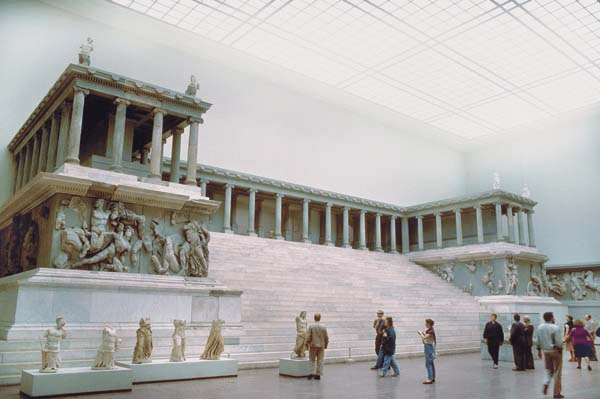
The Altar of Pergamum is considered one of the greatest surviving monuments from antiquity, now located in the Pergamum Museum, Berlin, Germany

“To the angel of the church in Pergamum write:

These are the words of him who has the sharp, double-edged sword. I know where you live—where Satan has his throne. Yet you remain true to my name. You did not renounce your faith in me, not even in the days of Antipas, my faithful witness, who was put to death in your city—where Satan lives.

Nevertheless, I have a few things against you: There are some among you who hold to the teaching of Balaam, who taught Balak to entice the Israelites to sin so that they ate food sacrificed to idols and committed sexual immorality. Likewise, you also have those who hold to the teaching of the Nicolaitans. Repent therefore! Otherwise, I will soon come to you and will fight against them with the sword of my mouth.

Whoever has ears, let them hear what the Spirit says to the churches. To the one who is victorious, I will give some of the hidden manna. I will also give that person a white stone with a new name written on it, known only to the one who receives it. (New International Version)

I’ve lived in one or two places in my life that I might have secretly described as the city where Satan lives. Jesus, however, in words to an ancient church, put it out there that they were living in such a place.

We aren’t told why Jesus described the city of Pergamum that way. Many ancient and important places typically had a prominent temple to some Greek god or goddess. In Pergamum, there existed a temple to Asclepius, the god of healing, symbolized by a snake – which isn’t exactly a positive icon in the worship of God.

The bad names didn’t stop there. Balaam is mentioned. He was a foreigner to Israel who is associated with false prophecy and leading worshipers of God astray. Balaam was blamed for the people’s idolatry and immorality before entering the Promised Land. (Numbers 31:16)

“Probably the greatest tragedy of the church throughout its long and checkered history has been its constant tendency to conform to the prevailing culture instead of developing a Christian counter-culture.”

John R.W. Stott

The name “Nicolaitans” is likely a Greek form of saying “Balaamites.” Thus, they are one in the same thing. It seems that Jesus was pointing a finger directly at particular religious practices consistent with the tradition of Balaam, namely, eating food sacrificed to idols and committing sexual immorality.

Idols and temples and eating were a hot button issue in the earliest church. All the places that churches were established, there were a significant number of Gentile converts from Greek religion to following Christ and worshiping God. And it was anything but a nice easy clean break from the old to the new.

I would surmise that the Balaamites and Nicolaitans are a group of Christian converts from paganism who were embracing a more syncretistic religion, and urging others to do the same – to maintain and engraft some of the Roman values and Greek religious practices so that the church would become more socially accepted and economically viable. Perhaps, they may have reasoned, there would be less persecution and things would generally go better for everyone.

“Some Christians want enough of Christ to be identified with him but not enough to be seriously inconvenienced.”

D.A. Carson

Whereas the Apostle Paul had a more nuanced understanding of the relationship between the church and the culture, the communication to the church at Pergamum was a definitive statement that Nicolaitans are immoral idolaters and the only thing to do in such a case is for them (not the entire congregation as a whole) to repent, stop the syncretism, and start devoting themselves completely to the worship of God alone.

Jesus himself was advocating for a firm refusal in trying to achieve respectability, to make compromises in religious practice. It certainly appears that, at least in the case of Pergamum’s converts, there was to be absolutely no connection with the old religion – not even with eating any meat or anything else that came from the pagan temple.

The Greek god Asclepius was connected with medicine and healing. So, why would this be such a problem for the fledgling church? Why would the city of Pergamum be labeled as the place where Satan lives?

Pergamum was a prominent city. It’s Greek culture, cultural and social traditions, and religious center represented the pinnacle of pagan society. This perhaps explains in part why early Christians viewed the place as a bastion of the devil.

Antipas, the Christian Bishop of Pergamum, is said to have been martyred there at the end of the first century, C.E. – which is around the time when many scholars believe the Book of Revelation was composed.

Whatever was actually going on at the time, there were most certainly significant tensions between the Christian and pagan communities which existed in the ancient city of Pergamum. Avoiding persecution, even death, may have been foremost in the minds of the Nicolaitans – who wanted accommodations with paganism that went too far, even for Jesus.

“Christ claims no man purely as a natural being, but always as one who has become human in a culture; who is not only in culture, but into whom culture has penetrated.”

H. Richard Niebuhr

It’s always been a difficult thing for Christians of every historical age to know how to deal with being in a society that is of a different culture and religion. And every generation of believers need to struggle through and reaffirm what Christian faith looks like wherever they live in this world, and in whatever cultural context they find themselves within.

In the letter to the church at ancient Pergamum, we perhaps find some guidance in Christ’s affirmation of holding onto Christian faith and keeping up a public profession of fidelity to him; and in Christ’s denunciation of diluting that Christian faith with too much accommodation to pagan culture.

Not every believer is going to agree in how to practically proceed with such matters. Yet these are issues worth having constructive conversations about, rather than simply digging into an established personal trench and, from there, lobbing unhelpful volleys of words at those who disagree.

Almighty God and Father of our Lord Jesus Christ, you are a jealous God who will not accept any attachment to other gods. I affirm you as the Most High God, and you will not give your honor or acclaim to idols. Please help us your people to avoid putting anything or anybody above or below you. Amen.