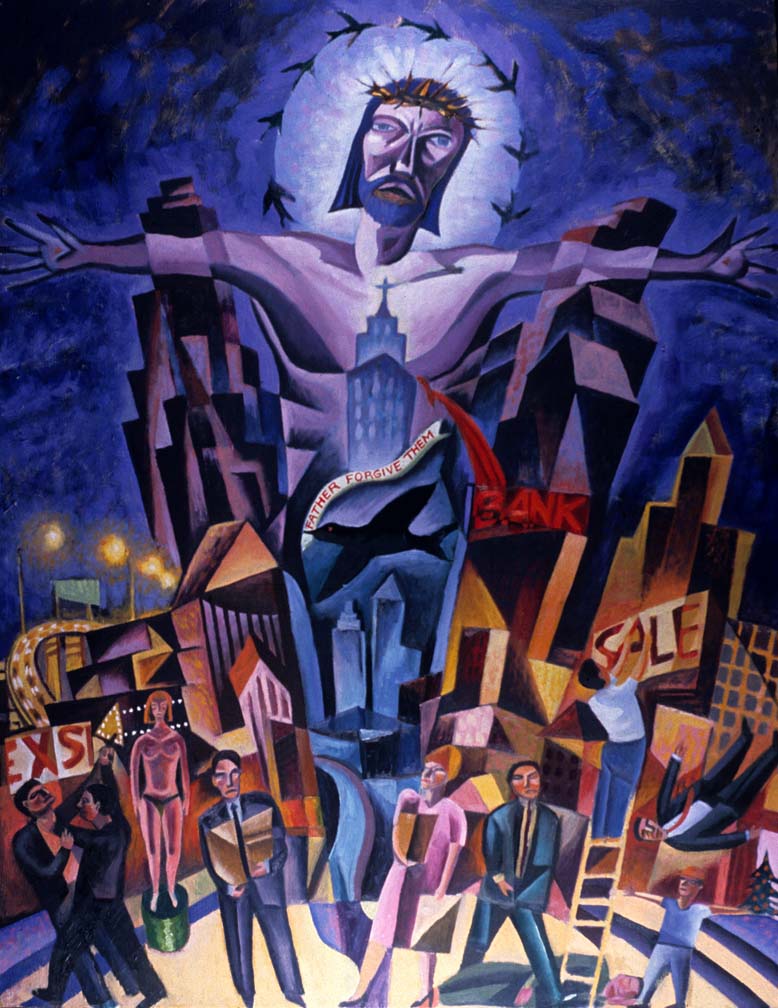
Pray and Give Thanks (1 Timothy 2:1-7)

First of all, then, I urge that supplications, prayers, intercessions, and thanksgivings be made for everyone, for kings and all who are in high positions, so that we may lead a quiet and peaceable life in all godliness and dignity. This is right and acceptable before God our Savior, who desires everyone to be saved and to come to the knowledge of the truth. For

there is one God;
    there is also one mediator between God and humankind,
Christ Jesus, himself human,
    who gave himself a ransom for all

—this was attested at the right time. For this I was appointed a herald and an apostle (I am telling the truth; I am not lying), a teacher of the gentiles in faith and truth. (New Revised Standard Version)

In our extreme busyness, do any of us stop long enough to consider what is of upmost importance in our lives? Or do we scurry about, not considering why we fill every minute of the day with constant motion and activities which – if we are honest – only frustrate us?

Whether we know anything about William Shakespeare’s tragic play, Hamlet, or not, many a person lives out his centuries old words:

Life’s but a walking shadow, a poor player,

That struts and frets his hour upon the stage,

And then is heard no more. It is a tale

Told by an idiot, full of sound and fury,

Signifying nothing.

Writing to Timothy, a new and young pastoral leader of the Ephesian Church, the Apostle Paul made it clear what is, above all, the activity which the church and all believers in Jesus are to engage in: prayer.

Perhaps that sounds too trite or simple. Yet, there is really nothing easy about prayer. To pray is more like heading out on a wrestling mat with the Incredible Hulk. This is going to take some serious work.

The most important activity we can do is to keep persevering in prayer, never giving up, but continually getting back out there on the wrestling mat of prayer and putting all of your energy into it.

Everyone in leadership must be prayed for. Yes, each person who leads needs our prayers, without exception.

Christians are to be, first and foremost, people of prayer. And those prayers are to be for all sorts of various situations, and for all sorts of persons.

We are to pray for specific needs; general circumstances and situations; urgent and emergent requests; and, as the capstone to all prayer, expressions of thanksgiving and gratitude are most needed.

A weak and ineffective prayer is one that gives no thanks to God, nor offers gratitude to God for anyone.

Conversely, however, prayer filled with power and effectiveness is stuffed with thanksgiving to God, and liberally offers thanks to God for everyone, including the ones we don’t much care about.

Specifically, whenever we fail to pray for, and give thanks for, the very people we don’t much like, and would rather not pray for, at all, then we ought not expect any of our prayers to be heard nor answered by the God who is concerned for every human being on the face of this planet.

For the Christian, prayer is never optional nor merely occasional; prayer is necessary and vital, all the time. And prayer is a close relative to thanksgiving.

Pray in the Spirit at all times in every prayer and supplication. To that end, keep alert and always persevere in supplication for all the saints.

Ephesians 6:18, NRSV

Do not be anxious about anything, but in everything by prayer and supplication with thanksgiving let your requests be made known to God. (Philippians 4:6, NRSV)

In the ancient world of Paul and Timothy, much like our present contemporary world, prayers are needed so that we can live peaceably, with godliness and dignity.

We need religious tolerance and political stability, guaranteed by people in leadership positions. We need God’s sovereign and gracious enablement and direction of world leaders, so that God’s benevolent kingdom will come, and God’s ethical will be done, here on this earth, as it is always done in God’s heaven.

Christians recognize one God. The ancient Romans acknowledged many gods. In fact, veneration of the Roman Emperor as a god began after the assassination of Julius Ceasar in 27 B.C.E. He was proclaimed as divine, and added to the official pantheon of state gods in the Empire. Praying to divinized Ceasars became a real thing in the Roman world.

Paul clearly instructed Timothy to pray for Kings and Caesars, and not to them. Just like everyone else, rulers are dependent upon the mercy of God. Leaders are mortal, not divine; and ought never to be treated like gods.

So, when the Apostle stated that there is one God and one Mediator between God and humanity, he was clearly saying that Christ is King, and Ceasar is not. This was subversive language, at the time, and could get a Christian into some serious trouble.

For us today, it may seem silly to worship a ruler. Yet, we in our contemporary culture have a definite bent toward divinizing particular celebrities, politicians, sports icons, and music and movie stars. Some of what folks do certainly looks like worship of famous persons.

All of the celebrities of this world need God, and need our prayers for them (and not to them!) as people, like us, requiring deliverance from guilt and shame, just like we do.

I am a Calvinist, a person who holds to a Christian tradition from the Reformer John Calvin. I have encountered many people who believe that Calvinism is determinism, as if people are wholly bad, and cannot make choices because everything is already predetermined.

A Reformed Christian tradition simply places emphasis where (we believe) emphasis is due: upon God, and God’s sovereign decrees, commands, will, and decisions. Because ultimately, everything comes down to God, not us.

We worship God, not our choices, or anyone else’s. Before we ever chose God, God chose us.

Everyone needs deliverance, but not everyone receives it. The Reformed concept of “limited atonement” simply recognizes that not everyone will be redeemed. The atonement of Christ is unlimited in its scope for all people, but limited in its application to some persons.

The heart of God is that everyone would be saved and come to a knowledge of the truth. Yet, not everyone experiences this.

This, in no way, flies in the face of a Christian theological tradition like Calvinism. A human judge may pronounce a severe sentence upon the accused; but that does not necessarily mean that the judge desires it, or enjoys putting someone away.

Jesus, the Son of God, and Son of Humanity, gave himself as a ransom for all. This assumes we all carry a significant debt that cannot simply be canceled; it must be reckoned with and redeemed.

Statue of Christ the Redeemer, Rio de Janeiro, Brazil

Spiritual captives need freedom. Spiritual debtors need redemption. The spiritually oppressed need a champion, a warrior. Spiritual slaves need someone to pay for their release from bondage.

The death of Christ is the atoning act which provides new life for humanity. An existential exchange happened, in which Jesus vicariously took our place, and released us from the power of sin, death, and hell.

This is the good news which Christianity proclaims: In Jesus Christ, we are forgiven, and are now free to live a good, right, and just life. There is now nothing hindering our prayers. We have full access to God through Christ.

Thus, we are to use this incredible privilege of accessibility by praying to God on behalf of everyone; and giving thanks for all things, especially the deliverance which has been secured for us.

There are quite enough grumpy curmudgeons in this world. We don’t need any more of them. What we do need, and can never get enough of, are people who have heartfelt thanksgiving – and are grateful for both the good and the bad; those they don’t like, as well as the people they do like; those in an opposing political party, along with their own; their enemies, and their friends.

The good news of Jesus changes us to be people who exist in the world for good; and not for ill. And those who insist on hate speech and hateful actions, are evidencing that they are not people of prayer, and are ingrates who do not know God.

They shall find out the hard way that there is no unlimited atonement.

The Gospel is not a tale told by an idiot.

Lord Jesus Christ, Son of God, have mercy on me, a sinner.

Christ, have mercy, and grant me your peace. Amen.

The Pleasing Aroma of Worship (Exodus 30:1-10)

The Altar of Incense, by Erhard Altdorfer (1480-1561)

“Make an altar of acacia wood for burning incense. It is to be square, a cubit long and a cubit wide, and two cubits high—its horns of one piece with it. Overlay the top and all the sides and the horns with pure gold, and make a gold molding around it. Make two gold rings for the altar below the molding—two on each of the opposite sides—to hold the poles used to carry it. Make the poles of acacia wood and overlay them with gold. Put the altar in front of the curtain that shields the ark of the covenant law—before the atonement cover that is over the tablets of the covenant law—where I will meet with you.

“Aaron must burn fragrant incense on the altar every morning when he tends the lamps. He must burn incense again when he lights the lamps at twilight so incense will burn regularly before the Lord for the generations to come. Do not offer on this altar any other incense or any burnt offering or grain offering, and do not pour a drink offering on it. Once a year Aaron shall make atonement on its horns. This annual atonement must be made with the blood of the atoning sin offering for the generations to come. It is most holy to the Lord.” (New International Version)

Worship is intended to engage the whole person, including our five senses. That’s why God instructed Moses to oversee construction of an altar for burning incense. Smells and aroma matter. We associate certain smells with particular times, places, or people. Inhaling the incense signifies and reminds people that God is with us.

Included in the instructions about the altar of incense is about when and where to burn it. The incense was to be utilized just outside the great curtain that veiled the Holy of Holies – which was the place where God met with Aaron the high priest.

The people not only smelled the incense, but could also see the smoke rise – and so be reminded of the great pillar of cloud that went before the Israelites in the exodus from Egypt. The cloud was a visible manifestation and reminder of God’s presence with the people.

Experiencing the smell of the incense and the visual smoke were comforting. It was a spiritual encounter that reinforced and strengthened the faith needed to keep on living for the Lord.

At the same time, the incense smoke highlighted the Holy of Holies curtain in front of the worshiper. Although God is close and near to the people, God is also distant and unreachable.

The Lord is both immanent and transcendent – able to meet us where we are and know our intimate needs. Yet, God is also so far above us – the high and holy God – so as to see the big picture of the world. The Lord knows us and our troubles, and has the perspective and power to do something about it.

The altar of incense with its billowing smoke and sweet smelling aroma was not only pleasing to the people, but also to God. Whenever worshipers present their offerings with joy and gladness on the altar of sacrifice, then the Lord is pleased with their faithfulness.

For example, Noah built an altar to the Lord and provided burnt offerings on it. God smelled the pleasing aroma and was stirred to say:

“Never again will I curse the ground because of humans, even though every inclination of the human heart is evil from childhood. And never again will I destroy all living creatures, as I have done.”

“As long as the earth endures,
seedtime and harvest,
cold and heat,
summer and winter,
day and night
will never cease.” (Genesis 8:21-22, NIV)

Incense and pleasing aromas are not so much the point, but what the smell represents. If we miss this, then worship becomes mechanical, and a primitive way of trying to appease an angry deity. But if we see and smell with spiritual eyes and nose, then we discern and know that our senses are a doorway to connection with God.

Our offerings are acceptable and pleasing when they are offered with sincerity of heart, integrity of spirit, and faithfulness to the God who cares not only about what we do, but why we do it.

A heart inclined toward disobedience, a mind with a bad attitude, and feet that would rather be elsewhere than at the altar, are a noxious smell to God; it is odious to the Lord. But the greatest and sweetest incense is the life offered in faith and devotion to God. In the New Testament, the Apostle Paul commented on the offerings of God’s people:

I now have plenty and it is more than enough. I am full to overflowing because I received the gifts that you sent from Epaphroditus. Those gifts give off a fragrant aroma, an acceptable sacrifice that pleases God. (Philippians 4:18, CEB)

The altar of incense giving off its smell also clued-in the worshiper to the ultimate offering to come. The Apostle Paul pictured the cross of Christ as the greatest and sweetest fragrance of all:

You are God’s dear children, so try to be like him. Live a life of love. Love others just as Christ loved us. He gave himself for us—a sweet-smelling offering and sacrifice to God. (Ephesians 5:1-2, ERV)

All of the offerings in the sacrificial system were designed to be temporary, preparatory, and anticipatory – foreshadowing the day when a final sacrifice and the sweetest fragrance of all would come; a sacrifice to end all sacrifices.

Jesus Christ was the aroma so sweet, so compelling, that we can now offer our incense of faith, hope, and love to the Son of God by taking up our cross and following him.

O Lord, listen to me as I pray. Please hurry and help me! Accept my prayer like a gift of burning incense, the words I lift up like an evening sacrifice. Help me control what I say. And don’t let me say anything bad. Take away any desire to do evil. Keep me from joining the wicked in doing wrong. My Lord God, I look to you for help. I look to you for protection. Amen. (Psalm 141:1-4, 8)

Hebrews 9:23-28 – Once and for All

atonement modern

“Just as people are destined to die once, and after that to face judgment, so Christ was sacrificed once to take away the sins of many; and he will appear a second time, not to bear sin, but to bring salvation to those who are waiting for him.” (New Revised Standard Version)

Once and for all.  Those are some of the most gruesome and beautiful words in the entirety of Holy Scripture.  The sacrifices of bulls and goats in the Old Testament had its place.  But those were mere shadows pointing to the reality of Messiah – the one whose sacrifice is so potent as to do away with sacrifice forever.

Christ’s cross was the once for all sacrifice that has settled the sin issue forever.

This is the heart of the New Testament’s good news.  Forgiveness of sins comes through the sheer grace of God in Christ.  Through faith, we have the privilege of entering the realm of new life.  In other words, Jesus has paved the way for eternal life, everlasting salvation, and complete remission of sins.

If it has not yet become self-apparent as to why Christ’s once for all sacrifice is such a game changer, then let’s take the cross from this angle: guilt is done away with, forever.  Do you think your life would change forever if you never had guilt hanging over your head?  What if all your past indiscretions; stupid life decisions; failures to speak or act; overt things done which you cannot take back; or, even the little things said or done in anger or hate; were all washed away, forever?

The precious blood of Jesus has nailed guilt to the cross once and for all.  There are three options of dealing with a guilty conscience when it happens.

1. Rationalize

First, you can rationalize it away, as if you have no responsibility or no culpability.  This is a one-way path to hardness of heart.  Whenever we sin in speech or in action, and don’t acknowledge it as our fault, then there is a little piece of us which hardens.  The next time it happens, it’s a bit easier to respond with callousness.  If you’ve ever encountered someone who seems utterly unfeeling to your situation, then there has likely been a pattern in that person’s life of keeping distance from pain.  It only leads to hardness of heart.

2. Punish

A second way of facing guilt is just the opposite of rationalization.  It is to punish and beat yourself for your faults and sins.  Heaping abuse on ourselves for our sins takes two different tracks with either: discouragement, defeat, and depression resulting in inaction; or, working like crazy to try and earn God’s favor with hyper-activity.  Both ways are a kind of self-imposed penance to try and atone for one’s sins or failures.

3. Confess

The third way is a biblical path to facing guilt.  When there is true guilt for things done or undone, said or unsaid, we must confess it, repent of it, and believe God has taken care of it.  Unlike dealing with guilt in unhealthy ways resulting in callousness, discouragement, and super-activity, the path of confession and repentance allows the person to have a clear conscience, resulting in freedom.  Christ’s once for all sacrifice is completely able to clear the conscience of the worshiper so that he/she may live into the grace and freedom of an enjoyable daily life.

Nothing needs to hang over the believer’s head because Jesus Christ, the pioneer of our salvation, has accomplished deliverance from and forgiveness of sin, once and for all.  He didn’t just put a nice-looking veneer over sin; he took care of it, thoroughly.  Jesus didn’t whitewash things so that we looked okay; the salvation he offers is permanent.

The cross which held Christ’s naked and tortured body exposed the true violence and injustice of sin.  The cross revealed what kind of world we have and what kind of God we have: a world of gross unfairness and sin; and, a God of extreme sacrificial love and grace.

What this world, and you and me, need more than anything else is forgiveness – not a cheap sentimental forgiving, but a real forgiveness that is so costly that it lasts forever and ever.

Either to justify or to judge is God’s business.  Our business is to believe in the once-for-all sacrifice of Jesus that brings permanent and lasting forgiveness; and, to share that life-giving message with others so that they, too, might experience deliverance from sin and its horrible effects.

“For he delivered us from the domain of darkness and transferred us to the kingdom of his beloved Son, in whom we have redemption, the forgiveness of sins.” (Colossians 1:13-14, NIV)

May you know the freedom and joy today which comes from knowing Christ as Savior.