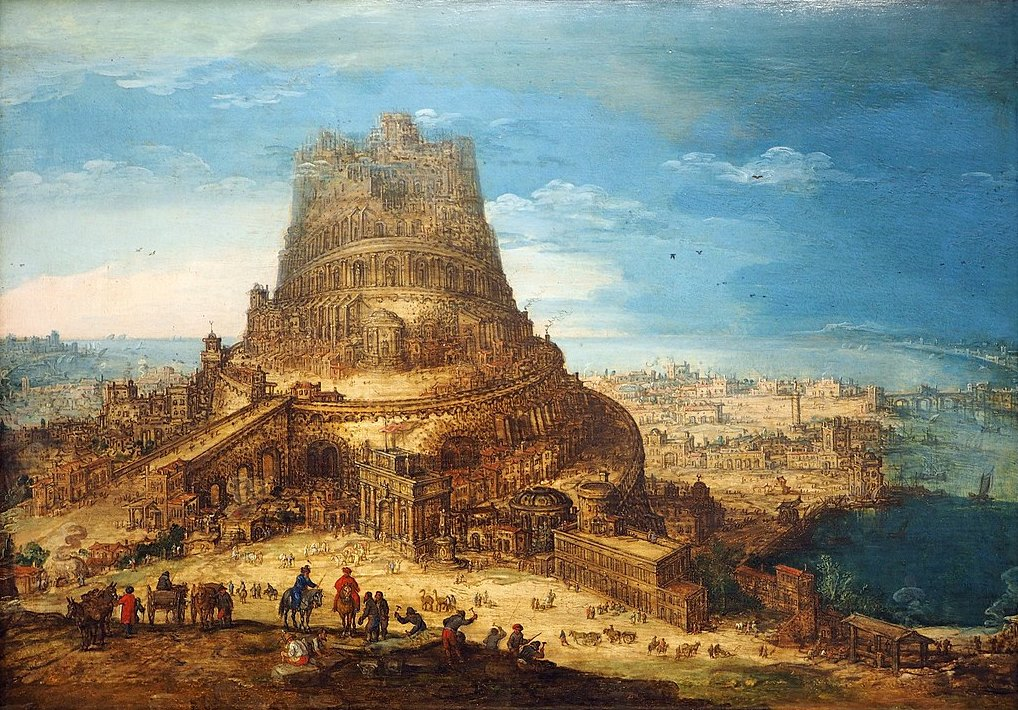
The Tower of Babel (Genesis 11:1-9)

The Tower of Babel, by Hendrick van Cleve III (1525–1589)

At one time, the whole Earth spoke the same language. It so happened that as they moved out of the east, they came upon a plain in the land of Shinar and settled down.

They said to one another, “Come, let’s make bricks and fire them well.” They used brick for stone and tar for mortar.

Then they said, “Come, let’s build ourselves a city and a tower that reaches Heaven. Let’s make ourselves famous so we won’t be scattered here and there across the Earth.”

God came down to look over the city and the tower those people had built.

God took one look and said, “One people, one language; why, this is only a first step. No telling what they’ll come up with next—they’ll stop at nothing! Come, we’ll go down and garble their speech so they won’t understand each other.” Then God scattered them from there all over the world. And they had to quit building the city. That’s how it came to be called Babel, because there God turned their language into “babble.” From there God scattered them all over the world. (The Message)

At first glance, the Bible reader may wonder what the big deal is about people coming together to build a tower.

A mere cursory look at the text might seem as if God is having some sort of divine anal-retentive moment of control. After all, the people are just trying to get some work done; it’s not like they’re going to somehow invade God’s privacy with a very tall tower.

But that’s not what was going on, way back there several millennia ago. Something more subversive was afoot, and the Lord was completely savvy to what was happening.

The previous chapter (Genesis 10) presents a rather orderly spread of the burgeoning humanity across the earth – which is consistent with God’s original blessing and mandate at the creation of people:

“Prosper! Reproduce! Fill Earth! Take charge!
Be responsible for fish in the sea and birds in the air,
    for every living thing that moves on the face of Earth.” (Genesis 1:28, MSG)

Yet, here in Genesis 11, people have intentionally stopped discovering the earth. It appears they are more curious about heaven. So, they amassed themselves together and decided to move vertically rather than horizontally across the world.

There seems to have been a great deal of human ambition that was eyeing an assault and takeover of the divine realm, instead of busying themselves with their God-given human realm. Another way of putting it is that they were irresponsible – not caring for creation – but more concerned about having some leverage on God.

Ambition, in and of itself, is neither good nor bad; it’s where that ambition is aimed. And the early people were directing their sights up rather than out – trusting in their human ingenuity and technological abilities to achieve autonomy for themselves.

Because God created humans in the divine image and likeness, people were (and still are!) amazing creatures who can accomplish incredible feats of achievement in whatever they set their minds and hearts to do. Yet, in the case of constructing a tower (or ziggurat) humanity was ignoring their mandate to care about the earth and its inhabitants. Instead, they were working their own will to build a name for themselves, apart from God.

So, the Lord stepped in by confusing their common language so that they would have difficulty communicating with one another. On the surface, it might seem that God was being capricious. But examining just a bit deeper, we can observe what would happen if people threw off their responsibility to the planet and all of its creatures.

The entire world could be subject to terrible inattention. Much like a backyard garden that becomes overrun with weeds due to neglect, the whole earth was in jeopardy of falling into a system of evil that would care nothing for its abundant life and intricate ecosystems. In short, the earth could be ruined.

If this sounds eerily like what we humans are doing today, its probably because that is precisely what we are doing – putting a collective stiff-arm to God and doing whatever the heck we want in exploiting the earth for our own human purposes.

Never mind that entire species of fish and animals, along with flora and fauna and forests and wetlands and grasslands are being harmed and destroyed by so called human ingenuity and technological advance.

It is our own arrogant pride and hubris of abject selfishness, in setting up ourselves as masters of the universe, that brings us to the edge of an environmental holocaust – not to mention fighting amongst ourselves about who will be in charge and in control of it all. We’ll engage in wars and atrocities if that’s what it will take.

Therefore, the Tower of Babel is a symbol of all that is wrong – not right – with humanity. Until we can unlearn our ancient ways of arrogance and injustice, ignorance and lack of awareness, and recover even older ways of caring for one another and the earth, then we will find ourselves being broken by the divine gravity of judgment which exists whenever people choose to defy the order of the world.

In many ways, primeval history remains alive in our daily current events. Yet, it can change. But it will take a heavy dose of humility and confession of guilt to begin undoing the harm we have imposed on others and on our world. And it will take a return to Eden, to the responsibility of creation care, and of healthy relational connections with both other people and God.

Every one of us is culpable – whether we have been directly involved in systemic evil, or not. We all have participated in and benefited from our privilege as human beings living on this planet – sometimes to the extent of turning a blind eye to the great needs of the earth and its inhabitants.

So, what will you do about it? Who will you turn to? Where does your ultimate trust rest? Are you willing to work for good, to be merciful, just, kind, and loving in a pursuit of right relationships with God, others, and the earth?

Sovereign Lord and Creator, renew our spirits and cleanse our hearts. Renew our minds and transform our lives. Renew our cities and rebuild our ruins. Renew our world, in your name we pray, Amen.

There Is No Other God (Daniel 3:1-30)

Shadrach, Meshach, and Abednego are thrown into a fiery furnace, by Chris Torre

King Nebuchadnezzar made a gold statue. It was ninety feet high and nine feet wide. He set it up in the Dura Valley in the province of Babylon. King Nebuchadnezzar then ordered the chief administrators, ministers, governors, counselors, treasurers, judges, magistrates, and all the provincial officials to assemble and come for the dedication of the statue that he had set up.

So the chief administrators, ministers, governors, counselors, treasurers, judges, magistrates, and all the provincial officials assembled for the dedication of the statue that King Nebuchadnezzar had set up. They stood in front of the statue the king had set up.

The herald proclaimed loudly: “Peoples, nations, and languages! This is what you must do: When you hear the sound of the horn, pipe, zither, lyre, harp, flute, and every kind of instrument, you must bow down and worship the gold statue that King Nebuchadnezzar has set up. Anyone who will not bow down and worship will be immediately thrown into a furnace of flaming fire.”

So because of this order as soon as they heard the sound of the horn, pipe, zither, lyre, harp, flute, and every kind of instrument, all the peoples, nations, and languages bowed down and worshipped the gold statue that King Nebuchadnezzar had set up.

At that moment some Chaldeans came forward, seizing a chance to attack the Jews. They said to King Nebuchadnezzar:

“Long live the king! Your Majesty, you gave a command that everyone who hears the sound of the horn, pipe, zither, lyre, harp, flute, and every kind of instrument should bow down and worship the gold statue. Anyone who wouldn’t bow and worship would be thrown into a furnace of flaming fire. Now there are some Jews, ones you appointed to administer the province of Babylon—specifically, Shadrach, Meshach, and Abednego—who have ignored your command. They don’t serve your gods, and they don’t worship the gold statue you’ve set up.”

In a violent rage Nebuchadnezzar ordered them to bring Shadrach, Meshach, and Abednego. They were brought before the king.

Nebuchadnezzar said to them: “Shadrach, Meshach, and Abednego: Is it true that you don’t serve my gods or worship the gold statue I’ve set up? If you are now ready to do so, bow down and worship the gold statue I’ve made when you hear the sound of horn, pipe, zither, lyre, harp, flute, and every kind of instrument. But if you won’t worship it, you will be thrown straight into the furnace of flaming fire. Then what god will rescue you from my power?”

Shadrach, Meshach, and Abednego answered King Nebuchadnezzar: “We don’t need to answer your question. If our God—the one we serve—is able to rescue us from the furnace of flaming fire and from your power, Your Majesty, then let him rescue us. But if he doesn’t, know this for certain, Your Majesty: we will never serve your gods or worship the gold statue you’ve set up.”

Nebuchadnezzar was filled with rage, and his face twisted beyond recognition because of Shadrach, Meshach, and Abednego. In response he commanded that the furnace be heated to seven times its normal heat. He told some of the strongest men in his army to bind Shadrach, Meshach, and Abednego and throw them into the furnace of flaming fire. 

So Shadrach, Meshach, and Abednego were bound, still dressed in all their clothes, and thrown into the furnace of flaming fire. (Now the king’s command had been rash, and the furnace was heated to such an extreme that the fire’s flame killed the very men who carried Shadrach, Meshach, and Abednego to it.) So these three men, Shadrach, Meshach, and Abednego, fell, bound, into the furnace of flaming fire.

Then King Nebuchadnezzar jumped up in shock and said to his associates, “Didn’t we throw three men, bound, into the fire?”

They answered the king, “Certainly, Your Majesty.”

He replied, “Look! I see four men, unbound, walking around inside the fire, and they aren’t hurt! And the fourth one looks like one of the gods.” Nebuchadnezzar went near the opening of the furnace of flaming fire and said, “Shadrach, Meshach, and Abednego, servants of the Most High God, come out! Come here!”

Then Shadrach, Meshach, and Abednego came out of the fire. The chief administrators, ministers, governors, and the king’s associates crowded around to look at them. The fire hadn’t done anything to them: their hair wasn’t singed; their garments looked the same as before; they didn’t even smell like fire!

Nebuchadnezzar declared: “May the God of Shadrach, Meshach, and Abednego be praised! He sent his messenger to rescue his servants who trusted him. They ignored the king’s order, sacrificing their bodies, because they wouldn’t serve or worship any god but their God. I now issue a decree to every people, nation, and language: whoever speaks disrespectfully about Shadrach, Meshach, and Abednego’s God will be torn limb from limb and their house made a trash heap, because there is no other god who can rescue like this.”

Then the king made Shadrach, Meshach, and Abednego prosperous in the province of Babylon. (Common English Bible)

Daniel’s three companions in the fiery furnace, by Adrianoupolitis Konstantinos, 1725

At the core of today’s story, and of the entire book of Daniel, is the assertion and demonstration that there is no other God but Yahweh.

King Nebuchadnezzar believed that he himself was big stuff. It turns out, not so much. Even the great king ended up confessing that there is no other god who is able to deliver like the God of Shadrach, Meshach, and Abednego. When the mighty king looked into the fire, all of his pomp and control and wrath and power proved to be nothing before the One God of all.

The earthly king threw all of his weight into showing how powerful and great he could be; and all of that unleashing of kingly destructive force did absolutely nothing to even singe the hair of the three worshipers of God.

Nebuchadnezzar did a lot of talking, a lot of posturing, and showed a lot of anger. Conversely, God said nothing, and was supremely successful over him. Turns out that Nebuchadnezzar was only a little yippee puppy barking in front of the large Mastiff dog who could squish him with but a movement of his paw if he wanted.

The experience of King Nebuchadnezzar is a telling lesson on all earthly rulers who presume to be supreme and all-powerful in their position.

And even in the great king’s confession of God’s true might and power, it’s almost tongue-in-cheek, as if Nebuchadnezzar himself is delusional enough to think that he’s the one who is setting up God as God. For those who are familiar with the prophecy of Daniel, they know what’s coming up in Nebuchadnezzar’s future that will purge him of that idea once and for all.

In truth, whatever strength Nebuchadnezzar had, it was God-given. In reality, you and I are recipients of God’s grace and strength; not a one of us conjured up our own success.

Things like a pompous attitude, a spirit of self-centeredness, and a position of hubris are totally out of sync with the values of God’s rule and reign on this earth. We fret and strut upon the stage of this planet in vain; the Lord is really the One who holds it all. Carrying the world on our shoulders is to be way out of touch with our job description as humans. Such a thing will only make us look as foolish as old King Nebuchadnezzar.

In between a rock and a hard place, within the throes of trouble, there is no step by step formula in dealing with it. Even in searching for clear instructions betrays that we desire to have situations within our own control. Shadrach, Meshach, and Abednego did not presume upon God, but fully trusted God and knew that they had no control over the circumstance other than choosing their own attitude in it.

All of the officials had gathered before Nebuchadnezzar’s statue; but by the end of the story they stood as witnesses to the work of the true God. Their worship of the statue had gained them nothing; they ended up under a new threat from Nebuchadnezzar. The king commended Shadrach, Meshach, and Abednego’s defiance of his decree, but followed it with a new decree commanding the worship of their God.

King Nebuchadnezzar commanded others, but he himself did not worship. His death-threat is hardly a fitting way to bring people to worship the true God. That sort of behavior ought to highly instruct us in this American  election year cycle.

The oppressor does not have the last word. God creates a future beyond oppressive human systems.

Sovereign Lord, I pray that You will right all wrongs taking place in our world; and vindicate those being treated unjustly. Keep us from taking matters into our own hands, for vengeance is Yours, not mine. In Your grace and mercy, give justice and peace to all who have been cruelly and unfairly treated by their fellow humanity. May injustice and carelessness end, and may all people be drawn into Your saving arms of grace. Amen.

Learning a Lesson from Balak and Balaam (Numbers 22:1-21)

Balaam and King Balak, by Maerten de Vos, 1585

Israel moved from there to the hills of Moab, where they camped across the Jordan River from the town of Jericho.

When King Balak of Moab and his people heard how many Israelites there were and what they had done to the Amorites, he and the Moabites were terrified and panicked. They said to the Midianite leaders, “That huge mob of Israelites will wipe out everything in sight, like a bull eating grass in a field.”

So King Balak sent a message to Balaam son of Beor, who lived among his relatives in the town of Pethor near the Euphrates River. It said:

I need your help. A large group of people has come here from Egypt and settled near my territory. They are too powerful for us to defeat, so would you come and place a curse on them? Maybe then we can run them off. I know that anyone you bless will be successful, but anyone you curse will fail.

The leaders of Moab and Midian left and took along money to pay Balaam. When they got to his house, they gave him Balak’s message.

“Spend the night here,” Balaam replied, “and tomorrow I will tell you the Lord’s answer.” So the officials stayed at his house.

During the night, God asked Balaam, “Who are these people at your house?”

“They are messengers from King Balak of Moab,” Balaam answered. “He sent them to ask me to go to Moab and put a curse on the people who have come there from Egypt. They have settled everywhere around him, and he wants to run them off.”

But God replied, “Don’t go with Balak’s messengers. I have blessed those people who have come from Egypt, so don’t curse them.”

The next morning, Balaam said to Balak’s officials, “Go on back home. The Lord says I cannot go with you.”

The officials left and told Balak that Balaam refused to come.

Then Balak sent a larger group of officials, who were even more important than the first ones. They went to Balaam and told him that Balak had said, “Balaam, if you come to Moab, I’ll pay you very well and do whatever you ask. Just come and place a curse on these people.”

Balaam answered, “Even if Balak offered me a palace full of silver or gold, I wouldn’t do anything to disobey the Lord my God. You are welcome to spend the night here, just as the others did. I will find out if the Lord has something else to say about this.”

That night, God said, “Balaam, I’ll let you go to Moab with Balak’s messengers, but do only what I say.”

So Balaam got up the next morning and saddled his donkey, then left with the Moabite officials. (Contemporary English Version)

 Art by Sefira Lightstone

Israel was at the cusp of finally entering the Promised Land. They had been delivered out of Egyptian slavery, wandered in the desert for forty years, and defeated all the tribes of the Transjordan in order to get to where they were going.

Fear had fallen on all the people surrounding Israel because of their success. The nation of Moab knew that Israel would not be defeated in battle; but maybe they could be defeated in a different way. So, they hired a professional seer to put a curse on Israel.

The seer, or diviner, Balaam, initially refused the offer, even though it was a lucrative one. But he finally acceded and went, with the caveat that he could only do what the Lord tells him to do.

Balak, the Moabite, desperately wanted Balaam to curse the Israelites. Balak essentially hired the most famous and effective diviner he could find. He fully expected all this to work in his favor, in order to give him an advantage over Israel.

Was Balaam a real prophet of God, or just a self-serving shaman? Although our text for today is essentially positive in its tone, subsequent generations look back on Balaam and understand him as in league with evil. (Numbers 31:8, 16; Joshua 13:22; Micah 6:5; Jude 11)

Although as biblical readers we might be somewhat flummoxed about what to really make of Balaam, he really serves as a mirror to the nature of humanity. For we are all people who are capable of both great evil and altruistic good, and everything in between. There is no such thing as a person who is all bad or all good; all of us are some sort of mix of the two.

Therefore, every one of us needs to be vigilant in how we shall then live – what choices we will make, what sort of goals we will establish, and what kind of people we will listen to and follow. If we seek to take some lessons from this story, perhaps we might do well to consider the motives of the main characters Balak and Balaam.

Balak was filled with dread and fear. Sickening fear and anxiety is most certainly one of the great emotional and spiritual hazards of our time. His debilitating fear was that he and his nation would be destroyed by Israel.

Yet, if you consider this, it is a groundless anxiety. Israel was all too willing to pass through on their way to the Promised Land without a fight. It was only when attacked that they fought back and destroyed other nations.

Balak wasted a bunch of wealth and worry on something that wasn’t even going to happen, unless he himself provoked it. It is likely that worry, fear, and anxiety, like Balak, is not serving you well; it’s keeping you under the tyranny of what might happen. And it is in such a state that we make poor decisions, such as consulting diviners to assuage us of the worry.

Balaam allowed himself to be manipulated into believing he could make his small fortune. After all, this nation of people needed him, and he perhaps vainly imagined he was doing the right thing and being above board.

But Yahweh is not like other gods. In reality there was no way Balaam was going to cajole God to get what he wanted. It may have worked that way in paganism, but wasn’t going to happen with the sovereign Lord of the universe. In the end, it was God who used Balaam for God’s own purpose – and not the other way around.

Some people want they want, and arrogantly assume that if they pray a lot and have their requests offered on many prayer chains, or that if they just use the right language and exhibit enough passion, that God will surely have to answer them and give them what they want. But Christian prayer is not like other prayer:

When you pray, don’t talk on and on as people do who don’t know God. They think God likes to hear long prayers. Don’t be like them. Your Father knows what you need even before you ask. (Matthew 6:7-8, CEV)

Everything comes down to trusting God and obeying his commands. When all is said and done, after all the fear and worry are spent, there is God, waiting for us to come and place faith in the divine law and promises.

Everything you were taught can be put into a few words:

Respect and obey God!
This is what life
    is all about.
God will judge
    everything we do,
even what is done in secret,
    whether good or bad. (Ecclesiastes 12:13-14, CEV) Amen.

Don’t Forget about Kindness and Truth (Proverbs 3:1-12)

My child, do not forget my teaching,
    but keep my commands in mind.
Then you will live a long time,
    and your life will be successful.

Don’t ever forget kindness and truth.
    Wear them like a necklace.
    Write them on your heart as if on a tablet.
Then you will be respected
    and will please both God and people.

Trust the Lord with all your heart,
    and don’t depend on your own understanding.
Remember the Lord in all you do,
    and he will give you success.

Don’t depend on your own wisdom.
    Respect the Lord and refuse to do wrong.
Then your body will be healthy,
    and your bones will be strong.

Honor the Lord with your wealth
    and the first fruits from all your crops.
Then your barns will be full,
    and your wine barrels will overflow with new wine.

My child, do not reject the Lord’s discipline,
    and don’t get angry when he corrects you.
The Lord corrects those he loves,
    just as parents correct the child they delight in. (New Century Version)

There is no wisdom apart from humility. And humility can only be accessed through being authentic and vulnerable. The proud person doesn’t look to God (or others) because they think they already know what is best and can figure out things without anyone’s help.

Wisdom is a skill that is attained through learning and application, over an extended period of time. The wise person has a solid body of knowledge, and is able to take that know-how and apply it to real life situations.

For the skill of wisdom to be realized, we must first take the posture of a child. We need to listen well, and humbly receive instruction. Without this initial mindset and heart attitude, wisdom will forever be elusive.

Then, when we learn and gain understanding, it’s imperative that we remember it. This is why the best learning engages all of our senses; it presses needed information deep inside us, so that what comes out of us is right, just, and good.

Concerning the Christian life, we can only obey commands which we know. So, it’s important to learn and retain the commands of God. This is one reason why I read my Bible every day; my mind and heart need the continual refreshment and recalling of Holy Scripture’s insight and instruction. I want to be so full of God’s good commands that if you cut me, I bleed Bible.

Kindness and truth are to be worn like a big gaudy necklace around our necks – so that we will always have in front of us what’s most important in living our lives.

The reason so many people are continually at odds with one another is that kindness and truth are neither acknowledged nor remembered. But you cannot have good relations without basic human kindness and a commitment to truth. Put another way, being gruff and mean, and fudging on reality, will not only get you nowhere, but it will also bring a profound lack of success in life.

That stubborn meanness and inattention to truth comes from spending way too much time alone in one’s head. Left alone for too long, every one of us will come up with all kinds of goofy thinking that we believe is the truth. But it’s really only craziness born of a tremendous lack of healthy interaction with others.

At some point, everyone must eventually trust the Lord – who is kindness and truth itself. Going it alone is not an option, that is, unless we want to be lonely, messed-up in the head, and miserable in both body and soul.

Let’s get real. Often, the reason why so many of us choose a path of arrogant pride, radical independence, and selfish loneliness is because we simply do not want to be hurt.

Someone, some group, or many persons have hurt us, and we’re determined to never be hurt and to hurt like that again. So, we shut others out – including God.

We may not go the route of becoming actual hermits, but we build invisible walls which no one can scale. This is why the loneliest people are actually around other people – they’ve shut them out emotionally, mentally, and spiritually, even though they are next to them physically.

Persons who take such a route to living eventually discover that, although they may have avoided the sort of pain they feared, a new kind of suffering is experienced. And it’s the kind of suffering that gnaws at your insides and slowly kills you.

Little does one know, but the fear, anger, and hatred morphs into a bitterness which becomes gangrene of the soul. The person dies a little bit at a time in an agonizing existence. We all must endure pain; it’s just a matter of what sort of pain we will accept: the bad kind or the good kind.

A good sort of hurt is the pain of healing, of making things right, of committing oneself to reconciliation and peace. It’s a soreness of being corrected by Holy Scripture and God’s directives, a suffering that will truly lead to life, not death.

So, what will it be? The book of Proverbs calls us to make a choice, not only between good and bad, but a choice of better and best, and of accepting the sort of pain that helps us grow; or rejecting that and enduring a debilitating hurt that damages deeply, maybe even permanently.

Let go of the pride and adopt humility. Become a student of wisdom. Take up the necklaces of kindness and truth. Honor God with a life full of experiential knowledge and devotion to the betterment of humanity. Learn to trust the Lord and others who are trustworthy. Know what it feels like to be merciful, pure, and peacemaking.

You may just find that the old tools of cynicism, sarcasm, skepticism, distrust, and unbelief become lost in the mental junk drawer of things rarely, if ever, used.

Lord Jesus Christ, you prayed for your friends that they would be one as you and your Father are one. We confess our resistance to your prayer. We have failed to maintain the unity of the Spirit. We have broken the bond of peace.