Mark 14:26-31 – Pride Comes Before the Fall

Peter Disowns Jesus by Ethiopian artist Nebiyu Assefa

When they had sung a hymn, they went out to the Mount of Olives.

“You will all fall away,” Jesus told them, “for it is written:

“‘I will strike the shepherd,
    and the sheep will be scattered.’

But after I have risen, I will go ahead of you into Galilee.”

Peter declared, “Even if all fall away, I will not.”

“Truly I tell you,” Jesus answered, “today—yes, tonight—before the rooster crows twice you yourself will disown me three times.”

But Peter insisted emphatically, “Even if I have to die with you, I will never disown you.” And all the others said the same. (New International Version)

Learning to Trust

I have two sisters-in-law who were lifeguards when they were teenagers. One day I watched one of them handle a group of kids experiencing their first swim lesson. She went to each child and told them to put their ears in the water and their belly buttons in the air while she was holding them up. “When I count to three, you won’t feel my hands underneath you, but they’re there,” she said. Most of the kids frantically jerked their knees toward their chins and flailed their arms. Truth is, almost all people float when they assume a posture of rest. But people who think they will sink don’t keep their posture for long. 

The disciples had a hard time trusting Jesus. They just couldn’t seem to rest and relax with Jesus holding them up. After all, Jesus said and did things they were not expecting him to say and do. Jesus preached the necessity of humility and loving one’s enemies. He focused ministry on the least and the lost. 

Different Agendas

The disciples had not yet really bought into Christ’s kingdom agenda. They kept pulling their knees up, thinking Jesus was going to lead a rebellion against the Romans and put Israel back on the map. Bless their hearts, the disciples mistakenly believed Jesus was there to immediately restore the glory days of Jewish dominance in the land.

Despite Christ’s teaching and ministry, some folks believe God’s agenda ought to be restoring prayer in public schools and The Ten Commandments back in courthouses. But Jesus has a different agenda. Christ goes to the heart of the matter. New life is what he is after. Transformation leads to observance of God’s will so the least and the lost persons among us will be reached. 

Jesus turned the world upside-down by insisting not that people come to the temple but that the temple worshipers go to the people. It was not a popular teaching with the disciples, let alone everyone else. The disciples had greater (or so they thought) ideas about how things ought to go.  

Christ followers might neglect the upside-down teaching ministry of Jesus because we believe ourselves to be good people. We already assume we know what God wants. And we would never betray Jesus, right!?  O, sure, we sin occasionally, but not like murderers and child molesters. Our sins are respectable – a little resentment here, a little prejudice there, or a smidge of gossip just to make sure outsiders know and respect their place.

However, we must first hear the bad news before we can hear the good news. And once we hear the bad news and accept it, we need to receive God’s remedy for it. The disciples Peter and Judas are contrasting figures in grasping Christ’s message and responding to it.

Peter and Judas

Peter and Judas had similar ideas about how the future should look – seeing Israel restored to its previous glorious prominence. Judas was a religious and political Zealot. And Peter had no problem picking up a sword when it seemed the time was ripe for a political rebellion and takeover.

Peter insisted he would never turn on Jesus. Yet, Jesus flat-out told him that would happen. Sure enough, Peter did a big belly flop in the pool of denial by disowning Jesus three times.

Then there was Judas. He caught on quicker than Peter that Jesus wasn’t going to lead a military coup. Talking about wasting time on marginal people who couldn’t help usher-in a glorious revolution was the last straw for him.  After Judas clearly saw Jesus had no intention of fulfilling what he thought should happen, he actively sought an opportunity to betray him.

In fact, none of the disciples wanted to take a step of commitment into the world of suffering as the means of reaching others. They wanted glory, not suffering. But Jesus chose the cup of suffering.

Both Judas and Peter realized, after denying Jesus, they had made a terrible mistake. However, that is where the similarities end. Judas responded to his guilt by completing suicide.  Rather than throw himself upon the mercy of God, Judas handled the guilt himself. It was a refusal of grace.

Peter, instead, wept bitterly. He realized his poverty of spirit. He mourned over his sin. Later, Peter became a genuinely meek person with God’s righteousness taking root within him. Having received grace, Peter became a preacher of truth and grace.

Stubborn Pride

Renewal comes from spiritual transformation. It requires a brutally honest assessment of self and others. “I will never fall” comes from a heart that believes “I’m not so bad.” Our failures of faith stem ultimately from pride and a lack of trust. We keep pulling our knees up because we are too anxious to let the agenda of Jesus control our lives. 

Proud people have little need for prayer because they are self-sufficient. However, humble people pray a lot! They don’t want to fall into temptation and defame the name of the Lord. They pray because apart from Jesus Christ they know they’ll act like a cockeye little dog who thinks he is a big dog. Even Jesus himself felt the need to watch and pray so that he could face his hour of pain and suffering on behalf of humanity.

When Jesus was arrested, Peter followed him at a distance. That describes too much of our own following of Christ. We want to see how everything will shake-out before we commit. Jesus invites us to trust him, to commit, to make and keep promises before we even know what it all means. 

It could be that we need to acknowledge we’ve made a mess of our lives through being stubborn. Perhaps we have willfully held to our own ideas of how things ought to go, for far too long.

If you find yourself in a mess, whether it is of your own making or of somebody else’s, grace is the thing that can handle it. That is, coming to God with honesty and humility. Being willing to rest and relax when Jesus is telling you to. It’s okay to let your knees go down and stick the belly button out – to rest in Jesus.

Give us honest hearts, O God, and send your kindly Spirit to help us confess our sins and bring us the peace of your forgiveness, in Jesus Christ our Lord. Amen.

Acts 4:1-4 – The Message of Resurrection

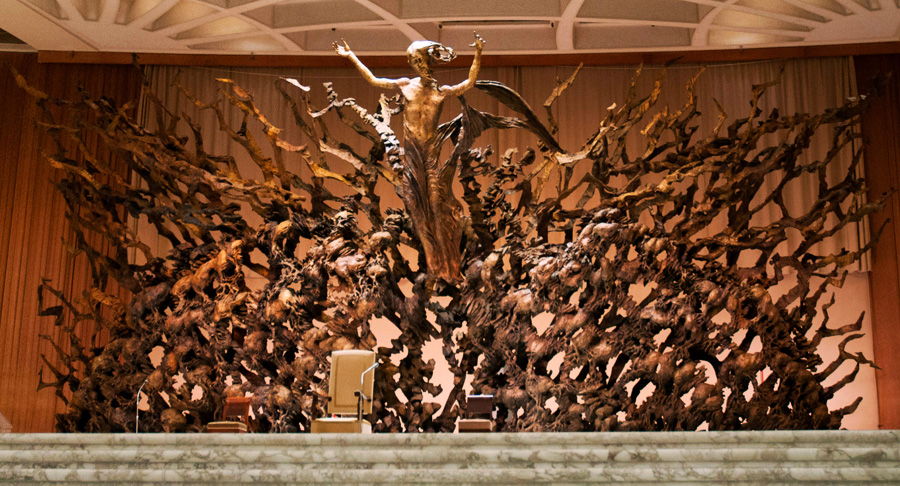
La Resurrezione by Italian sculptor Pericle Fazzini (1913-1987)

The priests and the captain of the temple guard and the Sadducees came up to Peter and John while they were speaking to the people.They were greatly disturbed because the apostles were teaching the people, proclaiming in Jesus the resurrection of the dead. They seized Peter and John and, because it was evening, they put them in jail until the next day. But many who heard the message believed; so, the number of men who believed grew to about five thousand. (NIV)

There’s nothing quite like upsetting the status quo. And that’s exactly what the apostles Peter and John were doing. Creating trouble, causing a stink, disturbing the peace, and making waves. At least, that’s how the ruling authorities saw the upstart Christians’ activity.

At the heart of the disturbance was the authorities’ deep concern of potential social disorder. After all, the Roman Empire with all its great strength was firmly ensconced in Judea. It was already hard enough trying to maintain Jewish customs and religious practices. Now, these rabblerousers come along with their unorthodox teaching and threaten the very social fabric of Jewish life. No! Get them out of here!

So, off to jail Peter and John went. That’s how the politics of fear typically works. Being afraid of change leads to removing the object of fear. Stuff the apostles in the gulag. Shut and lock the door. Maybe if they are out of sight they will be out of mind to the people.

The rulers were too late. So many people heard the message of Christ’s resurrection that the number of believers in Jesus swelled into the thousands. Well, now, everyone’s really in a pickle! Except the church. Each time the Christians get squelched and silenced, more of them show up. Oh, my, goodness. They’re multiplying like roaches!

It doesn’t help the ruling authorities that these religious bugs continue to interpret their own whippings and jailtime as a positive thing – enjoying the solidarity of suffering with their Lord. Ugh. What’s a decent Sadducee to do?

Turns out nothing can stop resurrection. It cannot be chained, bound, or imprisoned. Once life gets into the hearts of people, there’s no getting it out. The message just takes over and consumes the whole person. Then it spreads to another, like some infectious disease.

Before you know it, the entire social order is off kilter. What a bunch of weirdos. Following a dead guy who they say isn’t dead. Walked right out of the grave, they say. Sheesh. Pull yourselves together. So many unhinged delusional people believing in resurrection!

“Here’s to the crazy ones. The misfits. The rebels. The troublemakers. The round pegs in the square holes. The ones who see things differently. They’re not fond of rules. And they have no respect for the status quo. You can quote them, disagree with them, glorify or vilify them. About the only thing you can’t do is ignore them. Because they change things. They push the human race forward. And while some may see them as the crazy ones, we see genius. Because the people who are crazy enough to think they can change the world, are the ones who do.”

Rob Siltanen

It’s easy for some Christians to be hard on non-Christians, just as it was easy for the ancient Jewish rulers to be hard on others leaving their fold. Sometimes we followers of Jesus forget whence we have come. We can get so upset and worked up in fear. Could be our underwear is too tight. More likely, we take the prideful stance of believing our status quo is best for everyone. So, there’s no listening, paying attention, or teachable spirits.

Peter, John, and the other apostles just went about proclaiming good news with joy. And the gospel spread. Jesus became known first to thousands, then tens of thousands, hundreds of thousands, and millions. Today, according to the Pew Research Center, there are 2.5 billion Christians in the world. That’s a lot of people. Christianity has had two thousand years to create their own status quo, some of it good, some of it not so much.

Yet, at the heart of it all, is the resurrection of Jesus Christ from death. It’s a message that still speaks to billions. And it’s a message Christians need to come back to whenever they are fearful of others challenging their hegemony.

All the hopes and expectations of Christians everywhere are realized not in maintaining some Constantinian sort of Christendom but in the resurrection of Jesus Christ the dead. The former does a lot of handwringing over social and cultural issues. The latter has a lot of joy, celebration, and renewal which works itself out in both personal and systemic redemption.

Because the good news of Easter can hardly be contained in a single day’s celebration, it’s message of new life in Christ is like a bright sun of inexhaustible grace to people everywhere – still warming the earth all these centuries later.

The Apostle Peter went on to pen a letter to struggling Christians facing hard circumstances in a world not yet dominated by Christianity, reminding them of the heart of Christian faith:

Praise be to the God and Father of our Lord Jesus Christ! In his great mercy he has given us new birth into a living hope through the resurrection of Jesus Christ from the dead, and into an inheritance that can never perish, spoil or fade. This inheritance is kept in heaven for you, who through faith are shielded by God’s power until the coming of the salvation that is ready to be revealed in the last time. In all this you greatly rejoice, though now for a little while you may have had to suffer grief in all kinds of trials. These have come so that the proven genuineness of your faith—of greater worth than gold, which perishes even though refined by fire—may result in praise, glory and honor when Jesus Christ is revealed. Though you have not seen him, you love him; and even though you do not see him now, you believe in him and are filled with an inexpressible and glorious joy, for you are receiving the result of your faith, the salvation of your souls.

1 Peter 1:3-9, NIV

May we come back repeatedly to Christianity’s message so that our faith is strengthened, the church is edified, and the world is blessed. Amen.

1 Peter 4:1-8 – Holy Saturday

The death of Christ, Holy Hill, Hubertus, Wisconsin

Christ suffered here on earth. Now you must be ready to suffer as he did because suffering shows that you have stopped sinning. It means you have turned from your own desires and want to obey God for the rest of your life. You have already lived long enough like people who don’t know God. You were immoral and followed your evil desires. You went around drinking and partying and carrying on. In fact, you even worshiped disgusting idols. Now your former friends wonder why you have stopped running around with them, and they curse you for it. But they will have to answer to God, who judges the living and the dead. The good news has even been preached to the dead, so that after they have been judged for what they have done in this life, their spirits will live with God.  Everything will soon come to an end. So be serious and be sensible enough to pray.  Most important of all, you must sincerely love each other, because love wipes away many sins. (CEV)

I haven’t been a confessing Christian my entire life. I can relate to Peter’s exhortation. I still remember what it feels like to live my life without any thought to God or spiritual matters. The thing about partying and immorality is that it’s a life filled with constant movement. Slowing down only makes one come face-to-face with what is truly inside the soul. 

If someone has an empty vacuous soul, or a damaged spirit, or a broken heart, then attempting to drink or work away the inner pain makes sense when there’s no regard for God. The last thing I ever wanted to do was suffer, yet until I had my spiritual awakening, it seemed I could never outrun the hurt no matter how hard I tried, even with all the constant locomotion.

Today is Holy Saturday – a quiet place sandwiched between the ignominy of the cross and the celebration of resurrection – a day of solitude, silence, and stillness. This is something of a lost day for many folks. In fact, many Christians haven’t had a thought that Holy Saturday could have any significance. Yet, this very day has its place in the scheme of the Christian life.

There cannot be resurrection and new life without death and dying to self. There must be suffering before there can be glory. Whenever Christians quickly jump to triumphal language about victory and speak little-to-nothing about suffering, then we are left with a cheap grace which has been purchased with the counterfeit currency of velocity. 

Today is meant for us to get out of our heads and wrap our hearts around the important reality that Jesus Christ was in the grave. It was real suffering on Good Friday. It was a real death on Holy Saturday. There is no movement. All is silent and still. Jesus is in the solitude of a dark tomb. There’s no getting around it. If we want a Resurrection Day with all its celebration and glory, then we cannot circumvent Holy Saturday. 

To put this in the spirit of the Apostle Peter: Are we ready to follow Jesus and suffer as he did?  Are we willing to stop our striving, manifested through constant movement, and embrace the Holy Saturday of solitude, silence, stillness with its contemplation and embrace of suffering?  Will you and I have sense enough to pray?  Will we practice a Christian counter-cultural shift and face the ridicule of friends so that we might take some much-needed time to be with Jesus in the tomb?  Or are we so antsy and anxious that we just want to leap into Easter with no solidarity with our Lord in the grave?

You may think I’m being a bit too hard or harsh or cold…. That’s because Jesus is cold. He has a bonified cold dead body. It’s no fake death. There’s no “swoon theory” here, as if Christ only passed-out and did a weird divine fainting spell. Nope. He’s dead. And if you and I want to live with Jesus, we must die with Jesus. 

Anyone who tries to promise new life apart from journeying with Jesus into the grave is a spiritual charlatan.  Only through death can there be life. 

On this Holy Saturday, let’s intentionally slow down, do less, give ourselves a large chunk of unstructured time, and put aside routine matters. Fill the time with unfettered access to God in Christ. Slowly read the Gospel accounts of Christ’s death and burial. Read the book of 1 Peter. Allow prayers to arise from the careful and mindful reading of Scripture. Feel the solidarity with Jesus, journey with him along the way from life to death… so that there might be a truly glorious resurrection filled with abundant life and flourishing – a life that doesn’t need hedonism and workaholism to feel happy and significant.

May you die well so that you might live well.

Loving Lord Jesus, today all is silent. You died a horrific death and gave incredible mercy from your wounded heart. Now you rest in the tomb as the soldiers keep vigil. I also keep vigil, although in a quite different way. I know this day doesn’t last forever; there is tremendous glory coming. Yet, for now I sit quietly mourning your death. Assist me, God Almighty, to enter the sorrow and the silence of this Holy Saturday. Today, help me to wait patiently and to sit with this constellation of emotions swirling around my heart. As I keep this sacred vigil, fill me with hope – not only looking forward to the celebration of your Resurrection – yet also to anticipate the hope of my own share in the new life you offer, as you lay lifeless and still. May your rest transform the brokenness of my own soul, my weaknesses, and my sin. I express my trust, O God, in your mighty power to do all things through Jesus Christ, my Lord, your beloved Son, who lives and reigns with you and the Holy Spirit, one God, now and forever. Amen.

Acts 2:14-24 – From Flaky to Faithful

Preaching of the Apostles (crayon on paper) by Peter Gorban, 1990

Peter stood up with the Eleven, raised his voice and addressed the crowd: “Fellow Jews and all of you who live in Jerusalem, let me explain this to you; listen carefully to what I say. These people are not drunk, as you suppose. It’s only nine in the morning! No, this is what was spoken by the prophet Joel:

“‘In the last days, God says,
    I will pour out my Spirit on all people.
Your sons and daughters will prophesy,
    your young men will see visions,
    your old men will dream dreams.
Even on my servants, both men and women,
    I will pour out my Spirit in those days,
    and they will prophesy.
I will show wonders in the heavens above
    and signs on the earth below,
    blood and fire and billows of smoke.
The sun will be turned to darkness
    and the moon to blood
    before the coming of the great and glorious day of the Lord.
And everyone who calls
    on the name of the Lord will be saved.’

“Fellow Israelites listen to this: Jesus of Nazareth was a man accredited by God to you by miracles, wonders and signs, which God did among you through him, as you yourselves know. This man was handed over to you by God’s deliberate plan and foreknowledge; and you, with the help of wicked men, put him to death by nailing him to the cross. But God raised him from the dead, freeing him from the agony of death, because it was impossible for death to keep its hold on him. (NIV)

In the New Testament Gospels of the Holy Bible, the Apostle Peter was a flake. He sometimes got it, and sometimes didn’t. Peter could discern Jesus was Messiah, but then would turn around and refuse that Christ had to die on a cross. He would get bold and walk on water, then, end up falling short and needing help from drowning. Peter stood tall for Jesus, and then denied him three times.

However, following the Gospels in the Acts of the Apostles, Peter is a completely changed man. He now gets it. He is brave. He confesses Christ with confidence and boldness. And, while the reader might be waiting for the other shoe to drop yet again, all the while Peter does not falter, flinch, or back down. Alright, Peter, way to go!

So, what is the difference between the Gospels and Acts with Peter? Why is there such a turnaround from flaky to faithful? The Scriptures make it plain: The Holy Spirit comes upon Peter. And he is never the same again. Everything falls into place for Peter. He proclaimed the life and death of Jesus in such a way that thousands changed their way of thinking, as well as their way of life, and placed their faith and hope in Christ as Savior and Lord. Not a bad day’s work for a former fisherman.

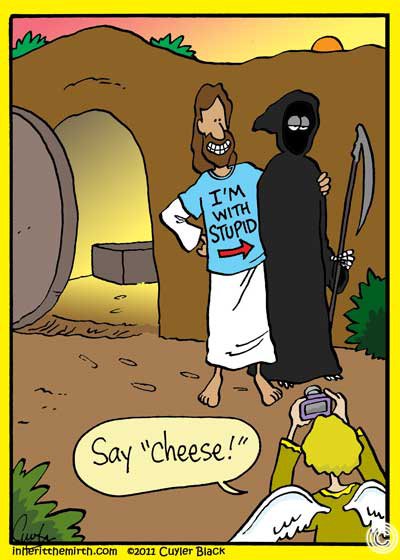
Peter’s message was pointed and straightforward: God raised Jesus up, forever changing the nature of death. Peter was dogmatic about stating that it wasn’t even possible for death to get a grip on Jesus. Oh, death thought it had him, the Grim Reaper believed he had Christ nailed to death for certain. Not so. The grave could not contain the immense and incredible power of divine love for humanity.

Inherit the Mirth

If it was impossible for death to keep its grip on Jesus, then there is absolutely nothing that can deter Jesus or hold him back from accomplishing what he wants to accomplish. Flaky believers are not going to frustrate Jesus or upset his plans; he’ll just send the Holy Spirit. 

We too often imprison ourselves in self-made spiritual jail cells, flaking-out in the Christian life, sometimes getting it right and once-in-a-while hitting upon some right combination we can’t explain, like a golfer who hits an amazing shot but can’t reproduce it no matter how hard he tries. The truth is: Jesus has conquered sin, death, and hell. By faith, we have forgiveness of sins in Christ and have the way opened to a new life in the Spirit. It isn’t a secret; it is a new reality.

The season of Lent is a time of remembering those things which hinder us in our walk with Jesus and repenting of our sins so that we can live anew. As we quickly approach Holy Week, the golf clubs of vulnerability, confession and prayer will keep us in God’s fairway and allow us to shoot par.

Gracious God, who raised Jesus from the dead, may the same power reside in me so that I can do your will in every situation through the power and presence of your Holy Spirit.  Amen.