From Darkness and Death to Light and Life (Acts 20:1-16)

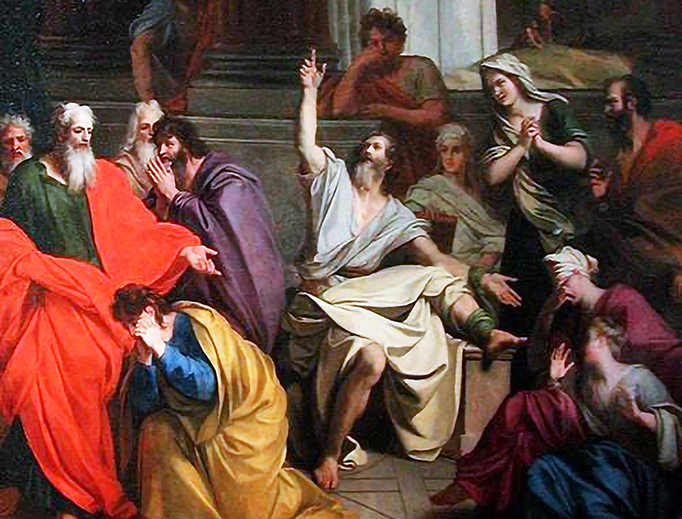
St. Paul Restoring Eutychus to Life, by Taddeo Zuccaro (1529-1566)

When the uproar had ended, Paul sent for the disciples and, after encouraging them, said goodbye and set out for Macedonia. He traveled through that area, speaking many words of encouragement to the people, and finally arrived in Greece, where he stayed three months.

Because some Jews had plotted against him just as he was about to sail for Syria, he decided to go back through Macedonia. He was accompanied by Sopater son of Pyrrhus from Berea, Aristarchus and Secundus from Thessalonica, Gaius from Derbe, Timothy also, and Tychicus and Trophimus from the province of Asia. These men went on ahead and waited for us at Troas. But we sailed from Philippi after the Festival of Unleavened Bread, and five days later joined the others at Troas, where we stayed seven days.

On the first day of the week we came together to break bread. Paul spoke to the people and, because he intended to leave the next day, kept on talking until midnight. There were many lamps in the upstairs room where we were meeting. Seated in a window was a young man named Eutychus, who was sinking into a deep sleep as Paul talked on and on. When he was sound asleep, he fell to the ground from the third story and was picked up dead. 

Paul went down, threw himself on the young man and put his arms around him. “Don’t be alarmed,” he said. “He’s alive!” Then he went upstairs again and broke bread and ate. After talking until daylight, he left. The people took the young man home alive and were greatly comforted.

We went on ahead to the ship and sailed for Assos, where we were going to take Paul aboard. He had made this arrangement because he was going there on foot. When he met us at Assos, we took him aboard and went on to Mitylene. The next day we set sail from there and arrived off Chios. The day after that we crossed over to Samos, and on the following day arrived at Miletus. Paul had decided to sail past Ephesus to avoid spending time in the province of Asia, for he was in a hurry to reach Jerusalem, if possible, by the day of Pentecost. (New International Version)

Paul Raises Eutychus to Life, by Gerard Hoet, 1728

The Apostle Paul was fresh off a riot in the city of Ephesus. Reading through the book of Acts in the New Testament, this almost seems like another day in the office for Paul. Everywhere he went, Paul created a stir – not on purpose – but just for being himself. Much like the Lord Jesus he served, Paul was a guy people either loved or hated.

We pick up Paul’s journey as he was heading to Macedonia. There were several companions who accompanied him, as was usual. The Apostle rarely, if ever, traveled alone; he was always in an entourage and mentoring others in the ways of Christian ministry.

This journey was different than the others. Paul knew what was coming for him. He was beginning a farewell tour, knowing that he would end up back in Judea – which may mean death for him.

One of the reasons there was such a commotion everywhere Paul went was because the Jews continually opposed him. But Paul was not deterred; he was determined to persevere, and especially to encourage the churches he had formed.

While in Troas, Paul met with the believers on a Sunday. Since this was a final message to those gathered, Paul did the longwinded preacher thing by talking until midnight. Apparently, all the young people were sitting in the back (some things never change) and one of them, Eutychus, fell asleep in the window where he was seated, and fell out of the window to the ground.

By the time Paul got to Eutychus, he was pronounced dead. But the Apostle wasn’t having it. He scooped up the young man into his arms and declared that life is still in him. Like the Lord Jesus before him, Paul restored the presumably dead person back to life.

This is the power of resurrection, specifically the spiritual power of Christ’s resurrection: Death doesn’t have the last word.

Paul was speaking at night, which is why there were many lamps lit in the place. Despite the light, Eutychus closed his eyes and succumbed to shutting out the light. He quite literally fell into darkness, and into the place of death.

Yet, it doesn’t take much light to dispel the darkness. A small candle is enough to luminate a way forward. Paul had more than a candle available to him; he had enough to literally light up Eutychus.

And then everybody went back upstairs and Paul did what any preacher worth their salt would do next: He kept preaching.

I’m sure Paul’s everlasting long sermon after that dramatic event with Eutychus centered on the message to “stay awake!” And indeed, that’s exactly what believers in Jesus are to do.

Then Jesus returned to his disciples and found them sleeping. “Simon,” he said to Peter, “are you asleep? Couldn’t you keep watch for one hour? Watch and pray so that you will not fall into temptation. The spirit is willing, but the flesh is weak.” (Mark 14:37-38, NIV)

Paul wanted to sail past the port of Ephesus in order to get to Jerusalem quicker. When he was previously in the city, and established a church of new believers out of their old paganism, he said to them:

For you were once darkness, but now you are light in the Lord. Live as children of light (for the fruit of the light consists in all goodness, righteousness and truth) and find out what pleases the Lord. (Ephesians 5:8-10, NIV)

The Apostle Paul was an intense guy. And that’s a good thing, when it’s channeled in ways of encouraging others, supporting them spiritually, and even raising someone from death.

Fortunately, the intensity of his light can still be seen these two millennia later.

O God, who for our redemption gave your only-begotten Son to the death of the cross, and by his glorious resurrection delivered us from the power of our enemy: Grant us so to die daily to sin, that we may evermore live with him in the joy of his resurrection; through Jesus Christ your Son our Lord, who lives and reigns with you and the Holy Spirit, one God, now and forever. Amen.

Temporary vs. Permanent (2 Corinthians 5:1-5)

For we know that if the earthly tent we live in is destroyed, we have a building from God, an eternal house in heaven, not built by human hands. Meanwhile we groan, longing to be clothed instead with our heavenly dwelling, because when we are clothed, we will not be found naked. For while we are in this tent, we groan and are burdened, because we do not wish to be unclothed but to be clothed instead with our heavenly dwelling, so that what is mortal may be swallowed up by life. Now the one who has fashioned us for this very purpose is God, who has given us the Spirit as a deposit, guaranteeing what is to come. (New International Version)

Back in the day, when my kids were small, we did our fair share of camping. We had a large two room tent that we called “The Tabernacle.” But even that large tent could not compare to finally getting back home to our house.

We are all on something of a perpetual spiritual camping trip. It may or may not feel like one, but every person is living in a tent. 

One of the challenges of the biblical writers is that they worked to communicate hope and spiritual realities in concrete language. They often made use of metaphors to help us understand. So, when the Apostle Paul likens our current lives to being in a tent, he means that what we are experiencing now with our bodies is temporary. 

Compared to the permanent resurrected body that will be coming in the future, our existence now in this present life, in this body, is not very glorious.

We consider someone homeless if they live in a tent on a permanent basis. In many ways, the Christian is homeless; we are not completely at home in this present body, nor in this present world. So, it seems rather curious to me that many believers in Jesus can be ruthlessly attached to the trappings and stuff of this contemporary campground.

If we were to make a list of all the things we do and all the things we have that are extra-biblical, that is, not specifically mentioned in the Bible, it would not take long to discover that much of what we do on a day to day basis – not to mention religiously and through church ministry – is rather quite temporary. Yet, too many persons cling to their stuff and their ways as if all of it will endure forever.

In those times when we experience bereavement; in the situations that demonstrate that we are mortal; and, in the circumstances that occur in which we glimpse how fleeting this present life can be, we begin to understand that what we need to be living for is the permanence of relationships expressed through the ever-present Spirit of God. 

It is good for us to long for a better day when we will no longer groan in the tent of this body so that we will connect with the unseen God who goes before us, with us, after us.

Camping can be both fun and challenging. But if we had to make an actual tent our real home, I can easily imagine how much groaning would happen every day. We would certainly long for a more established residence. Paul gets at this exasperation, which a temporal finite existence can be, when writing to the Roman Christians:

We know that the whole creation has been groaning as in the pains of childbirth right up to the present time. Not only so, but we ourselves, who have the first-fruits of the Spirit, groan inwardly as we wait eagerly for our adoption to sonship, the redemption of our bodies. (Romans 8:22-23, NIV)

Because we have the Spirit, we have help. The Spirit is our advocate. Sometimes, because of our situation, our prayers to God only come out as groans; words can seem far away from us. Yet, that is enough. The Spirit speaks groaning, and knows how to interpret it.

The Spirit helps us in our weakness. We do not know what we ought to pray for, but the Spirit himself intercedes for us through wordless groans. And he who searches our hearts knows the mind of the Spirit, because the Spirit intercedes for God’s people in accordance with the will of God. (Romans 8:26-27, NIV)

God has our back. We may not know what exactly we are going through, and why we are going through it, much less how to even pray about it. But the one thing we do know is that God works for the good of those who love him, who have been called according to his purpose. (Romans 8:28)

With the Spirit alongside us, there is the continual assurance and reassurance that we belong to God. Our present existence may be temporary, but the presence and love of God are permanent and will never change.

For I am convinced that neither death nor life, neither angels nor demons, neither the present nor the future, nor any powers, neither height nor depth, nor anything else in all creation, will be able to separate us from the love of God that is in Christ Jesus our Lord. (Romans 8:38-39, NIV)

Our present circumstances will eventually pass; they are temporary. But the love of God has staying power; it is permanent and forever. Our bodies are always changing; someday we will die. Yet, because of Christ’s resurrection, believers shall be raised with a body fit for eternity. Our tent will be fashioned into a house.

Eternal God, who always has been and always will be, help me to so connect with your Holy Spirit that I can discern the difference between what is temporary and what is permanent. Guide me with your holy hand so that I can place my present efforts into the things that will make a difference for eternity, through Jesus Christ my Lord. Amen.

Accomplishing the Mission, No Matter What (Acts 25:1-12)

Saint Paul before Festus and Agrippa, by Philip Galle (1537-1612)

Three days after arriving in the province, Festus went up from Caesarea to Jerusalem, where the chief priests and the Jewish leaders appeared before him and presented the charges against Paul. They requested Festus, as a favor to them, to have Paul transferred to Jerusalem, for they were preparing an ambush to kill him along the way. Festus answered, “Paul is being held at Caesarea, and I myself am going there soon. Let some of your leaders come with me, and if the man has done anything wrong, they can press charges against him there.”

After spending eight or ten days with them, Festus went down to Caesarea. The next day he convened the court and ordered that Paul be brought before him. When Paul came in, the Jews who had come down from Jerusalem stood around him. They brought many serious charges against him, but they could not prove them.

Then Paul made his defense: “I have done nothing wrong against the Jewish law or against the temple or against Caesar.”

Festus, wishing to do the Jews a favor, said to Paul, “Are you willing to go up to Jerusalem and stand trial before me there on these charges?”

Paul answered: “I am now standing before Caesar’s court, where I ought to be tried. I have not done any wrong to the Jews, as you yourself know very well. If, however, I am guilty of doing anything deserving death, I do not refuse to die. But if the charges brought against me by these Jews are not true, no one has the right to hand me over to them. I appeal to Caesar!”

After Festus had conferred with his council, he declared: “You have appealed to Caesar. To Caesar you will go!” (New International Version)

The Story Up to Now

Paul was in a pickle. Earlier in his life, as an up and coming star amongst the Jewish Pharisees, he had a life-changing encounter with the risen Christ. Paul did a complete 180 degree turn from opposing and persecuting Christians to becoming a Christian himself.

As you might imagine, this did not go over well with the Jewish establishment, and especially the Pharisees. From the event of Paul’s conversion and onward, he was a marked man. And he knew it.

But Paul didn’t care. He embraced his new life and calling with as much or more zeal than his old life. Paul dedicated himself to missionary journeys, proving that Jesus is the Christ, and establishing churches. Some of the Jews (by no means all) hated him for it. As a result, the Apostle Paul was whipped, stoned, and left for dead more than once. Finally, the upset Jews were able to get Paul arrested and jailed.

And that is where we pick up Paul’s story. And it’s also likely why he appealed to Ceasar instead of staying in Palestine; he knew he wouldn’t survive for too long surrounded by the same sort of people whom he used to run with in trying to stamp out the Christians.

The Present Story

Paul originally dealt with Felix (Acts 24) but then with a change in administration, he faced Festus. The Jews who opposed Paul wanted him transferred to Jerusalem from Caesarea. But Festus was no dummy; he knew this was an age old trick to try and ambush the Roman guards on the way and assassinate Paul. So, Festus went and saw Paul in Caesarea.

Things went as one might expect: Unsubstantiated charges are leveled against Paul in court; Paul maintains his innocence; Festus asks Paul if he wishes to go to Jerusalem for trial, or not; and Paul refuses. But the thing that no one expected is that Paul took the further step of appealing directly to the emperor himself.

We aren’t told why Paul made this appeal – although it certainly appeared as if he may not get a fair trial in Palestine. Yet, we do know that Paul had a desire to fulfill his calling of bearing witness to the gospel of Christ in the West, and to Rome.

It seems to me that, at this point, Festus saw an opportunity to rid himself of all this Jewish weirdness (as he saw it) and send Paul off and out of his own jurisdiction. One less difficult Jewish problem to have to deal with in this far off Roman outpost in the Middle East.

The Story to Come

As Bible readers, we know what is upcoming for Paul – all of the dramatic events and twist and turns of his life getting to Rome and under house arrest in the city. Yet, even though none of us really know what another day will bring, the Apostle Paul was driven by his purpose of gospel proclamation and bringing the message of Christ to the farthest western reaches of the Roman Empire. And to that end, he was not going to be dissuaded or deterred, even when he had little to no control over his life as a prisoner.

A person with meaning and purpose is a person with faith and hope. And when love is the thing animating the purpose, then it doesn’t much matter what the outward circumstances are. Perseverance and resiliency always find a way where there seems to be none.

Half of life is spent discovering, learning, and developing our skills, gifts, and abilities. The other half is applying and honing those skills in new and different contexts. As long as we know what we’re about, and we keep putting in the hard work and practice it takes for continued and sustained excellence, then each situation we encounter becomes an opportunity to extend my purpose in a new experience.

And that is what the Apostle Paul did. It wasn’t about changing or manipulating situations or people; rather, it was about finding pathways to accomplishing his mission on this earth with the calling he received from God. I would say that Paul did a pretty dang good job at that.

I also believe that you and I can do it, too.

Holy God, you search us out and know us better than we know ourselves. Help us to discern your voice and your calling. We seek to listen and learn from the wisdom of Christ. Raise up faithful people who will speak words of life with clarity and grace, with justice and true compassion; in the strength of the Holy Spirit. Amen.

Recover the Relational Commands (1 Timothy 6:13-16)

In the sight of God, who gives life to everything, and of Christ Jesus, who while testifying before Pontius Pilate made the good confession, I charge you to keep this command without spot or blame until the appearing of our Lord Jesus Christ, which God will bring about in his own time—God, the blessed and only Ruler, the King of kings and Lord of lords, who alone is immortal and who lives in unapproachable light, whom no one has seen or can see. To him be honor and might forever. Amen. (New International Version)

Jesus is Lord, and Ceasar is not. The Apostle Paul’s letter to Timothy, in some ways, could be summed up in this way.

As Timothy ministered to the fledgling church in Ephesus, he was to continually keep his eyes on Jesus and take his cues for ministry on the apostolic teaching handed down to him. Timothy was not to get caught up in the fear of living in an Empire that commanded fealty to Ceasar as the supreme being over all.

Timothy was to flee all that is contrary to the sound doctrine of Christian faith. He was instead to pursue righteousness, godliness, faith, love, endurance and gentleness. Paul encouraged and exhorted Timothy to fight the good fight of the faith; and take hold of the eternal life to which he was called. Timothy was to live into his confession of Christ and his call from God.

Embrace Jesus as Lord, and quit trusting in Ceasar as Lord.

Although we see nothing subversive about today’s New Testament lesson, it very much was when Paul originally wrote it. The Apostle was essentially saying that, as Timothy goes about pastoring the church at Ephesus within the Roman Empire, he must always uphold the sovereignty and lordship of Jesus Christ as supreme – which, if seen by Roman authorities, would be taken as a subversive action against the state.

The Empire cares about submission to the state, and would see Jesus as Lord as Timothy and Paul teaching people to submit to a different ruler than Ceasar. And they would be right because neither Paul nor Timothy had any intention of engaging in the cult of Ceasar.

Contrary to the Roman imperial gods, and Ceasar himself, Paul lifted up the God who gives life to everything. It is this God – embodied in the Lord Jesus Christ – whom Timothy is encouraged to maintain a steadfast and consistent commitment to. And, what’s more, this commitment is to be carried out without any spot or blame.

Timothy had no need to bully people or shame others into accepting and holding onto the gospel. The means and the methods of how we embrace our charge from God matters a lot. By persevering in faith, holiness, and humility, Timothy would preserve himself and be of benefit to his listeners.

Believers are to keep up this spiritual commitment until Christ returns. It is always open season on gospel proclamation and Christian growth and maturity – lived with a gracious spirit.

By looking to Jesus, followers of Christ can maintain their witness. Times of discouragement are bound to come. And in those difficult seasons of life, we are not to change or switch our allegiance to the political powers. As important as government is, politicians are not saviors; and a particular system of government is not going to deliver us from our greatest oppressions.

The Apostle Paul described Jesus as the King of kings and Lord of lords, the blessed and only Ruler. Christ is  sovereign over all earthly powers.

Furthermore, God alone is immortal and lives in unapproachable light. God is pure light, and in the Lord there is no darkness. God’s glory is bright and blinding; therefore, no one can see God. To this God deserves honor and might forever.

The mighty and holy God will fulfill all divine promises. Paul was looking to reinforce some courage in Timothy by reminding him of the sort of God they both serve.

In our current and contemporary world, it’s easy to become discouraged. Injustice abounds. Hardness of heart is everywhere. An inability to truly see one another is rife. And people look everywhere and to anyone who appears successful. They want to know the secret in how to survive and thrive on this earth, in their workplaces, and in their homes.

But it’s no secret. The hard work of relationships is what it takes – both human and divine. There is no replacement or surrogate work to the labor of investing yourself into others lives. There’s no substitute for a relationship with God which involves prayer and basic Scripture reading, worship and spiritual disciplines; and face to face relations with actual real people – getting to know them, their joys, their fears, and what motivates them.

Until we recover things such as spiritual mentoring, spiritual practices, group prayer, congregational worship, and create the time for relationships, we shall continue to struggle with a fundamentally broken world and all of its dysfunctional relationships.

No matter the organization, the neighborhood, the family, or the church, we need real people to do honest real work. Whenever a manager, a block captain, a parent, or a pastor allows themselves to be vulnerable and authentic – and lives on the same level as those they serve – then no one is looking for a secret sauce to success.

The Christian’s path of life is always to involve humility, gentleness, mercy, purity, and peacemaking, in doing the work of right relations with the people around them. This is the way of Christ.

Trying to discover a process or a system – apart from the muck of relationships – will fail, every time. This is the way of Ceasar.

Paul took the time and invested the effort into his relationship with Christ. Then, he put himself in a position to mentor others in the faith. Furthermore, he encouraged people like Timothy to do the same. Apart from this work, there is no Christianity.

Believers in Jesus are here today because of Paul and Timothy and the body of teaching and work they passed on to others who, in turn, did the same.

You then, my son, be strong in the grace that is in Christ Jesus. And the things you have heard me say in the presence of many witnesses entrust to reliable people who will also be qualified to teach others. (2 Timothy 2:2, NIV)

It’s time to roll up your sleeves and fulfill the calling you have received, the calling of righteousness (right relationships) with both God and others – because Jesus is Lord, and Ceasar is not.

Eternal Father, you gave to your incarnate Son the holy name of Jesus to be the sign of our salvation: Plant in every heart, we pray, the love of him who is the Savior of the world, our Lord Jesus Christ; who lives and reigns with you and the Holy Spirit, one God, in glory everlasting. Amen.