Yet Another Conflict (Acts 21:27-39)

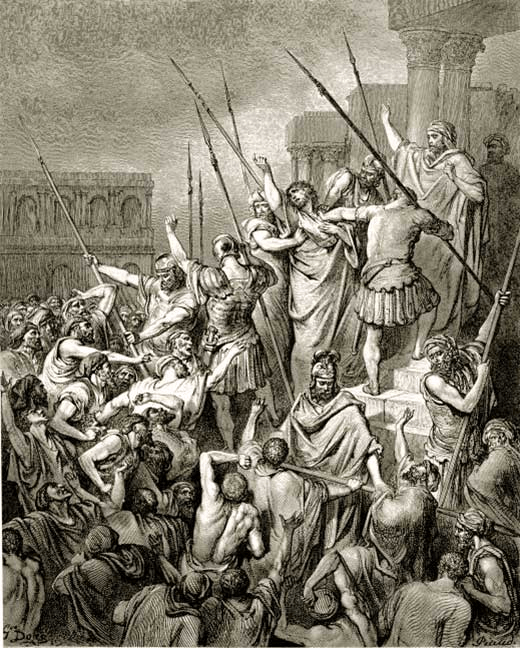
Apostle Paul in Jerusalem, by Gustave Doré, 1878

When the seven days were nearly over, some Jews from the province of Asia saw Paul at the temple. They stirred up the whole crowd and seized him, shouting, “Fellow Israelites, help us! This is the man who teaches everyone everywhere against our people and our law and this place. And besides, he has brought Greeks into the temple and defiled this holy place.” (They had previously seen Trophimus the Ephesian in the city with Paul and assumed that Paul had brought him into the temple.)

The whole city was aroused, and the people came running from all directions. Seizing Paul, they dragged him from the temple, and immediately the gates were shut. While they were trying to kill him, news reached the commander of the Roman troops that the whole city of Jerusalem was in an uproar. He at once took some officers and soldiers and ran down to the crowd. When the rioters saw the commander and his soldiers, they stopped beating Paul.

The commander came up and arrested him and ordered him to be bound with two chains. Then he asked who he was and what he had done. Some in the crowd shouted one thing and some another, and since the commander could not get at the truth because of the uproar, he ordered that Paul be taken into the barracks. When Paul reached the steps, the violence of the mob was so great he had to be carried by the soldiers. The crowd that followed kept shouting, “Get rid of him!”

As the soldiers were about to take Paul into the barracks, he asked the commander, “May I say something to you?”

“Do you speak Greek?” he replied. “Aren’t you the Egyptian who started a revolt and led four thousand terrorists out into the wilderness some time ago?”

Paul answered, “I am a Jew, from Tarsus in Cilicia, a citizen of no ordinary city. Please let me speak to the people.” (New International Version)

The Apostle Paul arrived in Jerusalem, after a sojourn in Greece and the province of Asia. He had been gathering a collection for the believers in need. In his journey, Paul received messages, warnings, and even prophecy that he would be arrested if he went to Jerusalem.

Since the prophecy did not tell Paul to stay away, he kept going, ready not only to be arrested but to also die for his faith, if need be. (Acts 21:10-14)

Iron handcuffs (chains) from the Roman Empire, Archaeological Museum in Durrës, Albania

The first week of being Jerusalem entailed the status quo for Paul: He dealt with yet another church conflict between Jews and Gentiles. Then, the prophecy began to unfold and become reality.

Jews from Asia, who had seen Paul in the Temple and recognized him as a Christian agitator, immediately jumped to the conclusion that Paul was up to no good. It appeared to them that Paul had taken a Gentile into the Temple, thus defiling it, which in fact, he had not.

But when you have a grudge against someone, and an axe to grind, you begin making mental correlations and causations that aren’t really there.

So, the Jews from Asia got the crowd all stirred up by judging Paul as a person who teaches everyone everywhere against the people, the law, and the Temple. In other words, they accused Paul of being anti-Semitic and fomenting violence against the Jews.

Ironically, however, that is just what the Asian Jews did themselves. Without just evidence, they evoked the crowd’s emotions enough to drag Paul from the Temple. And they weren’t inviting him to tea. It seems they had every intention of doing him in, and not by throwing sugar cubes at him.

The only thing that stopped a death that day was the Roman authority getting in between Paul and the crowd. As per the prophecy, Paul was arrested and bound with chains.

The crowd had turned so riotous that the Roman commander could not ascertain Paul’s identity. The mob became violent, so Paul was whisked away by the Roman soldiers. As he left, the shouts of “Away with him!” could be heard throughout the city.

Jesus had a similar experience, but went to his death without any opportunity for a defense speech before an angry crowd.

Paul requested, however, to address the mob. And the Roman commander was aghast to learn that Paul spoke Greek – supposing that he was just another annoying religious nut on the street corner who got up into everyone’s grill a bit too much.

Yet, the commander quickly discovered that he was dealing with a citizen of the Empire who was no kooky preacher. Here we see a turn of events and a flip-flop between two groups of people.

It’s the Roman army who upheld proper justice and protected the interests of the individual; whereas the Jewish crowd became vigilante, ironically violating their own law by trying to put an innocent person to death without justification.

In a twist of history, the Roman arrest of Paul was his deliverance from a Jewish mob. Go figure.

Today’s story opens for me a set of questions that are both genuine, as well as a bit rhetorical:

  • How often do we – as both individuals and churches – accuse others of being unfaithful and/or unbiblical, when it is we ourselves who are going rogue from Holy Scripture?
  • In what ways do we handle false charges, judgmentalism, and unjustified criticism from others who misunderstand and/or misinterpret us?
  • What do we do (and not do) whenever there are differences within the church, family, community, workplace, or nation?
  • Does our manner of approaching conflict include the verbal violence of gossip and slander and/or actual physical violence through passive-aggressive behavior?
  • Am I looking too closely and/or critically under the hood of your soul? What will you do with me, let alone Jesus?

If you can receive this, I recommend taking some time and space today for answering those questions honestly through writing them in a journal and/or talking about them with a trusted friend.

May God have mercy upon our human institutions, societies, and relationships. To God be the glory. Amen.

Our Riches In Christ (Colossians 2:1-5)

I want you to know how hard I am contending for you and for those at Laodicea, and for all who have not met me personally. My goal is that they may be encouraged in heart and united in love, so that they may have the full riches of complete understanding, in order that they may know the mystery of God, namely, Christ, in whom are hidden all the treasures of wisdom and knowledge. 

I tell you this so that no one may deceive you by fine-sounding arguments. For though I am absent from you in body, I am present with you in spirit and delight to see how disciplined you are and how firm your faith in Christ is. (New International Version)

When you already have everything you need, it’s useless – and can even be damaging – to indulge in listening to fine sounding arguments about how you are missing out, lacking something, and/or falling short in some way.

For the Christian, the truth is: You now possess God’s treasure chest of wisdom and knowledge in Christ Jesus. So, why would you ever let someone deceive you through slick persuasion about having something superior to what you already have?

“Heresy” is really nothing more than making a bold claim to an alternative theological understanding than what you presently adhere to.

In some cases, an existing belief system is inferior and bogus. So, it’s a good thing when someone turns from bad religion in order to embrace a religion which is life-giving, helpful, and good.

Yet, if we already have a belief which is robustly full of righteousness and justice, and is good for the common life of everyone in the community, then it is dangerous to consider replacing it, or letting it fall into disuse.

The Apostle Paul’s consistent and overarching theme throughout his letter to the Colossian Christians is that Jesus Christ is sufficient, he is enough – more than enough – for our life and salvation.

That means the task of the Christian is to hold on to and cultivate what already has been taught to them according to apostolic tradition (that is, the Scriptures).

Another way of putting the matter: Learn to appreciate and enjoy what you already have, because it really is worth exploring, living into, and celebrating.

So, let’s put away any notions that standing firm in the faith involves defending your own personal brand of the Christian life (which is usually done obnoxiously) or for others to adhere to every jot and tittle of your own dogmatic theology.

To remain steadfast in the faith means primarily to nurture your faith – to actively pursue the spiritual life and concern oneself with the development of the soul. It is, more specifically, to keep on struggling to live into the words and ways of Jesus Christ; and to keep on learning and applying the apostolic teaching which has been passed down to us.

This is not too much to ask. It is reasonable (and biblical) to expect professing believers in Christ to put solid energy into encouraging one another in love and unity by means of sound Christian theology and doctrine.

Genuine and lasting unity depends upon both truth and love. Christians need to be of one mind and one heart, embracing the same values.

My dear wife and I recently celebrated 39 years of marriage together. Someone asked me today how we’ve made it all these years. I said that the main reason is that, although we are extreme opposites in nearly every way, we have both shared the same basic core values throughout our marriage. And that has gotten us through a lot of things.

Love for one another in the church will be maintained when we understand there is nothing being held back from us by God. The mystery of Christ has been revealed. There are no secrets. Solid and lasting relationships are built upon the foundation of truth. Nothing is held back.

We might as well lay bare everything, because it’s eventually going to happen one way or another.

Nothing in all creation is hidden from God’s sight. Everything is uncovered and laid bare before the eyes of him to whom we must give account.

Hebrews 4:13, NIV

If we begin to think the grass is greener on the other side of the fence, then we start listening to other people – perhaps even inviting other lovers into our lives. But the truth is: If I have some delicious fresh fried catfish on my plate, why in the world would I ever settle for a measly can of tuna?

The unity of the Colossian Church was at stake for the Apostle Paul. Just because someone is skilled in the art of persuasion, and can speak a good line, doesn’t necessarily mean that those words are good, right, or just.

There’s nothing wrong with persuasion. In fact, Paul himself was highly skilled in rhetoric and persuasion. At issue is losing sight of the message and focusing solely on the means of communicating the message.

Oftentimes a false teacher who peddles a different message other than apostolic teaching, has a highly believable way about them – which is why folks can be deceived. When one is being charmed, then critical analysis is rarely on their mind.

We can also be self-deceived, deluding ourselves, and talking ourselves into going down a bad path. It is most necessary to evaluate things according to the content rather than the attractiveness of the packaging.

Gifts of speaking and persuasion are good, so long as they are used for good, and controlled by sound thinking and directed by compassionate hearts.

There is no compelling witness for Christ if the church is fragmented and divided. But if we are convinced that our spiritual riches are found in Jesus Christ, then we shall find ways to remain connected and caring.

Therefore, let’s live as if we really believe this.

I always pray to the great and glorious Father, the God of our Lord Jesus Christ. I pray that he will give you the Spirit, who will let you know truths about God and help you understand them, so that you will know him better.

I pray that God will open your minds to see his truth. Then you will know the hope that he has chosen us to have. You will know that the blessings God has promised his holy people are rich and glorious. And you will know that God’s power is very great for us who believe. Amen. (Ephesians 1:17-19, ERV)

The “Fool’s” Speech (2 Corinthians 11:16-33)

I repeat: Let no one take me for a fool. But if you do, then tolerate me just as you would a fool, so that I may do a little boasting. In this self-confident boasting I am not talking as the Lord would, but as a fool. Since many are boasting in the way the world does, I too will boast. You gladly put up with fools since you are so wise! In fact, you even put up with anyone who enslaves you or exploits you or takes advantage of you or puts on airs or slaps you in the face. To my shame I admit that we were too weak for that!

Whatever anyone else dares to boast about—I am speaking as a fool—I also dare to boast about. Are they Hebrews? So am I. Are they Israelites? So am I. Are they Abraham’s descendants? So am I. Are they servants of Christ? (I am out of my mind to talk like this.) I am more. I have worked much harder, been in prison more frequently, been flogged more severely, and been exposed to death again and again. 

Five times I received from the Jews the forty lashes minus one. Three times I was beaten with rods, once I was pelted with stones, three times I was shipwrecked, I spent a night and a day in the open sea, I have been constantly on the move. I have been in danger from rivers, in danger from bandits, in danger from my fellow Jews, in danger from Gentiles; in danger in the city, in danger in the country, in danger at sea; and in danger from false believers. I have labored and toiled and have often gone without sleep; I have known hunger and thirst and have often gone without food; I have been cold and naked. Besides everything else, I face daily the pressure of my concern for all the churches. Who is weak, and I do not feel weak? Who is led into sin, and I do not inwardly burn?

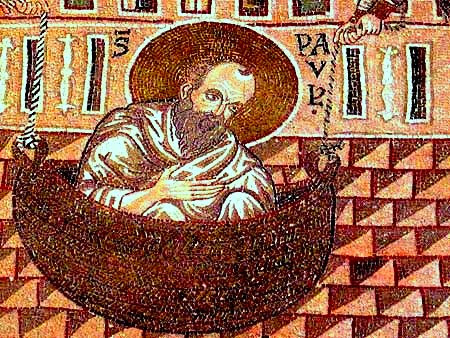
If I must boast, I will boast of the things that show my weakness. The God and Father of the Lord Jesus, who is to be praised forever, knows that I am not lying. In Damascus the governor under King Aretas had the city of the Damascenes guarded in order to arrest me. But I was lowered in a basket from a window in the wall and slipped through his hands. (New International Version)

Paul escaped the city of Damascus by being lowered in a basket at night (Acts 9: 23-25)

At this point in the Apostle Paul’s second letter to the Corinthian Church, he levels a direct and devastating attack on his proud, arrogant, and boastful opponents in the church. He points out the foolishness of their boasting, by means of playing the fool himself.

The gist of Paul’s argument was to boast of his humiliating experiences. In truth, Paul had plenty of glorious accomplishments he could have droned on about. Instead, he sought to expose the wide gulf that separated his understanding of apostolic ministry, and theirs.

With some rather hefty sarcasm behind his words, Paul offered some foolish boasting according to the human standards of his opponents. The Corinthians believed themselves to have superior strength and wisdom. Surely, they’re able to put up with these pathetic apostolic weaklings!

In reality, it is Paul’s weakness – and not humanly contrived understandings of strength – which establish his credibility and superiority as a minister of Christ’s gospel. The evidence is his hardships and trials – not his many triumphs. Paul intended for this irony to be felt by the Corinthians.

The Apostle’s litany of woes and adversities wasn’t meant to one-up the Corinthians. Rather, it was intended to be a parody of the Corinthians’ claims to superior wisdom and spiritual power.

While the church boasted of all the things that showed their strength, Paul boasted of his weaknesses – because it’s truly in weakness that the transcendent power of God is made known and manifested in this world.

Paul’s experience in Damascus not only illustrated the extreme danger he was in, but it served as an example of his weakness in contrast to the mighty strength of the Roman Empire.

In the Roman army, the soldier with the greatest strength and valor was the one who scaled the enemy wall first. The courageous ascent of the Roman soldier is viewed alongside the inglorious descent of Paul along the wall in escaping.

Christianity grew, flourished, and thrived not because of superior earthly strength, but because of humiliating weakness which allowed the power of heaven to work through it.

In light of Paul’s view of leadership and ministry, I find that many contemporary leadership theories are woefully lacking in an understanding of how people tick.

For example, some philosophies treat humans as if they were machines, and treat workers as cogs or parts in a larger mechanistic worldview, as if they could be replaceable.

Yet, leadership that relies on the factory system will inevitably demean a person’s basic humanity and see nothing of their inherent uniqueness and deserving of respect.

Instead, a more biblical, compassionate, and practical leadership style discerns that relationships are key; and that individual persons bring something special to their work, even if they are doing the same job as others.

In this understanding of leadership, every single person does their work or ministry in a way that isn’t fully reproducible by others. Our individual human uniqueness ensures that our place in the world is needed, and that what we bring to every endeavor we do is a special one-of-a-kind offering that no one else can do.

What’s more, in this view of leadership, there’s no room for boasting, at all. And no place for arrogant pride, because boasting is based upon comparison.

If every person is a unique creation of God, and everyone brings something individually special to their efforts, then comparison is a foolish waste of time, and boasting is nothing more than a fool’s game.

You can always tell the fool by how they keep talking and cannot keep their mouth shut about all of their accomplishments and everything they know. If they believe they’re right, and try and prove it with their comparative superiority to others, then you can bet that what you have in front of you is a card-carrying honest-to-goodness genuine Fool, with a capital “F.”

We can do better. And we can be better leaders and offer better leadership philosophies which are based in humility, the value of each person, sound relationships, and effective peacemaking.

Anything less than that will likely get a sarcastic comment from the Apostle Paul in heaven.

Give us, O God,
leaders whose hearts are large enough
to match the breadth of our own souls;
and give us souls strong enough
to follow leaders of vision and wisdom. Amen.

Addressing the Divisions Amongst Us (1 Corinthians 4:8-13)

Are you already satisfied? Are you now rich? Have you become kings while we are still nobodies? I wish you were kings. Then we could have a share in your kingdom.

It seems to me that God has put us apostles in the worst possible place. We are like prisoners on their way to death. Angels and the people of this world just laugh at us. Because of Christ we are thought of as fools, but Christ has made you wise. We are weak and hated, but you are powerful and respected. 

Even today we go hungry and thirsty and don’t have anything to wear except rags. We are mistreated and don’t have a place to live. We work hard with our own hands, and when people abuse us, we wish them well. When we suffer, we are patient. When someone curses us, we answer with kind words. Until now we are thought of as nothing more than the trash and garbage of this world. (Contemporary English Version)

On this particular July 4 in the USA, there is perhaps no more pertinent biblical passage than today’s in addressing the current American political and emotional climate. Yet, before this is specifically addressed, let’s understand what was going on with the Apostle Paul and the Corinthian Church…

The Corinthian Divisions

Special interest groups had formed within the church. Each was following a specific person – some Paul, some Apollos, and some other leaders and teachers. The groups began to harden into political church factions. And Paul wanted nothing to do with this way of being Christian, because it is antithetical to the gospel itself.

Christ died to bring unity, not division. Paul established egalitarian churches that showed no favoritism. The Corinthians were called to a way of being that breaks down barriers between rich and poor, Jew and Greek. This business of groups and factions only fostered the division which Christ died to do away with.

By the time the Apostle wrote his letter to the Corinthian Christians, they had devolved a way of being with each other that was judgmental. They were pointing out unhealthy and demeaning comparisons, and boasting about how their group was more spiritual and wise than the others.

The Apostle Tackles the Divisions

So Paul, never one to shy away from initiative and justice, went on the offensive. Admittedly, in today’s New Testament lesson, Paul is quite sarcastic. He was actually mocking the Corinthians for their sinful arrogance and pride; and he used their own ways of being together against them to demonstrate how utterly foolish and ridiculous they were being.

The Apostle Paul countered with some comparisons of his own, using the example of the apostles themselves. Through his sarcastic comparison, he essentially argued that God used the very real oppression and suffering of the apostles toward good and positive ends.

Paul contrasted the apostles and the Corinthians to show the injustice that was happening in their factional wars with each other. By drawing attention away from the Corinthians and putting it on the apostles, Paul upheld a Christian ministry of weakness, not strength.

The apostles endured much suffering and opposition in their ministry. Paul viewed himself as a sort of dishrag that was used to clean the dirty dishes of the world. And he was okay with that, because it had a redemptive purpose. But he was not at all okay with the dirty business of factions and divisions within the church.

George Washington Addresses the Divisions

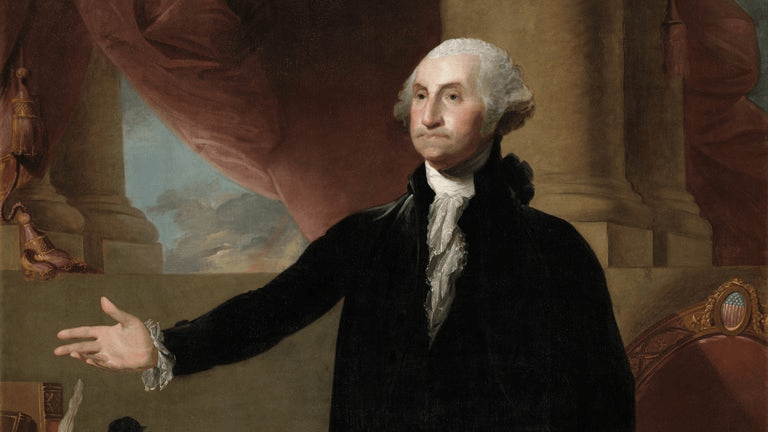
In our own day, it’s as if we have not learned the lessons of the past. And that is most likely because we have such little historical knowledge and awareness. I know of few people who realize George Washington was very much against a party system of government – and argued against it for similar reasons to the Apostle Paul.

Washington considered parties to be the bane of republican government. Parties were factions that threatened to divide the electorate into competing groups who might use violence to advance their interests.

He argued that political parties might also disrupt the separation of powers, especially in the case of unified government where loyalty to a party could interfere with the system of checks and balances.

What’s more, Washington said that parties threatened to stand in the way of effective representation, with elected officials tempted to represent only fellow party members and to leave opposition groups without a voice in government.

George Washington was mostly unique among the founders in never reconciling himself with political parties and never acknowledging the positive things that parties can bring to republican government.

Although it’s likely that Washington understood that parties were inevitable, he argued for keeping them under restraint and limiting their interference in the political process as much as possible.

Obviously, the party system won out, and rather quickly. In a healthy state of being, political parties can mobilize voters and encourage voter participation. They help build support for officeholders and serve as conduits of communication to the people. Political parties allow minorities to form coalitions to create majority rule.

Stick with the Evidence

Yet, what we seem to continually experience nowadays is the unhealthy aspect of the party system. People are hardened and reified into established positions and refuse to listen to the other. In such a position, evidence-based practices take a back seat.

For example, although there is not a shred of evidence that the former U.S. President experienced a hung jury and a corrupt judge in being convicted on 34 felony counts, a sizable chunk of Americans believe the corruption to be true – seemingly only because the former President said so, and without any objective, reasonable, and serviceable evidence to offer in backing up that claim.

And that prideful hardened spirit is the very thing that was happening in the ancient Corinthian Church. They wanted what they wanted, and they didn’t care what the other group thought. Each group believed (without evidence) they were wise and right. Yet, all of them were, in reality, foolish and unjust.

If we want a better public political climate; the freedom to be who we are; and confidence for the future; then, we had better begin with examining ourselves and listening well to the other first, before we assume that our own group is in the right and should be in control.

The privileges of freedom can only be enjoyed by embracing the responsibilities of freedom. And those responsibilities include a unified concern for the common good of all citizens, and not just the ones I like and who agree with me.

O God, the Father of our Lord Jesus Christ, our Savior, and the Prince of Peace; Give us grace to lay aside our unhappy divisions. Take away all hatred and prejudice, and whatsoever else may hinder us from godly union and concord. Help us to build bridges, not walls, and live into the unity you provided for us in Christ, through the Spirit. Amen.