1 Corinthians 15:42b-49 – Attention to the Body is Spiritual

It’s the same with the resurrection of the dead: a rotting body is put into the ground, but what is raised won’t ever decay. It’s degraded when it’s put into the ground, but it’s raised in glory. It’s weak when it’s put into the ground, but it’s raised in power. It’s a physical body when it’s put into the ground, but it’s raised as a spiritual body.

If there’s a physical body, there’s also a spiritual body. So, it is also written, the first human, Adam, became a living person, and the last Adam became a spirit that gives life. But the physical body comes first, not the spiritual one—the spiritual body comes afterward. The first human was from the earth made from dust; the second human is from heaven. The nature of the person made of dust is shared by people who are made of dust, and the nature of the heavenly person is shared by heavenly people. We will look like the heavenly person in the same way as we have looked like the person made from dust. (Common English Bible)

Laying around on clouds. Strumming harps. Perhaps chanting. Maybe an angel choir. Ethereal. Yes, quite disembodied. That’s the stereotypical idea when it comes to the afterlife for many people. Although many believers in Jesus realize heaven won’t be quite like that, they still might think of it as non-corporeal.

The stereotypical view really comes from Plato, not Scripture. The ancient Greek philosopher Plato (423-347, B.C.E.) believed the soul to be immortal and the body mortal. Hence, after death, an ethereal existence with no physical attributes. Plato saw death itself as an emancipation from the body.

A New Testament understanding of the body is that it’s perishable and will die. However, the body will be resurrected and become permanently imperishable. Just as Christ died and rose again, so shall we. Since Jesus was raised to new life with an actual spiritual body, complete with the scars of crucifixion, so humanity is raised to new life – not without a body but with a renewed one – and will be fit to exist with God forever.

“All the fullness of deity lives in Christ’s body.” (Colossians 2:9, CEB)

This all might seem like theological trivia or quibbling over philosophical musings. But when we mosey through the Bible, the body is important, lifted-up as equal to the spirit or soul. The material and the immaterial are not to be ranked in order of importance; they are to be held together as equal partners of personhood.

The Lord God formed a man from the dust of the ground and breathed into his nostrils the breath of life, and the man became a living being. (Genesis 2:7, NIV)

Body and soul belong together like a hand in a glove; like biscuits and gravy; or like copy and paste; Calvin and Hobbes; cupcakes and frosting; the moon and the stars; gin and tonic; bacon and anything; and, well, like Adam and Eve. Care of both the material and immaterial dimensions of personhood are vital and necessary.

Our bodies are the vehicles in which we do the will of God in the world. And the same shall be true after this life is over. The next life requires some full lungs to sing to the Lord; tongues to praise God; hands to lift high in worship; and feet to dance with the Trinity – not metaphorically but with actual plain speech and real live action.

We were made from dust, and to dust we shall return. But that isn’t the end of the story. Resurrection has the final say. Mortality will give way to immortality. The perishable will become imperishable. Temporal existence will cease and a permanent life, eternal life, shall endure without degeneration or entropy, with no disease, disorder, or death.

We, therefore, have hope – a confident expectation that it will not always be this way – a planet filled with pain, heartache, and grief. The tent of our present existence will be left behind for a grand mansion with God at the center – all things revolving around divine grace and love with the light of glory dispelling the night forever.

Our faith is embodied; and will be for all time. Embodied spirituality discerns all human dimensions—body, soul, heart, mind, emotions, and consciousness—as equal partners in bringing oneself into fuller personal alignment and engagement with the world.

Spiritual transformation is incomplete unless it encompasses the body. We need to be aware of and connected to our physical selves. Else, we lack wholeness and integrity. The body is not a platonic prison of the soul but a spiritual temple of the Holy Spirit. It is our home and the place where we meet with God.

A complete human being with a full-orbed spirituality is firmly grounded in the body, fully open to the spirit, and in community with others experiencing transformation from the inside-out.

One way of honoring our bodies is to incorporate them into our prayers. Here are some physical postures we can take when praying:

  • Sit with hands open, palms up, ready to receive grace and love from God.
  • Stand with hands open and raised overhead, and face toward ceiling/sky.
  • Kneel with head bowed (I personally use a kneeler. My knees aren’t what they used to be).
  • Kneel with hands/head in one of the positions described above.
  • Walk a prayer labyrinth.
  • Lie on your back (on your bed, the floor, the grass).
  • Lie face down with hands outstretched (prostrate).
  • Genuflect (bow) and make the sign of the cross.
  • Cupped hands facing up to receive blessing from God.
  • Deep breath in (saying “more of you”) and a full exhale out (saying “less of me”).

Our worship on this earth is training us for worship in the new heavens and the new earth. Paying attention to our bodies is good spiritual sense, not to mention being thoroughly biblical.

Almighty God, Creator of heaven and earth, we await your divine presence in our lives – not as we expect or imagine – but just as it is. We allow and invite all the ministry of your Spirit into our lives. We accept whatever you give to us or withhold from us as a gift. And we will attend to our bodies and care for them as faithful stewards of this flesh and blood existence, through Jesus Christ our Lord. Amen.

Titus 1:1-9 – Effective Spiritual Leaders

From Paul, a slave of God and an apostle of Jesus Christ. I’m sent to bring about the faith of God’s chosen people and a knowledge of the truth that agrees with godliness.

Their faith and this knowledge are based on the hope of eternal life that God, who doesn’t lie, promised before time began. God revealed his message at the appropriate time through preaching, and I was trusted with preaching this message by the command of God our savior.

To Titus, my true child in a common faith.

Grace and peace from God the Father and Christ Jesus our savior.

The reason I left you behind in Crete was to organize whatever needs to be done and to appoint elders in each city, as I told you. Elders should be without fault. They should be faithful to their spouse and have faithful children who can’t be accused of self-indulgence or rebelliousness. This is because supervisors should be without fault as God’s managers: they shouldn’t be stubborn, irritable, addicted to alcohol, a bully, or greedy. Instead, they should show hospitality, love what is good, and be reasonable, ethical, godly, and self-controlled. They must pay attention to the reliable message as it has been taught to them so that they can encourage people with healthy instruction and refute those who speak against it. (Common English Bible)

Paul wrote his letter to Titus so that spiritually solid competent virtuous leaders might be appointed to guide the church on the island of Crete (located in the Mediterranean Sea, south of Greece). 

There was no ambiguity with Paul about the importance of leadership. The Apostle clearly laid out his expectations that church officials must have a good reputation – not bossy, quick-tempered, heavy drinkers, bullies, or dishonest in business. Instead, they must be friendly to strangers and enjoy doing good things. They must also be sensible, fair, pure, and self-controlled.  They must stick to the true message they were taught, so that their good teaching can help others and correct everyone who opposes it.

I find it interesting that very few biblical scholars view this teaching as an ideal to aspire – while many churches and believers think this is the case. There is neither any indication nor reason within the biblical text to think that Paul presented his expectations for the ideal leader, as if no one could really be this way. 

Furthermore, Paul did not provide his instruction as a strategy for getting apathetic people off their butts and into some form of service. No, it’s best to understand that Paul meant what he said. He knew that compromising on the character of leadership would erode and destroy the church.

“True leadership is found in giving yourself in service to others, not in coaxing or inducing others to serve you.”

J. Oswald Sanders

The selection of church leaders is important because just one bad belly-aching non-virtuous apple can upset the entire apple cart. Good people provide good teaching and good wisdom. Selfish people with a self-centered agenda find ways to subvert or manipulate sound instruction to get what they want. 

Everyone in the Body of Christ is to grow in the wisdom and knowledge of God. They are to be wise to all the shenanigans of myopic persons through understanding the commands and instruction of Holy Scripture. This is yet another reason to immerse ourselves in the Bible so that we will lead with confidence.

If a church or faith community feels the need to overlook character defects to fill empty leadership seats, then Houston, we have a problem. Any short order cook worth his salt would never crack open a rotten egg and mix it in with the rest to make an omelet. And any group of people who throw a bad egg into their leadership team had better be ready to get sick and vomit when meetings are called to order.

It is imperative that spiritual leaders possess the following:

  • A good reputation
  • Faithfulness and fidelity to their families.
  • A clear-mind and consistent good behavior.
  • Self-control
  • The moral courage to speak truth with grace.
  • A spirit and practice of hospitality.
  • An ability to communicate well so that people are built up in their faith.
  • Sobriety
  • Humility
  • Respectability
  • Gentleness
  • Patience
  • Generosity
  • Compassion
  • Maturity
  • Sincerity
  • Honesty
  • Empathy
  • Purity

All these traits are needed for effective and godly spiritual leadership. Compromising on virtue will never end well. Upholding moral character brings blessing.

“The authority by which the Christian leader leads is not power but love, not force but example, not coercion but reasoned persuasion. Leaders have power, but power is safe only in the hands of those who humble themselves to serve.” 

John R.W. Stott

God calls and sets apart individuals for service. The Lord desires to reveal and manifest the divine presence among people through leaders who reflect God’s good attributes. Jesus Christ wants his church to be built up through faithful service. The Spirit seeks to sanctify and empower for effective ministry.

Nowhere do we find in Scripture that a leader’s main job is listening to complaints. That’s because God has a zero tolerance policy toward murmuring, grumbling, and ingratitude. In fact, the New Testament clearly says to do everything without complaining or arguing. (Philippians 2:14)

Neither will you find the church is supposed to operate just like an American form of democracy. Spiritual leaders are not representatives of the people to do their will. Instead, they are representatives of God to the people so that God’s will is done in all things. 

That all means prayer to God and outreach to the world is the major work for spiritual leaders. And it takes virtuous and ethical persons leading to realize love to all kinds of people. So, feel free to exercise leadership. Just make sure that leadership is grounded in the God of integrity and the Word of grace and truth.

Almighty God, the One who gives good gifts to people, may every grace of ministry rest on divinely appointed leaders. Keep them strong and faithful so that your church may prosper in peace. Grant leaders wisdom, courage, discretion, and benevolence so that they may fulfill their charge to the glory of Jesus Christ and in the power of your Holy Spirit. Amen.

1 Corinthians 15:50-58 – Keep the Easter(tide) Coming

He Is Not Here by He Qi

What I am saying, brothers and sisters, is this: flesh and blood cannot inherit the kingdom of God, nor does the perishable inherit the imperishable. Listen, I will tell you a mystery! We will not all die, but we will all be changed, in a moment, in the twinkling of an eye, at the last trumpet. For the trumpet will sound, and the dead will be raised imperishable, and we will be changed. For this perishable body must put on imperishability, and this mortal body must put on immortality. When this perishable body puts on imperishability, and this mortal body puts on immortality, then the saying that is written will be fulfilled:

“Death has been swallowed up in victory.”
“Where, O death, is your victory?
    Where, O death, is your sting?”

The sting of death is sin, and the power of sin is the law. But thanks be to God, who gives us the victory through our Lord Jesus Christ.

Therefore, my beloved, be steadfast, immovable, always excelling in the work of the Lord, because you know that in the Lord your labor is not in vain. (NRSV)

Throughout my years of conducting Easter Sunday services, I inevitably have someone mention to me after the glorious resurrection celebration how much they enjoy Easter music and cantatas. Then, the conversation oftentimes ends with some sort of statement on how it is too bad we only sing such songs once a year.

Here is my proposal: Then don’t just sing them once a year. Instead, rejoice with resurrection singing and gusto to God, who gives us the victory through our Lord Jesus Christ, for the next several weeks.

“I am the resurrection and the life. Those who believe in me, even though they die, will live, and everyone who lives and believes in me will never die.” – Jesus

John 11:25-26, NRSV

The hopes and expectations of Christians are realized in Christ’s resurrection. The good news of Easter cannot be contained or limited to a single day (Easter Sunday). That is why, according to the Christian Calendar, Easter is only the first of fifty days of celebration called “Eastertide” which leads to the day of Pentecost. Eastertide is a season designed especially for exploring the new life we have in Jesus and the joyful Christian life we can all experience.

Just as we would likely not think of taking only one vacation day in the year for renewal, so it is necessary to take more than one day to enjoy Easter. If nothing else, Eastertide gives believers an opportunity to let Christ’s resurrection percolate in our hearts so that we end up becoming people in real life who exhibit an alive spirit.  And, God knows, we could use much more of that in our congregations and our world!

“The message of Easter is that God’s new world has been unveiled in Jesus Christ and that you’re now invited to belong to it.”

N. T. Wright

If life, eternal life, and the necessity of being alive are all needs for us, then it only makes sense that we would want to take advantage of what Eastertide has to offer: A deliberate look at Christ’s resurrection, exploring its implications and impact for us. Simply assuming we all know about resurrection will not do, any more than my wife simply assuming I love her without looking her straight in the eye and telling her so. 

If Christ has not been raised, your faith is futile (1 Corinthians 15:17). Without an Eastertide, there’s a sin-as-usual kind of approach to life with a sort of shoulder shrug that says, “Meh, what’s a guy to do?”  Instead, we have the hope of life everlasting because Christ has risen from death. We have the hope of individual renewal, corporate revitalization, and worldwide revival because there is a risen Savior.

Spring is the time of year which can give shape to the rest of our seasons. Christ’s resurrection gives us a reason to rejoice, hope, persevere, and serve gladly, knowing that our labor in the Lord is not in vain. 

Easter is not over. It is just beginning. 

Therefore, throwing parties for Jesus is in order. Celebrating life, new life, is not only fun but biblical. Maybe some people outside the church look at Christians as uptight and repressed because we are not throwing the best parties and celebrations. 

After all, we have the highest reason possible to celebrate loudly with great passion and joy. Our joy can lead us to paint the town red, whoop it up, raise the roof; splurge, and be effusive with our worship. Christians, full of redemption and reconciliation, break out of their staid existence to hail King Jesus not just today but all through Eastertide because Christ is risen!  He is risen, indeed!

Almighty God, who through your only begotten son Jesus Christ overcame death and opened to us the gate of everlasting life: Thank you for giving me a reason to celebrate with joy my Lord’s resurrection. May I be raised from the death of sin by your life-giving Spirit and give the best party in the neighborhood; through Jesus Christ who lives and reigns with you and the Holy Spirit, one God, now and forever.  Amen.

Philippians 2:5-11 – Palm Sunday

In your relationships with one another, have the same mindset as Christ Jesus:

Who, being in very nature God,
    did not consider equality with God something to be used to his own advantage;
rather, he made himself nothing
    by taking the very nature of a servant,
    being made in human likeness.
And being found in appearance as a man,
    he humbled himself
    by becoming obedient to death—
        even death on a cross!

Therefore, God exalted him to the highest place
    and gave him the name that is above every name,
that at the name of Jesus every knee should bow,
    in heaven and on earth and under the earth,
and every tongue acknowledge that Jesus Christ is Lord,
    to the glory of God the Father. (NIV)

I often take the posture of kneeling or prostrating when I pray. I do this, not because I think my prayers are more effective that way, but because this embodies my petitions with a recognition of Christ’s lordship over my life. Also, for me, there is no experience quite like using the kneelers on church pews and bowing together in a common experience of recognizing the lordship of Jesus Christ.

I sometimes ponder a question as I am on my knees: What kind of people would we be if we looked like these verses in Philippians?  The Apostle Paul said to the church in Philippi that their “attitude” should be the same as that of Christ Jesus. Their mindset, the way they think about everything, ought to be just like the mind of Christ. If we want to know how to think well and live well, how to relate to others in a good way, then we ought to thoroughly adopt the mind and the attitude of Jesus.  

How we should think and live comes from God. Within the life of the triune God exists three persons: Father, Son, and Spirit. Within this great three-in-one God exists perfect love, absolute holiness, united harmony, and constant respect. The Holy Scriptures tell us that just as God is holy, we are to be holy. Just as God is love, so we are to love one another. Just as God is harmonious, we are to live in harmony with one another. And just as God is supremely exemplified in the person of Jesus as a humble servant, so we are to practice humility and service in all our relations.

None of this is optional for the Christian. There is no place in the believer’s life for pride, posturing, and power-broking. There is to be humility, taking the posture of lowliness, and using any kind of influence for the benefit and encouragement of others – just like Jesus did while on this earth.

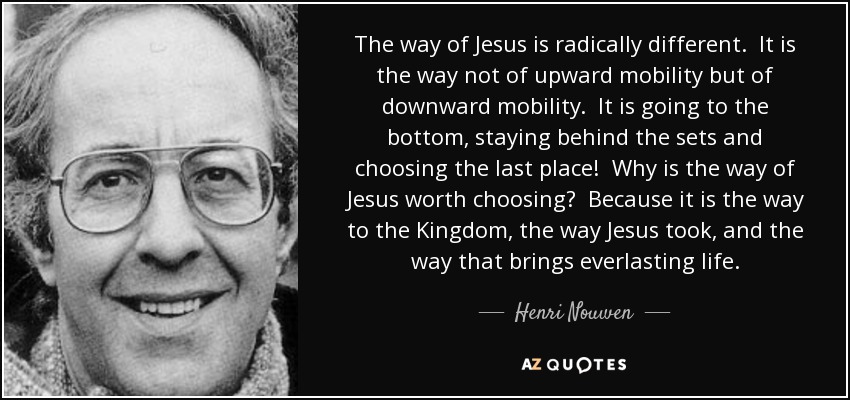
In a world pre-occupied with power and control, safety and security, influence and throwing its weight around, there is Jesus. He did just the opposite of engaging in upward mobility; he practiced downward mobility, and in doing so Christ descended into greatness as Lord and Savior.

Jesus did not consider equality with God as something to be grasped. The pre-incarnate Christ did not sit in heaven as the second person of the Trinity and hold onto his lofty position with tight fists – he did not grasp it tightly. When Jesus came to this earth, there was a humble willingness to open his hands and relinquish his rights and privileges as God. Christ made himself nothing, taking the very nature of a servant. Jesus gladly, not reluctantly, emptied himself for us. Jesus became one of us.

The television series, Undercover Boss, is a reality show in which high-level corporate executives leave the comfort of their offices and secretly take low-level jobs within their companies to find out how things are really working and what their employees are honestly thinking about their jobs and what is happening. In the process of this undercover mission, they learn of the perceptions about their companies, the spirit of their work forces and — maybe — something about themselves as well.

None of the executives cease to be executives. They just make a willing decision to take the lowest level job in their own company to hopefully benefit the employees and the entire corporation. The best episodes are when the most generous executives go above and beyond helping the employees around them at the end of the show. 

Jesus descended to earth. He never ceased to be God. Yet, Christ willingly put his kingly robe in the closet and donned Dickies and work boots. He came among us and purposely limited himself to identify with us fully – and secured for us the greatest generosity imaginable – an answer to the problem of guilt and shame through forgiveness of sins.

Jesus became a servant. He completely tied himself to us. Jesus did not come to this earth seeking to be served, but sought to serve and give his life as a ransom for many. Christ kept going lower and lower to the point of descending to the greatest humiliation of all – death on a cross. Jesus endured the ultimate shame of the ancient world by dying a terrible death. The King of the universe was killed by vicious humanity so that he might redeem and save those very same people from their terrible plight of bondage to evil.

We are to be humble people, embracing a lowly status of slaves to God and to one another. The ancient Philippian church had a real problem with pride which is why Paul talked about emulating the mind and attitude of Christ in his humiliation. The following are exhortations Paul gave to the Philippians, which were to reflect the practice of humility in relationships:

  • Whatever happens, conduct yourselves in a manner worthy of the gospel of Christ (1:27). 
  • Do nothing out of selfish ambition or vain conceit, but in humility consider others better than yourselves (2:3). 
  • Continue to work out your salvation with fear and trembling (2:12). 
  • Do everything without complaining or arguing (2:14). 
  • Join with others in following my example and take note of those who live according to the pattern we gave you (3:17). 
  • Do not be anxious about anything, but in everything, by prayer and petition, with thanksgiving, present your requests to God (4:6). 

Because of Christ’s humble obedience to the Father, he was exalted from the lowest place to the highest place.  King Jesus is on the throne, above everyone and everything. Because of his descent to this earth, Christ has ascended in glory and honor. We can now see God in a new way, through Jesus. And when we do, it causes us to kneel in prayer and profess that Jesus Christ is Lord.

In the ancient world, this was subversive language. If Jesus is Lord, Caesar is not, and ultimate allegiance does not belong to the Roman Empire. If Jesus is Lord, the local gods are not. And in our day, it is no different. Historical characters and religious deities may come and go, but the issue of ultimate allegiance still pertains to us. If Jesus is Lord, no politician or celebrity is owed lordship status. Pride and arrogance are to be put down at every turn in favor of humble service and loving actions.

If we are to follow Jesus Christ truly and really, we will practice downward mobility and embrace humility. Bowing, kneeling, and prostrating will become second nature to us as we give our unflagging allegiance to Jesus. We will accept our creaturehood and God as Creator. We will live in the reality that Jesus is Sovereign over all creation. 

As we enter the Christian Holy Week, let us acknowledge and know the humiliation and exaltation of Christ….

Just watch my servant blossom!
    Exalted, tall, head and shoulders above the crowd!
But he didn’t begin that way.
    At first everyone was appalled.
He didn’t even look human—
    a ruined face, disfigured past recognition.
Nations all over the world will be in awe, taken aback,
    kings shocked into silence when they see him.
For what was unheard of they’ll see with their own eyes,
    what was unthinkable they’ll have right before them.

Who believes what we’ve heard and seen?
    Who would have thought God’s saving power would look like this?

The servant grew up before God—a scrawny seedling,
    a scrubby plant in a parched field.
There was nothing attractive about him,
    nothing to cause us to take a second look.
He was looked down on and passed over,
    a man who suffered, who knew pain firsthand.
One look at him and people turned away.
    We looked down on him, thought he was scum.
But the fact is, it was our pains he carried—
    our disfigurements, all the things wrong with us.
We thought he brought it on himself,
    that God was punishing him for his own failures.
But it was our sins that did that to him,
    that ripped and tore and crushed him—our sins!
He took the punishment, and that made us whole.
    Through his bruises we get healed.
We’re all like sheep who’ve wandered off and gotten lost.
    We’ve all done our own thing, gone our own way.
And God has piled all our sins, everything we’ve done wrong,
    on him, on him.

He was beaten, he was tortured,
    but he didn’t say a word.
Like a lamb taken to be slaughtered
    and like a sheep being sheared,
    he took it all in silence.
Justice miscarried, and he was led off—
    and did anyone really know what was happening?
He died without a thought for his own welfare,
    beaten bloody for the sins of my people.
They buried him with the wicked,
    threw him in a grave with a rich man,
Even though he’d never hurt a soul
    or said one word that wasn’t true.

Still, it’s what God had in mind all along,
    to crush him with pain.
The plan was that he gives himself as an offering for sin
    so that he’d see life come from it—life, life, and more life.
    And God’s plan will deeply prosper through him.

Out of that terrible travail of soul,
    he’ll see that it’s worth it and be glad he did it.
Through what he experienced, my righteous one, my servant,
    will make many “righteous ones,”
    as he himself carries the burden of their sins.
Therefore I’ll reward him extravagantly—
    the best of everything, the highest honors—
Because he looked death in the face and didn’t flinch,
    because he embraced the company of the lowest.
He took on his own shoulders the sin of the many,
    he took up the cause of all the black sheep. (Isaiah 52:13-53:12, MSG)