Filled with Divine Fullness (Colossians 2:6-15)

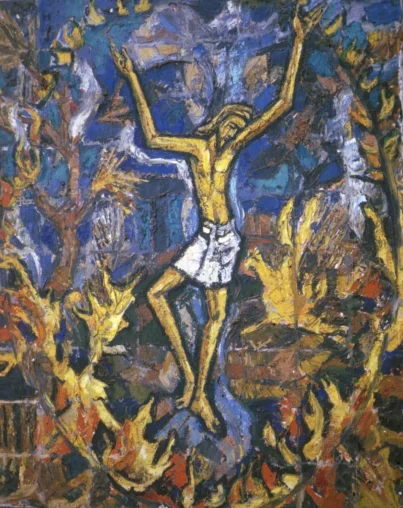
Resurrection, by Oliver Pfaff

As you therefore have received Christ Jesus the Lord, continue to walk in him, rooted and built up in him and established in the faith, just as you were taught, abounding in thanksgiving.

Watch out that no one takes you captive through philosophy and empty deceit, according to human tradition, according to the elemental principles of the world, and not according to Christ. 

For in him the whole fullness of deity dwells bodily, and you have come to fullness in him, who is the head of every ruler and authority. In him also you were circumcised with a spiritual circumcision, by the removal of the body of the flesh in the circumcision of Christ; when you were buried with him in baptism, you were also raised with him through faith in the power of God, who raised him from the dead. 

And when you were dead in trespasses and the uncircumcision of your flesh, God made you alive together with him, when he forgave us all our trespasses, erasing the record that stood against us with its legal demands. He set this aside, nailing it to the cross. He disarmed the rulers and authorities and made a public example of them, triumphing over them in it. (New Revised Standard Version)

On the television gameshow “Let’s Make a Deal,” selected members of the studio audience are offered something of value, and then given a choice of whether to keep it or exchange it for a different item.

The game’s drama is that the other item is hidden from the person until that choice is made. The participant does not know if the alternative item is of equal or greater value; or an item purposely chosen to be of little or no value.

The “deal” with Christianity is that Christians already have something of significant value. But they often lose it by going after something they aren’t even sure they actually want, or not.

Followers of Jesus have been given a valuable gift. And the Apostle Paul’s exhortation to the Church at Colossae was to go ahead and keep going with the prize you already possess.

Believers in Jesus have received him. Therefore, the believer is not to trade the words and ways of Jesus, and the redemption secured in Christ, for something else.

Having been redeemed by the Cross of Christ, believers are deeply rooted in Jesus. They are on a firm foundation of faith. Christians possess a faith full of hope and love.

So then, believers are encouraged by the Apostle Paul to take everything they have been taught, and everything they have received, and run with it.

It doesn’t matter what is behind another door, or what is on the other side of the curtain; grab ahold of what you possess in Jesus Christ. Stop considering a better way to live, and start living the life that’s been given to you.

Allow gratitude and thanksgiving to arise within you, and to come forth out of you. Quit looking how much greener the grass is on the other side of the fence. That pasture isn’t really greener; and there is not really a better way.

Many people have become disillusioned with institutional religion. They’ve had it with church. So, some of them end up throwing out the baby with the bath water, entertaining all sorts of ideas and approaches other than the grace-filled Christianity they once received.

Unfortunately, there are plenty of spiritual charlatans who seek to bedazzle people with fine sounding words. But it’s all nothing but a bunch of pseudo-intellectual philosophical babble.

Yet, because the messenger appears confident and makes grand pronouncements, they let themselves be captured, and go with it. And there are others who become enamored with endless theological talk, that has neither any real effect on one’s daily life, nor eternal life.

The Apostle was warning the Colossian believers about getting lost in the myriad traditions and superstitions that have an absence of Christ in the middle of them.

The way of Jesus has Christ directly and purposefully at the core of one’s life. Anything less is to make a deal and see what is behind another door.

The way of Jesus has very little to do with a particular theological tradition about the end times, or a certain literal interpretive stance, or a liturgical or non-liturgical approach to the Christian life.

Everything of God is right, just, and good. And according to Christianity, it comes through the person and work of Jesus, through Christ’s words and ways as expressed in the New Testament Gospels.

It seems to me that the Apostle Paul would be aghast today at how many supposed Christian believers worship him and his epistles! Instead of giving their full adoration to Christ.

The last word doesn’t come from Paul, but from Jesus. Keep in mind that Paul worshiped Christ, and did not point people to himself as the be-all-end-all of any philosophical approach.

Jesus the Dancer, by Jyoti Sahi

Everything the Christian needs is within the fullness of Jesus Christ.

All things are empty without Christ, including the vast universe. The power and authority of Christ extends over all things and all people everywhere. Paul was insistent on this in all of the churches he established.

Thus, Christians must enter into the fullness of their Lord Jesus.

You can spend a lifetime, even an eternity after death, trying to figure out how God works, but you will never get to the end of it. God’s arm has that long of a reach. The fullness of Jesus is that big and filling. The strength of the Spirit is that powerful.

The heart and center of Christianity has nothing to do with circumcision, modes of baptism, keeping long lists of laws, or maintaining multiple spiritual practices. Because the Christian is already in, and already united with Christ.

This is why Paul prayed for believers to explore and realize what they already have in Christ, so that, with the eyes of their heart enlightened, they may perceive what is the hope to which God has called them, the riches of God’s glorious inheritance among the saints, and the immeasurable greatness of divine power for those who believe. (Ephesians 1:18-19)

The Christian has been spiritually raised from the dead, just as Christ was physically raised from death to life. And believers will also be physically raised, as Jesus was, if they have the spiritual eyes to see it.

Think of all those times in the past when you were stuck, and living a dead-end existence. Remember how God made you alive in Christ. All of your guilt and shame forgiven. All the stuff that kept you down and out, all that kept you from God, was nailed to the Cross of Christ.

The malevolent forces of this world have been stripped of their power, and can be seen as the sham they actually are.

It will not be nearly as valuable nor practical – not even close.

Being grounded in the person and work of Christ is where it’s at, my friend.

Watch out that nobody comes along and tries to sway you from Jesus. Don’t make any deals. You and I have Jesus. He is all we need.

Lord Jesus, you are worthy of our adoration, affection, and allegiance. Because of you, we don’t have to guess what God is like; there is no need to create our own image of God. Everything we need to know about God is revealed in and through you. Along with the Father and the Spirit, you have always existed in perfect relationship and unimaginable wonder.

Blessed Holy Trinity, the God whom I serve, may your divine dance of Father, Son, and Spirit pulsate within me, and flow out of me in a trust that you are enough. Then I will know that I, too, am enough as I avoid the false philosophies and promises of this world.

Almighty God, you fill the center of my being, so that I can let You be You, and so, be content and at peace, despite the alternative voices that chatter constantly around me. May your will be done, today and every day, to the glory of Jesus Christ my Lord. Amen.

Build Spiritual Wealth (1 Timothy 6:11-21)

But you, man of God, flee from all this [love of money] and pursue righteousness, godliness, faith, love, endurance and gentleness. Fight the good fight of the faith. Take hold of the eternal life to which you were called when you made your good confession in the presence of many witnesses. 

In the sight of God, who gives life to everything, and of Christ Jesus, who while testifying before Pontius Pilate made the good confession, I charge you to keep this command without spot or blame until the appearing of our Lord Jesus Christ, which God will bring about in his own time—God, the blessed and only Ruler, the King of kings and Lord of lords, who alone is immortal and who lives in unapproachable light, whom no one has seen or can see. To him be honor and might forever. Amen.

Command those who are rich in this present world not to be arrogant nor to put their hope in wealth, which is so uncertain, but to put their hope in God, who richly provides us with everything for our enjoyment. 

Command them to do good, to be rich in good deeds, and to be generous and willing to share. In this way they will lay up treasure for themselves as a firm foundation for the coming age, so that they may take hold of the life that is truly life.

Timothy, guard what has been entrusted to your care. Turn away from godless chatter and the opposing ideas of what is falsely called knowledge, which some have professed and in so doing have departed from the faith.

Grace be with you all. (New International Version)

Whether we like it, or not, every one of us is a slave. I don’t mean slavery in the sense of nineteenth century antebellum black chattel slavery; but a slave in the vein of being a bondservant – one who is bound to a particular master by choice, and not by coercion.

Jesus put the matter this way:

“No one can serve two masters. Either you will hate the one and love the other, or you will be devoted to the one and despise the other. You cannot serve both God and money.” (Matthew 6:24, NIV)

Both Jesus and Paul had the assumption that we are all in service to something or someone, without exception. So, the question then becomes, “Who is your master?”

Becoming a bondservant to Master Mammon will cause a person to place their ultimate hopes and dreams in wealth and possessing financial resources. However, money will possess them, and not the other way around. Their relationships will suffer, wither, and become disconnected.

Conversely, being a bondservant to the Lord Jesus will lead a person to place their ultimate hope in God. Possessing a godly life, faith, love, endurance, and gentleness will be their way of life. They will give themselves to a spirit of generosity and the pursuit of good deeds. These servants of God will take hold of eternal life, and find themselves possessed by it.

The Apostle Paul, in writing one of his final letters on this earth, reminded his young protégé Timothy to teach his congregation the importance of being bonded in service to the right master, to build spiritual wealth in heaven, and not just financial wealth here on this earth.

The letter of Paul to Timothy is given as a relational gift, reminding the young pastor of the many things taught to him in the apprenticed relationship they enjoyed together. In this sense, it was a personal letter, designed to recall the importance of keeping tethered to Christ their Lord.

Through written language, Paul came alongside Timothy and spoke to him, saying to never become intimidated by riches or rich persons. Financial wealth is merely superficial, and holds no credit or influence in the kingdom of God.

God is far richer, and infinitely more powerful than anyone or anything in this world, Paul insisted. So, keep serving God alone; continue being bonded and united to Christ, which Paul knew was not an easy thing to do.

In a world of looking out for number one, survival of the fittest, and hyper-capitalistic economies, many succumb to the allure of trusting in Master Mammon. Instead, stay focused on the Lord Jesus, his words and his ways, and on living an exemplary life.

What is more, Paul exhorted Timothy to command those who are rich in this world to become rich in good deeds. It is possible to be wealthy and be a bondservant of Christ; yet, it is not at all easy to do so.

Which is why the rich person needs continual encouragement, exhortation, and accountability, in order to remain bound to what is most important. Such persons need the command to put their hope continually in God, and not in money or bit-coins; in Christ, and not in building a strong financial portfolio that will keep one swimming in plenty of financial resources.

Again, none of this teaching of the Apostle means that having an array of financial capital is somehow wrong or ungodly. Rather, it means that we must be quite intentional and careful to build our equity in the kingdom of God, and use our worldly wealth for good and just purposes that reflect a righteous life—a life of wonder, faith, love, steadiness, and kindness.

Guard the precious treasure given to you, that is, the great spiritual riches entrusted to you. Allow the overwhelming grace of God in Jesus Christ to keep you faithful and loving in this greedy and feckless world.

The Lord Jesus taught us in his Sermon on the Mount:

“Don’t hoard treasure down here where it gets eaten by moths and corroded by rust or—worse!—stolen by burglars. Stockpile treasure in heaven, where it’s safe from moth and rust and burglars. It’s obvious, isn’t it? The place where your treasure is, is the place you will most want to be, and end up being.” (Matthew 6:19-21, MSG)

Lord of our lives, teach us how to use our money and our possessions. Deliver us from stinginess and wasteful extravagance; inspire our giving with the spirit of true generosity. Help us always to remember your generous love for us, that we may be wise and faithful stewards of the good gifts you have given us. Amen.

Caring For the Aged (1 Timothy 5:1-8)

Do not rebuke an older man harshly, but exhort him as if he were your father. Treat younger men as brothers, older women as mothers, and younger women as sisters, with absolute purity.

Give proper recognition to those widows who are really in need. But if a widow has children or grandchildren, these should learn first of all to put their religion into practice by caring for their own family and so repaying their parents and grandparents, for this is pleasing to God. 

The widow who is really in need and left all alone puts her hope in God and continues night and day to pray and to ask God for help. But the widow who lives for pleasure is dead even while she lives. Give the people these instructions, so that no one may be open to blame. Anyone who does not provide for their relatives, and especially for their own household, has denied the faith and is worse than an unbeliever. (New International Version)

Timothy was the young Pastor of the Church in Ephesus, having been appointed by his mentor, the Apostle Paul. Paul wrote to his protégé in order to clarify and remind Timothy of how to go about his ministerial duties amongst the congregation.

In dealing with older persons, Paul instructed that they must not be dealt with harshly. There needs to be gentleness and moderation in correcting any faults with elders. Old folks already take quite enough medicine they don’t like. No one, especially some whipper-snapper, ought to come along and add some bitter medicine to their regimen.

Instead, provide exhortation which is tolerable, and evidences genuine concern and humility. Make it good medicine.

Timothy was not to allow the older folks to get away with being stinkers. And the way to handle this is by being respectful, considerate, and gentle.

Since the Body of Christ is a family, older men need to be treated as fathers, and older women as mothers. The younger women, too, must be corrected, when necessary. Although it is a delicate task, it needs to be engaged with the same care as the older men.

If Timothy thought about his ministry with people as dealing with his own mother, then he would do it with a great deal of love, humility, grace, and wisdom. Not only is the message to be conveyed; the spirit behind the message is just as important.

Younger women are to be treated as sisters; and young men as brothers. The way everyone is handled is significant. All persons, without exception, need love and attention.

The Apostle pointed out that there are certain groups of people which require special attention. Therefore, distressed widows need to be honored and treated with high regard.

A father to the fatherless, a defender of widows,
    is God in his holy dwelling. (Psalm 68:5, NIV)

Widows are identified in Scripture as those who are under the special care of God. So, how we treat them, is how we are treating God.

Any widow in the church who had no little to no support were to be provided for by the church. In the earliest church, this was important enough to warrant the creating of a new church ministry of deacons. (Acts 6:1-6)

Those widows who have children and/or grandchildren are to be first and foremost cared for by their family. Paul was unequivocable on this point. He insisted that a family with needy members, such as widows, are to put their religion into practice by ensuring that their mother or grandmother or aunt or any widow in the family is given what they need to live.

The Apostle’s directive to Timothy is that the church must not be unnecessarily burdened. Paul’s larger concern, however, was that adult children should honor their parents. That is their first religious duty as Christians. They ought to make a real and substantial effort toward mom and dad by providing for them in their old age, when they need it.

“It is easier for one poor father to bring up ten children, than it is for ten rich children to provide for one poor father.”

Dutch proverb

The provision for needy parents is to be done with a spirit of gratitude, love, and appreciation. I understand that this admonition gets rather dicey when it comes to adult children who were raised by a mother or father who was, at best, a stinker, and at worst, downright mean or abusive.

Yet, the wise Christian will learn to find ways toward returning a curse with a blessing, and so, honors both the parent and God. This in no way requires ignoring one’s own needs; it just means that we will strive to discover how to honor and provide for an aged mom or dad.

Having said that, there is a wide difference between the widow who puts her trust in God, and the widow who lives frivolously with no concern for God or others. The pious widow with no family must be cared for by the church. And the dissolute widow is not to be treated the same. The church, as well as the family, will need to be creative in how to approach such widows.

Each case within both the church and the family needs to be considered on its own merits. There is not necessarily a one-size-fits-all approach in every situation with a needy person. The following verses are helpful for us, as we consider how to assist:

Jesus said to his disciples,

 “A new command I give you: Love one another. As I have loved you, so you must love one another.” (John 13:34, NIV)

“My command is this: Love each other as I have loved you.” (John 15:12, NIV)

And the Apostle Paul said to the Church in Galatia,

“Carry each other’s burdens, and in this way you will fulfill the law of Christ.” (Galatians 6:2, NIV)

Whatever we do, or not do, we are not to neglect needy persons in our family or faith community. To reject or deny such persons is tantamount to rejecting one’s Christian faith.

Let us strive for both duty and delight in caring for the needy amongst us. Both are important. Sheer duty without delight is mere drudgery; it cannot be sustained. And only delight without any duty is irresponsible; it is also unsustainable.

May God’s provision and blessing be with you, as you strive to honor both your biological family, and your spiritual family. Amen.

Accept One Another (Romans 15:7-13)

Christian Unity, by Gisele Bauche

Accept one another, then, just as Christ accepted you, in order to bring praise to God. For I tell you that Christ has become a servant of the Jews on behalf of God’s truth, so that the promises made to the patriarchs might be confirmed and, moreover, that the Gentiles might glorify God for his mercy. As it is written:

“Therefore I will praise you among the Gentiles;
    I will sing the praises of your name.”

Again, it says,

“Rejoice, you Gentiles, with his people.”

And again,

“Praise the Lord, all you Gentiles;
    let all the peoples extol him.”

And again, Isaiah says,

“The Root of Jesse will spring up,
    one who will arise to rule over the nations;
    in him the Gentiles will hope.”

May the God of hope fill you with all joy and peace as you trust in him, so that you may overflow with hope by the power of the Holy Spirit. (New International Version)

Anyone who desires to follow the pattern of Christ, actively seeks and promotes the acceptance of one another.

Jesus is the Christian’s model: Christ did not seek to be served, but to serve, and give himself for the benefit of others. The ministry of Christ was meant for the whole world, and not just for some persons. Christ’s mission and ministry included non-Jews, and not only his own Jewish people.

The person and work of Jesus Christ confirmed the promises made to the original Jewish patriarchs of Abraham, Isaac, and Jacob. Jesus did nothing brand new; he was simply upholding and actively seeking to accept Gentiles and bring them to God. This has always been true of God’s plan and purpose – which is why the Apostle Paul cited four different Old Testament passages.

All four references are to the Gentiles, to non-Jewish persons. And this is why Paul himself had a ministry to Gentiles. The biblical verses mentioned by the Apostle include Gentiles who offer praise to God; Gentiles engrafted alongside Jews as God’s people; and Gentiles who put their hope in the root of Jesse, the Messiah.

The good news of Jesus Christ is an inclusive – not exclusive – message. Thus, Christian ministry is designed to include others, to bring them into the fold of those who are redeemed by God.

Christian community is made up of all kinds of people from every race and ethnicity – without exception, and without favoritism.

The Apostle Paul made it clear to the Roman Church of both Jew and Gentile that his bedrock Christian ethic was one of inclusion and care for others. He supported his ethical understanding from Holy Scripture.

Paul was concerned that the Church include all sorts of Christ followers who may have some differing understandings and practices in living out their own Christian faith.

The Body of Christ is designed and meant to be big enough, strong enough, and resilient enough to handle all sorts of people who together want to follow Christ and serve others, like Jesus did.

The Apostle’s prayer is one of hope, having everyone in the church be accepting of one another. Paul wanted all Christians to work and worship together as the one people of God who live according to the pattern of Christ.

The Christian model of living is based not upon dietary laws or special days; it instead has it’s foundation in the example of Christ’s earthly ministry. All Christians are to:

  • glorify God together for the divine mercy shown to them
  • rejoice together as a unified voice expressing faith, hope, and love
  • share together in the hope that God’s promises are and will be fulfilled completely in Christ

God fills us with joy and peace, and causes us to overflow with hope by the power of the Holy Spirit – made possible because of the person and work of Jesus Christ.

Since God grants faith to whomever God wants to grant faith; and since the Holy Spirit fills whomever the Spirit wants to fill, we are, therefore, to accept those whom God has already accepted – without exception, and without prejudice.

For the Apostle Paul, the church’s identity was at stake. Paul was concerned for two questions:

  1. Will the church be, at its core, a community of redeemed persons by the grace of God who center all their lives around the person and work of Jesus?
  2. Or will the church be a community of opinionated individuals and groups all jockeying for position to have their way on how they believe things should go?

You can tell what a person’s identity is by their “identity markers.”

For the Jewish Christians, Sabbath-keeping, circumcision, food laws, and holding to certain days on the calendar marked their identity as God’s people. Those issues were so important that if you took them away, there would be an identity crisis; the people felt totally lost without their traditions.

For Gentile Christians, their identity was built around being more free-thinking. So, if you take away their freedom and ability to choose, the Gentiles will go nuts and have an identity meltdown. 

Paul’s answer was for both Jew and Gentile to accept one another and build their unity around Jesus, period. They needed to be sensitive to each other and focus on their shared identity of Jesus as the center of the Christian life.

It is very difficult to have hope, peace, and spiritual power, whenever there is disunity. The lack of acceptance is typically like a cancer which invades the Body and destroys it, unless there is a spiritual intervention.

Acceptance of others is more than a nice idea; and it doesn’t mean that we overlook differences of convictions or dogma. It just means that we choose to focus on what is most important. And for the Apostle Paul, that meant having a unity around the pattern of Christ.

Loving Lord, you came not to be served but to serve. Empower us to bless one another and our neighbors, so that your spirit of generosity, compassion, and selfless action transform us and the people in our midst. We pray together, as the one people of God, that you will guide us in your way; through Jesus Christ our Savior, in the strength of the Holy Spirit. Amen.