Truth Stumbles In the Public Square

In these past few months, as an American citizen, I have often wondered what God thinks about the current political situation and climate of the United States.

I must say that with a serious reading of the biblical prophets, it’s rather easy to imagine what the Divine stance likely is:

Justice is far from us,
    and deliverance does not reach us;
we wait for light, but there is only darkness;
    and for brightness, but we walk in gloom.
We grope like the blind along a wall,
    groping like those who have no eyes;
we stumble at noon as in the twilight,
    among the vigorous as though we were dead.
We all growl like bears;
    like doves we moan mournfully.
We wait for justice, but there is none;
    for salvation, but it is far from us.
For our transgressions before you are many,
    and our sins testify against us.
Our transgressions indeed are with us,
    and we know our iniquities:
transgressing and denying the Lord
    and turning away from following our God,
talking oppression and revolt,
    conceiving lying words and uttering them from the heart.
Justice is turned back,
    and deliverance stands at a distance,
for truth stumbles in the public square,
    and uprightness cannot enter.
Truth is lacking,
    and whoever turns from evil is despoiled.

The Lord saw it, and it displeased him
    that there was no justice. (Isaiah 59:9-15, NRSV)

These days, many of my prayers echo the complaint of the ancient prophet Isaiah. I too, have an expectation that God will grant justice and righteousness; and that the Lord will take pity upon us for our ignorance of what is just, right, and good.

And like the prophet Isaiah, I grieve a situation of profuse lying, political malpractice, and socio-economic illiteracy. Many, if not most, Americans and the world community alike, lacks things it needs to live a viable and joyous life. So, I mourn, like a bear growling for a long-awaited meal.

It seems to me that we are failing one another. Our collective vice, and lack of virtue, have led us on a path of injustice. We are a flawed people; we need Divine help.

Perhaps you believe I am being something of a curmudgeon, being too negative – that I’m seeing the glass darkly as only half empty. But no, I’m actually seeing the glass as completely empty, for we are a bereft people.

But just maybe this emptiness can be filled with justice and righteousness, and not shallowness and lack of education, nor gaslighting and manipulative selfishness. Just maybe we can filled to the full in truth.

Our public life together depends upon ethics of accountability.

This insipid business of people stating that they are “being transparent” is nothing but a red flag letting us know that they are doing just the opposite.

We need a new community – a fresh vision of what life can be together. And we are getting anything but that. Instead, in the U.S., we get entrenched yelping from both Republicans and Democrats. And in the face of injustice, we receive an eerie silence from those who ought to know better.

This is not simply a struggle for a political party and its policies. What is happening now transcends each party’s vision of how to live together as a people.

Historically, the Democratic party has generally believed that government ought to raise money through a fair system of taxation. The funds then are to be used to provide basic services that serve the common good of all persons, i.e. ensuring a living wage, protection through laws, maintenance of infrastructure, equal access to healthcare and education, etc.

The Republican party has approached a more individualistic vision of government, believing that each person should manage their own money to make the best use of a market economy. Then, they can create economic growth without reliance upon government regulation of business. Private philanthropy and non-profit organizations are relied upon to provide social services. Private companies are called upon to handle infrastructure needs.

In essence, at the core, Democrats have a vision of community and caring for one another, whereas Republicans have a vision of each person living prosperously under their own fig tree without the interference of others.

This is why things like tax increases and tax cuts become such visceral issues, because they get at the practical outworkings of each party’s vision of how to live together.

But the stakes are even higher than an American two-party system. There is presently leadership in the United States that is openly antagonistic, belligerent, bullying, rude, and frankly, unbiblical and unvirtuous. There is nothing that comes out of the current president’s mouth that reflects the words of Jesus; and there is nothing he does which is consistent with the ways of Jesus.

Many, if not most, “Christian” Republicans are woefully out of touch with their own Bibles; and, at the very least, are complicit in retraumatizing the already traumatized people in the nation (and the world) through supporting unjust leadership.

In the time of the prophet Isaiah, not only was there injustice (common citizens not receiving what they need to build a good life and flourish) but there was no one willing and available, no one engaged and at work to turn around an unjust system so that the government would respect basic human rights for the poor and the needy, the least and the lost in society.

So, the prophet was on the scene to announce that Yahweh, the God of Judah, has noticed. Yahweh has seen that the leadership would not accept responsibility for implementing the Law of God (namely, a set of just, right, and good laws which were to frame all of Jewish society).

Nobody cared. No one bothered to help those without a voice and without hope. And Yahweh knew it. Therefore, a sorry state existed which eventually turned into the people losing their land through an active judgment of God.

Truth matters. And when it is suppressed in the public square, God’s eyebrow is raised.

Lips that speak lies, tongues that mutter wickedness, attitudes which are dishonest, hands that work only for self, and feet which run to violence are all anti-truth practices. (Isaiah 59:3-4)

There is no way on this earth and in this life to get along without government. And because of that, government’s legitimate duty to its people is to provide necessary order, safety, peace, and ensure justice – which means making sure that all citizens have what they need to grow, thrive, and prosper.

Both survival and prosperity must have the glue of truth holding society together – which means that a nation’s government needs to have the basic fundamentals of justice in mind and at heart.

A telltale sign that leaders do not have the best interests of their own people is how they speak to and treat others outside their own nation, people in differing circumstances in different places.

“They did not want to consider their duty. They have distorted their intelligence so as to not understand what ought to be done… They have distanced themselves so far from the truth that they openly combat those who turn away from perversity and choose the good.”

Theodoret (393-457 C.E.)

I cannot think of a better way to describe our current failure of leadership in this world.

Lord, have mercy upon us.

Instead of selfishness we need self-discipline. Rather than a personal concern for earthly wealth and profit, we need to seek first the kingdom of God and God’s righteousness.

Instead of simply loving those who love us, we can  love our enemies and seek to do good. We can actively walk alongside beleaguered people who have had quite enough of belligerent bullying and bogus bellicosity in their lives.

To God belongs the ability to save, deliver, redeem, and judge. To you and I belongs the responsibility for treating our fellow humanity with justice, equity, goodness, and humility with a gentle spirit, holding one another accountable for our attitudes and actions. In short, it means living the truth.

That includes every politician and political party.

“Truth is difficult to reach and endure, but it is always the doorway to new freedom and life.”

John O’Donohue

If you yet are looking for some sort of positive outlook, some kind of hope, it is this: Our present suffering of spirit can serve to burn away any illusions (and delusions) that a politician or political process will save us.

Any disillusionment we may have becomes an opportunity to discover both old and new ways living the truth. It often takes suffering to teach us what is truly most important to us.

Our current malaise, national anxiety, and world troubles can become the means of future possibility, if we will let it. Worrisome circumstances can open to us the light of undiscovered truth about ourselves and our world.

We may stumble, yet there is always the chance to catch ourselves and not fall. So, what does God think of this present national and world situation? The prophet Isaiah insisted:

Let the wicked forsake their way
    and the unrighteous their thoughts;
let them return to the Lord, that he may have mercy on them,
    and to our God, for he will abundantly pardon.
For my thoughts are not your thoughts,
    nor are your ways my ways, says the Lord.
For as the heavens are higher than the earth,
    so are my ways higher than your ways
    and my thoughts than your thoughts. (Isaiah 55:7-9, NRSV)

No matter what happens on this earth, Isaiah’s perspective insists upon the truth and reality of God’s ultimate authority. We shall not always understand divine authority, yet at its core, is full of justice and righteousness. And nothing can stop from it breaking out into the public square.

May it be so, to the glory of God.

Abundant Life (1 Kings 8:1-21)

Solomon dedicates the Temple at Jerusalem, by James Tissot (1836-1902)

Solomon then summoned to Jerusalem the elders of Israel and all the heads of the tribes—the leaders of the ancestral families of the Israelites. They were to bring the Ark of the Lord’s Covenant to the Temple from its location in the City of David, also known as Zion. So all the men of Israel assembled before King Solomon at the annual Festival of Shelters, which is held in early autumn in the month of Ethanim.

When all the elders of Israel arrived, the priests picked up the Ark. The priests and Levites brought up the Ark of the Lord along with the special tent and all the sacred items that had been in it. There, before the Ark, King Solomon and the entire community of Israel sacrificed so many sheep, goats, and cattle that no one could keep count!

Then the priests carried the Ark of the Lord’s Covenant into the inner sanctuary of the Temple—the Most Holy Place—and placed it beneath the wings of the cherubim. The cherubim spread their wings over the Ark, forming a canopy over the Ark and its carrying poles. These poles were so long that their ends could be seen from the Holy Place, which is in front of the Most Holy Place, but not from the outside. They are still there to this day. Nothing was in the Ark except the two stone tablets that Moses had placed in it at Mount Sinai, where the Lord made a covenant with the people of Israel when they left the land of Egypt.

When the priests came out of the Holy Place, a thick cloud filled the Temple of the Lord. The priests could not continue their service because of the cloud, for the glorious presence of the Lord filled the Temple of the Lord.

Then Solomon prayed, “O Lord, you have said that you would live in a thick cloud of darkness. Now I have built a glorious Temple for you, a place where you can live forever!”

Then the king turned around to the entire community of Israel standing before him and gave this blessing: “Praise the Lord, the God of Israel, who has kept the promise he made to my father, David. For he told my father, ‘From the day I brought my people Israel out of Egypt, I have never chosen a city among any of the tribes of Israel as the place where a Temple should be built to honor my name. But I have chosen David to be king over my people Israel.’”

Then Solomon said, “My father, David, wanted to build this Temple to honor the name of the Lord, the God of Israel. But the Lord told him, ‘You wanted to build the Temple to honor my name. Your intention is good, but you are not the one to do it. One of your own sons will build the Temple to honor me.’

“And now the Lord has fulfilled the promise he made, for I have become king in my father’s place, and now I sit on the throne of Israel, just as the Lord promised. I have built this Temple to honor the name of the Lord, the God of Israel. And I have prepared a place there for the Ark, which contains the covenant that the Lord made with our ancestors when he brought them out of Egypt.” (New Living Translation)

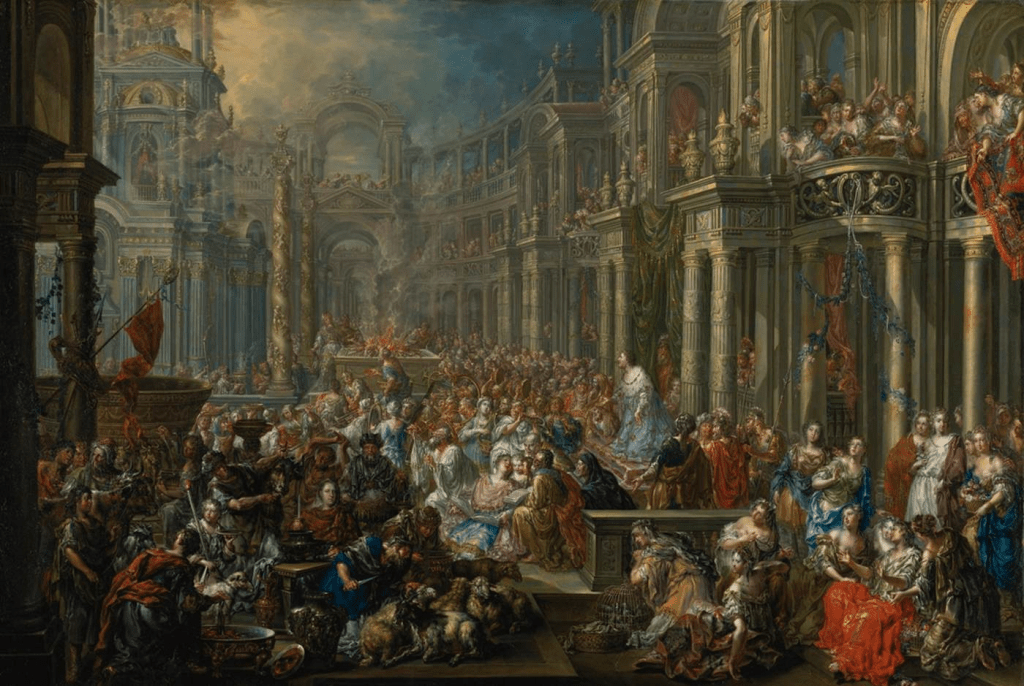
Dedication of Solomon’s Temple in Jerusalem, by Johann Georg Platzer (1704-1761)

I admit, at many times, that I am prone to melancholy. I tend to be quick at accepting blame, and rather slow at owning my good work. Another way of putting this is that it is easier to give than to receive.

Those who have endured a lot of hard circumstances, and persevered through many adversities, can sometimes be reticent to accept the good, the abundant, and the beautiful, whenever it comes to us in this life.

Waiting for the other shoe to drop, far too many people hold back themselves from receiving and enjoying the really good things in life. They worry that the goodness will disappear, or be taken away; and so, they withhold gratitude and blessing, whenever they are in the presence of great abundance.

Just so you know, in case there are those of you who need to hear it spelled out plainly: That’s messed up.

People are meant to be abundantly generous, as well as wildly receptive. It’s likely why there are so many spiritually unhealthy persons in the world.

Bless their hearts, they give a lot, without receiving much, and then their spiritual diarrhea makes it so they can’t give anymore. And they oftentimes give to those who are in such a habit of receiving (and not giving) that the receiver’s spiritual constipation becomes a terrible problem.

Let’s avoid both extremes by letting ourselves both give and receive with equal abandon. No one can be spiritually growing, healthy, and mature without the dynamic of giving and receiving.

Solomon knew how to do both. King Solomon was the king of abundance. He accepted and received big; and he gave and blessed big. Nobody before him or after him received and gave more.

The Temple, in all of its glory and grandeur, with the Ark of the Covenant encrusted with gold as the central object in the building, was all for a God who doesn’t live in houses, a God who is invisible.

In Solomon’s dedication of the Temple, he made it clear that the God of Israel is not, and cannot, be restricted to, or located within, a single place. Thus, the Lord is limitless, and not subject to any human manipulation.

God is free to give with great abandon. And God is also free to take away. Blessed be the name of the Lord God. If we continually try and anticipate or predict what God will do, we will likely be a nervous ball of anxiety all of the time, wondering when the unexpected and/or unwanted will visit us.

It is much better to receive the good things the Lord gives us, and enjoy them while we have them.

“I came that they may have life and have it abundantly.”

Jesus (John 10:10)

Nothing is permanent, with the exception of relationships and love. So, if we can connect the temporal material things of this life in service to the immaterial realities of this universe, then we are in a position to experience peace, joy, and satisfaction.

If and when the material disappears, or is taken away, then it shall neither defeat us, nor destroy us. For our relational connections with God and others exist, and are free flowing, with the energy of gracious receiving and giving as the conduit of abundant life.

Melancholy is important and has its place for us in this present life; yet, so do things like celebration, dedication, joy, exuberance, emotional commitment, and open love. Indeed, to have these in abundance is a reflection of the God of abundance, in whose name we are bold to pray:

God of abundance, you have fed us with the bread of life and cup of salvation; you have united us with Christ and one another; and you have made us one with all your people in heaven and on earth. Now send us forth in the power of your Spirit, that we may proclaim your redeeming love to the world and continue forever in the risen life of Christ our Savior. Amen.

The Feeding of the Four Thousand (Mark 8:1-8)

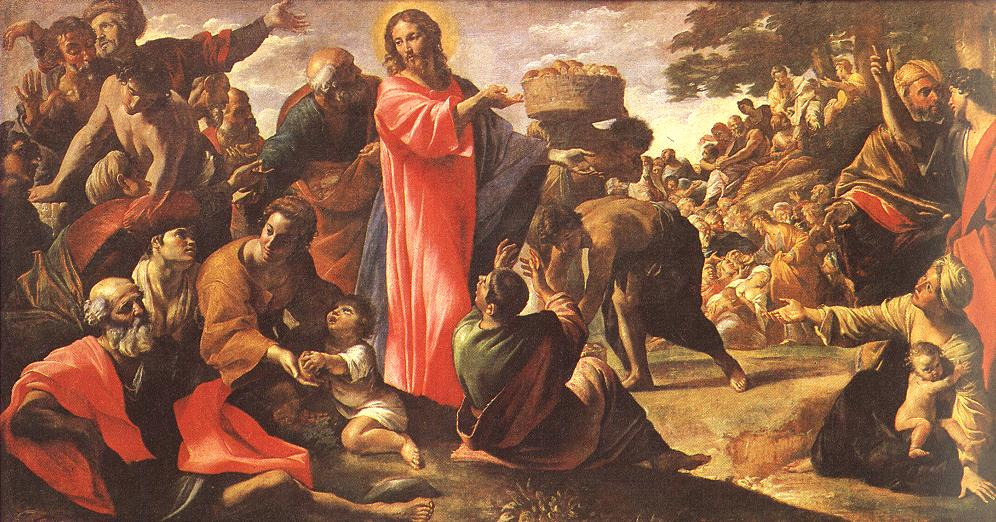
Miracle of the Loaves and Fishes, by Giovanni Lanfranco, c.1620

In those days when there was again a great crowd without anything to eat, he called his disciples and said to them, “I have compassion for the crowd because they have been with me now for three days and have nothing to eat. If I send them away hungry to their homes, they will faint on the way—and some of them have come from a great distance.” 

His disciples replied, “How can one feed these people with bread here in the desert?” He asked them, “How many loaves do you have?” They said, “Seven.” 

Then he ordered the crowd to sit down on the ground, and he took the seven loaves, and after giving thanks he broke them and gave them to his disciples to distribute, and they distributed them to the crowd. They had also a few small fish, and after blessing them he ordered that these, too, should be distributed. 

They ate and were filled, and they took up the broken pieces left over, seven baskets full. Now there were about four thousand people. And he sent them away. And immediately he got into the boat with his disciples and went to the district of Dalmanutha. (New Revised Standard Version)

This was an incredible miracle by Jesus. And it was also an incredible lack of faith on the part of his disciples. Christ had already taught them an important faith lesson by feeding 5,000 people earlier. You’d think they would have gotten it right this time.

It appears that the disciples were anxious about the situation. After all, whenever we are given to anxiety within a stressful circumstance, we typically are not thinking wisely about what to do.

There simply was no evidence that the disciples were tapping into their wise minds – even though they could have. And there’s where the rub is: Do we have the wherewithal to pause, in order to connect with what and who we know?

Let’s notice in the story that Jesus did not seem at all perturbed by the disciples’ small faith. And he certainly was not hindered in any way by the meager supply of food which was on hand. So, a remedial lesson was provided.

All the food the disciples pulled together was given to Jesus. It wasn’t much for thousands of people. Seven loaves of bread and a few fish. Yet, Christ transformed it into enough to feed the entire crowd of mostly Gentiles, without depriving the disciples of their share. They collected enough to fill seven baskets large enough to hold a man.

So there’s the lesson redone and restated, but with a different twist. Whereas the earlier miracle of food was provided for mostly Jews, the feeding of the four thousand consisted of nearly all Gentiles.

Perhaps the disciples did not really want a miracle to begin with. Maybe they believed their ministry ought to be with Israel, and not the heathen nations around them. It could be that Christ’s disciples simply did not want to be in Gentile territory at all, let alone have to engage in ministry to them, up close and personal.

So, we may be dealing with something more than an issue of faith; we might be looking at plain old fashioned prejudice against another group of people. Discriminatory behavior shrinks one’s faith and makes it small – whereas including others, and seeing their inherent worth as God’s image-bearing creatures, increases our faith and helps it grow large.

Jesus had a heart big enough, a mind open enough, and more than enough ability to make the miracle of food happen. In other words, Christ wanted to do it. He had compassion on the people, regardless of the fact that they were not like him.

It could be that a lesson in prejudice was the teaching he wanted them to get a hold of.

We see in today’s story a trajectory of inclusion, that the kingdom of God is meant to be full of diverse people from every nation, race, and background. Jesus purposely went to the Decapolis, a geographical region with a lot of different people – mostly non-Jews.

The Decapolis (which means “Ten Cities”) was a group of ten Hellenistic cities. It was a center of Greek and Roman culture, in a region mostly populated by Jews and Arameans. Each city functioned as a sort of city-state which was dependent upon Rome. There was enough diversity within the Decapolis itself which seemed to prevent them from working together as an organized region.

When it comes to Christian ministry, there are often two issues going on, namely because ministry is all about working with people. One is that we may have a problem, like the disciples of old, in going to a place we’ve never been before – and really don’t ever want to go. We have particular ideas about the people who live there and what they’re like – and we’d rather not have to deal with them.

The second issue is that we may have a problem with ourselves. Unlike the first issue in which we wonder why Jesus would care about those people, the second is wondering if Jesus really cares about me.

In this, you have no problem believing that Jesus would go to the Decapolis and have compassion on the Gentiles. But you struggle with God caring for you, and that Jesus could ever use you in ministry to people like those in the Decapolis. You can think of all sorts of other people who could do the job much better than yourself.

Since you know yourself pretty well, you understand your own doubts, weaknesses, and sins; and have a hard time trusting that the Lord could or would want to involve you in any ministry.

We, of course, could read today’s Gospel lesson from either of the two issues. Yet, we probably need not make it an either/or issue; it may be more of a both/and issue.

That is, Christ’s disciples – including those past and present – likely struggle with both: We continually keep finding that we have personal prejudices which prevent us from reaching out to particular people; and we also have personal insecurities and inhibitions about God truly loving us enough to use us in effective ministry.

Within the story of Jesus feeding the four thousand, both issues can find their resolution. The fact of the matter is that Jesus cared about the people in the region of the Decapolis, and created a miracle in order to take care of them; and, Jesus used a group of men who probably were likely prejudiced, and also insecure about being used for such a ministry.

May you know that you are infinitely loved by God – and loved alongside all sorts of other people, as well, from everywhere in every place. And may you understand that God has you on this earth to be a blessing to all kinds of persons.

May it be so, to the glory of God. Amen.

The Lord Is My Shepherd (Psalm 23)

Psalm 23, by Cliff Gleason

The Lord is my shepherd;
    I have all that I need.
He lets me rest in green meadows;
    he leads me beside peaceful streams.
    He renews my strength.
He guides me along right paths,
    bringing honor to his name.
Even when I walk
    through the darkest valley,
I will not be afraid,
    for you are close beside me.
Your rod and your staff
    protect and comfort me.
You prepare a feast for me
    in the presence of my enemies.
You honor me by anointing my head with oil.
    My cup overflows with blessings.
Surely your goodness and unfailing love will pursue me
    all the days of my life,
and I will live in the house of the Lord
    forever. (New Living Translation)

This is one of the best known places in the Bible – even for people who are not religious. And that is for good reason. The psalm is timeless in it’s relating to us in our human condition. It taps into our human need for a compassionate presence, secure protection, and abundant provision. I believe that, most of all, Psalm 23 effectively goes to our inner selves and reminds us of our greatest need: God.

My underlying conviction concerning this wonderful psalm is that the reason we adore it so much is because we humans have an innate primal desire for God. Whether we are consciously religious or not, our deepest longing is for connection with the Divine.

Much of humanity, it seems to me, have repressed this desire. Many people bury this longing underneath multiple layers of other interests and competing desires. Others experience the primal desire for God as a yearning for wholeness, completion, or fulfillment.

Yet, regardless of how particular individuals or groups may frame it, humanity’s basic need is to love and be loved – to move ever closer to the source of love. This inner craving is the essence of the human spirit, and it is captured well in a biblical psalm which pictures a person who settled into the God who is Love.

“Our hearts are forever restless until we rest in God.”

St. Augustine

With Psalm 23, our human longing is spelled out in a mere 50 or so words – we can imagine not only being transported, but also being actually transformed into an enjoyable divine/human relationship, set within an idyllic landscape of settled peace, safety, and strength.

Serenity for our anxious racing thoughts becomes a real hope, for there is a shepherd who protects the human flock and ensures that they have everything they need.

It is understandable that the relationship between God and humans is likened to that of a shepherd and sheep. In reality, sheep need a shepherd. They require someone to look out for them and provide for them. Sheep, in my opinion, are not stupid and clueless; they are skittish animals who only function well if they are non-anxious and at peace.

The presence of a caring shepherd makes all the difference. And, more than that, the shepherd does a myriad of needed things for the sheep that they are not able to do themselves, such as protecting them from wolves, finding adequate pasture to feed upon, and relieving them of the intestinal gas from eating all that grass which would literally kill them without the shepherd’s intervention.

Whereas human shepherds may or may not be faithful in their duties and extend genuine care to the flock, God is always present and loving. Moving to the rich pasture of the New Testament, Jesus is described as the Good Shepherd who will care for and preserve the sheep in every way needed. (John 10:1-21)

Psalm 23, by Cliff Gleason

Indeed, with Jesus as the consummate shepherd, people want for nothing and have everything they need. No wolf can snatch them out of his hand, and the mundane tasks of washing their feet is lovingly done for them. With Jesus, the deep yearning of the inner person becomes satisfied; the soul is restored.

Even the implements of a rod and a staff are used for good, and not for ill. An unfaithful shepherd will likely beat the sheep and berate them, only concerned for fleecing them to sell their wool on the market. But Jesus uses the rod to guide and direct in the way we ought to go, for our benefit and well-being. And the staff – the shepherd’s crook – is benevolently used to rein in the strays who don’t realize how in danger they’re in.

Truly, discipline and encouragement are not mutually exclusive concepts; they instead go together as two forms of loving leadership and care. Only those who take the time and effort to correct another are the ones who really care enough to do so.

In the shepherd’s presence, we can exist with a sense of security, even though there is danger all around us. Our longing for peace, and to be secure within oneself, is not a pipe dream, but a real possibility. To be provided for by God in the face of hard circumstances strengthens faith, awakens hope, and fosters love. It becomes an overflowing feast of the soul.

And this goodness is not fleeting. It can be a continuous present reality. Since God is good, all the time, and there is never a time when God is not good, we are continually and actively pursued and shepherded by goodness and not by harm, all the days of our lives.

The threat of death – and even death itself – cannot thwart the avenues of righteousness from being available to us. We can walk the true path toward inner peace and fulfillment, of genuine connection with God and others, without moral or spiritual harm.

There are good and right paths of life. Those avenues are guarded by a gracious God; they will never be destroyed or damaged. If the psalm is correct, and if my core convictions are right, then there is no longer any reasonable or justified basis for fear.

A good care-taking Shepherd is protecting the flock, and providing the sheep with everything they need. We can live a morally strong, ethically sound, and eminently happy life, without being constantly afraid.

Blessed and Good Shepherd of all, by laying down your life for the flock, you reveal your love for all. Lead us from the place of death to the place of abundant life, so that guided by your care for us, we may rightly offer our lives in love for you and our neighbors. Amen.