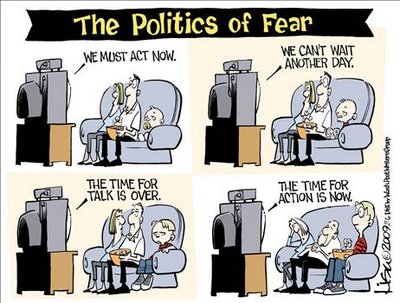
We all have personal fears. They may be different, all the way from snakes and creepy clowns to public speaking and talking on the phone. Whatever the fear, being afraid can multiply exponentially when a group of people collectively fear something. When that happens, the politics of fear takes over and faith is replaced by what a church thinks might happen. Most church problems and conflicts do not arise out of doctrinal differences, but out of a clash of fears.
Consider just a few scenarios. One group of people think women should serve in leadership capacities the same as men, and another group believes that women can only serve in limited leadership roles. The former group fears that if women are not allowed leadership status that the church will wither for lack of fully utilizing the giftedness of half or more of the congregation; they fear the church will not grow. The latter group is afraid that if women attain leadership roles that the men of the church will become lazy and not serve; it is only, they fear, a slippery slope to an all-female run congregation with no men leading.
A more obvious scenario is the so-called “worship wars.” One group holds to a more traditional and liturgical form of worship with hymns and responsive readings. They fear that if this form changes it will dilute the true worship of God and degenerate into an unfamiliar form that they will not like; they are afraid of change. Another group believes that “contemporary” worship (usually understood as praise songs and choruses with a simple sing and speak liturgical model) is the way to go because they fear people will leave the church for another if things do not change. One group fears change, the other fears not changing.
Fear is a reality that all pastors and church leaders must navigate. And God himself knows it. This is why the command to not be afraid is common throughout Holy Scripture. We find, as well, that the command to not be afraid is given often to leaders. The patriarch Isaac was told to not be afraid because God was with him (Genesis 26:24). The prophet Jeremiah was told to not be afraid because God was with (Jeremiah 1:8). Jesus was pointed with the synagogue ruler concerning his dead daughter: “Don’t be afraid; just believe” (Mark 5:36).
Non-anxious leaders help congregations deal with fear because their calm presence in the face of competing anxieties creates the environment that everything is going to be okay, that engaging in faith will work out, and that God’s promises and presence trumps all realities. Before facing the conquest of the Promised Land, the Lord commanded Joshua to be strong and courageous and boldly engage the enemy, with the result that the people acted in faith and took Jericho. David courageously and confidently faced down Goliath, and later led the people of Israel and Judah as king because he understood that the Lord was his strength, and, so, fear could melt away. David’s best friend, Jonathan, acted in faith while all his fellow Israelites were hiding in fear from their Philistine enemies. His courageous stepping out emboldened everyone else to win the battle.
Jesus Christ has promised that he will build his church, and the gates of Hades will not prevail against it. We have the promised presence of the Holy Spirit as we engage in Christ’s mission to be witnesses. God’s steadfast love is with us. Therefore, we choose to live above the fray of naked fear and trust the kingdom values of humility, meekness, mercy, purity, and peace-making in facing down whatever issues are gripping the church. God, in his sovereignty, has ordained certain persons to take the lead in recognizing the presence of the Spirit and moving forward in faith, not fear. Faith and fear cannot co-exist. “Everything that does not come from faith is sin” (Romans 14:23) is the Apostle Paul’s way of saying not to give in to the politics of fear within the church.
So, how will you live? How will you lead? In what ways can you bring a non-anxious presence to the people for whom you minister? How does knowing that God is with us change how you face difficult problems and people? Can you think the thought that courage is a spiritual discipline? How will you stretch your faith muscle so that the weakness of fear can take a back seat to your decision making?
May the power and presence of God’s Spirit fill us all now and always with faith to accomplish God’s will.




 Rev. Tim Ehrhardt